How I Passed 2025 HireQuotient Online Assessment: Real Questions

I recently completed the BCG online assessment on the HireQuotient platform. The session was divided into two parts. The first part was a case interview with a 35-minute time limit. The second part consisted of a video pitch with one minute of preparation time and one minute for the response. A webcam was required to be on throughout the process.
I am really grateful to Linkjob.ai , the AI interview assistant for helping me pass my online assessment, and that’s also why I’m sharing my entire OA experience here. Having an undetectable AI interview copilot indeed provides a significant edge.
BCG HireQuotient Online Assessment Format and Questions
The BCG online assessment is designed to simulate a real client situation and give a glimpse into the type of work they do for their clients. Below, I will share the specific questions I encountered and the overall test format. However, I have noticed that other candidates experienced different formats and question types, so I will also share the other interview experiences I have come across later in this post.
First Section: HireQuotient Interview
The first part consists of 9 questions to be completed within 35 minutes. The question types include qualitative reasoning, business logic, and calculations.
Difficulty: I need solid case study fundamentals and some basic knowledge of corporate finance.
This section involves a conversation with Casey, which is the name of the chatbot. It starts by introducing the case background and then proceeds to ask questions. It looks like this:
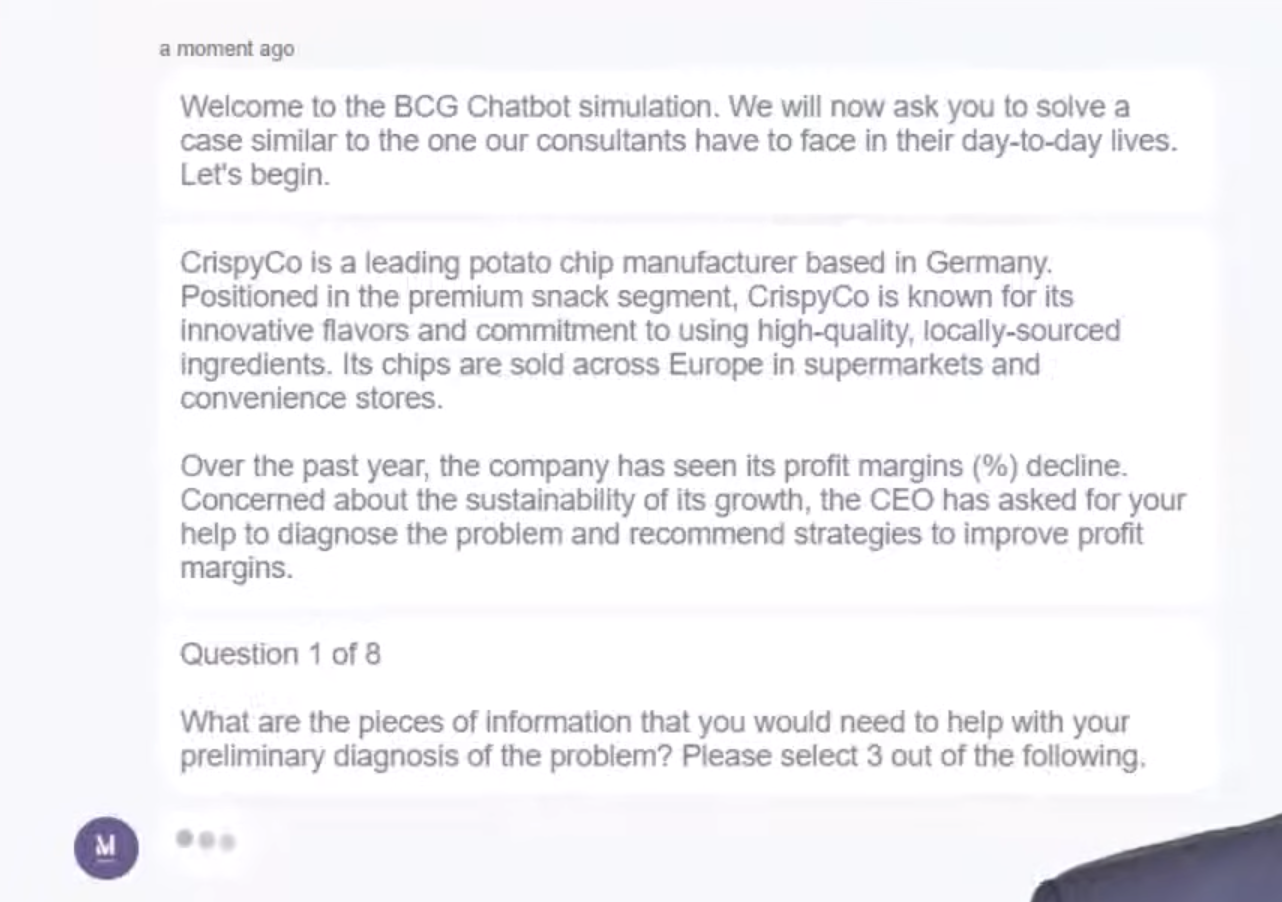
Then, I just typed my response directly into the answer box.
My personal lesson was that using a manual calculator was too slow and prone to errors. Manually entering results into the Casey interface wasted time, and it was very easy to make typos on a calculator. Furthermore, if I made a mistake in an earlier step, there was no way to detect or fix it later because the system did not allow me to go back and edit previous answers. Despite this, a calculator was still an absolute necessity.
My advice is to have a comfortable and familiar calculation tool open on the computer, such as a Python Jupyter notebook, to keep all calculation steps. For many subsequent questions, I only needed to copy and paste the formulas or results from previous steps and add a few words. However, I did not try pasting my answers directly into Casey because I was afraid the system might flag me for cheating. For the last few questions, I used Linkjob AI because the time was extremely tight.
Second Section: One-way Interview
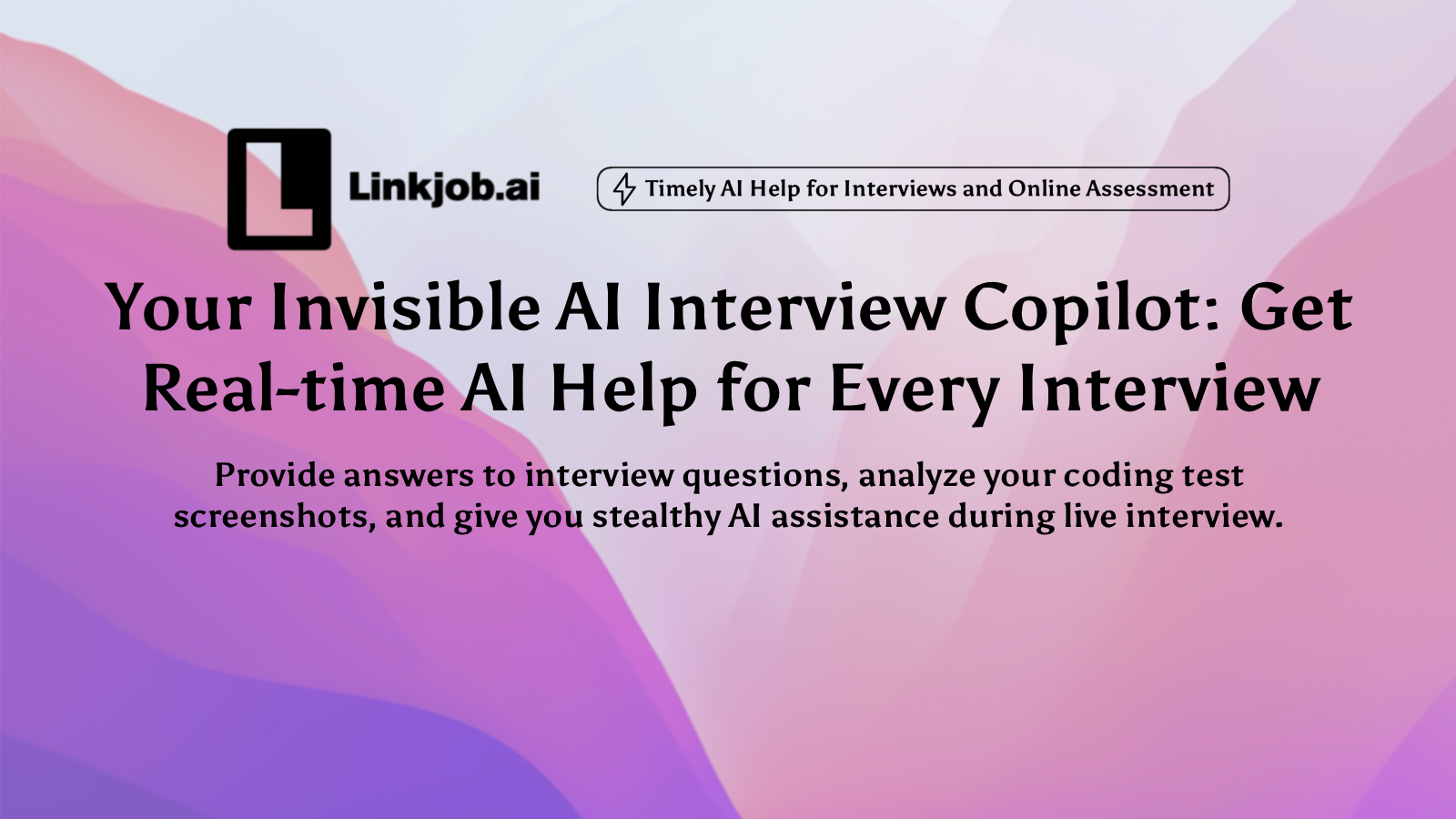
The video assessment allows only one attempt. Before starting the response, I was given one minute to read the question and think, followed by one minute to record the answer and present the solution to a hypothetical client CEO.
The prompt was a case-related question.
In terms of difficulty, the question type falls under business scenario analysis and strategic recommendation, so the focus is primarily on impromptu delivery and structured thinking.
BCG HireQuotient Online Assessment Experience
Below are the experiences I have come across regarding different formats of the one-way interview:
BCGX AI SWE / DS Oneway Video
The one-way interviews for DS and AI SWE positions seem to use the same set of questions. There are five questions in total, with two attempts allowed for each, and a three-minute time limit per response.
My feeling is not to over-prepare. Since the preparation time for each question is unlimited, I spent way too much time practicing the first question before recording, which wasted a lot of my time. During the recording, I made sure to look directly at the camera or the top center of the screen and avoided letting my eyes wander, as that can easily raise suspicion.
Describe your understanding of BCG X in 3-5 sentences (who we are, what we do, etc.) and what motivated you to apply?
Describe the last analytical tool you taught yourself, why you chose it, how you taught yourself
Please tell me about the most complex and analytically challenging project you have worked on. What were the results/insights? What impact did your solution have? What did you enjoy most/least about it?
What languages, packages & tools are you most comfortable with?
Can you share a time you were a part of a highly successful team? What made it so successful?
HireQuotient Online Assessment Question Types
The BCG online case typically contains 8-10 questions, but it ultimately boils down to only six main question types. I have categorized them and summarized the corresponding strategies:
Structuring Question
Characteristics: Usually the opening of the case, requiring the selection of key information needed to analyze the problem from multiple options, or asking to propose an analytical framework.
My Strategy: Just like a real case interview, I quickly build an Issue Tree in my mind. For example, if the goal is to improve profit margin, I think about the formula: Profit Margin = (Revenue - Cost) / Revenue. Then, I break down the various components of revenue and cost. I prioritize options that help with a top-down, macro analysis of the problem.
Practical Experience: Do not get distracted by overly detailed options; focus on broad category information that helps establish the analytical framework.
Follow-up Question
Characteristics: Immediately following the structuring question, this requires explaining the reasoning behind previous choices or the analytical framework. It is usually an open-ended text box.
My Strategy: Keep it concise and clear. Imagine being graded by an AI, so the wording must be direct and the logic must be transparent. For example, I explained why I selected specific revenue and cost data by stating how they help calculate the profit margins for each product line.
Practical Experience: No need for a long essay; use 1-2 sentences to refine and articulate the logic.
Graphical Analysis Question
Characteristics: Multiple charts (bar charts, line graphs, etc.) are provided. The task is to extract information, conduct analysis, and draw conclusions or answer questions. This may involve minor calculations.
My Strategy:
Quick Scan: Quickly look through all charts to understand what data each one presents.
Identify Trends and Anomalies: Focus on data trends, maximums, minimums, and any unusual fluctuations.
Establish Connections: Try to correlate data between different charts to find causal relationships. For example, if sales volume increases but profit decreases, it is often necessary to look at changes in the product mix.
Calculation Verification: When necessary, perform simple calculations to verify hypotheses.
Practical Experience: This question type best tests business sense. I once encountered a case where revenue grew but profit margins declined. Usually, this happens because the sales of high-margin products drop while low-margin products rise, diluting the overall profit margin. Being prepared for these classic case scenarios in advance is very helpful.
Business Sense Question
Characteristics: This tests the understanding of business scenarios and strategies. It is typically a multiple-choice question (single or multiple answers) where the most reasonable or important business decisions/considerations must be selected.
My Strategy: Read the case background carefully and judge based on industry common sense and consulting logic. For each option, ask: "How important is this in the real business world? Is it highly relevant to the case objectives?"
Practical Experience: The elimination method is very effective. For instance, in M&A cases, while tax benefits exist, they are usually not the primary strategic driver for a merger. In contrast, supply chain optimization and headquarters integration are often common synergies.
Math Question
Characteristics: Often the "tough nut to crack" in BCG online cases, these are the most time-consuming and involve multi-step calculations. They can be open-ended fill-in-the-blank or multiple-choice (though you usually still need to calculate the answer).
My Strategy:
Clarify the Goal: Be clear about what the question is ultimately asking to calculate.
Break Down Steps: Deconstruct complex problems into small, manageable calculation steps.
Read Carefully: Pay close attention to every number and unit to avoid errors caused by oversight.
Use a Calculator: Use a calculator without hesitation! This is not a test of mental math, but a test of rigorous analytical ability.
Practical Experience: It is essential to stay calm and take it step-by-step with this question type. Practice more with mock questions to become familiar with interpreting various data tables and calculation methods. For example, calculate cost savings after layoffs by analyzing the productivity and salaries of different teams.
Summary Question/ Video Assessment
Characteristics: The final stage of the case, requiring a verbal summary of findings and recommendations within one minute, which is then recorded and submitted.
My Strategy:
Utilize Preparation Time: Make full use of the one-minute prep time before clicking start. I usually jot down key points on paper: the case objective, major findings, 1-2 supporting details, and the final recommendation or next steps.
The "Elevator Pitch" Rule: Adopt the "Pyramid Principle" or "Elevator Pitch" structure commonly used by consultants: start with the conclusion (recommendation), follow with supporting evidence (findings), and briefly mention next steps at the end.
Clear Delivery: Speak clearly at a moderate pace to ensure the AI can accurately recognize the speech.
Eye Contact: Look at the camera as much as possible to simulate eye contact with a real interviewer.
Professional Image: Wear business casual attire and ensure there is sufficient lighting and a clean background.
Practical Experience: I specifically practiced the "Elevator Pitch" communication style, which made my responses more organized and persuasive. Additionally, thinking about the final summary throughout the case process helped me gain valuable preparation time.
FAQ
In the Hirequotient test, can I withdraw or change an answer?
No. When interacting with Casey, it is best to think through the response thoroughly before submitting, as the system does not allow you to return to the previous step. If you are worried about giving an incorrect answer, you can try using Linkjob AI. For the last few questions, I relied on it to provide the answers for me.
Is the time pressure intense?
With 9 questions to complete in 35 minutes, the pressure is very high. Calculation questions are the biggest time sinks. My advice is this: if you have been stuck on a calculation for more than 3-4 minutes without a clear path forward, make a reasonable estimate based on the available data and move on. It is much more important to secure points on the subsequent questions than to get bogged down by a single difficult one.
See Also
How I aced the BCG X CodeSignal assessment in 2025
How to Use Technology to Cheat in CodeSignal Proctored Exams
My Secret Hacks For Beating HackerRank Proctoring and Detectiona

© Copyright 2025 Linkjob.ai - All Rights Reserved.