How I Cracked the Microsoft Coding Interview in 2026

I cracked the microsoft coding interview by sticking to a few simple steps. My journey to the offer letter was built on three pillars.
I practiced Microsoft-tagged LeetCode problems every day. I made sure I understood core algorithms instead of just memorizing answers.
I focused on clear communication because interviewers want to hear my approach, not just see the final code.
I also prepared for behavioral and system design questions to cover all bases.
However, even with the best preparation, the pressure of a live technical round is a different beast entirely. Having an undetectable AI copilot Linkjob AI during my live interview gave me a massive advantage, providing real-time support and ensuring my answers remained sharp and structured. I got the offer thanks to this tool, so I'm invited to share my experience here.
Key Takeaways
Practice coding problems daily, focusing on Microsoft-tagged questions to build familiarity with the interview style.
Communicate your thought process clearly during interviews; explain your approach before coding to showcase your problem-solving skills.
Prepare for behavioral questions using the STAR-L format to structure your answers and highlight your experiences effectively.
Understand core algorithm patterns and focus on common topics like arrays, strings, and linked lists to maximize your preparation.
Microsoft Coding Interview Format
Interview Rounds Overview
Here’s a quick look at the typical stages:
Stage | Description |
|---|---|
Resume Screening | Initial review of candidates' resumes. |
Recruiter Call | Discussion about the role and candidate's background. |
First-Round Technical Assessment | Online coding test focusing on algorithms and data structures. |
Onsite Interviews | Comprises 4-5 rounds of technical and behavioral interviews. |
Debrief | Team discussion about the candidate's performance. |
Hiring Committee Review | Final evaluation by the hiring committee. |
Offer and Negotiation | Discussion of the job offer and terms. |
The Reality of Microsoft Coding Live Interview
Codility and Microsoft Teams
Microsoft uses Codility to check coding skills in a fair and structured way. (For more details on their initial screening formats, you can check out this guide on the Microsoft HackerRank test). I liked Codility because it gave me a clear timer and instant feedback. After the online test, most interviews happen virtually on Microsoft Teams. Teams made the process smooth and interactive. I could talk to interviewers in real time, share my screen, and explain my code. This setup helped me show my communication skills and problem-solving approach.
Tip: Practice coding in an online editor and get comfortable explaining your solutions out loud. It makes the virtual interview feel more natural.
Question Types
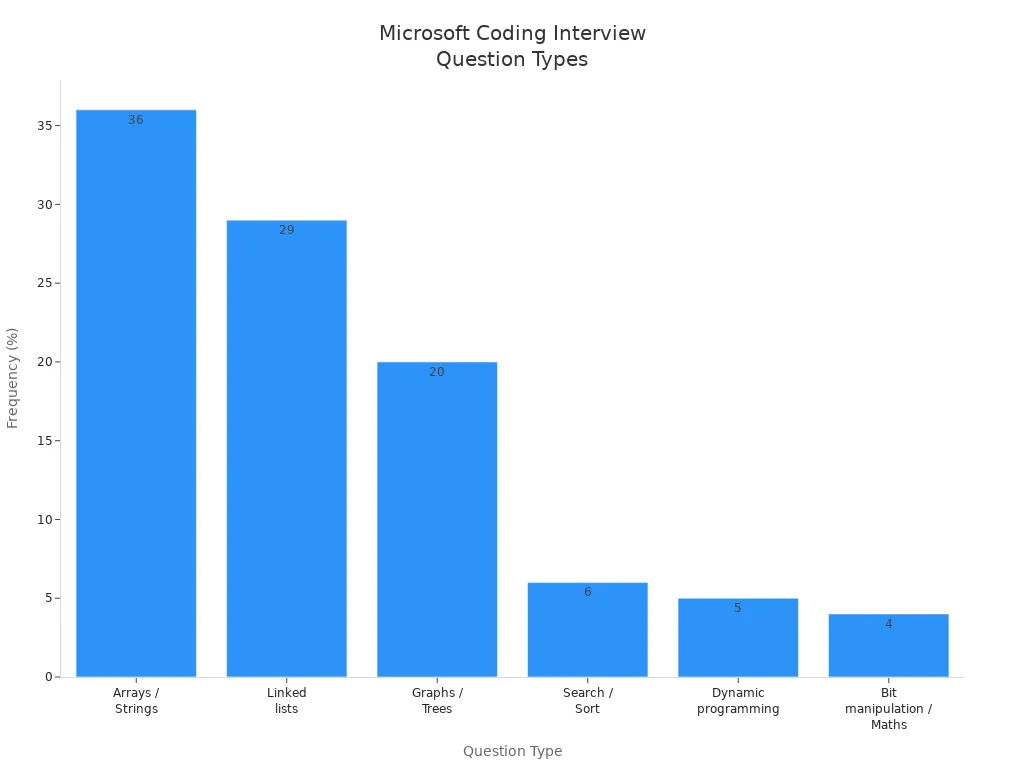
During the microsoft coding interview, I saw a mix of technical questions. Most focused on algorithms and data structures. Here’s a breakdown of what I encountered:
Question Type | Frequency (%) |
|---|---|
Arrays / Strings | 36% |
Linked lists | 29% |
Graphs / Trees | 20% |
Search / Sort | 6% |
Dynamic programming | 5% |
Bit manipulation / Maths | 4% |
Single Element in a Sorted Array
The Challenge: Find the only element that appears once in a sorted array where every other element appears twice.
Constraints: Time Complexity must be O(log n); Space Complexity must be O(1).
1. Logic & Intuition
The Binary Search Trigger: The "Sorted" property combined with the
O(log n)requirement is a dead giveaway that we need to use Binary Search.The Index Pattern: * Before the single element: Pairs start at even indices (0, 2, 4...).
After the single element: Pairs start at odd indices (1, 3, 5...).
The Goal: Find the first even index
iwherenums[i] != nums[i+1].
2. Optimized Implementation (Python)
Python
def singleNonDuplicate(nums):
    left, right = 0, len(nums) - 1
    while left < right:
        mid = left + (right - left) // 2
        # Ensure mid is even to check the start of a pair
        if mid % 2 == 1:
            mid -= 1

        # If the pair is still intact, the single element is further right
        if nums[mid] == nums[mid + 1]:
            left = mid + 2
        else:
            # If the pair is broken, the single element is at mid or to the left
            right = mid
    return nums[left]
Here is the hard truth: while a strong foundation in CS is essential, the pressure of a live interview can cause even the best candidates to freeze. You can grind LeetCode for months, but when the timer starts and the interviewer is watching your screen, your mind can go blank. This happened to me in my early mock interviews, which led me to find a solution that completely changed my interview game.
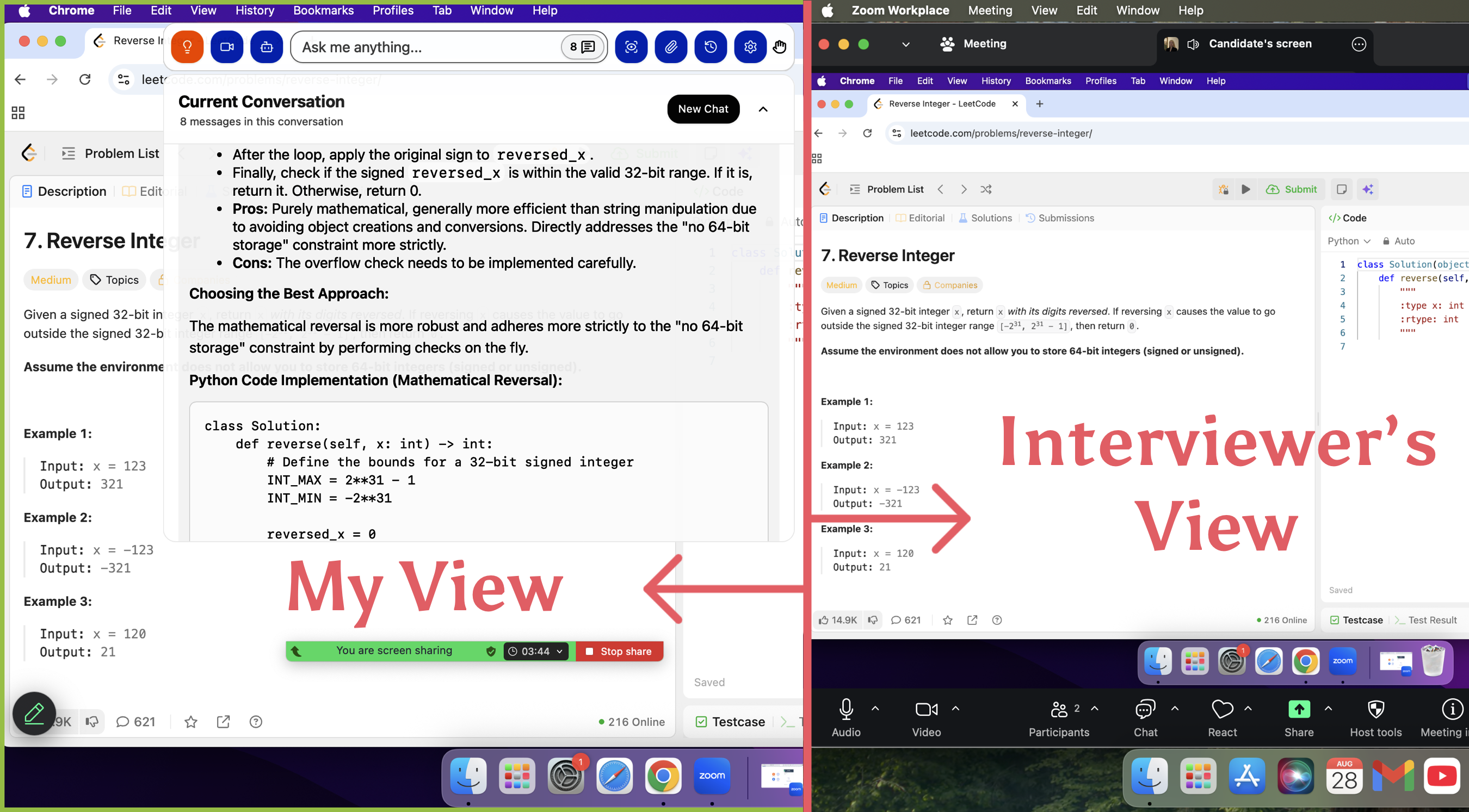
Unlike generic tools or simple cheat sheets, I used the Linkjob AI that gives undetectable real-time support. It provides subtle, real-time guidance that helps you maintain your thought process without breaking the flow of communication.
Whenever I hit a wall on a tricky edge case or temporarily forgot an optimal approach, this tool nudged me in the right direction. It allowed me to stay confident, keep my communication clear, and focus on connecting with the interviewer rather than panicking over syntax. If you struggle with live interview anxiety, I highly recommend integrating a tool like this into your strategy.
Microsoft Interview System Design and Domain-Specific Prep
For system design, interviewers want to see how you build real-world, scalable systems (think OneDrive, Teams, or Azure services).
Key Focus Areas: Designing for millions of users, ensuring high availability, managing security/compliance (e.g., GDPR), and understanding multi-tenant architectures.
The Strategy: Always structure your answers. Start with a high-level overview, drill down into components (like data pipelines or APIs), and explicitly discuss trade-offs. Justify why you chose a specific database or architecture over an alternative.
Common System Design Topics
When I prepared for system design interviews at Microsoft, I focused on the topics that show up most often. I noticed that interviewers love to ask about real-world systems. They want to see how I design things like Microsoft Teams, OneDrive, or cloud services such as Azure. Here are the main areas I practiced:
Designing scalable systems that can handle millions of users
Making sure my designs are reliable, secure, and meet compliance standards like GDPR or HIPAA
Thinking through open-ended prompts and explaining my trade-offs
Showing how multi-tenant architectures and Azure integrations work
Discussing alternatives, justifying my technology choices, and handling failure scenarios
I always tried to structure my answers. I started with a high-level overview, then drilled down into details. I made sure to talk about trade-offs and why I picked certain solutions.
Here are the core patterns you must know:
Pattern | Why It Matters in Microsoft Interviews |
Arrays/Strings | Shows up in almost every round; tests foundational logic. |
Linked Lists | Tests pointer logic and memory management. |
Trees/Tries | Checks recursion and hierarchical thinking. |
Hash Maps/Sets | Assesses efficiency and fast lookup skills. |
Graphs | Evaluates complex relationships and traversal abilities. |
Sorting | Tests algorithmic efficiency (an |
Handling Edge Cases Like a Pro
Interviewers at Microsoft love to see how you handle tricky inputs. I made it a habit to ask myself, "What could break my code?" before finalizing any problem.
Strings: What if the string is empty? What if all characters are the same?
Arrays: What if the array has only one element? What if it’s already sorted?
Actionable Tip: Walk through your code with real examples out loud. This helps you spot bugs before the interviewer does and demonstrates robust engineering practices.
The Power of Referrals
Never underestimate networking. Applying with a referral significantly boosts your visibility:
Metric | Referral Application | Resume-Only Application |
Likelihood of Interview | ~20% | ~1% |
Likelihood of Hire | ~7% | ~0.6% |
Keep your LinkedIn profile updated, reply to recruiters promptly, and tailor your resume for the specific team you are targeting.
Free Resources for Practice
I didn’t spend money on expensive courses. I used free resources that helped me practice system design questions and core algorithms. Here are my favorites:
LeetCode: I found over a thousand problems on topics like Arrays, Trees, and Dynamic Programming. These helped me build a strong foundation.
I practiced Microsoft-tagged LeetCode problems every day. I made sure I understood core algorithms instead of just memorizing answers.
(Note: The same fundamental approach works wonders whether you are facing an Amazon coding interview or an OpenAI coding interview).
Leeco: This free AI coding guide gave me structured learning paths and timed mock interviews. It helped me practice DSA patterns and get comfortable with interview pressure.
Tip: I set a timer when I practiced. This helped me get used to thinking and explaining my ideas under time limits.
Domain-Specific Questions
I learned that Microsoft tailors domain-specific questions to the team and role. For example, if I interviewed for a cloud networking team, the questions focused on cloud architecture and networking challenges. If I aimed for a backend role, I might need to design an API or discuss data pipelines. Interviewers often asked me to share stories about complex problems I solved in past projects. I made sure to prepare detailed examples from my experience. This showed my depth in the domain and helped me stand out.
Microsoft places a massive emphasis on culture fit, collaboration, and cross-functional communication.
Cracking the Microsoft interview Behavioral (BQ) Rounds
Core Competency | Interviewer's Hidden Goal | Pro-Tip |
Technical Challenge | Can you navigate ambiguity? | Discuss a project where you solved a "controlled disaster." |
Conflict Management | Are you easy to work with? | Focus on how you used metrics to resolve a disagreement with a peer. |
Inclusivity | Do you fit Microsoft’s culture? | Share a specific example of how you ensured every voice was heard in a group project. |
The STAR-L Framework
I always use the STAR-L format when answering behavioral questions. This method helps me organize my thoughts and keeps my answers clear. STAR-L stands for Situation, Task, Action, Result, and Learning. I start by describing the situation, then explain the task I faced. Next, I share the actions I took, followed by the result. Finally, I talk about what I learned from the experience.
Tip: Practicing STAR-L stories before the interview makes it easier to recall them under pressure.
Here’s how I prepare:
I pick real situations from my past projects.
I break each story into the STAR-L steps.
I rehearse my answers out loud to make sure they sound natural.
Genuine Storytelling
Interviewers at Microsoft want to hear authentic stories. I avoid generic examples and focus on unique situations that show my skills. I make sure to highlight moments where I adapted to change, solved tough problems, or worked with different teams.
I use specific examples to show my adaptability and problem-solving.
I reflect on my choices and explain my thought process during challenges.
I share stories about ethical dilemmas and how I handled them.
I align my stories with Microsoft’s values, like innovation and collaboration.
I talk about times I went above and beyond for customers.
Soft Skill | How I Show It in Stories |
|---|---|
Communication | Explaining ideas clearly |
Collaboration | Working across teams |
Adaptability | Adjusting to new situations |
Initiative | Taking action without waiting |
Clear Thought Process
I always make my thought process visible during interviews. I define the problem, explain my strategy, and walk through my solution step by step. If I make assumptions, I clarify them and show how I use data to make decisions.
“Strong communication, of course, is key in any interview. Make sure you understand what’s being asked of you, and watch the interviewers for clues that show they’re following what you’re saying.”
I use examples from my experience to demonstrate my approach. This helps interviewers see my judgment and problem-solving skills. I stay positive and take ownership of my actions. I focus on clear communication because Microsoft values candidates who can explain their ideas and work well with others.
Interview Day Mindset and Follow-Up
On interview day, I focus on staying calm and prepared. I avoid common mistakes like skipping a practice run or not asking the recruiter for tips. If I feel unwell or unprepared, I reschedule instead of risking a bad performance.
After the interview, I always send a thank-you note to show my appreciation and remind them of my interest. I take a few minutes to reflect on what went well and what I can improve for next time.
I thank my interviewers and keep the conversation positive.
I review my performance and plan my next steps.
Tip: Treat every interview as a learning experience. Each round brings you closer to your goal.
FAQ
How many LeetCode problems did Isolve before my Microsoft interview?
I solved about 150 Microsoft-tagged LeetCode problems. I focused on quality, not just quantity. I reviewed my mistakes and repeated tough questions until I felt confident.
What should I do if I get stuck during the interview?
I stay calm and talk through my thought process. I ask clarifying questions. I share my ideas, even if they are not perfect. Interviewers want to see how I think.
Do I need to know advanced algorithms for the Microsoft coding interview?
No, I focused on core algorithms like arrays, strings, trees, and graphs. I practiced the Blind 75 list and Microsoft-tagged questions. That covered almost everything I needed.
How important is communication during the interview?
Communication matters a lot! I always explain my approach before I start coding. I ask questions and check if the interviewer follows my logic. Clear communication can make up for small mistakes.
See Also
Anthropic Coding Interview: My 2026 Question Bank Collection
My Firsthand Experience With Amazon's 2026 Coding Interview