My Real Microsoft Internship Interview Questions from 2026


My Microsoft internship interview process consisted of five rounds in total: an Online Assessment, two technical rounds, one Behavioral Question round, and a final round. Except for the OA, which lasted 90 minutes, each of the other sessions was between 45 and 60 minutes. I found the coding rounds quite challenging, but fortunately, I ended up receiving the offer.
I’m really grateful to Linkjob.ai for helping me pass my interview, which is why I’m sharing my interview questions and experience here. Having an undetectable AI interview assistant indeed provides a significant edge.
My Microsoft Intern Interview Rounds and Questions
Online Assessment (OA)
This was my first official hurdle: a 90-minute coding test on Codility. It consisted of two problems.
The first one was LeetCode 1696 (Jump Game VI), which I solved using dynamic programming.
The second was similar to designing a text editor, but the commands were provided as an array; I handled those using a series of if-else statements.
While preparing for the interview, I also came across an article specifically covering Microsoft's HackerRank test, which includes numerous real questions and detailed solutions. You may also find it helpful to read it for reference.
Technical Interview
Next came two back-to-back virtual technical rounds, each 45–60 minutes long.
Round 1: Pure Coding
The interviewer shared a code editor and gave me a problem very similar to finding the LCA in a Binary Tree. Instead of jumping straight into code, I sketched a simple tree on my notebook, walked through a recursive approach, analyzed the time and space complexity, and then discussed how an iterative solution might work. They appreciated that I considered multiple approaches.
Round 2: Coding + Light System Design
After solving a medium-difficulty array problem, they asked: “If you were to design a basic service for uploading and serving profile pictures in an app, what would you consider?” This wasn’t about building AWS-level infrastructure, it was about demonstrating that I could think through APIs, storage options like object storage vs. databases, and potential bottlenecks. I started with clarifying questions about scale and requirements, then drew a simple block diagram to outline my approach.
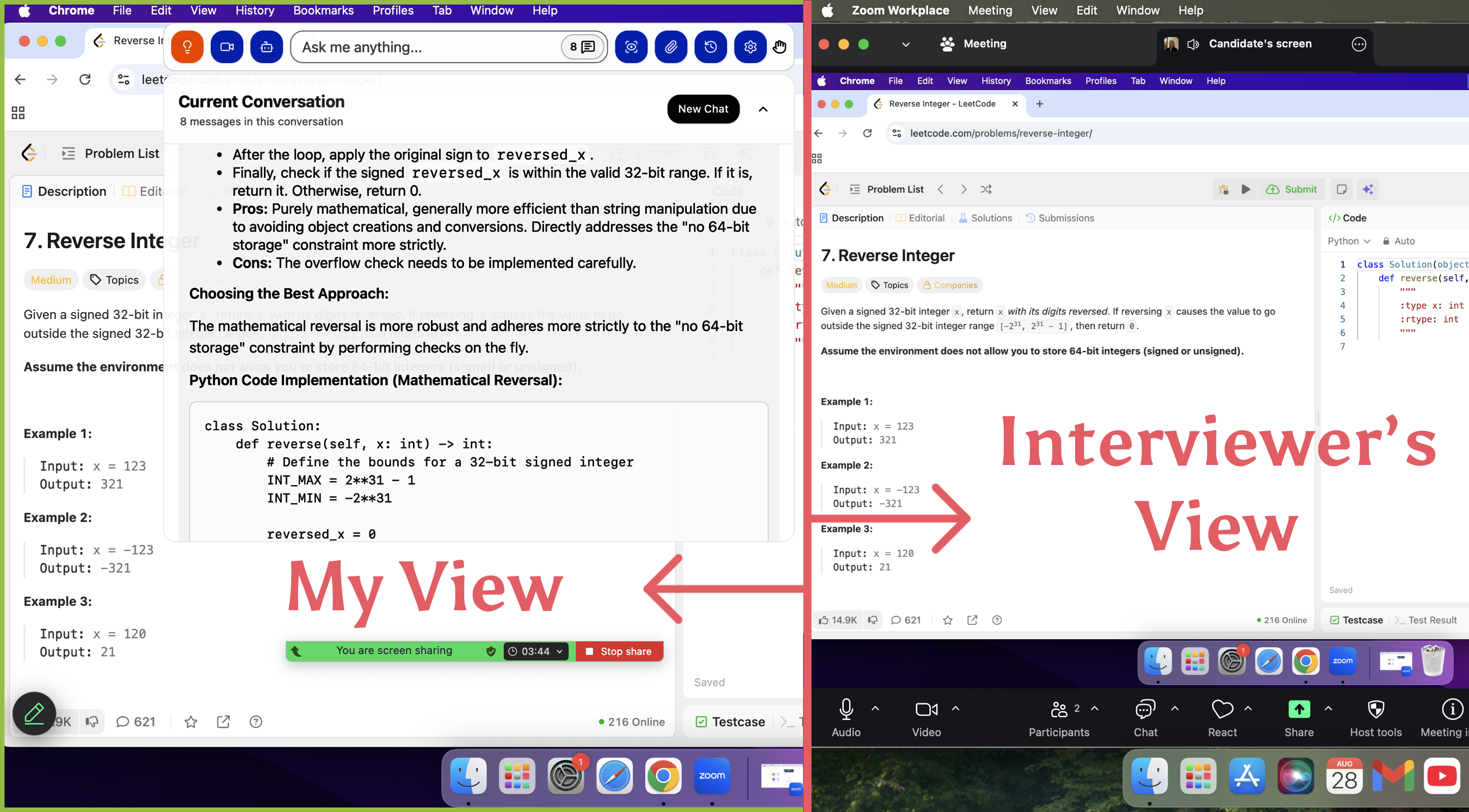
The questions in these two rounds were quite challenging, but Linkjob AI worked great and I got through the interview without a hitch. It’s completely undetectable, and the interviewer had no idea I was using it.
Behavioral Interview
This was a dedicated 45-minute chat with classic but targeted questions that required structured answers:
“Tell me about a time your team disagreed on a technical direction. What was your role?”
“Describe a project where you had to learn something new under pressure.”
I leaned heavily on the STAR method (Situation, Task, Action, Result). For the first question, I talked about a university group project where we split over database choices. I framed my action as organizing a quick pros-and-cons comparison session, which helped us reach a consensus. The interviewer specifically complimented the structure of this answer.
The Final Loop
My final interview was with a senior engineer and lasted longer than the previous rounds. We discussed a broader technical challenge, dove deeper into my past projects, and talked about why I was specifically interested in Microsoft. The vibe was more conversational, but the interviewer still assessed my technical communication skills and cultural fit.
Microsoft Internship Interview Key Evaluation Points
Coding and Technical Questions
Coding questions were the core of my interview, mixing algorithm problems and practical tasks. Interviewers cared more about how I approached problems than whether I got the right answer immediately.
Key Technical Concepts to Master:
Arrays and Strings
Linked Lists and Trees
Graphs and Recursion
Dynamic Programming
Object-Oriented Programming and Design Patterns
System Design Basics and API Design
Multithreading and Version Control
Tip: Prioritize practicing arrays, strings, and recursion. Always talk through your thought process, interviewers care about that more than the final answer.
Microsoft Systems Design Questions
These questions tests ability to build and scale real-world systems, balancing big-picture thinking with details.
System Design questions aren't typically part of the internship interview process. That said, I’ve compiled a few problems I came across during my prep, which I'm sharing here for your reference.
Design a Scalable URL Shortening Service (like Bit.ly)
Design a Video Streaming Platform (like Netflix)
Design a Payment Processing System
Design a Scalable Search Autocomplete System
Design a Social Media Feed (like Twitter)
Interviewers Evaluate These Criteria:
Evaluation Criteria | Description |
|---|---|
Structured Thinking | Breaking down the problem and clarifying requirements first |
Scalability | Explaining how to handle millions of users and high traffic |
Reliability | Discussing backups and ensuring service uptime |
Communication Skills | Describing your design clearly and asking for feedback |
Note: Always ask clarifying questions before designing. Draw diagrams if possible, explain your choices, and be ready to adjust your design based on feedback.
Behavioral & Soft Skills Questions
Behavioral questions help interviewers understand how you work with others and handle challenges. Soft skills questions test your communication, teamwork, and adaptability.
Common Behavioral Questions:
Tell me about a time you faced conflict in a team. How did you resolve it?
Describe a situation where you had to learn something quickly.
Give an example of when you took ownership of a project.
Common Soft Skills Questions:
How do you handle feedback?
Tell me about a time you worked under a tight deadline.
How do you explain technical ideas to non-technical people?
My Strategy: I used the STAR method for every answer, drawing stories from my university group projects. I focused on the actions I took and the results I achieved, highlighting my ability to stay calm under pressure and adapt my communication style for different audiences.
What the Microsoft Internship Interview Probing:
Expect a heavy focus on core data structures and algorithms during the tech rounds. On the behavioral side, interviewers dig deep into your teamwork and problem-solving stories.
My Microsoft Internship Interview Preparation Strategies
I didn’t just brute-force LeetCode, context and strategy were key. Here’s my structured prep plan and the resources that made a difference:
Weeks 1 & 2: Build Foundations
I used LeetCode’s “Top Interview Questions” list and filtered for Microsoft-tagged problems, aiming for 2–3 problems daily.
Focused on understanding patterns rather than memorizing solutions.
Week 3: Master Storytelling
Documented 5–6 bulletproof stories using the STAR method.
Practiced telling them until they sounded natural, not rehearsed.
Study others' Microsoft interview experiences (such as Microsoft AI Engineer interviews, Microsoft SDE interviews) and conduct targeted learning.
Week 4: Simulate the Real Thing
Did mock interviews with a friend who’d been through FAANG interviews, these were tough but essential.
AI mock interview tool: I selected the AI mock interview tool, LinkJob. It generates questions based on my resume and the job description, and after I answer, it keeps asking follow-up questions until I reach the level of proficiency I'm looking for.
Final Reflections & Pro Tips for Microsoft Intern Interview
Key Mindset Shifts
Your Process is the Product
Interviewers don’t just want a correct answer, they want to see how you think. Vocalize your thoughts, ask clarifying questions, and engage in a dialogue.
Clarity Beats Complexity
A simple, well-explained solution is always better than a complex, silent one. If you’re stuck, talk about what you’re considering and why you’re stuck.
You’re Already Qualified
They invited you to interview, walk in with the mindset that you’re there to have a technical conversation, not to be interrogated. Show curiosity about their work. I asked my interviewers about their projects, and it led to great discussions.
Mistakes to Avoid
Don’t wait until the last minute to deploy personal projects, host them online so recruiters can see your work.
Don’t skip reaching out to professionals on LinkedIn, send personalized messages to HR teams and current employees.
Don’t overlook mock interviews, they’re critical for building confidence and refining your communication skills.
Don’t panic if you get stuck, stay calm and remember that not landing an internship right away is not a failure.
Advice for Future Interns
Read Cracking the Coding Interview and practice LeetCode problems.
Try mock PM interviews and read Cracking the PM Interview if you’re exploring that path.
Know exactly why you want to intern at Microsoft, be ready to share your story.
The whole process was nerve-wracking, but it made me a more confident and structured thinker. It’s a grind, but it’s so rewarding. You’ve got this! If any part of this feels overwhelming or you have specific questions, feel free to reach out. Good luck!
FAQ
What coding languages should I practice?
I focused on Python and Java, most interview questions work with either. Pick one language and get comfortable with its syntax and libraries. Interviewers care more about problem-solving than language choice.
How did I manage interview nerves?
I took deep breaths before each round, reminded myself that every interview is a learning experience, and practiced extensively with friends and mock interview platforms. Staying positive made all the difference.
Do I need to know advanced algorithms?
Master the basics first: arrays, strings, trees, and graphs. You may be asked about dynamic programming or recursion, so make sure you understand the core concepts and can explain your solutions clearly.
Tip: Focus on the logic behind each algorithm, and practice explaining your thought process, it’s the most important skill you can develop.
See Also
My 2025 Anthropic SWE Interview Experience and Questions
My Journey Through Capital One CodeSignal Questions: What I Learned
My 2026 Roblox SWE Interview Process and Questions
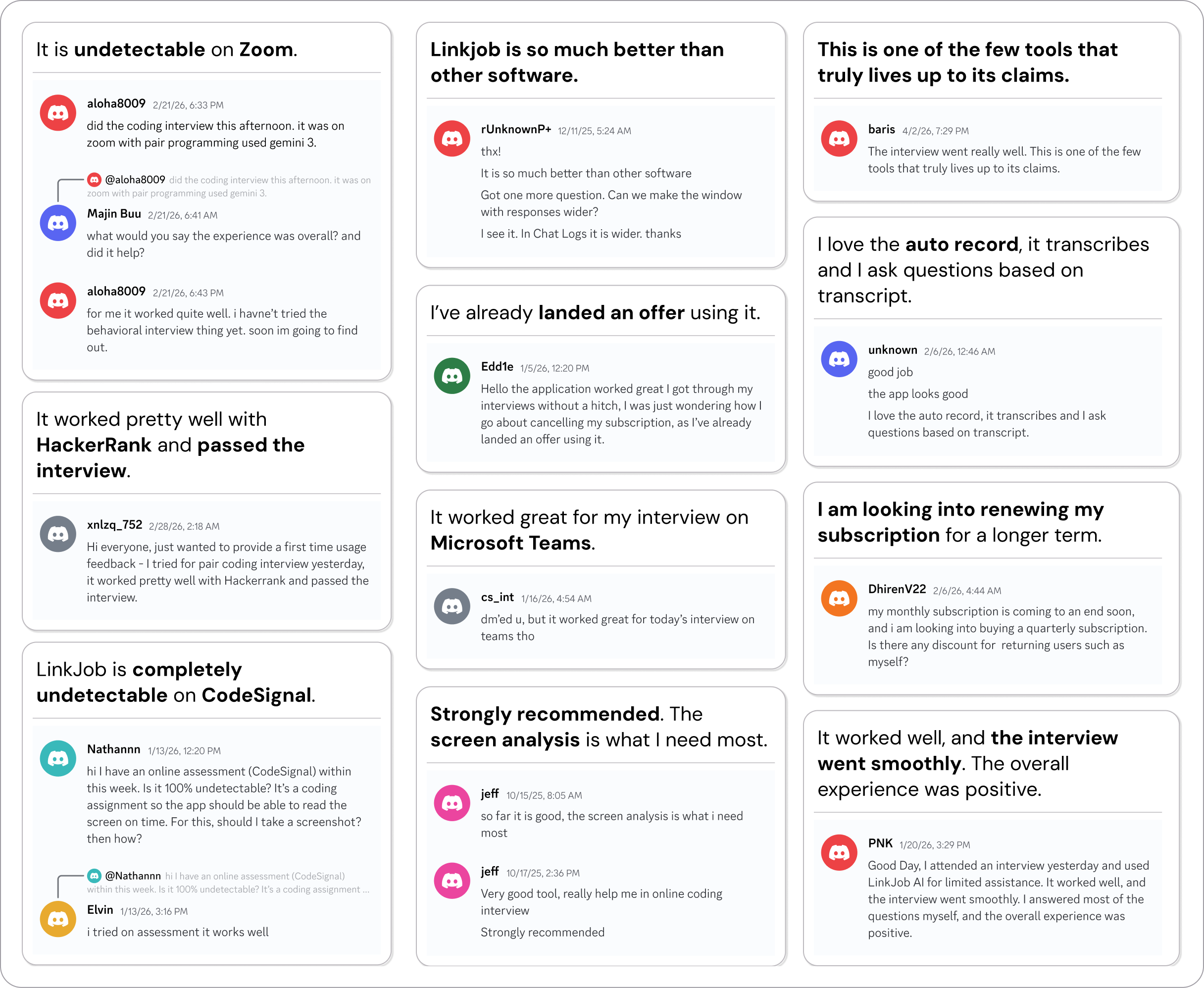
Why People Choose Linkjob AI
Smoother interviews, coding challenges cleared, and job offers landed. See how users describe their experience with Linkjob AI—in their own words.

© Copyright 2026 Linkjob AI - All Rights Reserved.