How I Tackled Microsoft Technical Interview Questions in 2026

Microsoft Technical Interview Process and Experience
In the Microsoft VO I recently completed, I was asked many technical questions. This stage had four rounds in total, covering technical topics, projects, and behavioral questions. Overall, the experience felt steady, no strange or unexpected questions. The formats were the types Microsoft typically asks.
Here’s what each round covered:
Round 1: Coding (arrays / strings)
Round 2: Coding (trees)
Round 3: Project deep dive + system design
Round 4: BQ + one small coding problem
Below, I’ll walk through the questions I encountered in each round.
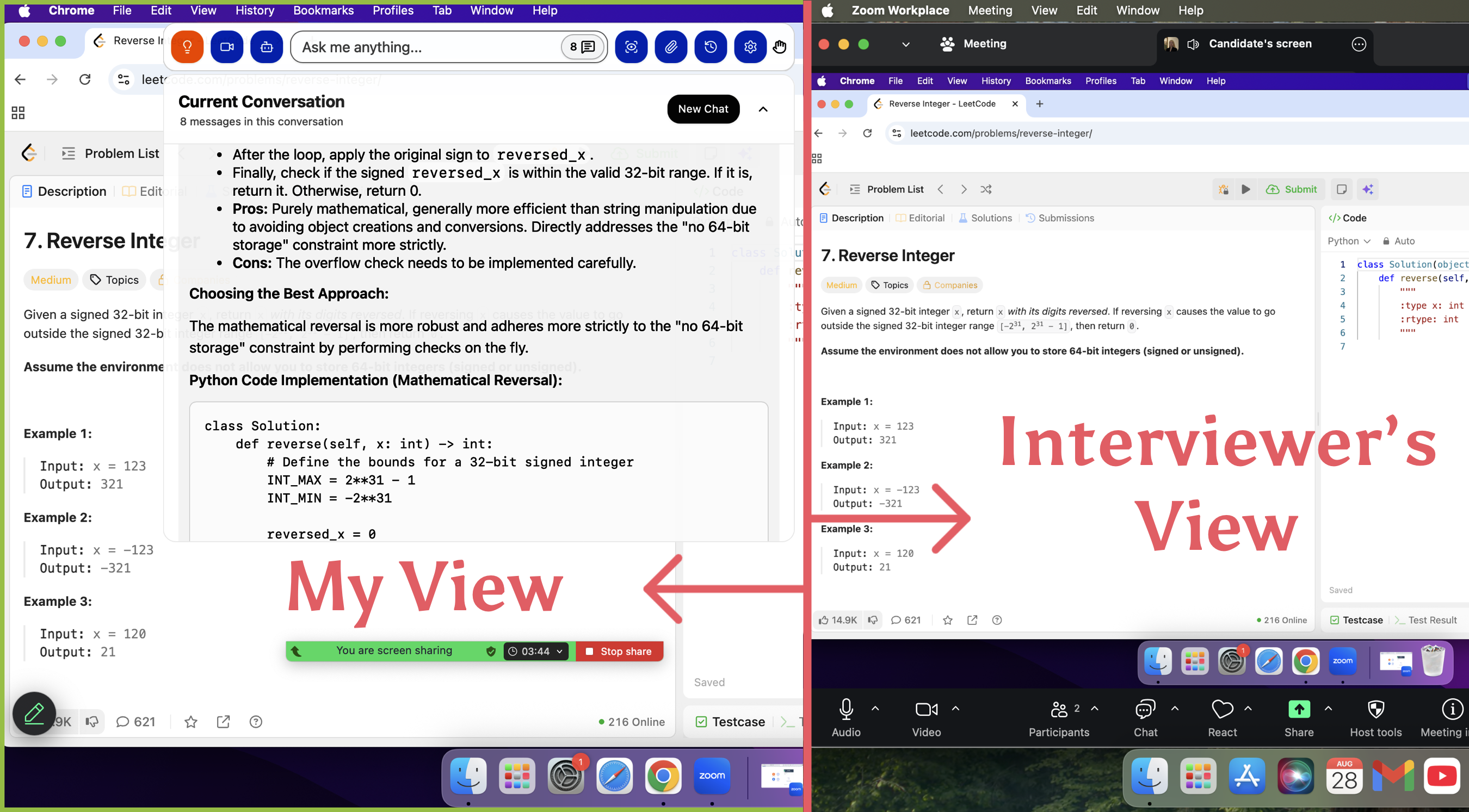
I am really grateful for the tool Linkjob.ai, and that's also why I'm sharing my interview experience here. Having an undetectable AI interview assistant for technical interview is indeed very convenient.
Microsoft Technical Interview Questions
Round 1: Coding (Arrays / Strings)
This round gave me a classic question: the length of the longest substring without repeating characters. I solved it with a sliding window plus a character index map. The follow-up was to return the substring itself, which just required tracking the start index. The atmosphere was relaxed, and my code went smoothly without any hiccups.
Round 2: Coding (Trees)
This round involved a binary tree, and I needed to return all root-to-leaf paths. I used DFS with backtracking and stored the path whenever I reached a leaf. The follow-up was to format each path as "1->3->5". The interviewer mainly focused on how I handled edge cases.
Round 3: Project Deep Dive + System Design
The interviewer first spent about 15 minutes asking about my project, such as:
Why the modules were structured that way
Which parts I owned
The biggest challenges I encountered
Then I was asked to design a small shared To-Do List system, explaining the data model, sync mechanism, concurrency handling, and how it would scale. It didn’t need to be overly complex, a clear framework was enough. I was already pretty tired by this point, so I used Linkjob AI to give me a structure. It handled several follow-ups decently, and I added my own thoughts. The interviewer even complimented me, so I think this round went pretty well.
Round 4: BQ + a Small Coding Question
This round was with the Hiring Manager. The main topics were:
How I handle team conflicts
The hardest initiative I’ve ever pushed through
My understanding of Microsoft’s culture
After the discussion, I got a very simple coding problem: merge two sorted arrays. I used a two-pointer approach and explained the complexity as I coded. I felt this round was mostly about communication style and collaboration.
Overall, the Microsoft technical interview wasn’t as difficult as I expected. With enough practice, being comfortable with LeetCode medium-level problems is generally sufficient.
Coding Questions and Problem-Solving
LeetCode-Style Challenges
When I sat down for the microsoft technical interview, I knew I would face LeetCode-style challenges. These questions tested my skills with real coding problems. I usually saw two or three rounds focused on these types of problems. The interviewers wanted to see how I handled classic topics and if I could think on my feet.
Here are some of the most common question types:
Check if a binary tree is a BST or not
Remove duplicates from a string, in-place
Search for an element in a rotated sorted array
Add two big numbers represented by linked lists
Print the last 10 lines of a big file or string
Clone a linked list with random pointers
Connect nodes at the same level in a tree
Find the least common ancestor in a binary tree or BST
Detect a cycle in a linked list
Validate a given IP address
I noticed that the questions covered a wide range of categories. The table below shows the main problem categories and some examples:
Problem Category | Examples of Topics |
|---|---|
Algorithms | Sorting, searching, recursion |
Data Structures | Arrays, linked lists, hash maps, stacks, queues |
Trees | Traversals, subtree operations, binary search trees |
Graphs | BFS, DFS, shortest path algorithms |
Dynamic Programming | Coin change, edit distance |
The difficulty of these questions varied. Some were easy, while others really made me think. Here’s a quick look at the range of difficulty levels and sample questions:
Difficulty Level | Example Question |
|---|---|
Easy | Min Cost Climbing Stairs |
Easy | Intersection of Two Arrays |
Easy | Find the Index of the First Occurrence in a String |
Easy | Merge Two Sorted Lists |
Medium | Nth Digit |
Medium | Find Original Array From Doubled Array |
Hard | Median of Two Sorted Arrays |
Hard | Longest Valid Parentheses |
Thought Process and Strategy
I learned that having a clear strategy made a huge difference. Interviewers at Microsoft cared about how I approached each problem, not just the final answer. They wanted to see my thought process and how I communicated my ideas.
Here’s how I tackled each coding question:
I started by thinking out loud. I explained my understanding of the problem and shared my plan before writing any code.
I wrote a simple, brute-force solution first. This helped me get something working quickly.
I looked for ways to optimize my code. I asked myself, “Can I make this faster or use less memory?”
I always considered edge cases. For example, what if the input was empty or very large?
I wrote clean code with good variable names. I wanted the interviewer to follow my logic easily.
I tested my code with sample inputs. This helped me catch mistakes early.
I also paid attention to the specific needs of the team. Microsoft interviewers checked if I understood the system I would work on. They looked for attention to detail and compliance with best practices. I made sure to ask clarifying questions if I was unsure about the requirements.
Handling Follow-Ups
After I finished coding, the interviewer often asked follow-up questions. They wanted me to optimize my solution or handle a new edge case. For example, they asked how my code would perform with very large inputs.
Here’s how I handled these moments:
I listened carefully to the question.
I repeated the question in my own words to make sure I understood.
I explained my next steps before making changes to my code.
I showed flexibility. If my first solution was not perfect, I was ready to improve it.
I asked for feedback and checked if my new approach met their expectations.
Microsoft Technical Interview Preparation Tips
Practice Techniques
I used LeetCode and HackerRank for daily practice. I always tried to write clean code and focused on understanding time and space complexity.
Here are some techniques that worked for me:
Break problems into smaller parts.
Clarify the problem before starting to code.
Consider edge cases in every solution.
Optimize my code after getting it to work.
Do mock interviews with friends or on platforms like Linkjob.
Behavioral and System Design Rounds
Behavioral Questions
When I reached the behavioral interview, I knew Microsoft wanted to see how I worked with others. The interviewer asked about teamwork, leadership, and how I solved problems in tough situations. I shared stories from my past jobs. I talked about times when I helped a teammate or handled a conflict. I made sure to show my values matched Microsoft’s culture.
Here’s a quick look at how the interview rounds are structured:
Interview Round | Focus Areas | Duration |
|---|---|---|
Technical Interviews | Coding, data structures, algorithms, system design | 45-60 minutes |
System Design (Senior) | Designing scalable systems, architecture, trade-offs | 45-60 minutes |
Behavioral Interview | Teamwork, leadership, problem-solving experiences | 45-60 minutes |
System Design Approach
System design questions felt tricky at first. I learned to break them down step by step. Here’s the approach that worked for me:
I started by asking questions to clarify the requirements. I wanted to know what the system needed to do and what mattered most.
I estimated the scale. I thought about how much data the system would handle and how many users might use it.
I listed the main parts of the system, like databases, caches, and load balancers.
I talked about trade-offs. I explained why I chose one design over another, thinking about cost, speed, and security.
Tip: Always draw diagrams if you can. Visuals help interviewers follow your ideas.
Balancing Skills
During the Microsoft technical interview, I had to switch between technical and behavioral questions quickly. I noticed that both skills mattered equally. Here’s a table that shows the balance:
Skill Type | Importance Level |
|---|---|
Technical Skills | 50% |
Communication | 50% |
I practiced moving from coding to system design and then to behavioral questions. This helped me stay sharp and ready for anything. I learned that strong communication made my technical answers clearer. I also made sure to listen carefully and respond thoughtfully.
The onsite loop mixes system design, coding, and behavioral questions.
I practiced switching between these types so I could handle any question with confidence.
Note: Balancing technical knowledge with good communication is key. Interviewers want to see both.
FAQ
How can I prepare for system design questions?
I review basic system components like databases, caches, and load balancers. I practice drawing diagrams. I ask clarifying questions during the interview. I focus on explaining my choices and trade-offs. Simple visuals make my ideas easy to follow.
How do you handle behavioral questions?
I share real stories from my experience. I use the STAR method: Situation, Task, Action, Result. I keep my answers honest and clear. I show how my values match Microsoft’s culture.
Is it okay to ask questions during the interview?
Absolutely! I ask questions to clarify requirements or understand the team’s needs. Interviewers like when I show curiosity. Asking questions helps me avoid mistakes and shows I care about building the right solution.
See Also
How I Passed the Microsoft HackerRank Test in 2026 on My First Try
Microsoft SDE Interview Secrets: SDE1 Journey, SDE2 Advice
How I Cracked the Microsoft AI Engineer Interview (2026)
How I Passed 2026 Stripe Technical Interview with Real Questions
How I Passed 2026 Oracle Technical Interview: Real Questions
© Copyright 2025 Linkjob.ai - All Rights Reserved.