How I Experienced My NVIDIA Deep Learning Interview in 2025

I just finished my NVIDIA Deep Learning Software Engineer interview. While the details are still fresh, I’m documenting my interview experience to serve as a reference for others preparing for similar interviews.
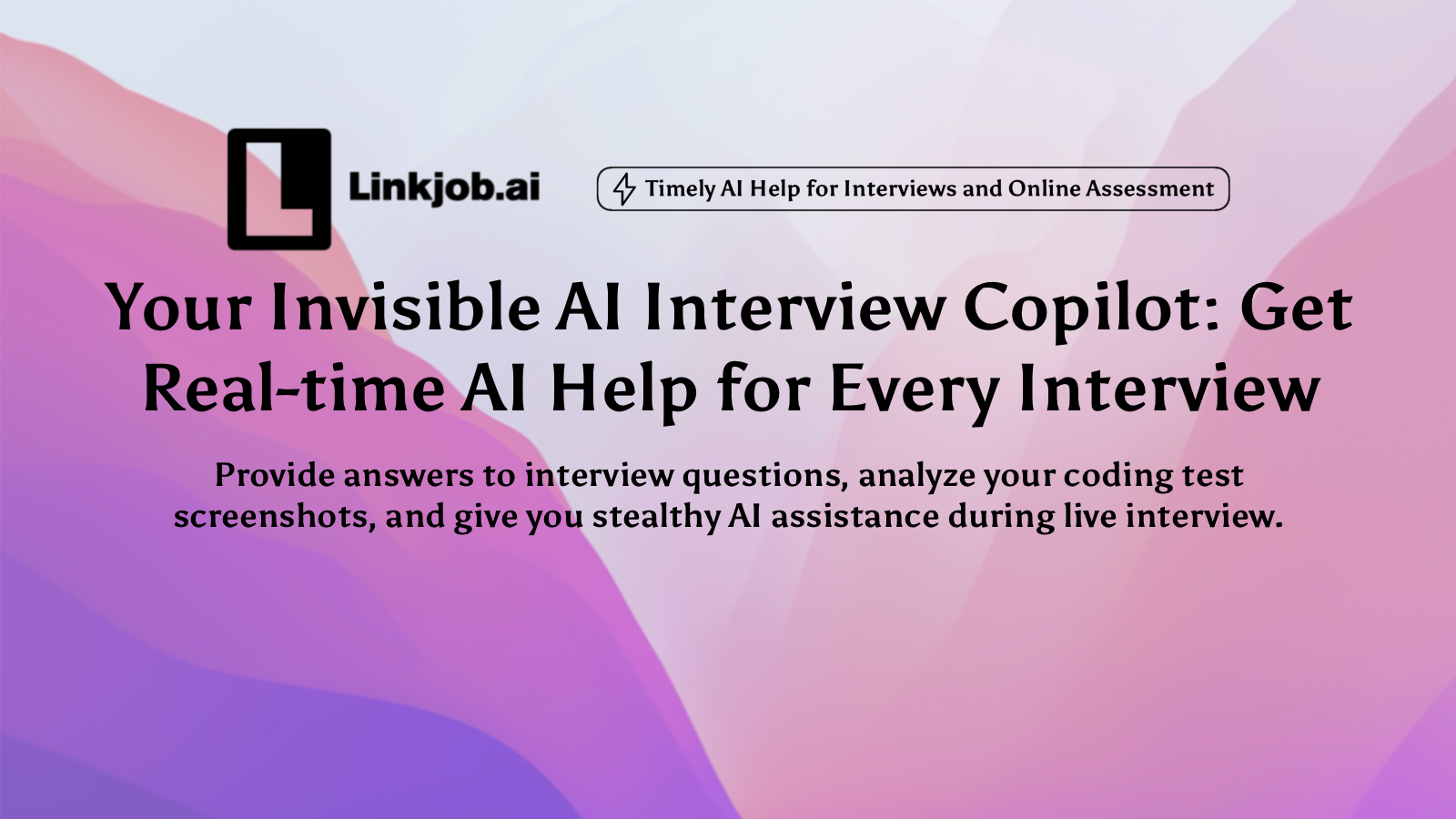
I’m really grateful to Linkjob.ai for helping me pass my interview, which is why I’m sharing my OA questions and experience here. Having an undetectable AI interview assistant indeed provides a significant edge.
NVIDIA Deep Learning Interview Process
Technical Screen
This round of the interview lasted 45 minutes. I initially expected it to start with self-introduction, followed by behavioral questions, and then LeetCode problems. However, the interviewer immediately said that today they would focus on machine learning concepts, and I wasn’t asked to introduce myself. There were three main questions.
Question 1: Gradient Descent Concept
Q: Could you please briefly explain how gradient descent works?
A: Ground truth minus loss, then multiply by the learning rate.
The interviewer said they were glad I mentioned the learning rate.
Q: Is there any guarantee that we can reach the global optimum?
A: No.
Q: Are there any types of loss planes where, no matter where you start—assuming an infinitely small learning rate and unlimited steps—you are guaranteed to reach the global minimum?
I considered many strange examples, but the answer was simple: convex plane.
Question 2: Different Types of Gradient Descent – Full-batch vs SGD
Q: Full-batch, mini-batch, and stochastic gradient descent (SGD): what are the advantages and disadvantages of the three methods?
I said that with SGD, because the sample size is small, it can be far away from the true gradient.
The interviewer asked, “Do you mean it has higher bias or higher variance?” (I answered in the wrong direction).
He drew a diagram to guide me: if there is a shallow local minimum and a deep global minimum, which method is more likely to find the deep pit, assuming we start near the shallow pit?
Answer: SGD, because it can jump out of the shallow pit. (With batch size = 1, we can be lucky and deviate from the true gradient, allowing us to escape the small pit.)
Question 3: Generalization Gap
Define:
g_population → true gradient of the population distribution
g_train → averaged gradient of the sampled training examples
Q: If we remove the condition that g_train = g_population, would you use full-batch gradient descent or mini-batch/SGD? Ignore computational cost.
I initially said full-batch, which was incorrect. The interviewer guided me to draw three types of loss functions:
Sharp minima (steep)
Medium
Flat minima (smooth)
Q: Which model would you choose?
Answer: The third model (flat minima), because the generalization gap is smallest. Population distribution inevitably differs from training, so smoother loss functions are more robust. Converging to smooth minima allows the model to generalize better.
Final Question: Would you choose a large batch size or small batch size?
Answer: Small batch, because large batch sizes tend to produce steep minima, whereas smaller batches can lead to flatter minima.
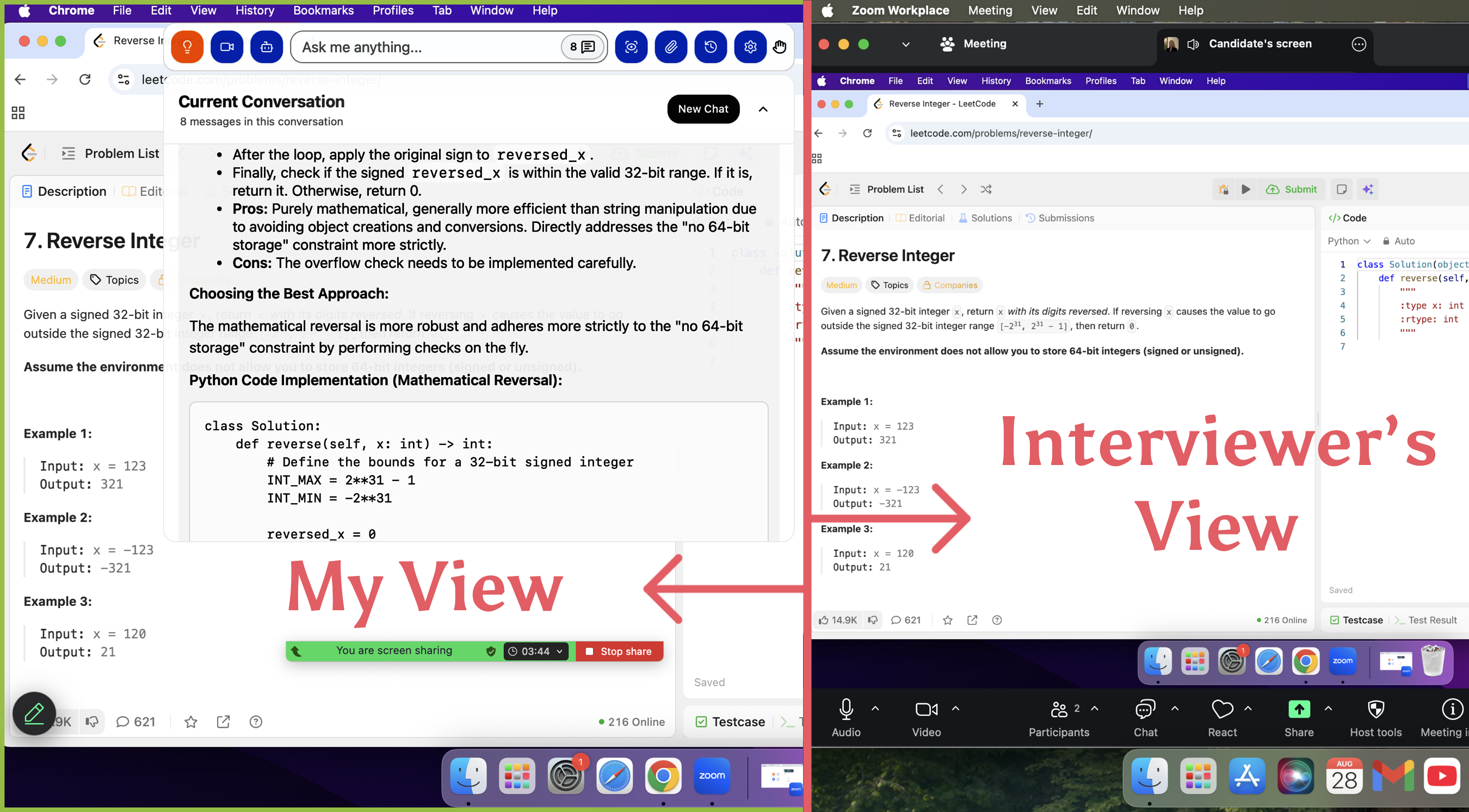
During the interview, I answered a few questions incorrectly, and the interviewer immediately pointed out my mistakes and asked me to correct them. I felt a bit flustered at that moment, so I used Linkjob to help me respond. Fortunately, I was able to adjust my answers based on the AI’s suggestions.
Onsite
NVIDIA conducts group hiring, so the interview questions can vary widely. Here, I’ll share my onsite interview experience. I went through 8 VO/panel rounds, and this is what I encountered:
Round 1: Coding + Behavioral
The coding question was a debug problem; I had to debug until all test cases passed.
Behavioral questions included my proudest project and a project that failed.
This round focused a lot on attention to detail and how I think through problems.
Round 2: ML System Design + Coding
The ML design question tested LLM’s ability to handle images and dialogue, ending with converting the dialogue into speech.
A coding question came up in the last 10 minutes; I finished it in 8 minutes but didn’t have time to test. The interviewer said as long as it was basically correct, it was fine.
The interviewer kept their camera off the whole time, and the design prompt was a bit unclear, so I stuttered a little while answering.
Round 3: ML Design (Project Related)
The question was similar to a project on my resume: with only a few SFT examples and a pretrained vision backbone, how would I fine-tune a pretrained LLM into a VLM?
I got stuck at first until the interviewer suggested I could generate synthetic data (without human labeling), which helped me find a solution.
Also involved strategies for collecting pretraining data and rapid fine-tuning.
Round 4: Vision Research
Questions included classical CV dataset sizes, image dimensions, efficient ways to download and read large datasets, how to evaluate experiment results, and common MLLM benchmark metrics.
I think this was probably the second round, but I’m not 100% sure of the order.
Round 5: LLM Basics + Behavioral / HR
LLM basics, including Transformer-related questions.
Behavioral / out-of-scope questions about projects.
HR chat was casual, asking about work-life balance, and wasn’t counted toward evaluation.
Round 6: Hiring Manager (HM)
HM introduced the team and projects, then asked detailed questions about my resume.
The focus was on whether my project experience and technical skills matched the role.
Round 7: Product Manager (PM)
PM had some technical understanding and gave me an MLLM design question about continuing pretraining.
Also asked about audio, video, ML Ops, etc. I answered honestly about anything not on my resume.
Overall Takeaways
The bar for hiring is really high, especially regarding technical fit and problem-solving skills.
The interview covered coding, system design, MLLM design, vision research, and behavioral questions.
NVIDIA Deep Learning Interview Questions
Categories of NVIDIA Deep Learning Interview Questions
Deep Learning Fundamentals: Includes basic neural network structures such as Multi-Layer Perceptrons (MLPs), Convolutional Neural Networks (CNNs), and Recurrent Neural Networks (RNNs), their principles, and application scenarios; usage of deep learning frameworks like TensorFlow and PyTorch.
Hardware Knowledge: Focuses on understanding GPU architecture, including parallel computing structure, memory hierarchy, and CUDA programming model.
Problem-Solving Skills: Involves analyzing real technical problems and proposing solutions, such as diagnosing model overfitting, identifying causes, and suggesting improvements.
Teamwork and Company Culture: Through questions, the interviewer evaluates how candidates collaborate with team members in past projects and their understanding of and alignment with NVIDIA’s culture of innovation and pursuit of excellence.
Deep Learning Fundamentals Interview Questions
Briefly explain how Transformers work and their applications in natural language processing.
Explain the principles and differences between Layer Normalization (LN) and Batch Normalization (BN), and describe the scenarios where each is applicable.
Write the mathematical formula for the cross-entropy loss function and derive its gradient.
Introduce DDPM (Denoising Diffusion Probabilistic Models) and DDIM (Denoising Diffusion Implicit Models), and explain the differences between them.
Hardware Knowledge Interview Questions
Describe the memory hierarchy of a GPU and explain the characteristics and roles of each memory level.
Explain the concepts of thread blocks and threads in CUDA programming, and how they work together.
How would you optimize CUDA code performance? List some common optimization techniques.
Introduce NVIDIA Tensor Cores, their functions and advantages, and their applications in deep learning.
Problem-Solving Skills Interview Questions
If your deep learning model performs well on the test set but poorly in real-world applications, how would you investigate and improve it?
Suppose you are optimizing the inference speed of a deep learning model—what measures would you take?
What solutions would you use if you encounter GPU memory limitations?
Describe a challenging deep learning problem you faced in a past project and how you solved it.
Teamwork and Company Culture Interview Questions
Share an experience where you disagreed with team members. How did you handle it?
Why do you want to join NVIDIA? What do you know about NVIDIA’s company culture, and how do you align with it?
Describe a project in which you coordinated work among different team members. How did you ensure the project proceeded smoothly?
If you encounter a problem at work that is beyond your current capabilities, how would you seek help and support?
NVIDIA Deep Learning Interview Unique 2025 Aspects
Interview Structure Changes
The interview structure at NVIDIA in 2025 looked different from previous years. I saw more stages and a smoother flow between each part.
Here’s a table that shows the new structure:
Stage | Description |
|---|---|
Recruiter Screening | Initial assessment of candidate qualifications and fit. |
Online Coding / Tech Assessment | Evaluation of coding skills through online tests. |
Technical Phone / Virtual Loop | In-depth technical discussions and problem-solving over the phone. |
On-site / Virtual On-site Loop | Comprehensive interviews including multiple technical and behavioral rounds. |
Hiring Panel & Offer | Final evaluation and decision-making by a panel before extending an offer. |
FAQ
Which programming language should I use for the NVIDIA Deep Learning interview?
While both Python and C++ are acceptable, I strongly recommend using Python if you have to choose one. Python allows you to write code faster and focus on correctness, which is crucial given the time constraints of the interview.
How should I approach machine learning design or model questions?
For ML design questions, focus on clearly explaining your thought process. Be prepared to discuss model architecture choices, data preprocessing, handling small datasets (e.g., generating synthetic data), and trade-offs between accuracy and generalization. Illustrating your reasoning with diagrams or pseudo-code often helps.
What kind of deep learning theory questions should I expect?
Expect questions on fundamental concepts, such as neural network types (MLP, CNN, RNN, Transformers), loss functions, optimization methods (SGD, Adam), and generalization. You may also be asked about specific models like DDPM, DDIM, GANs, or MoE, and their trade-offs. Being able to explain concepts concisely and relate them to practical applications is key.
See Also
How to Cheat HackerRank Tests With AI: My 2026 Update
The 2026 OpenAI Coding Interview Question Bank I've Collected
2026 Nvidia HackerRank Test: Questions I Got and How I Passed
© Copyright 2025 Linkjob.ai - All Rights Reserved.