How I Cracked Palantir Technical Interview Guide 2026


Palantir’s technical interviews are notoriously brutal, with a pass rate hovering around 9%. I recently went through the full 2026 loop for a Core SWE (Product Development) role and secured an offer. Unlike standard FAANG interviews, Palantir tests your adaptability and engineering intuition far more than rote memorization.
I managed to secure the offer, but full disclosure: I had Linkjob AI generating the code for me live, having a real-time AI interview copilot solve the logic for me gave me a huge edge.
Note: While my loop was for Core SWE, I’ve also compiled insights for FDSE and Gov tracks (like the specific 'Game Logic' questions) to make this a holistic guide for any Palantir engineering applicant.
Palantir Technical Interview: Core SWE
Here is the detailed breakdown of the Core SWE process and how to prepare.
1. Recruiter Call
They asked me "Why did you study Computer Science in the first place?" They were checking if I was driven by curiosity or just chasing a high TC.
My Advice:
Don't be Generic: Saying "You are the best data company" is a red flag.Explicitly link your background to their Mission. whether it's the commercial value of Foundry or the defense implications of Gotham.
Tip: Social Competence. the interviewer is looking at whether you are a person who can communicate normally. As long as you speak logically, don't be so nervous as to stutter, and show your passion (Mission) for Palantir naturally, this round is basically a freehand question.
2. Online Assessment (OA)
(Most candidates start here, and many end here)
The prompt described a complex business scenario (disaster resource allocation) and felt more like a Jira ticket. The hard part is translation was. I had to parse three pages of requirements before writing a single line. I spent the first 15 minutes just mapping out the data structures (heavy use of nested Dictionaries) to organize the chaos. If I had rushed to code without handling the edge cases , I would have failed.
My Advice:
Read Before You Code: Correctness > Speed.
Expect Complexity: This is a reading comprehension test. You will face long, text-heavy prompts.
Data Structures: Practice using Maps/Dictionaries to organize complex objects. The hidden test cases are brutal, so handle every edge case mentioned in the text.
Tip:Don't just focus on doing exercises. Practice your English reading speed more. Keep a stable mindset. Not being able to understand a problem is more fatal than not being able to write code.
3. Technical Phone Screen
This is a real technical round, usually conducted by an engineer. First came the Behavioral questions, and then a Leetcode-style problem. I got a complex Graph Traversal (BFS/DFS) problem involving a grid with changing states. I constantly narrated my thought process.
High-Frequency Alert: The "State-Space" Grid Problem
The graph problem I faced was a Complex Graph Traversal involving a grid with changing states.
This is a classic Palantir archetype. They love problems where the "state" isn't just your location (x, y), but also a dynamic variable (e.g., how many walls you've broken, keys collected, or time elapsed).
The Trap: If you just use a standard BFS with a
visited[row][col]set, you will fail. You must recognize that the state is 3-dimensional:visited[row][col][current_state].My Winning Move (Narrating the Trade-off): Solving it wasn't enough. I made sure to constantly narrate my thought process. I explicitly discussed Time vs. Space trade-offs before writing a single line.
What I actually said: "Since the constraints change as we move, simply tracking coordinates isn't sufficient. I need to expand my
visitedset to include the current statek. This increases the Space Complexity toO(M * N * K), but it's necessary to find the shortest path without getting stuck in cycles."The Result: The interviewer nodded immediately. They aren't just checking if you can code BFS; they are checking if you understand State-Space Search.
If you haven't finished scanning Neetcode 150 yet, do it right away. If you can solve three quarters of the problems in the LeetCode weekly competition, then your foundation is sufficient.
Palantir is extremely obsessed with Runtime Optimization. For example: The interviewer might hint to you, "This array is essentially ordered. Can it be faster?" At this point, Binary Search (log n) must immediately pop up in your mind. Even some less popular algorithms related to Tagged might be tested.
My Advice:
Content: Expect standard LeetCode Medium/Hard (Graphs, Grids, Intervals).
Communication is Key: Explain why you chose a specific data structure.
Optimization: Always discuss Big-O notation and potential bottlenecks.
Tip:Don't rote memorize.The questions in the question bank can only be used as a reference, and the real questions are often variations. Understanding the core concepts is more important than memorizing the code.
Technical Concept
Description
Algorithmic Coding
Graph theory, Grid traversal (BFS/DFS), HashMaps.
Communication
Clearly explaining why you chose a specific data structure.
Optimization
Discussing Big-O notation and potential bottlenecks.
4. The Onsite Loop :The Real Challenge
The onsite loop (Virtual Onsite) is unique and significantly harder than the earlier stages. It usually consists of 3 distinct technical rounds followed by a Hiring Manager round. The "System Design" here is actually a "Decomposition" round, and there is a unique "Learning" round.
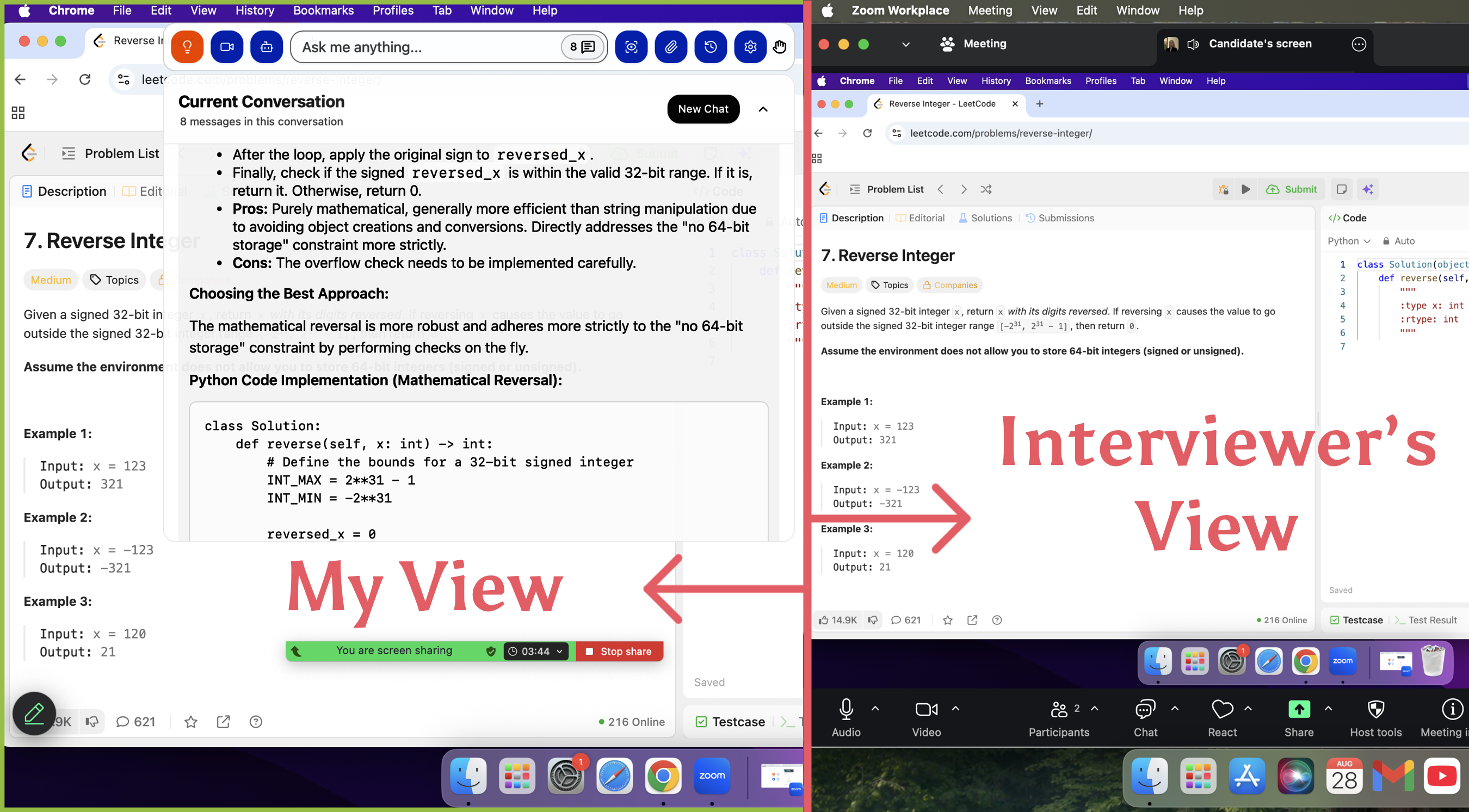
Linkjob AI worked well. And it is undetectable.
Stage | Number of Rounds |
Virtual Onsite | 3 (Decomposition, Learning/Codebase, Algo) |
Hiring Manager Round | 1 |
Round A: The Decomposition Round (Crucial)
This replaced the standard System Design interview.
The Task: I was given a vague operational problem: "How would you optimize the logic for a taxi dispatch system in London?"
The Requirement: I HAD to use a whiteboard tool (Excalidraw).
My Approach: They cared about the Logic, not the Infrastructure. I mapped out the Entities (
Driver,Rider,Ride) and the Data Flow logic. I treated the interviewer like a coworker, asking, "Does this logic make sense for the user?"
Round B: The Learning / Codebase Round
The Setup: They shared a screen with a pre-existing codebase (~200 lines) and documentation for a library I had never seen.
The Task: Read the docs, explain the code, and then implement a feature to optimize it.
The Experience: It felt like my first day on a new job. I didn't try to read every line. I scanned the entry points, ran the tests to see what happened, and then started coding.
What They Test: They are testing your "Time-to-First-Commit", how fast can you be useful in a messy repo?
The Trap: Sometimes the simple "bug fix" is a decoy. It might require implementing a complex algorithm (like a Trie or DFS) disguised inside the existing class structure.
Round C: Algorithmic Round
For Core SWE roles, this is mandatory.
The Task: A traditional hard coding problem disguised within a practical scenario. Expect complex structures like Tries or Dynamic Programming.
Round D: Hiring Manager (The "Vibe Check" That Kills)
The "Redo": The HM asked me to redo the technical part of a previous round where I had struggled. It was a test of self-awareness.
The Deep Dive: We spent 15 minutes just on one project from my resume. He grilled me on specific metrics and trade-offs. He wanted to know if I truly owned the project or just participated.
The Mission: He spoke passionately about the impact of Palantir's software on high-stakes problems (empowering critical institutions).I matched his energy.
Aspect
Onsite Interview Rounds
Hiring Manager Round
Structure
Back-to-back technical sessions (approx. 1 hour each)
Single behavioral/culture interview
Focus
Decomposition (Logic/Data Flow), Learning (Navigating new code), Algo (Hard implementation)
"Vibe Check", Mission alignment, and occasional unexpected technical questions
Key Requirement
Visualizing solutions (Excalidraw) & fast adaptation to new code
Demonstrating you are "Mission-Driven" and not just a mercenary
How I Actually Prepared
1. Decomposition Prep For the Decomposition prep, I picked messy, vague problems (like "How does a parking garage track open spots?") and forced myself to map out the Inputs → Business Logic → Outputs on Excalidraw.
2. The "Time-to-First-Commit" Drill I went to GitHub, found small Python/Java repositories, and set a timer for 30 minutes. I challenged myself to understand the code structure and implement a small new feature before the timer went off.
3. Linkjob AI. I applied it during the real-time interview process. Palantir’s questions are vague and difficult to understand. It generated the code for me during the interview, so I can express my train of thought more quickly and accurately.
Key Takeaway: If you're heading into this loop, my biggest advice is: Don't just be a coder.
That covers the Core SWE loop. However, if you are aiming for the Forward Deployed (FDSE) or Government tracks, the rules of engagement change. I’ve compiled the specific differences below.
Palantir technical interview: FDSE
Focus: Commercial Clients (Airbus, BP, Ferrari, etc.)
Key Skill: Engineering + Consulting
If Core SWEs build the car (Foundry), FDSEs drive it to the client, fix the engine in the rain, and teach the client how to race. The interview loop shifts from "System Architecture" to "Data Architecture" and "Client Outcomes."
1. Recruiter Call: The "Road Warrior" Check
They are looking for engineers with high Social Competence.
The "Travel" Question: You will be asked: "Are you willing to travel 25-50%?" Hesitation here is a dealbreaker.
The Vibe: You need to sound like someone who can sit in a boardroom with a non-technical CEO. If you sound too academic or introverted, you might be flagged.
2. Technical Rounds: Logic & Data Manipulation
FDSE coding questions are less about "LeetCode Hard Graph Theory" and more about practical data manipulation.
Common Themes: String parsing, complex HashMaps, and array manipulation.
The "Implementation" Focus: They might ask you to parse a messy log file or reformat a dataset. The code doesn't need to be fancy; it needs to be readable and correct.
3. The FDSE Decomposition (Data Integration)
Unlike the Core SWE "Taxi Dispatch" (state management), FDSE questions focus on Integration.
The Task: "An airline has terabytes of sensor data in JSON, CSV, and XML. How do you build a pipeline to predict engine failure for a mechanic?"
The Shift: Do not draw a Load Balancer. Draw the Data Pipeline:
Ingestion (Raw Data) $\rightarrow$ Cleaning/Normalization $\rightarrow$ Ontology (Objects) $\rightarrow$ User Interface.
Pro Tip: Ask about the User. "Who is using this? A data scientist or a mechanic?" The answer changes your design.
4. The Learning Round (The "Client Site" Sim)
The Task: You might be given a dataset and a new tool (like a proprietary SQL wrapper).
The Goal: "The client needs to know X by 5 PM."
Strategy: Speed matters. Learn the syntax, get the answer, and explain your results in plain English.
Palantir technical interview: Gotham / Defense
Focus: DoD, National Security, Disaster Relief
Key Skill: Mission & Security
This track is unique. It shares technical DNA with FDSE but adds a layer of Ethical Screening and Practicality.
1. Recruiter Call: The "Comfort" Check
The "DoD" Question: They will explicitly check your comfort level working with defense agencies. If you hesitate about the ethics of war/defense, the process ends.
Security Clearance: If you have an active Secret/TS Clearance, shout it from the rooftops. It is a massive "Green Flag" that can fast-track your application.
2. Coding Round: The "2048" & Practical Logic
Because Gov work often involves legacy systems or disconnected environments, they value implementation speed over abstract theory.
Real Example: The "2048" Game
The Prompt: Implement the logic for the game 2048. (Input:
[2,0,2,0]$\rightarrow$ Output:[4,0,0,0]).The Trap: The interviewer explained it poorly on purpose. They want to see if you can clarify requirements in a chaotic environment (simulating a deployed mission).
Why this fits Gov: It tests clean code and logic handling, not your ability to memorize Dijkstra’s algorithm.
3. Decomposition: The "Disconnected Edge"
The Scenario: Gov scenarios are often "High Stakes, Low Connectivity."
Example: "Design a system to track disaster relief supplies in an area with no internet."
The Constraint: You can't rely on AWS or Cloud. You need to think about Local Caching, Syncing when online, and Data Reliability.
4. Hiring Manager: The "Missionary" Test
For the Government track, the "Vibe Check" is intense.
The Narrative: You must genuinely care about the mission. The HM might ask: "Why do you want to work on Gotham instead of selling ads at Google?"
The Answer: Your answer needs to be about Impact. "I want my code to save lives/support national security," not "The tech stack looks cool."
Feature | Core SWE | FDSE (Commercial) | Government / Gotham |
Key Question | "Can you build scalable Infra?" | "Can you solve the client's problem?" | "Can you deliver on the Mission?" |
Coding Style | LeetCode Hard (Graphs/DP) | Data Manipulation / Strings | Implementation Logic (e.g., 2048) |
Decomposition | System Architecture | Data Pipeline & Ontology | Offline/Edge & Mission Logic |
Key Vibe | Engineering Excellence | Consultant + Engineer | Mission-Driven & Practical |
FAQ: Common Questions
Q: Do I need to know Palantir’s products before the interview?
A: Yes, absolutely. You don't need to be an expert, but you must know the difference between Foundry (Commercial Operating System, used by Airbus/Ferrari) and Gotham (Government/Defense OS). Mixing them up during the "Why Palantir?" question is a major red flag.
Q: Can I use any programming language?
A: Yes, but Python is highly recommended for the Online Assessment (OA) and Decomposition rounds. The OA is time-constrained and text-heavy. Python’s concise syntax saves you valuable minutes compared to Java or C++. For the Core SWE Algorithmic round, use whatever language you are most proficient in (Java/C++/Python).
Q: What is the difference between Core SWE and FDSE interviews? A:
Core SWE: Focuses on Depth. Expect standard System Design (Scalability, Distributed Systems) and LeetCode Hard algorithms (Graphs, DP).
FDSE: Focuses on Breadth & Logic. Expect "Data Pipeline" design questions and practical implementation logic (like the 2048 game) rather than abstract graph theory.
Q: Do I need a Security Clearance? A:
For Core SWE / Commercial FDSE: No.
For Government Track: It is not always required to apply, but having an active Secret or Top Secret clearance is a massive advantage. It can sometimes simplify the technical bar because cleared engineers are in such high demand.
Q: Is the "Learning Round" language-specific?
A: No. You cannot study for it. They might give you a Java repo, a TypeScript file, or a made-up Query Language. They are testing your ability to learn, not your prior knowledge.
Tip: Don't stay silent. Read the docs out loud and treat the interviewer like a pair-programming partner.
Q: Does Palantir offer remote roles?
A: Palantir has a strong "Office-First" culture (typically Palo Alto, NYC, London, DC).
Core SWE: Expect to be in the office 4-5 days a week.
FDSE: Expect to be in the office or traveling to client sites (25-50% travel is common).
Q: How do I stand out in the Recruiter Call?
A: Be a "Missionary." Do not talk about perks or compensation. Talk about solving hard problems (e.g., "I want to build software that helps disaster relief," not "I heard you pay well").
Q: What tools should I use to prep? A:
Algorithms: Leetcode 150 (Grind it).
Mock Interviews: Linkjob AI (Essential for practicing the "Decomposition" round and vague requirements).
System Design: Grokking System Design (Focus on Data Flow).
See Also
Insights From My 2026 Palantir Interview Experience
Strategies That Helped Me Ace My Palantir Interview
Details About My Perplexity AI Interview Journey in 2026
Why People Choose Linkjob AI
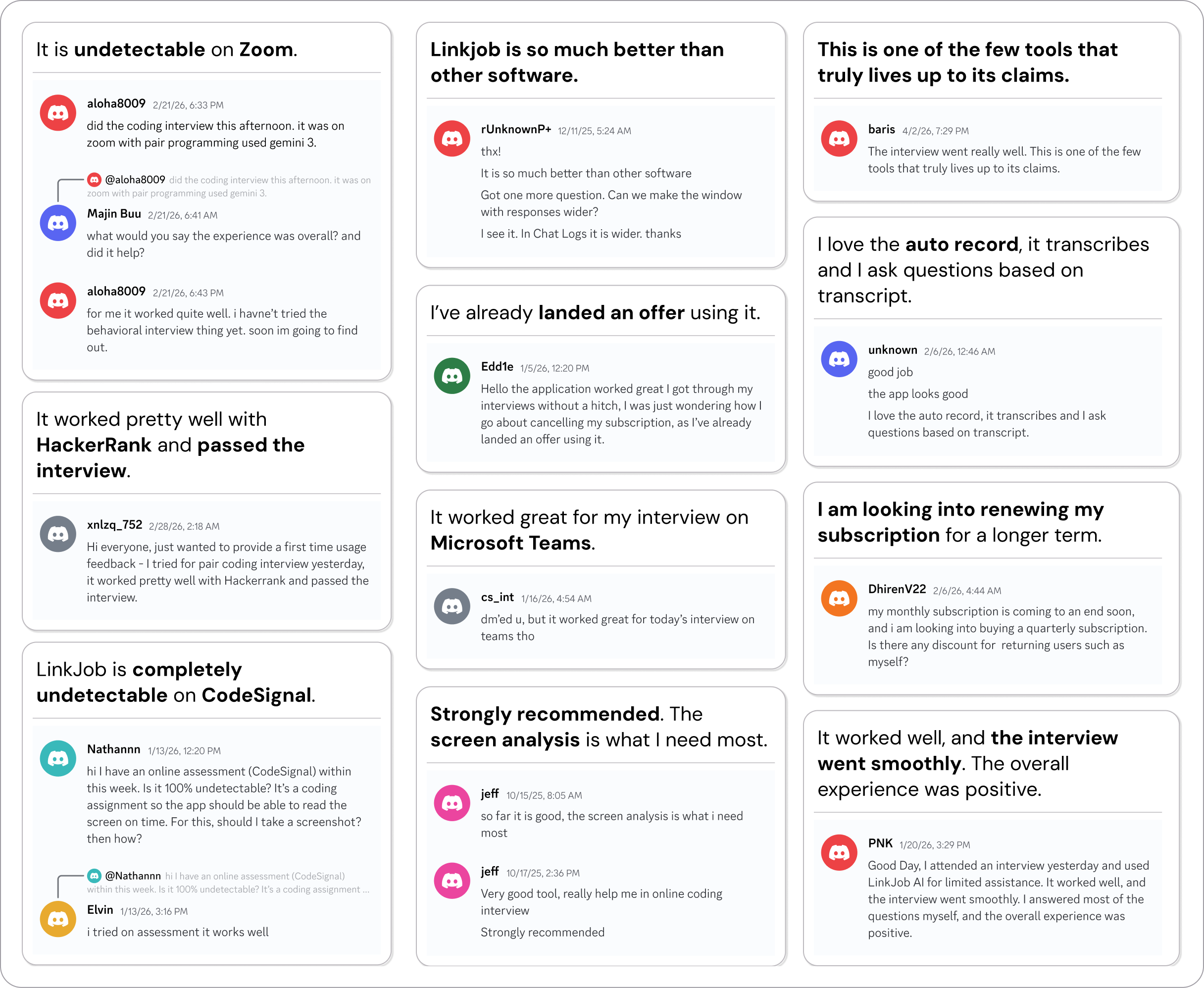
Smoother interviews, coding challenges cleared, and job offers landed. See how users describe their experience with Linkjob AI—in their own words.