My 2026 Snowflake HackerRank OA and the Questions I Got


Snowflake HackerRank OA Questions
The Snowflake OA is hosted on the HackerRank platform. There are three coding questions with a total time limit of 120 minutes. Overall, the questions are quite challenging, and the interview process tends to take a long time to progress.
I’m really grateful to Linkjob.ai for helping me pass my interview, which is why I’m sharing my OA questions and experience here. Having an AI interview tool for OA indeed provides a significant edge.
This article is part of the HackerRank series. If you're interested in other articles in this series, feel free to read: Microsoft HackerRank test, JP Morgan HackerRank test, Stripe HackerRank online assessment.
Question 1: Prime String
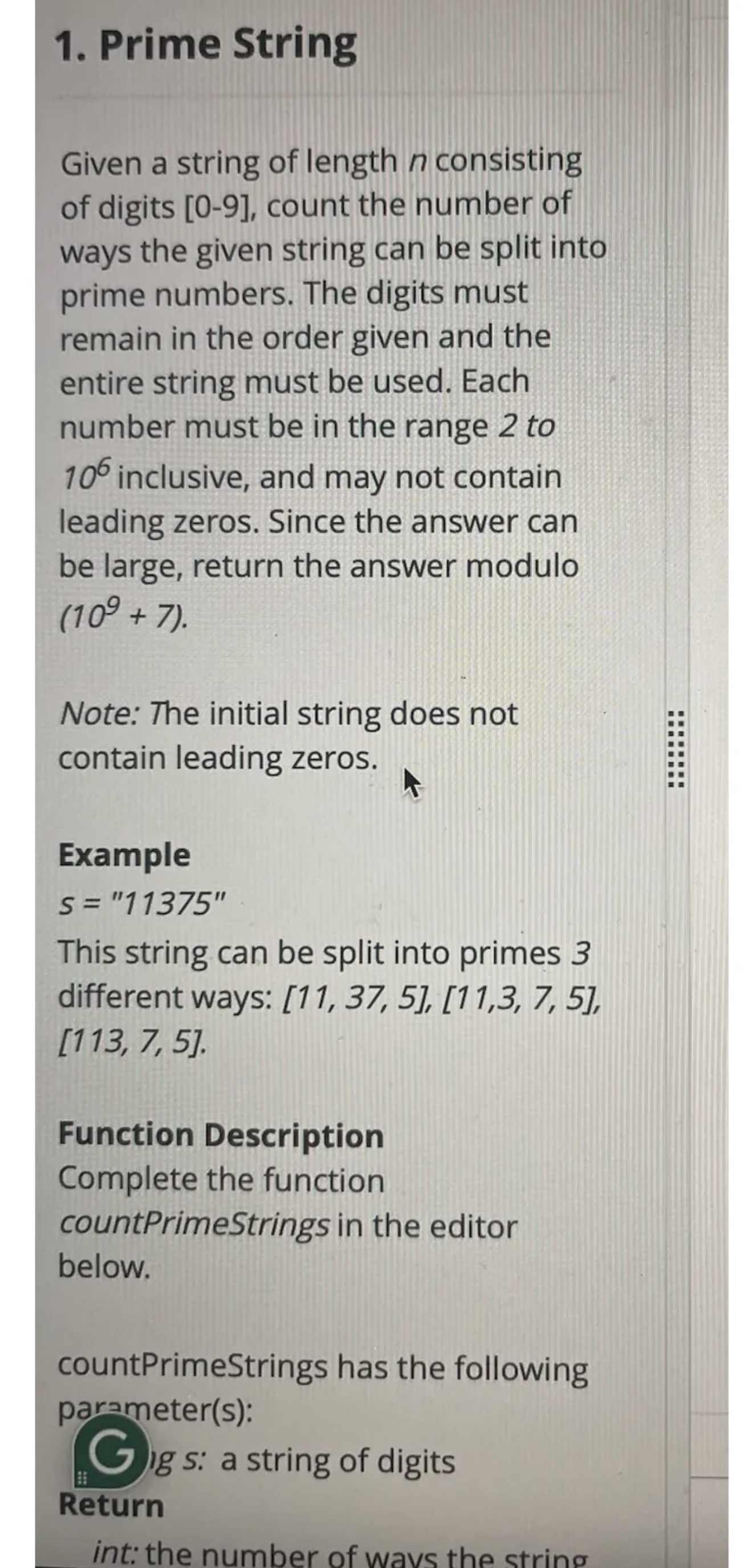
My problem-solving approach:
Precompute all primes up to 10^6 using the Sieve of Eratosthenes to quickly check primality. Use dynamic programming where dp[i] represents the number of valid splits for the first i digits. For each position i, loop back to j (from 0 to i-1), extract the substring s[j..i-1], ensure it has no leading zeros and is a prime, then add dp[j] to dp[i]. Finally, return dp[n] % (10^9 + 7).
Question 2: Text Scoring


My problem-solving approach:
To find prefixScore, iterate through each suffix of prefixString and check the longest match with a substring ending at each position in text. Similarly, for suffixScore, check the longest match of suffixString’s prefix with substrings starting at each position in text. For every possible start and end in text that align with these matches, compute textScore as the sum of their lengths. Keep track of the substring with the highest textScore; if there’s a tie, select the lexicographically smallest one.
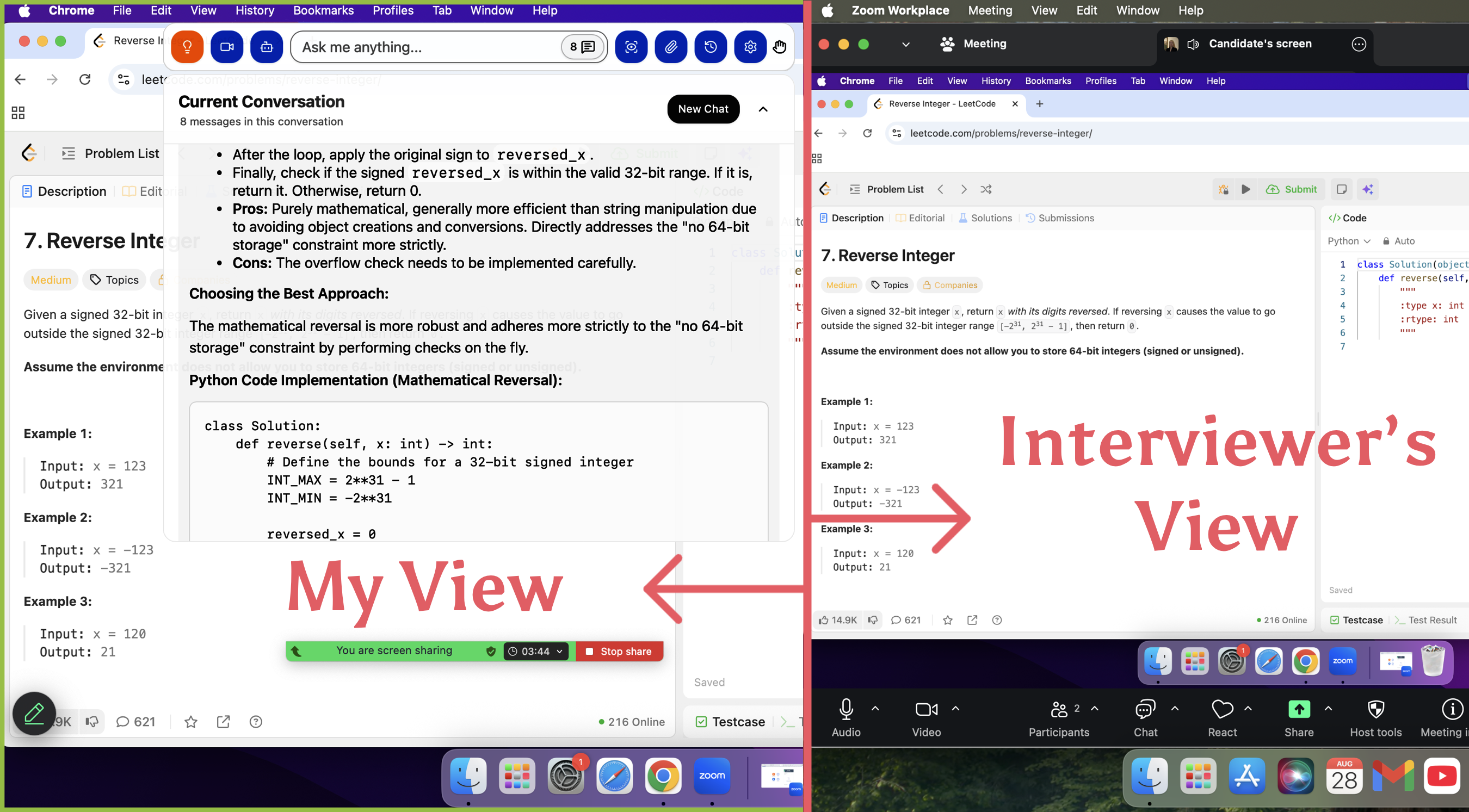
HackerRank is a platform with stringent monitoring measures (including page-switch detection, camera surveillance, and AI behavioral analysis). However, this doesn't mean AI interview assistants can't be used during the interview. Read HackerRank how to cheat to get the answers why Linkjob didn't trigger any HackerRank detection.
Question 3: String Transformation

My problem-solving approach:
First, verify if src can be rotated into target (if not, return 0 immediately). Use dynamic programming or matrix exponentiation to count the number of valid suffix splits at each step. Each step involves transforming the current string by moving a suffix to the front, so we track valid transitions that lead to target in exactly k steps. Return the result modulo 10^9 + 7.
Snowflake HackerRank OA Overview
Format and Expectations
The assessment usually gives you three coding questions. These questions test your skills in data structures and algorithms. Most of the time, the problems range from medium to hard difficulty. If you have practiced on platforms like LeetCode, you will notice that many questions feel familiar.
Common Question Types and Knowledge Points
Snowflake's HackerRank OA focuses heavily on algorithms and data structures, with dynamic programming (DP), string manipulation, and mathematical logic being dominant. For example, problems like "Prime String" require sieve-based prime checks combined with DP to count valid splits. Another type, like "Text Scoring", emphasizes string matching for prefix and suffix overlaps. Topics such as graph traversal (BFS/DFS) and efficient data structure usage (heaps, treemaps) also appear frequently, as seen in problems involving optimal transformations or interval management.
Snowflake OA Scoring: Correctness vs. Efficiency
Snowflake's evaluation in 2026 goes beyond passing test cases; it focuses on the dual standard of logic and performance.
Functional Correctness & Hidden Cases
Full Pass Requirement: Your code must pass all visible and hidden test cases to secure maximum points.
Handling Edge Scenarios: Scoring depends heavily on managing integer overflow (10^9 + 7 modulo), leading zeros, and extreme constraints.
Algorithmic Efficiency Standards
Complexity Benchmarks: Even if logically correct, high-complexity solutions like brute-force primality checks may fail due to Time Limit Exceeded errors.
Optimal Selection: Points are awarded based on choosing the right algorithm, such as using the Sieve of Eratosthenes O(n log log n) or Matrix Exponentiation for large transformations.
Engineering Quality
Performance Weighting: Correctness and efficiency carry nearly equal weight in the final score.
Readability: While automated, clean code structure and efficient data structure usage (e.g., rolling arrays for DP) reflect candidate quality during manual review.
Simple Tricks for Snowflake HackerRank OA Success
Prepare Code Templates in Advance
Before the Online Assessment (OA) starts, prepare a concise library of commonly used code snippets. It should include core content such as the Sieve of Eratosthenes for prime checks, standard Dynamic Programming (DP) initialization frameworks, and string matching helpers. This saves valuable time during the test. You don’t need to write basic logic from scratch, but can directly adapt these templates to fit the problem, reducing typos and allowing you to focus on core problem-solving.
Validate Edge Cases Early
Right after drafting your solution, be sure to validate edge cases immediately. For string-related problems, check scenarios like empty strings, single-character inputs, and leading/trailing zeros; for DP problems, confirm base cases and boundary conditions. Identifying these issues early prevents failing hidden test cases and saves time on later debugging.
Brute-force First, Then Optimize
If you can’t think of an efficient solution right away, use a brute-force approach first to ensure correctness. For example, in "Text Scoring", start with a simple loop to check all possible prefix/suffix matches, then optimize by cutting redundant checks. Brute-force helps you grasp the core logic of the problem and pass small test cases; once it works, identify performance bottlenecks and replace them with optimized methods.
Preparation Tips for Snowflake HackerRank OA
Targeted Topic Drilling
Focus on the high-frequency topics in Snowflake’s OA: Dynamic Programming (DP), string manipulation, and basic mathematical logic. Spend 60% of your practice time on DP. Master classic patterns like split-counting, subsequence matching, and state transition optimization. For string problems, practice prefix/suffix matching, rotation checks, and efficient substring validation to handle questions like "Text Scoring" and "String Transformation" smoothly.
Simulate Real Test Conditions
Adopt a timed training mode, strictly following the OA standard of "completing 3 questions in 120 minutes" to avoid rhythm chaos in the actual exam due to lack of time pressure during practice.
Create custom question banks on platforms like LeetCode and HackerRank, combining DP, string, and math problems in a ratio of "2 medium-difficulty + 1 harder-difficulty" to replicate the problem combination logic of the exam.
Conduct a review after each simulation: not only correct wrong answers but also record the time spent on each question. Focus on optimizing questions that take more than 30 minutes to prevent the overall exam from being affected by timeout on a single question.
Testing top AI tools for cheating: Ensuring my chosen AI copilot is sufficiently suitable and capable of running smoothly during actual interviews.
Leverage Candidate Experience & Auxiliary Resources
Gather OA recall questions from forums like Blind and Glassdoor, or from recent candidates’ blogs. Sort out high-frequency question types and answering pitfalls for targeted intensive practice.
Use a personalized mock interview platform like Linkjob.ai for practice. It tailors interview questions based on your resume and the position you’re applying for. After you answer, it follows up with probing questions, creating an experience that closely replicates a real interview.
FAQ
What programming languages are allowed in the Snowflake HackerRank test?
There are no specific language restrictions for the Snowflake HackerRank test. Languages like C++, Java, and Python are all allowed.
What is the subsequent interview process after passing Snowflake's HackerRank OA?
After passing the OA, the subsequent process usually includes three core interviews, each lasting 60 minutes:
The first is a Coding Interview, focusing on algorithms and data structures. The difficulty is similar to that of the OA but places more emphasis on on-site derivation of problem-solving ideas.
The second is a Behavioral Interview (BQ), which asks questions around scenarios such as personal project experience, team collaboration, and problem-solving to assess the candidate's fit with Snowflake's culture.
The third is a System Design Interview, requiring the design of technical solutions for business scenarios to evaluate architecture design and technology selection capabilities.
Is Snowflake's HackerRank OA scored only based on correctness, or does it also consider code efficiency?
The scoring adopts a dual standard of "correctness + efficiency", with both weights being basically equal. First, the code must pass all test cases to ensure correctness. Second, the time complexity and space complexity of the algorithm will affect the final score. For example, when solving "Prime String", the score of code using the Sieve of Eratosthenes (O(n log log n)) will be higher than that of code using brute-force prime checking (O(n√n)), even if both pass the tests. In addition, code readability is also a hidden scoring item.
See Also
2026 Nvidia HackerRank Test: Questions I Got and How I Passed
How I Cracked 2026 Citadel HackerRank Assesment Questions
My IBM 2026 HackerRank Assessment: Real Questions & Insights
My 2026 MathWorks HackerRank Assessment Questions & Solutions
Questions I Encountered in 2026 Goldman Sachs HackerRank Test
© Copyright 2025 Linkjob.ai - All Rights Reserved.