My Experience Navigating the Tesla Software Engineer Interview


The Tesla Software Engineer position is highly competitive, with a rigorous interview process, requiring focused preparation in three areas: understanding the skills required for the role, familiarizing yourself with the interview process, and practicing real interview questions.
I will share my actual interview experience in detail, providing a series of real questions to illustrate the first two aspects.
I’m really grateful to Linkjob.ai for helping me pass my interview, which is why I’m sharing my OA questions and experience here. Having an undetectable AI live interview assistant indeed provides a significant edge.
Tesla Software Engineer Interview Experience
OA (Online Assessment)
Requirements: 90 minutes
Problems:
Q1: Graph traversal
Implement BFS/DFS to check reachability.
Q2: Binary search
Classic “find first/last occurrence” type.
Q3: Multithreading
Use two threads to alternately append numbers to a list from 1 to n (tests synchronization).
Q4: Tree problem
Return the path from root to a given node (requires recursion or stack-based traversal).
Behavioral Questions
Why do you want to work at Tesla, specifically?
Describe a technical challenge you faced and how you solved it.
Walkthrough of resume projects, focus on your role, ownership, and impact.
What do you think differentiates Engineering from Science?
Which data structures have you applied in your projects, why were they chosen, and what were alternatives?
Have you ever faced breaking changes due to framework/library version updates? How did you debug and fix them?
Coding Questions
File processing
Read a large log file, sort its contents, and find the most frequent pair of items.
Stack operations
Implement push/pop/min stack or validate parenthesis sequence (tests knowledge of stack fundamentals).
Technical Interview
C/C++: Explain the role of static variables and static methods (lifetime, scope, memory usage).
C/C++: Difference between struct and union (memory layout + use cases).
Python: Difference between dict and list in terms of lookup, insertion, and memory.
System Design: ECU communication case. Design a Follower State Broadcast mechanism, with CRC checking and error counters reset logic.
Additional Notes
Interview length: 2 hours (coding + technical Q&A).
Panel: 1 senior engineer + 1 junior engineer.
Atmosphere: Friendly, collaborative, but detail-oriented.
Focus areas: Embedded C, bitwise operations, system design for automotive/ECU, debugging.
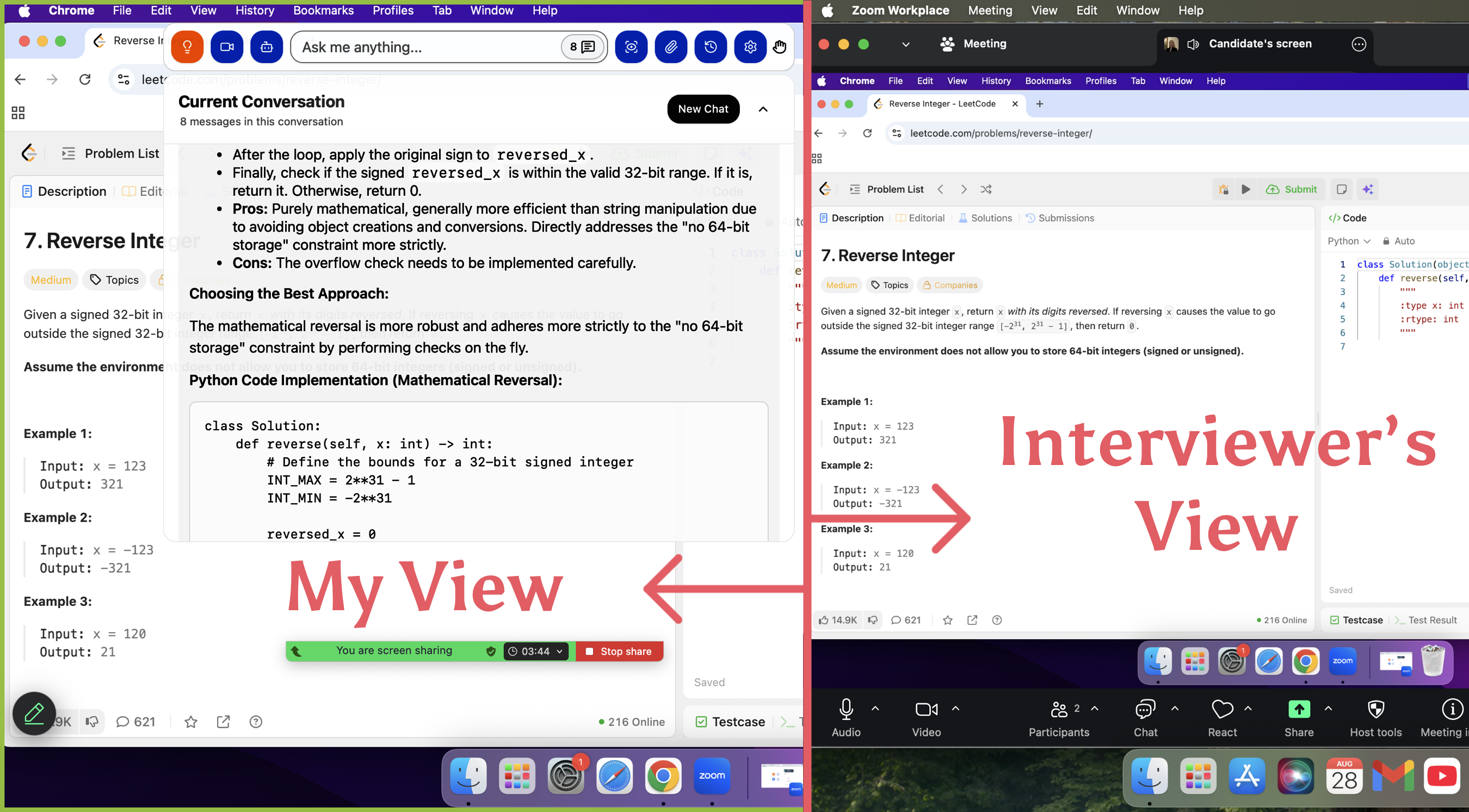
Linkjob AI worked great and I got through my interview without a hitch. It's undetectable, and the interviewer did not find that I used it.
Common Tesla Software Engineer Interview Technical Questions
The following real questions are provided as a supplement for technical questions.
Bitwise Operations & Math
1. XOR Product:
// Compute XOR of all integers from M to N (inclusive).
// Efficient implementation for M, N ∈ [0, 1e9]
2. Macro Definition:
#define C_TO_F(degC) ((degC) * 9 / 5 + 32)3. Bit Manipulation:
// Swap the highest bit in each nibble of an 8-bit integer.
void swapBits(uint8_t b);
Function Debugging & Implementation
1. Function Fix:
// Correctly compute (*x) * (*x)
uint16_t computeSquareADC(volatile uint8_t *x);
2. State Machine:
typedef enum { IDLE, READY, VENDING, FAULT } state_E;
typedef enum { COIN, COIN_RETURN, BUTTON, VEND_COMPLETE, GENERIC_FAULT } input_E;
// Implement vending machine state transitions
state_E updateStateMachine(input_E input);
3. Linear Interpolation:
// Given (x,y) arrays of size ARR_SIZE, return interpolated value.
// Return -1 if val is outside range.
float interpolate(float val);
SQL Problem
-- Find days where the stock price is a local maximum (greater than previous and next day)
SELECT day
FROM prices p
WHERE p.day > 1
  AND p.day < (SELECT MAX(day) FROM prices)
  AND p.price > (SELECT price FROM prices WHERE day = p.day - 1)
  AND p.price > (SELECT price FROM prices WHERE day = p.day + 1)
ORDER BY p.day ASC;
OpenAPI Specification Fix
# Corrected OpenAPI spec for orders endpoint (CRUD support)
openapi: 3.0.0
servers:
  - url: /api/v1
paths:
  /orders:
    get:
      responses:
        '200':
          description: Success
          content:
            application/json: {}
    post:
      responses:
        '201':
          description: Created
          content:
            application/json: {}
  /orders/{id}:
    get:
      responses:
        '200':
          description: Success
          content:
            application/json: {}
        '404':
          description: Not Found
    put:
      responses:
        '200':
          description: Updated
          content:
            application/json: {}
        '400':
          description: Bad Request
        '404':
          description: Not Found
    delete:
      responses:
        '204':
          description: No Content
        '404':
          description: Not Found
Common Tesla Software Engineer Interview Behavioral Questions and Answers
When reviewing a team member’s code, what do you consider most important?
Answer Approach: Emphasize the collaborative nature of code reviews, focusing on functionality, quality assurance, and constructive feedback.
Sample Answer: “I view code review as a process for collaborative improvement rather than just criticism. First, I ensure the code meets functional requirements and project standards to achieve the intended goals. Next, I look for potential issues, such as implementation choices that may affect scalability. Finally, when providing feedback, I focus on being constructive—discussing coding choices, alternative solutions, and best practices—creating an atmosphere where the team can grow together.”
How do you communicate and resolve disagreements when a colleague disagrees with your solution?
Answer Approach: Use a concrete example to demonstrate open communication, active listening, and collaborative problem-solving.
Sample Answer: “In a previous project, I suggested a microservices architecture to improve scalability, but a colleague was concerned about complexity and learning costs. I organized a team meeting to listen to everyone’s concerns, then proposed a design workshop where each person presented their preferred architecture. By collectively evaluating the pros and cons of each approach, we reached a compromise that balanced scalability and complexity, retaining the core advantages of microservices while simplifying the initial implementation.”
Have you encountered system scalability issues in past projects? How did you solve them?
Answer Approach: Clearly identify the cause, describe concrete solutions, and summarize lessons learned.
Sample Answer: “In a project I managed, a surge in users caused increased data volume and load, leading to system lag. We identified the core issues—inefficient database queries and no caching mechanism. First, we optimized database indices and queries to reduce redundant operations. Then, we introduced caching for frequently accessed data. Finally, we migrated some components to scalable cloud services to dynamically adjust resources. This experience taught me to consider scalability during initial design to avoid reactive fixes later.”
How do you manage multiple deadlines to ensure work progresses in an orderly manner?
Answer Approach: Explain logic for prioritization, combine with tools and methodologies, and emphasize breaking tasks into manageable units.
Sample Answer: “I prioritize tasks based on project needs and dependencies, such as addressing critical bug fixes first to ensure system stability. In an Agile environment, I use Scrum to plan sprints, clarify user stories, and estimate workloads, tracking progress via the sprint board. I rely on Git for version control and Jira for task management, breaking complex tasks into smaller units to ensure each is completed on time.”
Which project management tools have you used, and how did they support project delivery?
Answer Approach: List specific tools and explain how their features applied to project scenarios.
Sample Answer: “I have primarily used Jira and Trello. Jira is ideal for medium to large projects, allowing management of user stories, sprint tracking, and product backlog maintenance, with integrations to Bitbucket and Confluence for seamless development workflows. Trello suits smaller projects, providing visual task boards that make it easy to adjust priorities quickly. Both tools improve transparency and help ensure timely project delivery.”
Summary of the Tesla Software Engineer Interview Process
Resume Screening Round
Core Objective: Recruiters assess whether a candidate’s skills and experience match the job requirements.
Preparation Tips: Carefully review the job description and tailor your resume and cover letter to highlight experiences relevant to the role.
Online Assessment Round
Assessment Content: Complete a timed set of coding problems focusing on data structures and algorithms, including arrays, linked lists, trees, graphs, stacks, and queues.
Format: Hands-on coding; candidates must write and submit code within the given time.
Phone Interview Round
First Round (with Recruiter): Review online assessment results, clarify details, and walk through your resume. Discuss the role’s responsibilities and expectations.
Second Round (with Hiring Manager, if applicable): Evaluate motivation for the role, behavioral questions, communication and teamwork skills, and how past challenges were handled.
Onsite Technical Interview Round
Format: Multiple sessions where candidates explain their thought process and code logic. Focus is on critical thinking and technical skills.
Session 1 (System Architecture Design): Design a system based on a given scenario. The goal is not an optimal solution but to evaluate the reasoning process.
Session 2 (Coding / Algorithms): Solve coding or data structure and algorithm problems on-site, explaining your thought process while coding.
Navigated Tesla Software Engineer Interview Strategies and Tips
Communicate Your Resume in Advance
Make sure you can clearly explain every project and technical detail
Prepare concise answers about your project contributions and the challenges you faced
Understand the Problem Before Coding
For online assessments or onsite interviews, confirm the requirements and boundary conditions first
If a question is unclear, clarify assumptions with the interviewer
Clearly Demonstrate Your Thought Process
While coding, verbally explain your logic, time complexity, and edge cases
Solve problems step by step, especially for system design questions
Manage Your Time
A 90-minute online assessment may cover multiple problems; prioritize getting the core logic correct before optimizing
Behavioral Interviews
Use the STAR method (Situation, Task, Action, Result) to structure your answers
Emphasize teamwork, communication skills, and your approach to solving real problems
FAQ
What are some LeetCode problems you’d recommend practicing?
I recommend practicing problems like 227, 611, 56, 1117, 200, 41, 53, 121, 128, and 207. I picked these because I saw them mentioned in other candidates’ interview experiences. They’re all real questions that have been asked before.
Which programming language should I use for Tesla’s coding assessment?
Python is strongly recommended. It’s officially required for the online assessment, and it allows you to implement solutions quickly. Using other languages may make it difficult to complete all problems within the time limit.
See Also
How to Cheat HackerRank Tests With AI: My 2026 Update
The 2026 OpenAI Coding Interview Question Bank I've Collected
© Copyright 2025 Linkjob.ai - All Rights Reserved.