How I Passed My 2026 FloCareer Interview


When my first FloCareer interview invitation arrived on behalf of an enterprise engineering hiring team, my initial reaction was surprise—why was an external domain (flocareer.com) hosting my first-round technical screen instead of the company's own engineering manager? Over 700 global enterprises, technology leaders, and Global Capability Centers (GCCs)—including Deutsche Bank, American Airlines, Volkswagen Group Digital Solutions, Amdocs, Wipro, Siemens, Nike, HDFC Bank, and Turing—now outsource first- and second-round technical evaluations to FloCareer's Interview-as-a-Service (IaaS) platform. Depending on which link lands in your inbox, you face either NIVO (FloCareer's 20-to-45-minute voice-led conversational AI interviewer) or a live 45-to-60-minute structured video round led by a vetted freelance FloExpert with 10+ years of industry experience.
Knowing whether your invite routes to NIVO AI or a live human FloExpert shapes every hour of your preparation. Unlike silent coding tests where only final green checkmarks count, FloCareer grades conversational code ownership: NIVO tracks whether you explain trade-offs aloud while writing code (flagging long silences followed by sudden leaps in code complexity, or candidates who cannot walk through logic they just typed), while human FloExperts score every skill tag on a standardized rubric audited by an independent Quality Governance reviewer within 22 to 24 hours. That structured third-party scorecard model feels very close to what I experienced during my 2026 Walmart Karat assessment, with dedicated anti-proxy proctoring layered on top.
Because FloCareer's Smart and Automated Proctoring combines government photo ID verification, 360-degree webcam room scans, eye-gaze and lip-sync computer vision, audio whisper detection, and browser tab and clipboard tracking, I kept my testing computer 100% physically isolated during proctored sessions with Linkjob AI in Dual-Device Mode: my AI glasses photographed each prompt directly off the monitor, my phone's mobile webpage displayed the structured answer 1 inch below my webcam lens, and my laptop ran zero Linkjob AI desktop software—leaving zero local processes, zero overlays, and zero browser focus shifts (while reserving Desktop Floating Window Mode strictly for unproctored practice and compatible external video calls). Below is my complete 2026 breakdown of every FloCareer interview track, five 100% original, runnable Python 3 and SQL solutions with unit tests, my microservice verbal rubric notes, and how to close the client hiring manager round that follows.
Every FloCareer Interview Format in 2026 (NIVO AI vs. Live FloExpert Panel)
Founded in 2018, FloCareer has powered over 1,000,000 structured interviews across 600+ technical and functional skill combinations. Before clicking your single-sign-on room link, inspect your invitation email to identify which of three active tracks your target employer selected:
Track 1 — NIVO Conversational AI Screening & AI Coding Interview (20 to 45 Minutes, 24/7 On-Demand): Instead of recording static one-way video clips, you speak in real time with NIVO, FloCareer's voice-led AI interviewer. NIVO asks role-specific architecture or debugging prompts, parses your spoken reasoning via speech recognition, and asks dynamic, adaptive follow-up questions probing edge cases in what you just explained. When NIVO transitions into the embedded coding editor, you write and execute working code while thinking aloud; within minutes of submission, NIVO generates an automated scorecard covering your verdict, video recording, transcript, per-skill ratings, and proctoring risk findings.
Track 2 — Expert-Led Interview-as-a-Service (Live FloExpert Video Round, 45 to 60 Minutes): Conducted live by one of FloCareer's 8,000+ vetted external industry practitioners (FloExperts)—senior developers and architects with 10+ years of domain experience matched to your exact stack (Java and Spring Boot, Python and FastAPI, React and Node.js, Cloud and DevOps, Data Engineering, or QA Automation). Expect roughly 3 minutes for photo ID verification, 15 to 18 minutes of rapid-fire conceptual scenarios across 3 to 4 mandatory skill buckets, 25 to 30 minutes of live coding plus SQL or system design inside FloCareer's browser IDE and whiteboard, and 5 minutes wrap-up—mirroring the bank-grade outsourced rubric I navigated on my 2026 Citi Karat assessment. Across FloCareer's published GCC case studies for Deutsche Bank, American Airlines, and Volkswagen Group Digital Solutions, 60% to 67% of evaluated candidates advance to the client's internal hiring manager round, with audited scorecards delivered in roughly 22 hours.
Track 3 — Pre-Screen Chatbot & Skills Warm-Up (10 to 25 Minutes): High-volume staffing and campus drives occasionally prepend an automated chatbot check (confirming years of experience, notice period, location preferences, and primary stack) or a short multiple-choice and coding warm-up before unlocking NIVO or a scheduled FloExpert slot.
How FloCareer Proctoring & 100% Quality Governance Auditing Work
FloCareer built its enterprise footprint across banking, aviation, automotive, and IT consulting specifically around anti-fraud and anti-proxy enforcement. Keep all five integrity layers front of mind before joining your session:
Adaptive Government ID & Biometric Face Matching: At room entry, FloCareer matches your live webcam frame against your government photo ID and candidate profile to block proxy stand-ins, and checks facial continuity throughout the recording.
Eye-Gaze, Head-Pose & Lip-Sync Computer Vision: FloCareer's computer-vision pipeline flags sustained off-axis eye gaze (glancing sideways toward a secondary laptop or monitor), lip-sync audio latency mismatches (mouthing answers spoken by an off-camera helper), and extra faces entering the background, while high-security links also prompt a brief 360-degree webcam room scan.
Context-Aware Screen, Tab & Clipboard Tracking: Opening external browser tabs, launching browser developer tools, or pasting multi-line external code blocks triggers timestamped risk alerts on the proctoring timeline—screen-monitoring boundaries worth comparing against my guide on whether HireVue records your screen.
Conversational Code-Ownership Auditing (NIVO's Signature Signal): FloCareer explicitly documents that its AI coding engine flags extended silence during major code edits as well as abrupt jumps in code sophistication when a candidate cannot clearly explain why they chose a given data structure or how their loop handles boundary inputs.
Mandatory Post-Interview Human Quality Governance Review: Even after a live FloExpert submits positive ratings, an independent FloCareer Quality Governance auditor reviews your recorded video, transcript quotes, proctoring risk score, and rubric alignment before releasing the final report to the hiring company.
5 Representative FloCareer Interview Questions (With Clean-Room Python 3 & SQL Solutions)
Unlike Big Tech puzzle screens that test obscure bit tricks, FloCareer's enterprise question pool focuses on production backend reliability, microservice dependencies, rate limiting, analytical SQL, and telemetry parsing. Every problem below is 100% original, clean-room Python 3 (including SQLite-verified SQL) with runnable assert unit tests so you can practice coding and narrating simultaneously.
1. Idempotent Payment Webhook Deduplicator With Sliding TTL Window (20 Minutes)
Why Banking & Fintech GCC Panels Love This Problem: Across financial enterprise clients (such as Deutsche Bank or retail banking microservices), interviewers ask you to process incoming webhook deliveries carrying an event ID, arrival timestamp in seconds, and integer cent amount where upstream gateways retry unacknowledged payloads—requiring you to accept each unique event ID at most once within a rolling TTL window while evicting expired keys so memory never leaks across millions of daily webhooks.
Clean O(1) Amortized Design: Pair a double-ended queue of expiration-timestamp and event-ID tuples with an active dictionary mapping each live event ID to its expiration timestamp. Evicting expired entries from the front of the queue on each incoming call keeps both lookup time and memory strictly bounded.
from collections import deque


class WebhookDeduplicator:
    """
    Processes at-least-once webhook deliveries idempotently within ttl_sec
    in O(1) amortized time and O(W) bounded memory.
    """

    def __init__(self, ttl_sec: int = 300) -> None:
        self.ttl_sec = ttl_sec
        self.active_expiry: dict[str, int] = {}
        self.expiry_queue: deque[tuple[int, str]] = deque()
        self.net_processed_cents: int = 0

    def _evict_expired(self, now_sec: int) -> None:
        while self.expiry_queue and self.expiry_queue[0][0] <= now_sec:
            exp_ts, eid = self.expiry_queue.popleft()
            if self.active_expiry.get(eid) == exp_ts:
                self.active_expiry.pop(eid, None)

    def process_event(self, event_id: str, now_sec: int, amount_cents: int) -> bool:
        self._evict_expired(now_sec)
        if event_id in self.active_expiry:
            return False

        exp_ts = now_sec + self.ttl_sec
        self.active_expiry[event_id] = exp_ts
        self.expiry_queue.append((exp_ts, event_id))
        self.net_processed_cents += amount_cents
        return True


def test_webhook_deduplicator() -> None:
    dedup = WebhookDeduplicator(ttl_sec=60)
    assert dedup.process_event("evt_101", now_sec=10, amount_cents=2500) is True
    assert dedup.process_event("evt_101", now_sec=45, amount_cents=2500) is False
    assert dedup.net_processed_cents == 2500
    assert dedup.process_event("evt_101", now_sec=70, amount_cents=1500) is True
    assert dedup.net_processed_cents == 4000
2. Microservice Deployment Wave Planner With Cycle Diagnostics (Kahn's BFS, O(V + E)) (25 Minutes)
Returning Parallel Rollout Waves Instead of a Flat Order: Cloud and platform FloExperts regularly ask: given a list of microservice names and prerequisite pairs where a service depends on an upstream database or cache, group all services into minimum sequential deployment waves so every service inside the same wave can launch concurrently once prior waves pass health checks—returning an empty list immediately if a circular dependency blocks deployment. Sorting each wave alphabetically keeps unit tests 100% deterministic.
def plan_deployment_waves(
    services: list[str],
    dependencies: list[tuple[str, str]],
) -> list[list[str]]:
    """
    dependencies: pairs of (service, prerequisite_service).
    Returns deterministic parallel deployment waves, or an empty list on cycle.
    """
    adj: dict[str, list[str]] = {s: [] for s in services}
    indeg: dict[str, int] = {s: 0 for s in services}

    seen_edges: set[tuple[str, str]] = set()
    for svc, prereq in dependencies:
        if svc not in indeg:
            indeg[svc] = 0
            adj[svc] = []
        if prereq not in indeg:
            indeg[prereq] = 0
            adj[prereq] = []
        if (prereq, svc) not in seen_edges:
            seen_edges.add((prereq, svc))
            adj[prereq].append(svc)
            indeg[svc] += 1

    ready = sorted(s for s, deg in indeg.items() if deg == 0)
    waves: list[list[str]] = []
    deployed_count = 0

    while ready:
        waves.append(ready)
        deployed_count += len(ready)
        next_ready: list[str] = []
        for u in ready:
            for v in adj[u]:
                indeg[v] -= 1
                if indeg[v] == 0:
                    next_ready.append(v)
        ready = sorted(next_ready)

    return waves if deployed_count == len(indeg) else []


def test_deployment_waves() -> None:
    svcs = ["api-gw", "auth", "billing", "postgres", "redis"]
    deps = [
        ("auth", "postgres"),
        ("auth", "redis"),
        ("billing", "postgres"),
        ("api-gw", "auth"),
        ("api-gw", "billing"),
    ]
    assert plan_deployment_waves(svcs, deps) == [
        ["postgres", "redis"],
        ["auth", "billing"],
        ["api-gw"],
    ]
    assert plan_deployment_waves(["a", "b"], [("a", "b"), ("b", "a")]) == []
3. Multi-Tenant Token-Bucket API Rate Limiter With Zero Background Threads (20 Minutes)
What NIVO AI Probes in Follow-Up Questions: When building a per-tenant API rate limiter with a burst cap and steady per-second token refill rate, spawning a background timer thread per customer wastes thousands of operating-system threads, and binary floating-point math introduces rounding drift. Instead, store integer millitokens (1 token equals 1,000 millitokens) and compute lazy elapsed refill from the millisecond delta only when a tenant sends a request.
class LazyTokenBucketLimiter:
    """
    Exact integer-millitoken rate limiter (1 token = 1,000 millitokens)
    requiring O(1) state per tenant and zero background threads.
    """

    def __init__(self, burst_tokens: int, refill_tokens_per_sec: int) -> None:
        self.max_milli = burst_tokens * 1000
        self.refill_per_ms = refill_tokens_per_sec
        self.buckets: dict[str, tuple[int, int]] = {}

    def allow_request(self, tenant_id: str, now_ms: int, cost_tokens: int = 1) -> bool:
        need_milli = cost_tokens * 1000
        if need_milli > self.max_milli:
            return False

        if tenant_id not in self.buckets:
            avail_milli = self.max_milli
        else:
            prev_milli, last_ms = self.buckets[tenant_id]
            elapsed_ms = now_ms - last_ms if now_ms > last_ms else 0
            refilled = prev_milli + (elapsed_ms * self.refill_per_ms)
            avail_milli = self.max_milli if refilled > self.max_milli else refilled

        if avail_milli < need_milli:
            self.buckets[tenant_id] = (avail_milli, now_ms)
            return False

        self.buckets[tenant_id] = (avail_milli - need_milli, now_ms)
        return True


def test_lazy_token_bucket() -> None:
    limiter = LazyTokenBucketLimiter(burst_tokens=2, refill_tokens_per_sec=2)
    assert limiter.allow_request("t1", now_ms=0) is True
    assert limiter.allow_request("t1", now_ms=100) is True
    assert limiter.allow_request("t1", now_ms=300) is False
    assert limiter.allow_request("t1", now_ms=500) is True
4. Enterprise SQL Module: Top-2 Services Per Region With DENSE_RANK & Share Percentage (20 Minutes)
Why ROW_NUMBER vs. DENSE_RANK Is a Classic FloExpert Trap: Almost every Full-Stack, Backend, and Data Engineering FloCareer rubric includes a hands-on SQL competency task. When asked for the top 2 revenue tiers per region alongside each service's percentage share of regional revenue, windowing with DENSE_RANK partitioned by region preserves tied first-place services cleanly, while dividing by a partitioned regional SUM computes exact revenue share in one query pass.
import sqlite3


def top_regional_services_sql() -> list[tuple[str, str, float, int, float]]:
    conn = sqlite3.connect(":memory:")
    cur = conn.cursor()
    cur.executescript(
        """
        CREATE TABLE invoice_lines (
            region TEXT,
            service_name TEXT,
            amount_usd REAL
        );
        INSERT INTO invoice_lines VALUES
            ('NA',   'Cloud-Core', 500.0),
            ('NA',   'AI-Search',  500.0),
            ('NA',   'Data-Sync',  250.0),
            ('NA',   'Legacy-ETL', 100.0),
            ('EMEA', 'Cloud-Core', 600.0),
            ('EMEA', 'Sec-Vault',  400.0);
        """
    )

    query = """
    WITH svc_totals AS (
        SELECT
            region,
            service_name,
            SUM(amount_usd) AS svc_rev
        FROM invoice_lines
        GROUP BY region, service_name
    ),
    ranked AS (
        SELECT
            region,
            service_name,
            svc_rev,
            DENSE_RANK() OVER (PARTITION BY region ORDER BY svc_rev DESC) AS rnk,
            ROUND(svc_rev * 100.0 / SUM(svc_rev) OVER (PARTITION BY region), 2) AS reg_share_pct
        FROM svc_totals
    )
    SELECT region, service_name, svc_rev, rnk, reg_share_pct
    FROM ranked
    WHERE rnk <= 2
    ORDER BY region ASC, rnk ASC, service_name ASC;
    """
    rows = cur.execute(query).fetchall()
    conn.close()
    return rows


def test_flocareer_sql_ranking() -> None:
    out = top_regional_services_sql()
    assert out == [
        ("EMEA", "Cloud-Core", 600.0, 1, 60.0),
        ("EMEA", "Sec-Vault", 400.0, 2, 40.0),
        ("NA", "AI-Search", 500.0, 1, 37.04),
        ("NA", "Cloud-Core", 500.0, 1, 37.04),
        ("NA", "Data-Sync", 250.0, 2, 18.52),
    ]
5. Streaming Endpoint P95 Latency & Error-Rate SLA Auditor (20 Minutes)
Handling Nearest-Rank P95 & Dirty Log Rows: Production observability prompts give raw comma-separated endpoint, HTTP status code, and millisecond latency lines—including occasional blank or malformed entries—and ask for every endpoint breaching either a 5.0% server-error rate (HTTP status 500 and above) or nearest-rank P95 latency above the target SLA. Validating fields defensively before casting integers demonstrates senior production habits on your FloExpert scorecard.
import math


def audit_endpoint_slas(
    raw_lines: list[str],
    p95_sla_ms: int = 250,
    max_err_pct: float = 5.0,
) -> list[tuple[str, int, float]]:
    latencies: dict[str, list[int]] = {}
    err_5xx: dict[str, int] = {}

    for line in raw_lines:
        parts = line.strip().split(",")
        if len(parts) != 3:
            continue
        ep, code_s, lat_s = parts[0].strip(), parts[1].strip(), parts[2].strip()
        if not ep or not code_s.isdigit() or not lat_s.isdigit():
            continue
        code = int(code_s)
        lat = int(lat_s)
        latencies.setdefault(ep, []).append(lat)
        if code >= 500:
            err_5xx[ep] = err_5xx.get(ep, 0) + 1

    breaches: list[tuple[str, int, float]] = []
    for ep, lats in latencies.items():
        lats.sort()
        n = len(lats)
        p95_idx = max(0, math.ceil(0.95 * n) - 1)
        p95_val = lats[p95_idx]
        err_rate = round((err_5xx.get(ep, 0) * 100.0) / n, 2)
        if p95_val > p95_sla_ms or err_rate >= max_err_pct:
            breaches.append((ep, p95_val, err_rate))

    breaches.sort(key=lambda x: (-x[1], x[0]))
    return breaches


def test_sla_auditor() -> None:
    logs = [
        "/v1/pay,200,120",
        "/v1/pay,503,410",
        "corrupted_row_without_commas",
        "/v1/health,200,15",
        "/v1/health,200,20",
    ]
    assert audit_endpoint_slas(logs, p95_sla_ms=250, max_err_pct=5.0) == [
        ("/v1/pay", 410, 50.0)
    ]
My FloCareer Verbal Rubric & Microservice Follow-Up Cheat Sheet
Because FloExperts attach timestamped quote evidence to each 1-to-5 skill rating so Quality Governance approves the report, deliver crisp 60-second answers across these five high-frequency verbal segments:
REST API Idempotency (GET, PUT, and DELETE vs. POST With Idempotency-Key): Explain clearly why PUT (full state replacement) and DELETE are naturally idempotent on server state, whereas retrying a timed-out POST payment request requires a client-generated UUID Idempotency-Key persisted inside the same database transaction as the ledger row.
Composite Database Indexing & N + 1 ORM Query Bottlenecks: Walk through leftmost-prefix B+Tree indexing rules (a composite index on status and created_at accelerates queries filtering on status first, never queries filtering on created_at alone) and show how eager batch fetching collapses hundreds of lazy-loaded ORM round-trips into two queries.
Distributed Transactions (Saga Pattern + Transactional Outbox): Avoid proposing distributed two-phase commit locks across independent microservices. Recommend Choreographed or Orchestrated Sagas with explicit compensating actions (releasing reserved inventory when payment authorization fails) paired with a Transactional Outbox table so relational commits and Kafka events stay atomic.
Stateless JWT Access Tokens vs. Rotatable Refresh Tokens: Keep access JWT lifetimes short (5 to 15 minutes) verified via asymmetric public keys at the API Gateway, backed by HttpOnly, Secure rotatable refresh tokens so compromised sessions can be revoked centrally without hitting the user database on every internal service hop.
Narrating While Coding (Clearing NIVO's Silent-Jump Check): Follow a repeatable three-step rhythm on every coding prompt: state the brute-force baseline and why it misses scale targets in 15 seconds, announce your optimal data structure and Big-O time and memory bounds in 20 seconds, and introduce each helper block aloud right before typing it so your voice transcript and keystroke playback align seamlessly.
How I Use Linkjob AI Across Practice & Proctored FloCareer Sessions
Matching your setup to FloCareer's computer-vision, browser-focus, and screen telemetry keeps your session integrity report completely clean:
Dual-Device Mode for Proctored NIVO, Desktop Clients & LockDown Browser Rooms: Whenever I join a proctored FloCareer interview room—or any environment guarded by full-screen monitoring, desktop proctoring clients, process scanners, or LockDown Browser—I rely on Linkjob AI in Dual-Device Mode for complete hardware-level physical isolation. My testing computer runs zero Linkjob AI software—no desktop client installed or active in the background, zero local processes, zero screen-capture hooks, and zero on-screen UI. Instead, my AI glasses capture the coding or architecture prompt directly from my point of view, and the AI-generated talking points and Big-O breakdown stream straight to my phone's mobile webpage resting on a low stand 1 inch directly below my webcam lens. Because nothing runs on the host computer, my session logs 0 laptop hotkeys, 0 window.onblur focus exits, and 0 clipboard paste events while I keep natural eye-level camera alignment, explain every step in my own words, and type code manually.
Desktop Floating Window Mode for Unproctored Practice & Compatible Client Calls: During untimed mock coding drills (or subsequent direct-client video rounds where Zoom desktop has its one-time "Advanced Capture with Window Filtering" enabled beforehand), Desktop Floating Window Mode keeps concise architecture reminders right beside my workspace. Whenever an active browser assessment room is open, finish 100% of configuration before opening the interview link, never open Linkjob AI Settings mid-session, and never press Cmd + Backslash or Ctrl + Backslash during the live session.
What Comes After Your FloCareer Interview (22-Hour Report to Client Offer)
Understanding how enterprise hiring managers read your FloCareer scorecard helps you close the final internal rounds—often just one or two conversations:
Stage 2 — Quality-Audited Scorecard Delivery (22 to 24 Hours): Your FloExpert or NIVO compiles an overall hiring recommendation (Strong Hire, Hire, Borderline, or No Hire), granular per-skill scores (for example, Python 4/5, Microservices 4.5/5, SQL 4/5), runnable code snapshots, proctoring clearance status, and timestamped video highlights for the client hiring team.
Stage 3 — Client Hiring Manager Deep Dive (45 to 60 Minutes): Because FloCareer already validated your hands-on coding and SQL fluency, most GCCs and enterprise teams skip repetitive algorithm screens—referencing one or two takeaways from your FloCareer report while probing production ownership, squad architecture, and team communication fit before HR extends a formal offer.
Pre-Flight Checklist Before Joining Your FloCareer Room
Stage Your Government Photo ID & Clear Your Desk: Keep your driver's license, passport, or national ID within reach for the opening identity check, and clear paper notes or secondary laptops completely out of 360-degree camera view.
Run a Single Monitor & Quit Notification Apps: Unplug external displays, close Slack, WhatsApp, and Discord, and avoid opening external browser tabs mid-session unless your FloExpert explicitly invites you to check documentation.
Verify Headset Microphone Clarity for NIVO Voice AI: Use a wired or low-latency headset in a quiet room so NIVO's speech-to-text model transcribes technical terms like idempotency, DENSE_RANK, and topological sort cleanly without background echo triggering whisper flags.
Cap Conceptual Answers at 60 to 90 Seconds: Rambling five minutes per theory question starves your 25-minute live coding block—lead with the core architectural principle, give one production metric, and let your FloExpert move smoothly through every rubric competency.
Frequently Asked Questions About the FloCareer Interview
Why is FloCareer interviewing me instead of the company I applied to?
Over 700 enterprises and Global Capability Centers—including Deutsche Bank, American Airlines, Volkswagen Group Digital Solutions, Amdocs, Wipro, and Siemens—use FloCareer's Interview-as-a-Service (IaaS) platform so external senior engineers (FloExperts) or NIVO AI can conduct standardized, unbiased first-round technical screens without bottlenecking internal engineering sprints.
Will my FloCareer interview be with an AI bot (NIVO) or a live human engineer?
Check your invitation email closely. On-demand invitations with a multi-day completion window ("complete anytime within 48 or 72 hours") typically launch NIVO, FloCareer's 20-to-45-minute voice-led conversational AI and coding interviewer. Fixed calendar bookings (45 to 60 minutes at a scheduled slot) connect you live over video with a human FloExpert who has 10+ years of hands-on domain experience.
How strict is FloCareer proctoring during coding and video rounds?
Very thorough. Depending on client settings, FloCareer layers photo ID biometric matching, continuous eye-gaze, head-pose, and lip-sync computer vision, overlapping-voice and whisper audio detection, browser tab-switch and external clipboard tracking, and NIVO's conversational code-ownership checks that flag silent code jumps a candidate cannot explain aloud.
How fast do companies get my FloCareer interview results?
NIVO AI interviews generate transcripts, skill scores, and proctoring verdicts within minutes of submission, while live FloExpert scorecards pass through FloCareer's 100% human Quality Governance audit in an average 22 to 24 hours—so client recruiters typically follow up within 2 to 5 business days.
If I pass the FloCareer interview, how many rounds are left?
Because FloCareer replaces the employer's L1 (and often L2) technical screen, passing FloCareer usually leaves just 1 to 2 internal rounds before an offer—most commonly a 45-to-60-minute Client Hiring Manager and Architecture Fit conversation followed by HR compensation alignment.
Why People Choose Linkjob AI
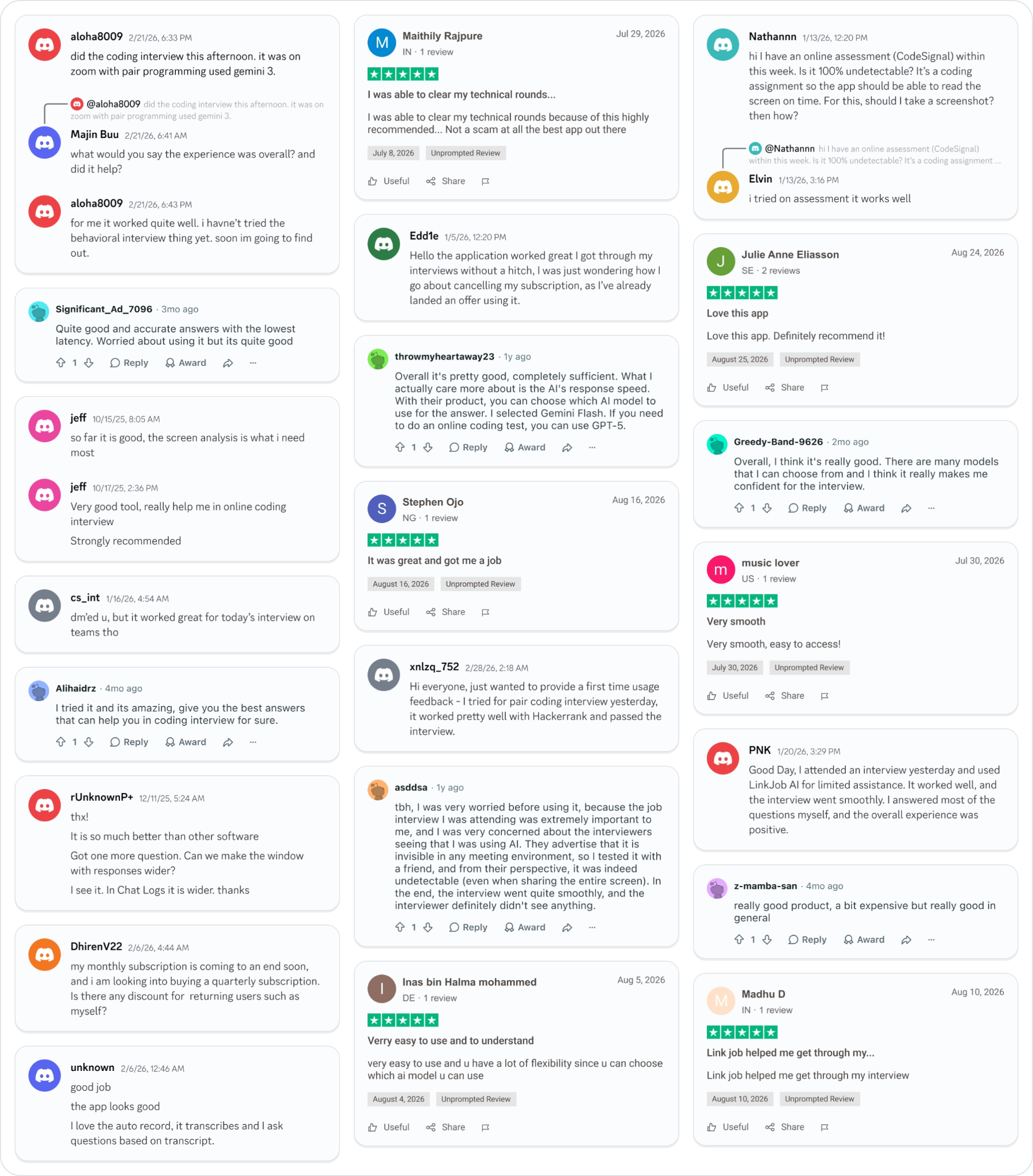
Smoother interviews, coding challenges cleared, and job offers landed. See how users describe their experience with Linkjob AI—in their own words.

© Copyright 2026 Linkjob AI - All Rights Reserved.