How I Use AI Interview Tool to Pass Glider AI Test in 2026


From what I can remember, people tried using Glider AI's assessments around four or five years back. At the time, there weren't many platforms offering AI-based assessments, so it got pretty much slammed by the critics. But still, people were asking everywhere: how to cheat on Glider AI tests?
But I recently took a Glider AI test myself and, with its AI proctoring enabled, managed to pass easily using Linkjob AI, a real-time AI interview assistant.
I've also used AI interview tools to help me cheat on HackerRank assessments, and I found some cheating tools that can bypass detection in Google Meet. If the online assessment you're taking is hosted on another OA platform, you might also be interested in my Codersignal cheating guide.
How to Cheat and Pass Glider Tests: Understanding the Platform
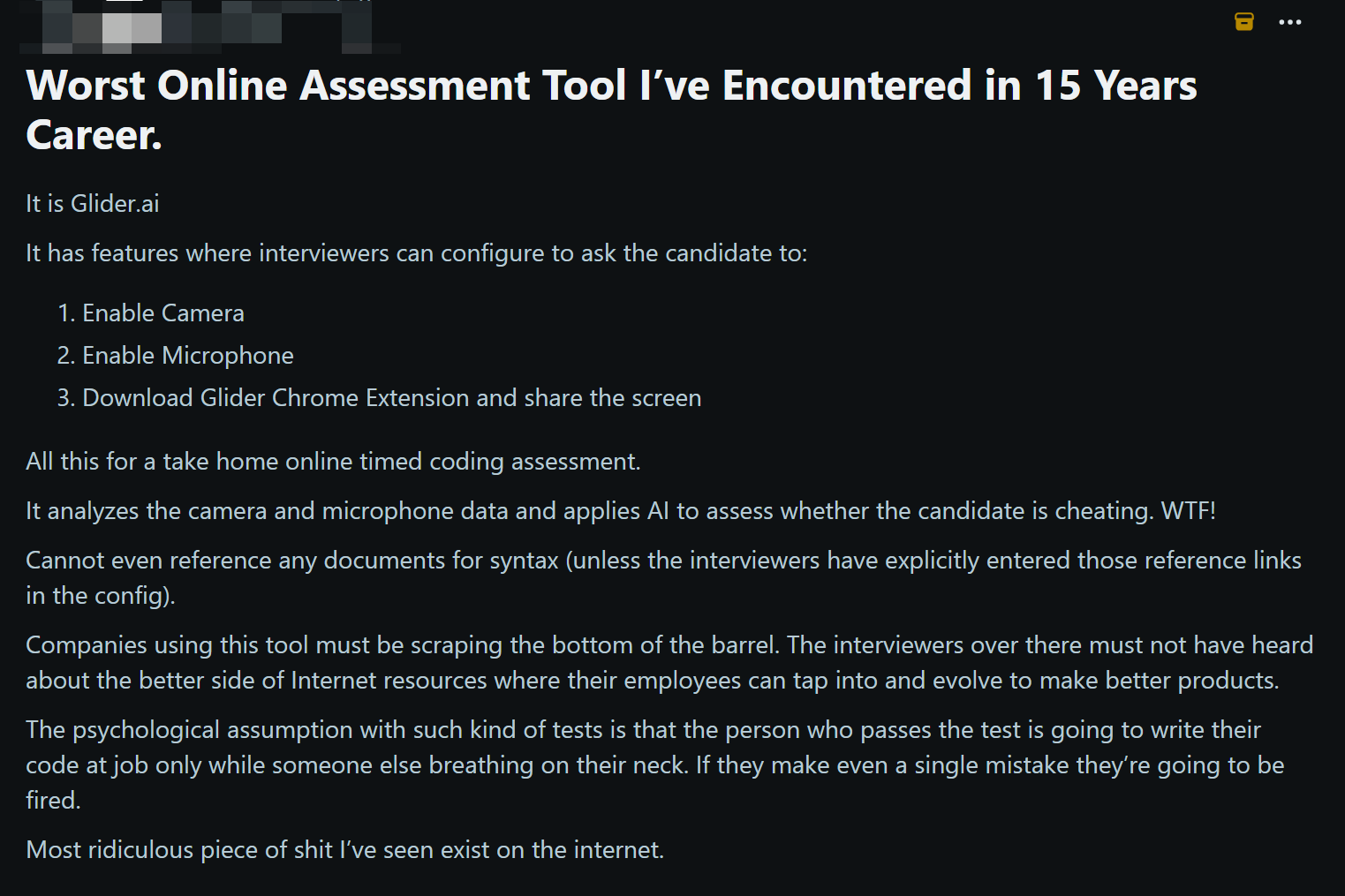
Before taking a Glider test, I actually checked out the official website just to understand how their anti-cheating system works and what the setup feels like in a real interview. A lot of people searching how to cheat on Glider are basically trying to figure out what the platform is even capable of detecting in the first place.
Honestly, Glider AI doesn’t go super deep into explaining everything in plain language. Most of the details are scattered across blog posts or documentation, so you kind of have to piece things together yourself.
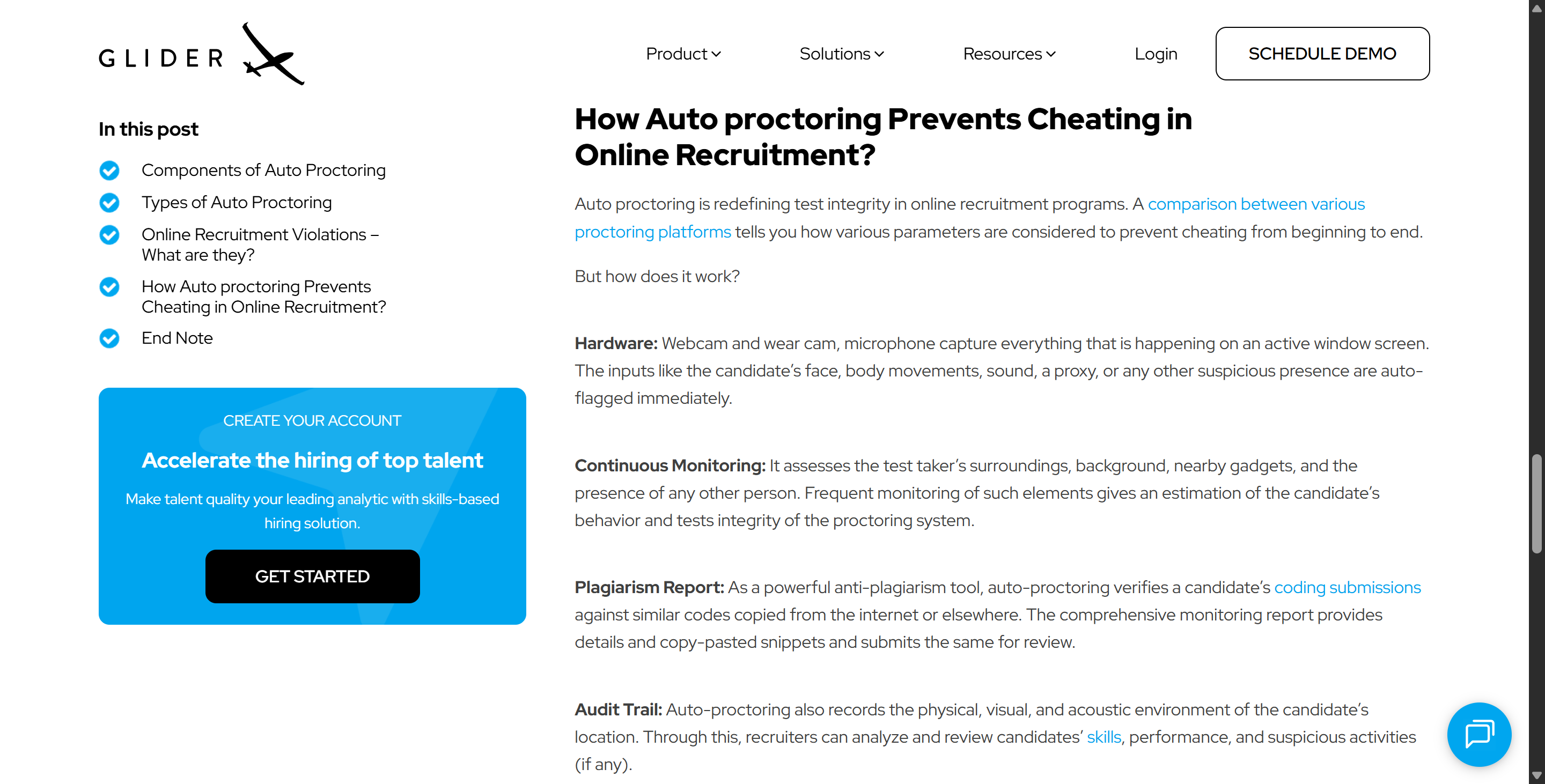
From what I found, Glider AI’s monitoring system is usually described in a few main categories:
Identity verification: checking whether the candidate is actually the right person taking the test
Audio and video monitoring: using webcam and microphone signals during the assessment
Screen and browser restrictions: limiting things like full-screen exit or unusual browser activity
Device-based signals: detecting environment or device-level inconsistencies
AI behavior analysis: using automated systems to identify unusual interaction patterns during the test
When people search how to cheat on Glider, what they’re usually really curious about is how strict these layers are and what kind of behavior gets flagged. In practice, it’s less about a single “rule” and more about multiple signals being combined together.
And yeah, it definitely has that “modern AI hiring system” vibe—less like a simple online quiz and more like a full monitoring setup that’s trying to understand context rather than just answers.
So instead of thinking in terms of how to cheat on Glider, it makes more sense to understand how the system is structured and what kind of testing environment you’re walking into before the interview starts.
Identity Verification
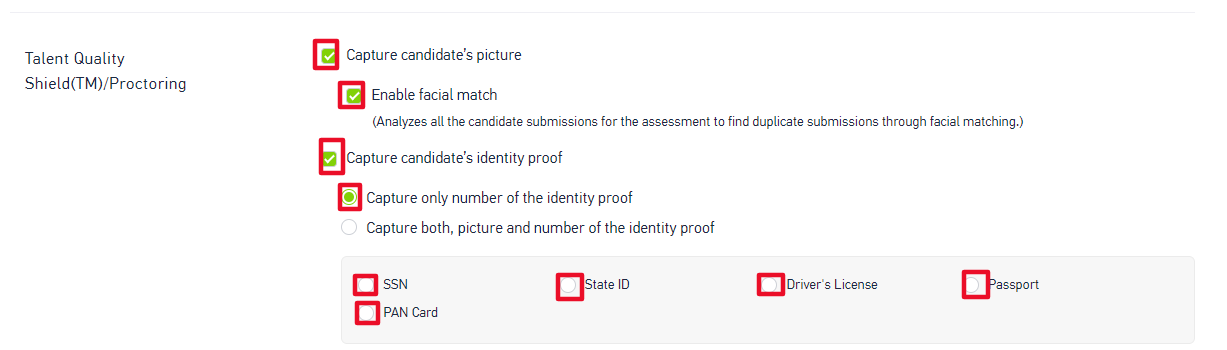
The ID verification process usually has three steps. Interviewers usually set these settings in advance via the config menu, but some companies skip this step and go straight to the interview. For my test, these were the steps I took:
Candidate Photo Capture: Before we begin, the platform will take a baseline photo of me to act as a reference for the whole assessment.
Facial comparison: AI compares my current facial features with historical records and the baseline photo to make sure that nobody is trying to impersonate someone else or using a proxy.
Identification verification: You'll need to upload a government ID or enter your ID information to prove who you are.
Audio & Video Monitoring
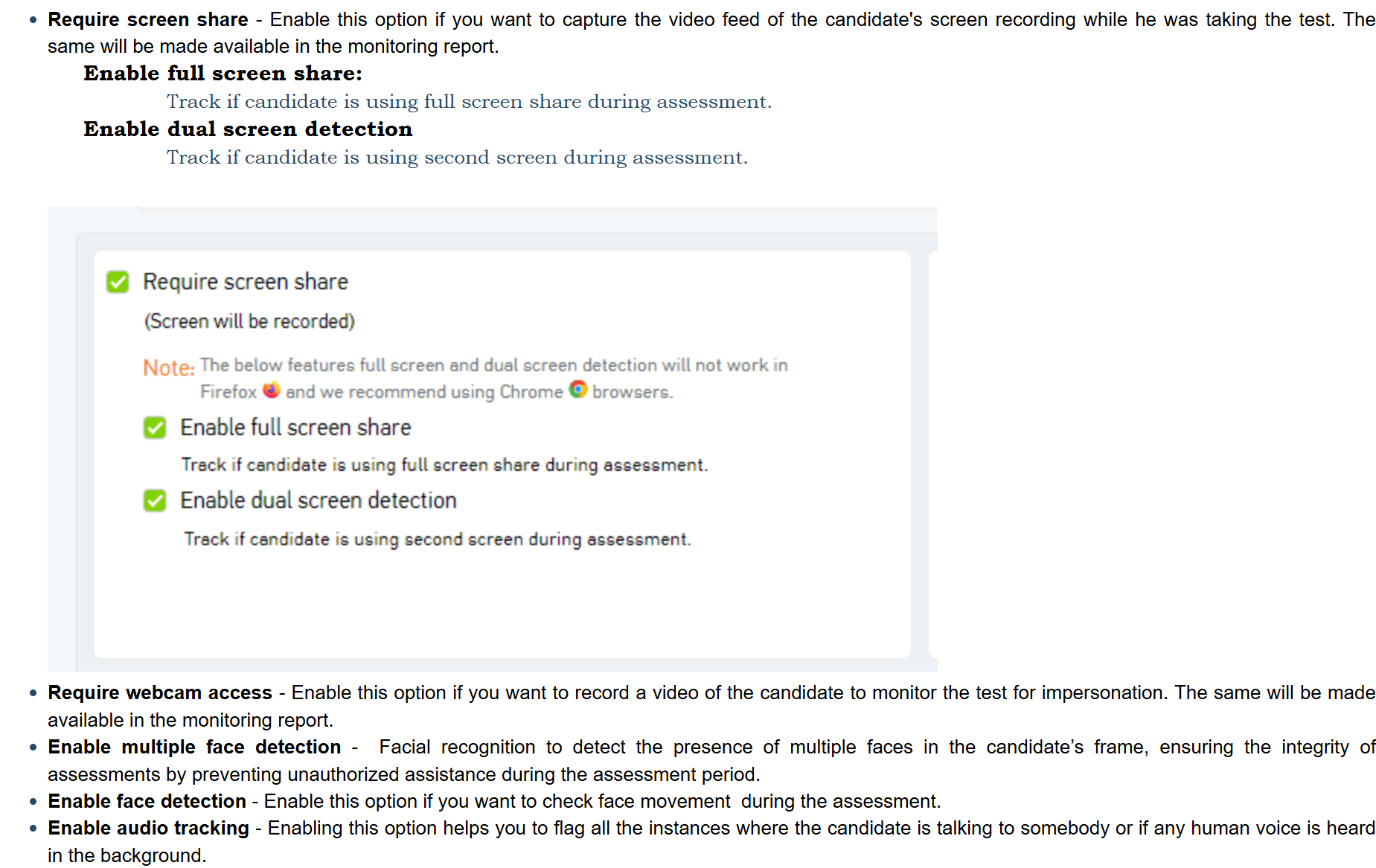
When I was testing, I was told about at least three ways it can detect things:
Webcam access: Keep on recording the candidate's video feed during the interview to make sure they aren't being helped.
Facial and eye tracking: Keep an eye on the candidate's head movements and where they're looking to see if they're checking their notes or chatting with someone.
Audio Monitoring: It'll also monitor background noise in real time to spot when people are whispering to each other or just talking, which could provide clues or answers.
Apparently, Glider AI can also do multi-face detection, which means that if there's more than one person in the frame, the AI will automatically let the interviewer know. I haven't personally come across this feature yet, though.
Screen & Browser Restrictions during Glider AI Test
The interviewer didn’t really walk through every setting in detail, but during the Glider AI assessment setup, I did notice some pretty standard things like full-screen mode enforcement and screen sharing requirements. A lot of people searching how to cheat on Glider are usually trying to figure out what kind of monitoring is actually running in the background when the test starts.
From what I could tell based on the interface behavior, there were also signals like tab switching detection and clipboard or copy-paste tracking. It wasn’t super obvious on the UI, but it felt like these checks were running quietly in the background during the whole assessment.
When I checked some setup documentation, these features are usually described as part of a broader online assessment framework:
Screen sharing and session recording: candidates may need to share their screen so the session can be reviewed later for integrity checks
Full-screen mode enforcement: the system may track whether you stay in full-screen during the test window
Multi-monitor detection: some setups can identify if extra displays are connected
Browser activity tracking: basic interaction data like navigation behavior or copy-paste events may be logged
Tab switching monitoring: excessive switching between tabs may be flagged as unusual behavior
When people search how to cheat on Glider, what they’re often really trying to understand is how strict these layers are and what actually gets flagged during a real test. In reality, it’s less about one single feature and more about multiple signals working together in the background.
From a bigger-picture view, platforms like Glider AI are basically moving toward multi-layer assessment systems instead of simple online quizzes. So if you see content about how to cheat on Glider online, most of it misses the point of how these systems actually combine different monitoring signals to evaluate test integrity.
Cross-device and environment monitoring in modern assessments
One interesting direction in AI-based assessment platforms is cross-device awareness. A lot of people searching how to cheat on Glider are basically trying to understand whether the system only relies on webcam monitoring or if it goes beyond that.
Instead of relying on just a single webcam feed, some systems combine multiple signals to get a more complete view of the testing environment. It’s less about “watching you” in one way and more about connecting different data points together in real time.
In general, these approaches are designed to reduce technical inconsistencies during remote assessments and keep the testing experience standardized across all candidates, no matter where they are or what setup they use.
AI-based behavioral and code evaluation
Glider AI and similar platforms also use automated analysis tools to evaluate coding assessments and candidate behavior patterns. When people search how to cheat on Glider, they’re often actually trying to figure out what kinds of signals might be analyzed during a test.
These systems are usually not about one single check, but more about combining different evaluation layers. The goal is to improve consistency in assessment results while still keeping human reviewers involved in the final decision.
Common categories include:
Candidate authentication signals: helps confirm that the same person is completing the test from start to finish
Code similarity analysis: compares submitted solutions with known patterns or external sources as part of plagiarism detection systems
Behavioral pattern analysis: looks at interaction signals like typing rhythm, navigation flow, and general test behavior to support evaluation consistency
Overall, platforms like Glider AI are part of a broader shift toward AI-assisted hiring systems. So when people search how to cheat on Glider, what they’re really encountering is a much bigger ecosystem where structured assessments rely on both automated signals and human review to improve fairness and reliability.
My Cheating Methods During Glider AI Tests
How I Cheated with Linkjob AI using ChatGPT
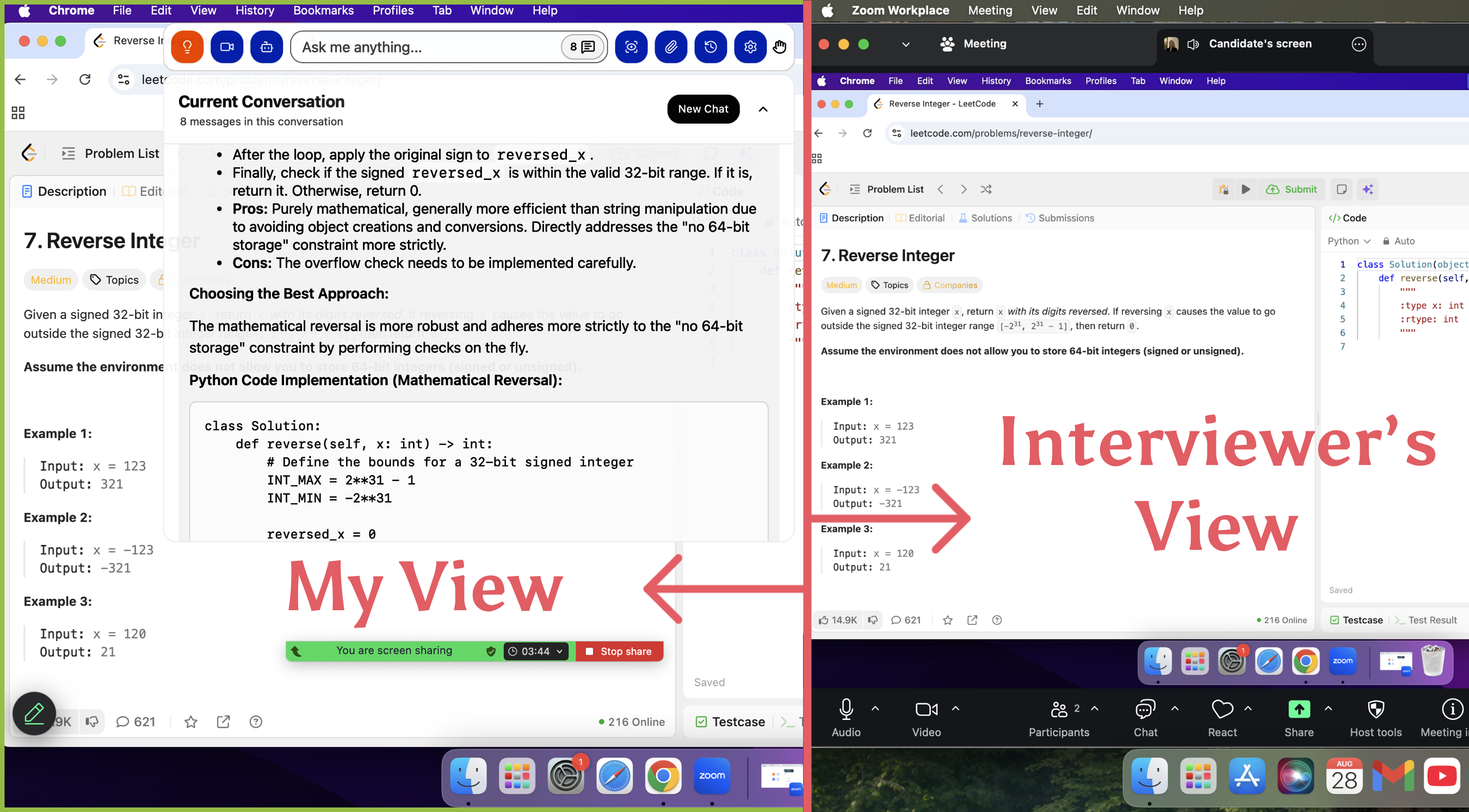
As I said before, I was asked to share my full screen, so I needed an AI that wouldn't be in the Dock, could be got at in real time, and would stay out of sight to help me finish the online assessment. I went for ChatGPT 5.1 as the model and used Linkjob AI to make the model completely invisible.
Linkjob AI is an AI interview assistant that you can use on its own. You won't need to switch tabs or activate browser extensions. Just open the app, tap "Live Interview", and it'll listen to the interviewer's questions, generate a transcript, and provide the answers along with potential follow-up questions.
For easier questions based on my CV, I used the customisation feature in advance to change the usual instructions, asking the AI to highlight particular words and info from my CV and give me useful details. Linkjob AI lets you upload screenshots and resume files, so I uploaded my resume beforehand and tweaked it bit by bit until it could effortlessly answer most of the resume-based questions.
When it came to analysing people's behaviour using AI, I put the Linkjob AI response window right under the camera, made sure I was keeping up with the interviewer's gaze most of the time, and used various keyboard shortcuts to avoid unnatural mouse clicks.
Using Code Generators to Cheat and Pass Glider AI Test
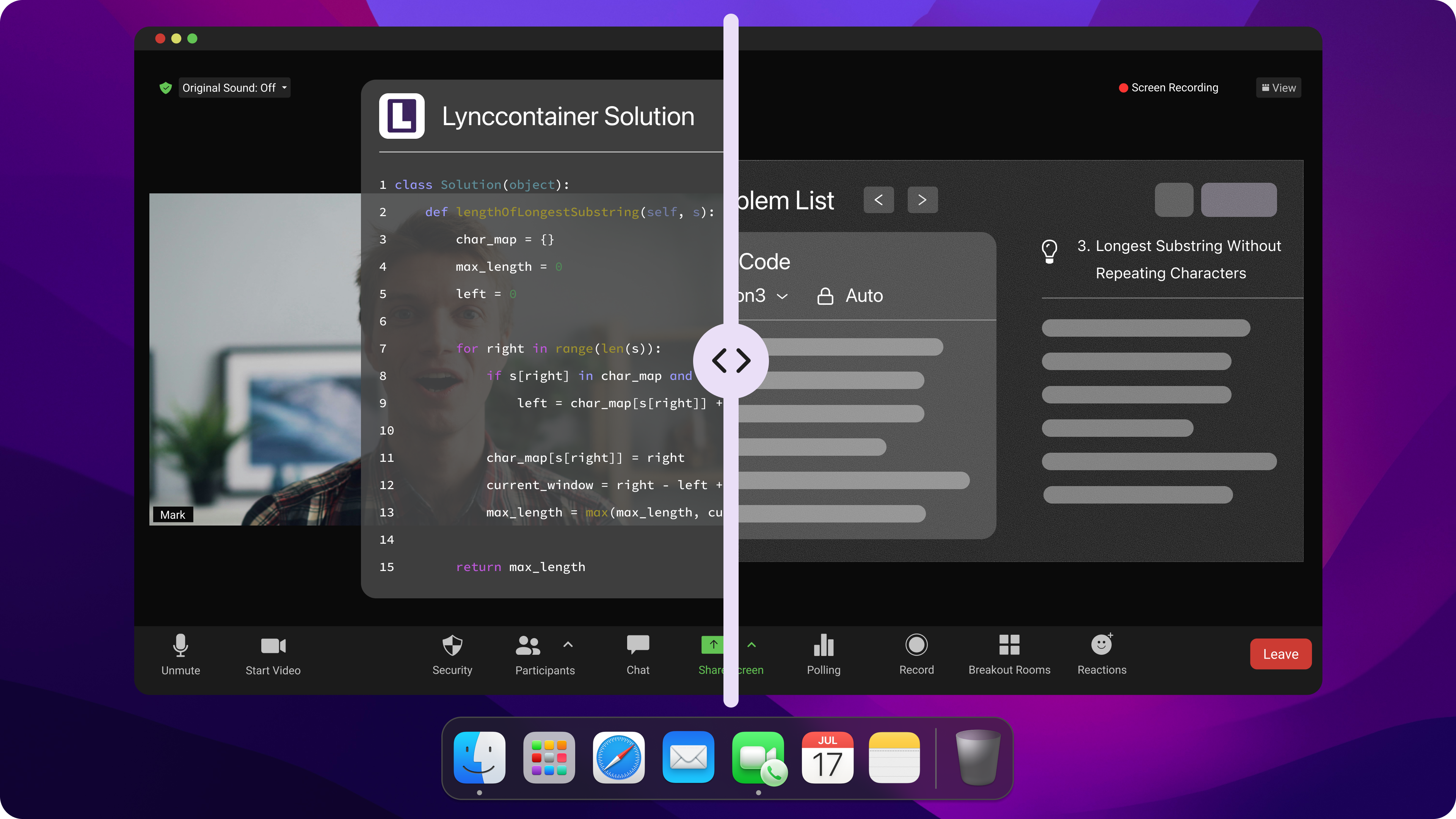
When I prepare for Glider-style coding tests, I sometimes use Linkjob AI as a coding assistant to help me understand problems faster and explore different solution directions. A lot of people searching how to cheat on Glider are usually just trying to reduce pressure in timed coding environments, but in practice what actually matters is how quickly you can understand the problem and structure a clean solution.
Instead of jumping straight into code, my workflow usually feels more like a warm-up process than anything else:
Read the coding question carefully and make sure I understand the requirements
Break the problem into smaller logical steps so it feels less overwhelming
Use Linkjob AI to explore possible solution approaches and compare ideas
Review the generated logic and understand why the solution works
Rewrite the final solution in my own coding style before practicing implementation
When people search how to cheat on Glider, what they’re often really looking for is a faster way to think through coding problems under time pressure. But over time I realized the real advantage isn’t shortcuts—it’s being able to break down unfamiliar questions quickly and stay structured while solving them.
I usually treat Linkjob AI more like a practice companion for learning rather than just a code generator. It helps me understand edge cases, logic flow, and alternative implementations, which gradually improves my coding speed and confidence in interviews.
One thing I’ve noticed is that Glider-style assessments tend to focus more on reasoning and clarity than just producing a final answer. So even when people search how to cheat on Glider, what actually makes a difference is how clearly you can think through and communicate your solution under time constraints.
For me, the best results always come from repeating this process: understand the problem, explore ideas with AI support, and then rebuild everything in a clean, structured way that reflects my own thinking.
Using Virtual Machines & Remote Access While Taking the Glider AI Test
Manipulating remote test environments is another way I see candidates cheat on glider tests. They use virtual machines (VMs) to create isolated spaces where they can run different operating systems. This lets them bypass some restrictions in remote assessments.
Sometimes, remote desktop tools would be used to get help from friends or access resources that aren’t allowed during the test.
Here’s a table showing the most popular methods for manipulating remote test environments:
Method | Description |
|---|---|
Virtual Machines (VMs) | Used to create isolated environments that can run different operating systems, allowing users to bypass restrictions of the test environment. |
OBS (Open Broadcaster Software) | A tool for video recording and live streaming that can be manipulated to share screens or provide external assistance during tests. |
Remote Desktop Protocol (RDP) | Enables remote access to another computer, allowing users to receive help or use resources not available in the test environment. |
Warning: Glider can detect some remote access tools. If you use VMs or RDP, make sure you know how to hide your activity.
Common Mistakes Candidates Make in Glider AI Tests
Many people searching for how to cheat on Glider are actually trying to understand why candidates get flagged or struggle during Glider AI assessments. In most cases, issues are not related to any single action, but to inconsistent behavior patterns during the test.
One common mistake is overthinking every answer instead of responding naturally. Another is trying to maintain overly “perfect” responses, which can look unnatural in timed assessments. A better approach is to focus on clarity, structure, and honest problem-solving under time pressure.
Here are some typical mistakes candidates should avoid:
Over-optimizing answers instead of focusing on clear reasoning
Trying to appear overly confident in unfamiliar questions
Ignoring time management during coding or structured tasks
From a preparation perspective, candidates who search how to cheat on Glider often benefit more from practicing realistic test simulations rather than focusing on shortcuts.
How to Prepare Effectively for a Glider AI Test
A better approach than searching for how to cheat on Glider is to understand how to prepare for structured AI assessments. Glider tests are designed to evaluate problem-solving ability, communication clarity, and technical consistency under time constraints.
Many candidates use AI interview preparation tools like Linkjob AI to simulate test environments before the actual assessment. These tools can help improve coding speed, answer structuring, and familiarity with common interview patterns.
Instead of focusing on test manipulation, structured practice helps candidates:
Improve confidence under timed conditions
Strengthen coding and reasoning skills
Reduce anxiety during real assessments
How Linkjob AI Supports Interview Preparation
Linkjob AI is an AI-powered interview preparation assistant designed to help candidates practice and improve performance in structured assessments like Glider tests.
For users who initially search how to cheat on Glider, the real value often comes from using tools like Linkjob AI to simulate interview scenarios, refine responses, and build consistency in problem-solving.
Rather than replacing skills, it is used to support:
Mock interview practice
Answer structuring improvement
Coding and reasoning skill reinforcement
This makes it a practical tool for candidates preparing for modern AI-assisted assessment platforms.
I read about a candidate who cheated and later caused a security breach. The FBI got involved, and the company had to notify customers and audit their security.
FAQ
How do I know if Glider is proctoring my test?
You can usually tell before starting. Many users searching for how to cheat on Glider are actually trying to understand how Glider monitoring works, but in most cases, proctoring is indicated through a webcam, microphone, or screen access permissions requested at the beginning of the test.
In general, if the platform asks for device permissions or identity verification, it means monitoring features are enabled as part of the assessment setup.
Can I use ChatGPT during a Glider test?
No, not as external assistance. People searching for how to cheat on Glider often ask this question, but most Glider assessments are designed to evaluate independent thinking and problem-solving skills.
From a preparation perspective, candidates often explore AI tools like ChatGPT or Linkjob AI to practice answering questions, simulate interviews, and improve response quality before taking the actual assessment.
How can AI tools like Linkjob AI help with Glider assessments?
They can support preparation, not test completion. Many users searching for how to cheat on Glider are actually looking for ways to feel more confident in timed assessments.
Linkjob AI is commonly used as a real-time interview preparation assistant that helps candidates practice structured answers, improve clarity, and simulate technical interview environments before taking Glider assessments.
What features does Linkjob AI provide for interview preparation?
It includes configurable real-time assistance features. For example, Linkjob AI offers adjustable response behavior settings such as speech sensitivity and timing controls, which can help users simulate different interview conditions during practice sessions.
Candidates who search how to cheat on Glider are often trying to reduce stress in timed tests, but structured practice with AI interview tools is typically a more effective long-term approach.
See Also
Final Round AI Review: Why It Didn't Meet My Hopes
Top Alternatives to Parakeet AI for Interview Assistance
Leading Alternatives to AI Apply for Interview Help