How I Handled the Bryq Test in 2026 with Instant AI Copilot


When I got a new interview invite, I found myself asking: Is it really possible to fool Bryq's security system in 2026? or is it possible to find out how to cheat on Bryq? It's pretty common for people to cheat in online assessments. Almost half of the students say they've cheated on similar tests, especially during the pandemic when loads of exams moved online.
I tried lots of different methods, like desktop and browser-based real-time AI interview assistants, phone-connected ones, and browser extensions. In the end, I went with a standalone, stealthy desktop AI interview assistant and passed that Bryq test with flying colours.
I've also had invites to test out other platforms and have been looking into how to cheat during Microsoft Teams meetings, as well as how to get around CodeSignal's anti-cheating detection. If your online assessment is based on these platforms, you can click here to see how I did it for reference.
Before the Question How to Cheat on Bryq: Is Cheating on Bryq Test Possible?
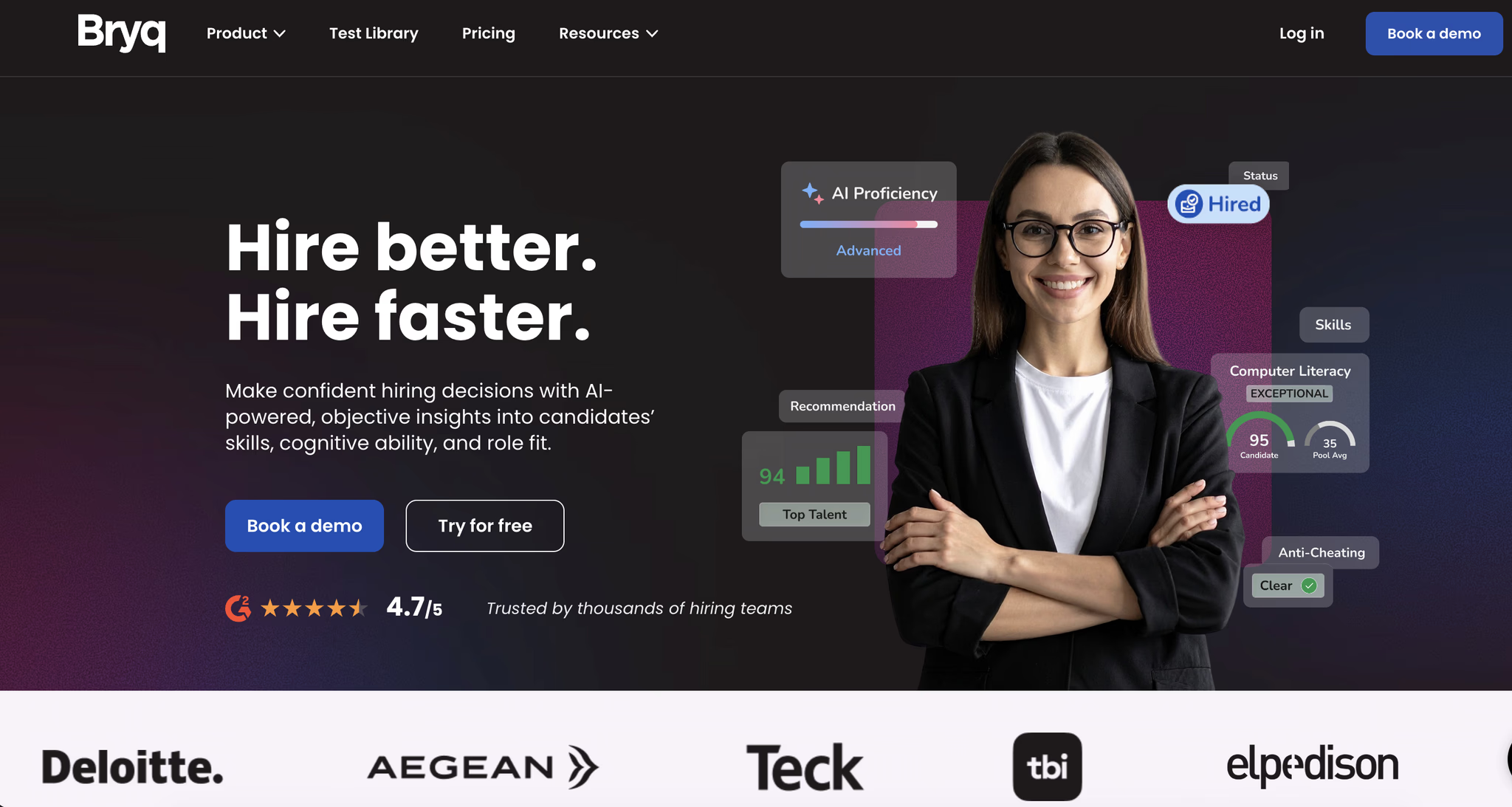
Before trying any tricks, I did some research to see how Bryq's system stops candidates from cheating. It basically takes standard testing methods and adds some extra features. When you combine this with replayable logs and the ability for human intervention, it creates what seems to be a foolproof anti-cheating system, but still, I beat it with Linkjob AI, an invisible AI for interviews.
Bryq's System Cheating Detection Overview
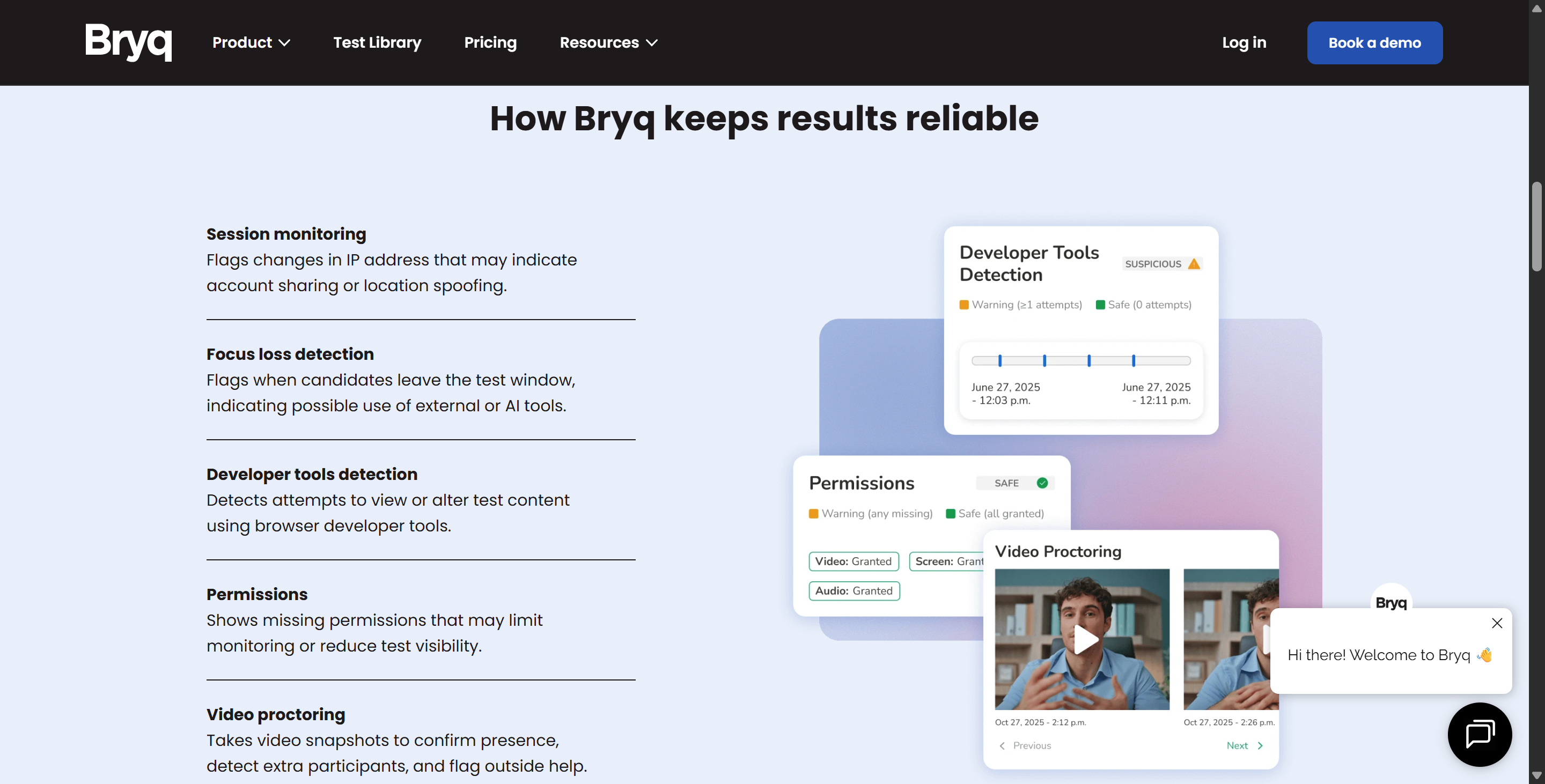
Bryq's test has a security and anti-cheating system to keep things fair by keeping an eye on behaviour and technology as it happens. It'll do IP tracking, focus loss detection, and developer tool detection, plus there's optional video verification as well. Each candidate is put into one of three levels of risk (Clear, Warning, Suspicious). It runs itself, so there's no need to set anything up, and it means that all an interviewer needs to do is start a test and see how candidates work.
Here’s a quick look at some other main anti-cheating measures:
Anti-Cheating Measure | Description |
|---|---|
Proctoring and Timed Questions | Webcam monitoring and strict time limits |
Controlled Mode of Administration | Registration required for access |
Content Interchangeability | Different question types and randomization |
Disablement of Copy-Paste | Prevents copying or pasting answers |
Single-Use Invitations | Unique links for each candidate |
1. Technology and Environment Monitoring
Bryq keeps an eye on the digital environment:
Distraction detection: The system will send you an alert when a candidate leaves the assessment window or switches tabs.
Apparently, this is flagged as looking up answers or using an AI assistant – or at the very least, as a yellow alert – if there are signs of it.
Checking for developer tools: Bryq can spot when people are trying to use browser developer tools to view page code or mess around with assessment content.
Plugins that are designed to extract assessment content by parsing code don't work in these cases.
IP and Session Monitoring: The platform flags changes in IP addresses to detect account sharing, location spoofing, or proxy testing.
Browser Permissions: The system keeps an eye on whether important permissions (like the camera or screen sharing) are disabled during the test to avoid being detected.
2. Behavioural Analysis
As well as flagging up any technical issues, Bryq looks at how candidates interact with the test.
Response Time: The AI can spot if a candidate's response is way too fast or slow compared to how complex the question is. This might suggest that they're "copy-pasting" from an AI or some other source.
Operation Logs: The system keeps track of questions that have been skipped and how people interact with the site (clickstreams), and it can spot if something seems a bit off or if there's something strange going on.
Copy/Paste Blocking: This feature is switched off during the assessment to stop candidates easily transferring questions to outside tools.
3. Visual Verification (Optional)
One thing to bear in mind is that Bryq doesn't actually do continuous video recording, but it does offer optional video proctoring settings:
Video Snaps: The system takes regular pictures to confirm the candidate is there.
Multi-Participant Detection: AI can tell you if there's more than one face in the frame.
Identity Verification: Each candidate is sent a one-time invitation link that's tied to their specific access point, so we can make sure the person taking the test matches the registered information.
Basically, this means making sure the candidate is there the whole time and that there are no other people helping them. It's designed to stop people from using proxies or VPNs, and it can even stop common cheating methods like virtual machines.
4. Designing against AI at the content level
Visual and Task-Based Question Types: Questions usually involve things like visual logic, timed tasks and simulated scenarios.
I've had similar issues myself; even when I tried to open a GPT page to copy and paste questions while taking the test, it was tricky to get a full answer straight away.
The randomisation process: During each test session, the order of the questions and answers is changed so that no two candidates see the same order.
Question Exposure Limits: Questions are retired after a certain number of uses to stop them from leaking into public question banks or groups.
These measures mainly target the creation and tracking of external question banks to stop test questions being leaked. If you look hard enough, you can still find some questions, but you can't be sure how recent they are or whether the details match exactly.
5. Cheating Metrics Dashboard
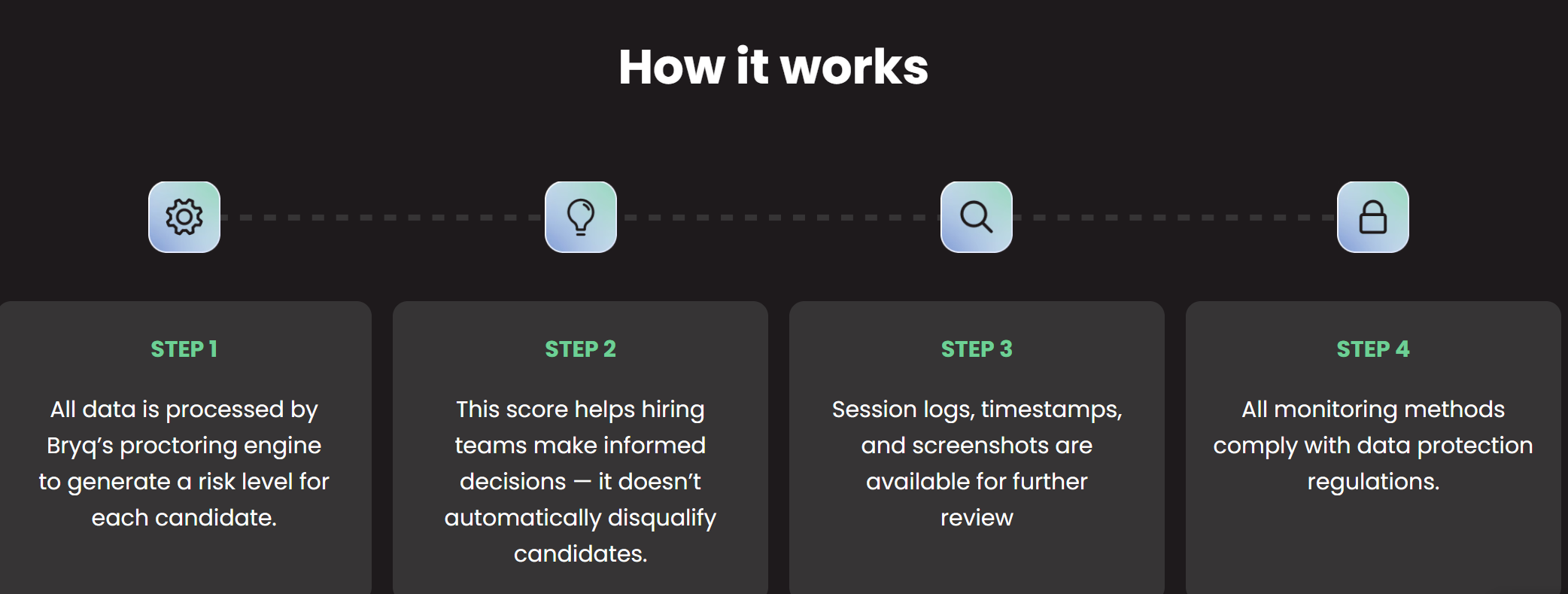
All my data is processed by the proctoring engine and assigned a colour-coded risk level:
🟢 Normal (Green): Behaviour is normal and meets expectations.
🟠 Warning (Orange): We've noticed some unusual activity, like you switching tabs a lot. This needs to be checked out by a recruiter.
🔴 Suspicious (Red): There's a pretty high chance of misconduct (e.g. opening developer tools or disabling the webcam).
How to Cheat on Bryq Test: My Tactics
Next, I'm going to show you the method I came up with to beat the Bryq test. I'll see if it actually works and how useful it is in helping me pass.
Using Invisible Desktop AI Assistant
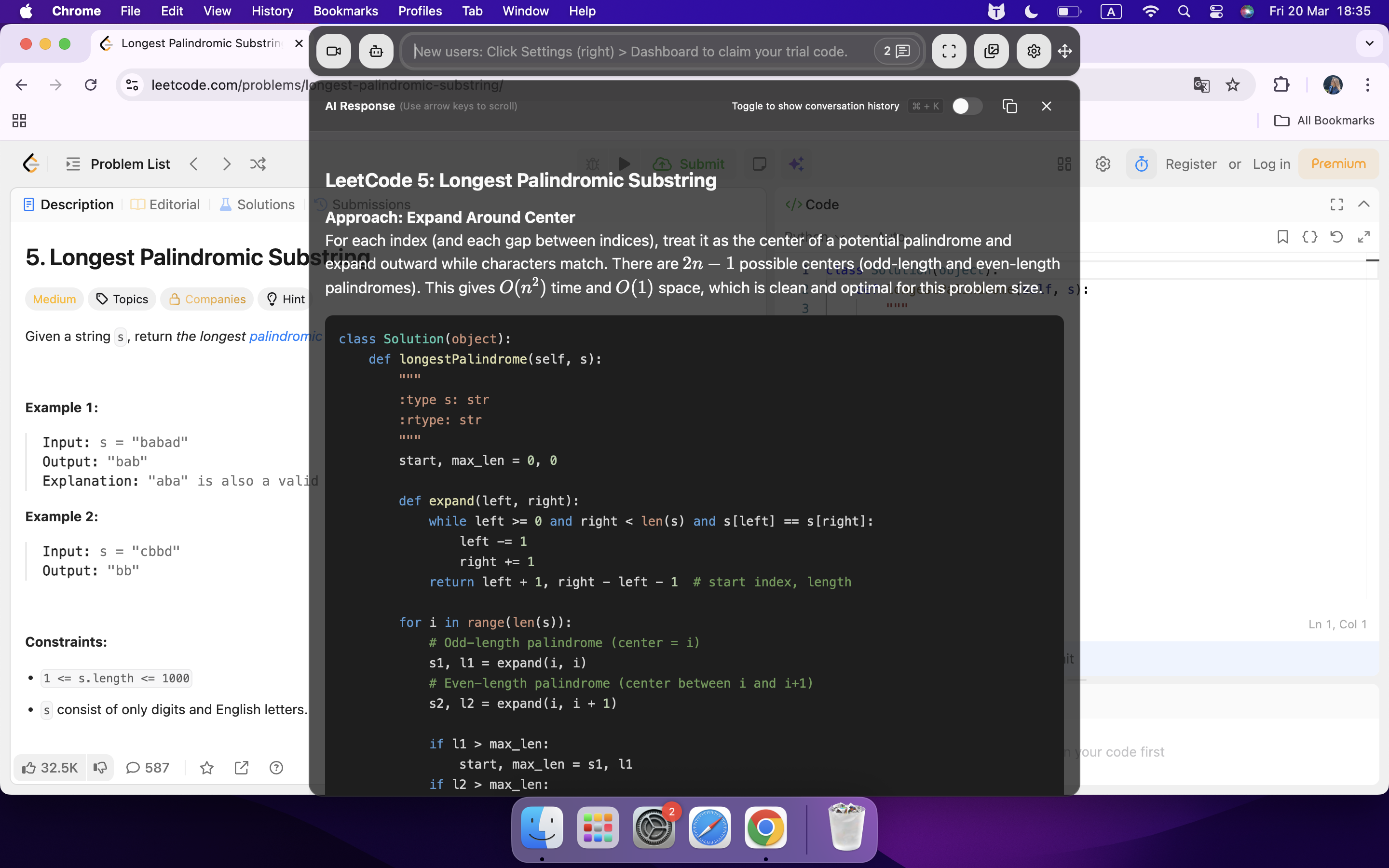
I like Linkjob AI best. It's an invisible AI assistant that you can use on your desktop. It has a window that you can't see, and it listens to your interview in real time or captures your screen using keyboard shortcuts. It then provides detailed answers, as you can see in the image below:
For me, the pros of this tool are:
There's no need to hide anything, which lets me focus fully on the test content.
I can control the pace of the test and only identify and solve tricky problems.
As long as it's set up properly, I can avoid leaving the test window and won't have to look away.
I can use completely invisible global hotkeys during the test to control various operations, avoid suspicious mouse movements and reduce suspicion.
But, there's actually one small issue:
Tools like Linkjob AI often need updates, and sometimes certain versions can have delays or errors, meaning I have to test them first and talk to the support team. This means there might be a few more steps involved in the prep. Also, you'll need a subscription to access all the services.
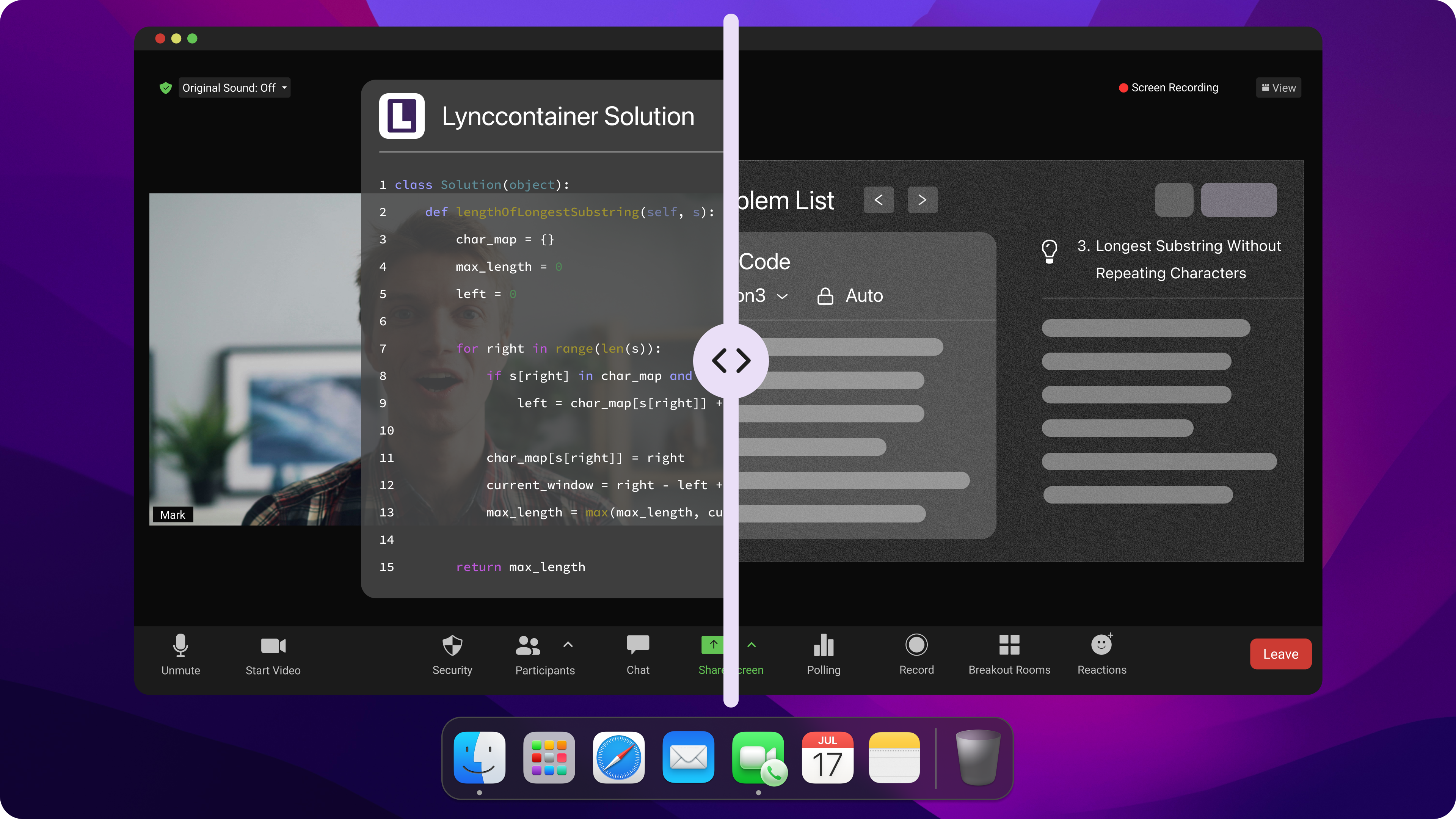
But for me, as long as I can pass the Bryq test, these drawbacks are nothing. I mean, I'm looking to land a new job after all!
Involving AI Extensions to Get Answers
I also thought about whether I could do my test using an AI interview assistant that didn't need downloading – specifically, a browser extension. I launched Linkjob AI's mock interview mode, opened a mock interview video (which I randomly found on YouTube) and did the test using Sensei AI. Here's a screenshot from that time:
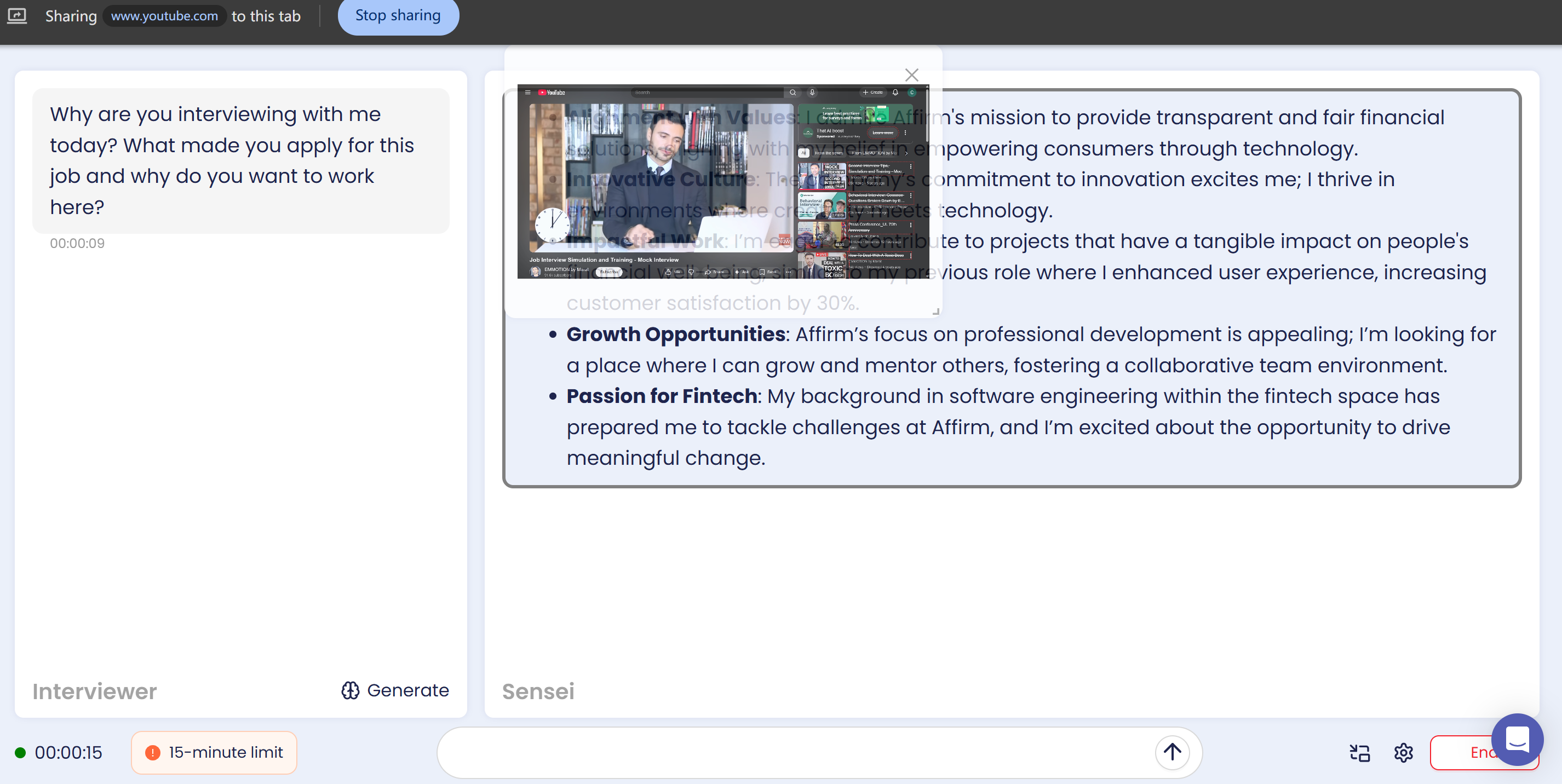
I couldn't see Linkjob AI at all, even when I was sharing my screen in full-screen mode, and I couldn't find it in the dock either.
But Sensei AI didn't work at all – it could only stay hidden when I shared its tab. So as soon as the interviewer asked me to switch to full-screen sharing, it would be completely exposed. That is the main reason why I chose Linkjob AI rather than it to digging into how to cheat on Bryq. Plus, Bryq takes full-screen screenshots of my computer every so often, which would definitely make me look like a cheater.
Also, I couldn't take screenshots using any keyboard shortcuts. I think this'll probably do the job for a standard video interview, but I don't reckon it'll work when you're using an OA platform like this.
What About Phone-Based AI Copilot?
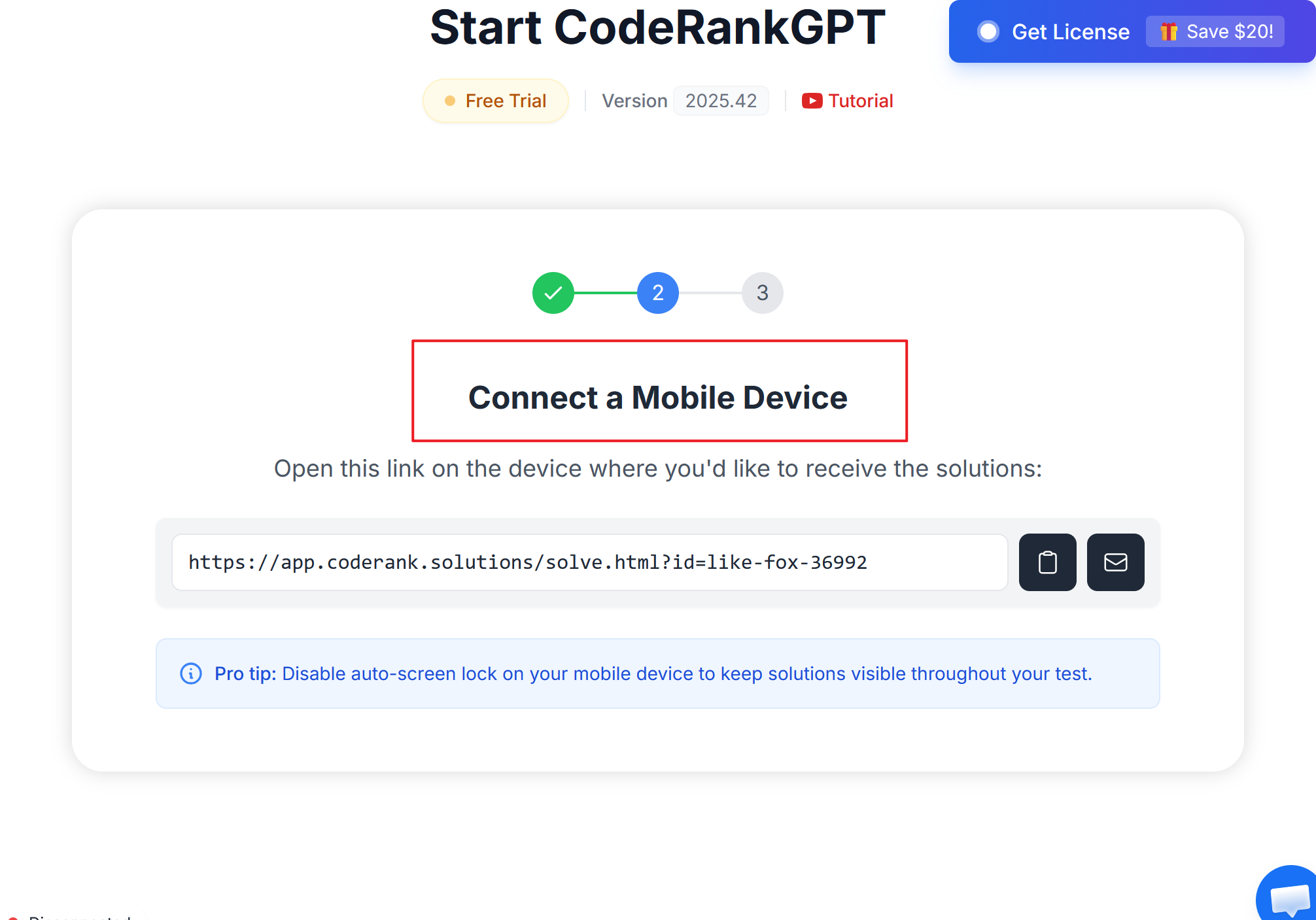
Yeah, I gave another common type of AI interview assistant a go too. You just enter a link to the interview or assessment, then connect the whole process to your phone or a second device, which gives you real-time answers.
I did think this was a good idea at first, but after doing a few practice tests, I changed my mind.
First, I found myself constantly distracted by the other screen, which meant I couldn't focus on the test.
Second, I know that Bryq's monitoring includes eye-tracking, which means I could only glance at the screen very quickly each time, or go to great lengths to position the device next to my computer screen without the interviewer noticing.
I only managed to get into the online meeting twice out of the four tests I did. The other two times, the page just kept loading. If I saw this in a real interview, it would be a deal-breaker.
In the end, I found that the AI interview assistant models from the third-party tools I discovered were either too outdated or didn't disclose the models they were using at all.
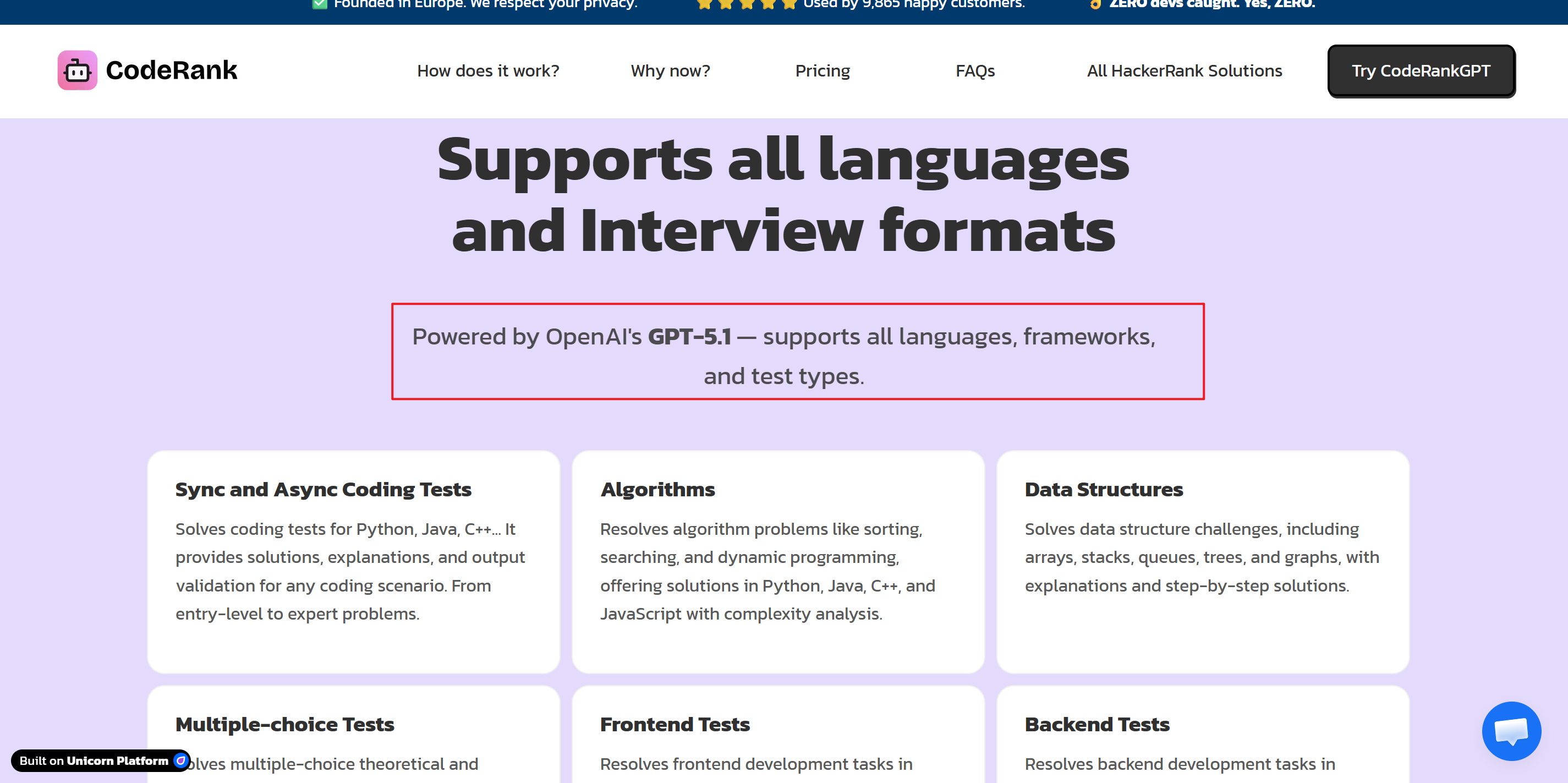
Linkjob AI has over a hundred models on offer, including Claude Opus, Grok 3 and more. I think it's really important that they disclose these models to build credibility. I just can't fully trust tools that don't meet this standard.
Final Verdict: Desktop Invisible AI Copilot Kills the Question of How to Cheat on Bryq
After evaluating different AI interview preparation tools, I explored Linkjob AI more deeply while researching how to cheat on Bryq and understanding how modern AI assessment platforms work. Many candidates searching how to cheat on Bryq are actually trying to find ways to improve performance in structured online tests, especially Bryq-style cognitive and behavioral assessments.
During my preparation, I used Linkjob AI as a desktop AI copilot to better understand question patterns, improve response structuring, and practice solving complex test scenarios more efficiently. When people search for how to cheat on Bryq, what they often need in reality is a reliable way to train for timed assessments and reduce uncertainty in test environments.
From a product perspective, the most important factors for me were stability, fast support response, and continuous updates. These qualities made Linkjob AI a strong option among AI interview assistants, often discussed in the context of how to cheat on Bryq, even though its real value lies in preparation, learning support, and performance improvement rather than shortcuts.
If you're preparing for Bryq assessments and searching for how to cheat on Bryq, a better approach is to use AI tools like Linkjob AI for practice sessions, mock interviews, and skill-building so you can perform more confidently in real test environments.
FAQ
Can candidates use browser extensions during Bryq assessments?
It depends. Many people searching how to cheat on Bryq are actually trying to understand whether browser extensions are allowed, but Bryq assessments generally differentiate between productivity tools and tools that interfere with test integrity.
Basic extensions like spelling or grammar tools may be permitted in some setups, while anything that modifies test behavior or interacts with assessment content is typically restricted and may be reviewed during evaluation.
What happens if Bryq detects suspicious behavior?
It depends. A Bryq flag does not automatically mean disqualification, even though users searching how to cheat on Bryq often assume immediate failure.
Instead, Bryq typically categorizes activity signals (such as low, medium, or high risk), and hiring teams review the full test report, logs, and context before making a final hiring decision.
Does Bryq monitor webcams during assessments?
Yes. Bryq uses webcam-based proctoring as part of its assessment integrity system, which is why many candidates researching how to cheat on Bryq are curious about how monitoring works.
Depending on the employer’s configuration, this may include periodic snapshots, identity verification checks, and additional monitoring signals combined with screen activity tracking.
Does Bryq use screen monitoring during tests?
Yes. Bryq may use screen activity monitoring depending on how the assessment is configured by the employer.
While users searching for how to cheat on Bryq often focus on monitoring tools, Bryq’s system is typically designed to combine multiple data points—such as timing, response patterns, and session logs—to evaluate assessment integrity.
See Also
Strategies to Navigate HackerEarth Proctoring in 2026
My Experience Evading Sherlock AI Detection During 2026 Interview
Ways to Successfully Outsmart Mettl Exam in 2026
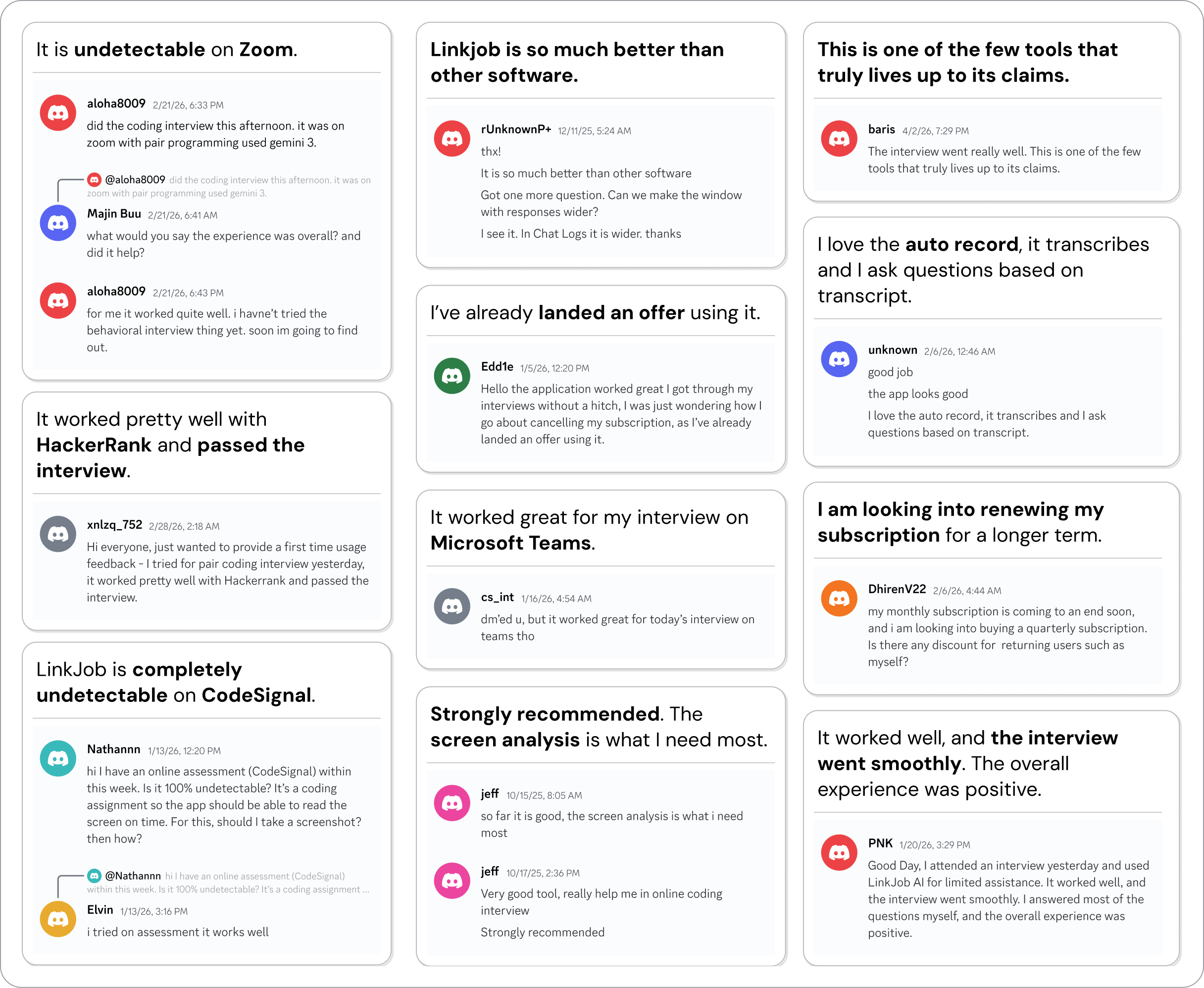
Why People Choose Linkjob AI
Smoother interviews, coding challenges cleared, and job offers landed. See how users describe their experience with Linkjob AI—in their own words.

© Copyright 2026 Linkjob AI - All Rights Reserved.