My 2026 Okta CodeSignal Assessment Experience and Key Insights

I just finished Okta’s CodeSignal OA. There was only one question, and I had two hours to complete it, so the time was more than enough. The OA had to be completed within seven days, the difficulty was moderate, and I could use my own IDE.
I’m really grateful to Linkjob.ai for helping me pass my interview, which is why I’m sharing my OA question and experience here. Having an AI interview assistant for the Codesignal assessment indeed provides a significant edge.
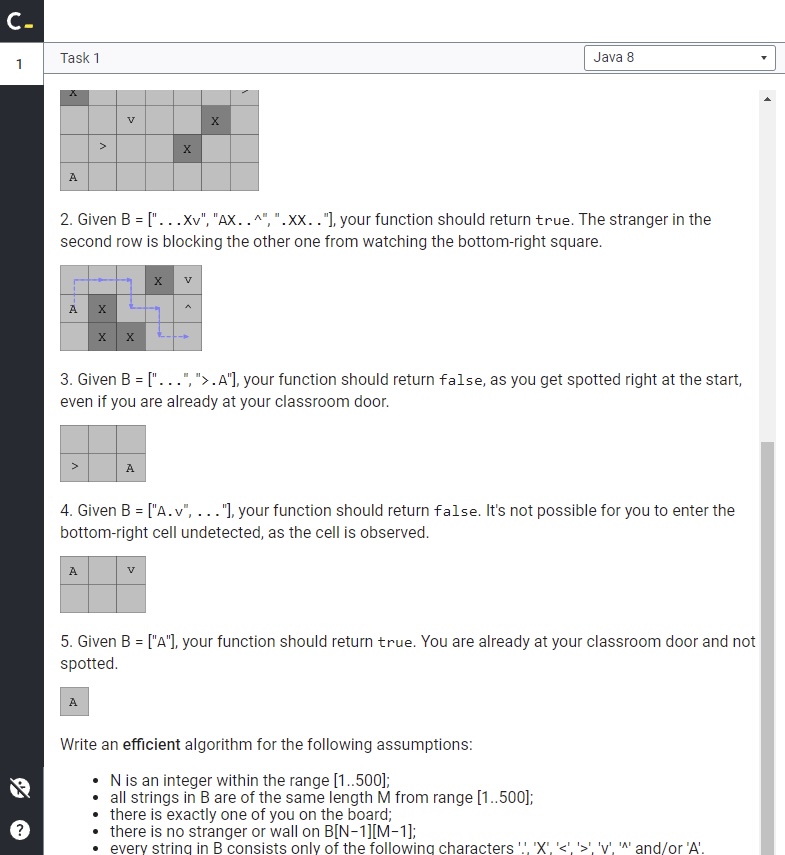
Okta CodeSignal Assessment Questions: BFS Sneak Path Problem
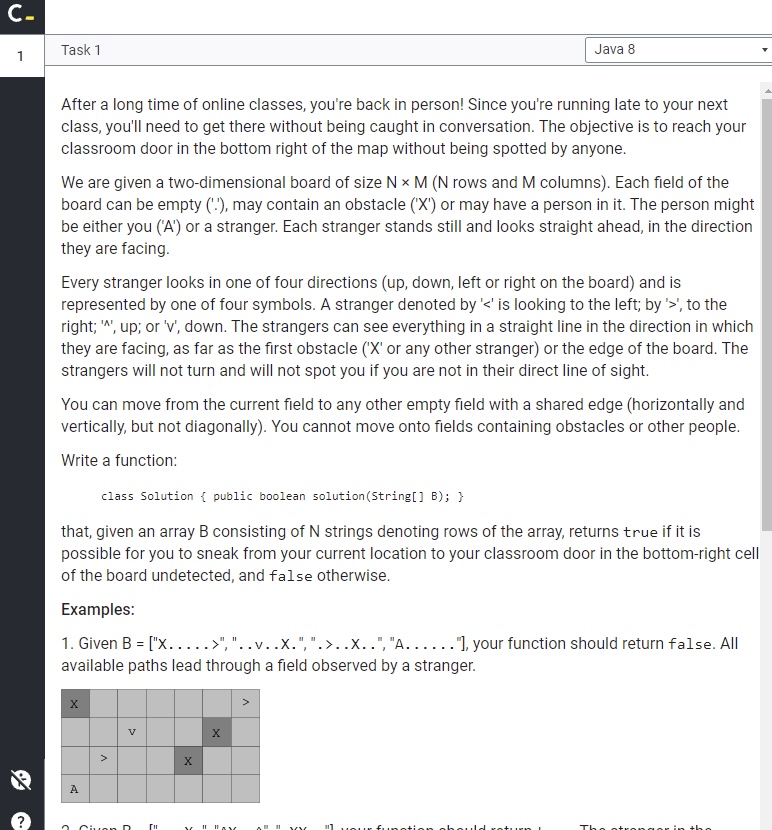
The question I got was a grid-based pathfinding problem that required a BFS approach combined with line-of-sight preprocessing. Below is the exact problem statement and my step-by-step solution.
Question: Sneak Path Check
Problem-Solving Approach
To solve this problem, we can use a breadth-first search (BFS) combined with line-of-sight preprocessing to ensure we find a valid path from the start to the end while avoiding the gaze of strangers.
Steps
Preprocessing: Identify Start, End, and Stranger Line of Sigh
Locate start (A) and end (bottom-right, i.e., (N-1, M-1)): Traverse the grid to find the start and end positions.
Mark strangers’ line of sight: For each stranger (<, >, ^, v), scan along their facing direction until encountering an obstacle (X), another stranger, or the grid boundary. Mark all walkable cells (.) along this path as “observed.”
BFS Traversal of Walkable Paths
Use a queue for BFS, keeping track of visited cells to avoid revisits, and follow these rules:
Move only to empty cells (.) that are not in a stranger’s line of sight.
Do not move onto obstacles (X), cells occupied by strangers, or already visited cells.
Each step can move up, down, left, or right (adjacent cells sharing an edge).
Termination Conditions
If BFS reaches the end, return true.
If the queue is empty and the end is not reached, return false.
Complexity Analysis
Time Complexity: Preprocessing the line of sight takes O(N × M × max(N, M)) (each stranger scans up to N or M steps). BFS takes O(N × M) (each cell is visited at most once). Overall, the time complexity is O(N × M × (N + M)), which is efficient for N, M ≤ 500.
Space Complexity: Storing visited status, line-of-sight markings, and the BFS queue requires O(N × M) space, which meets the problem constraints.
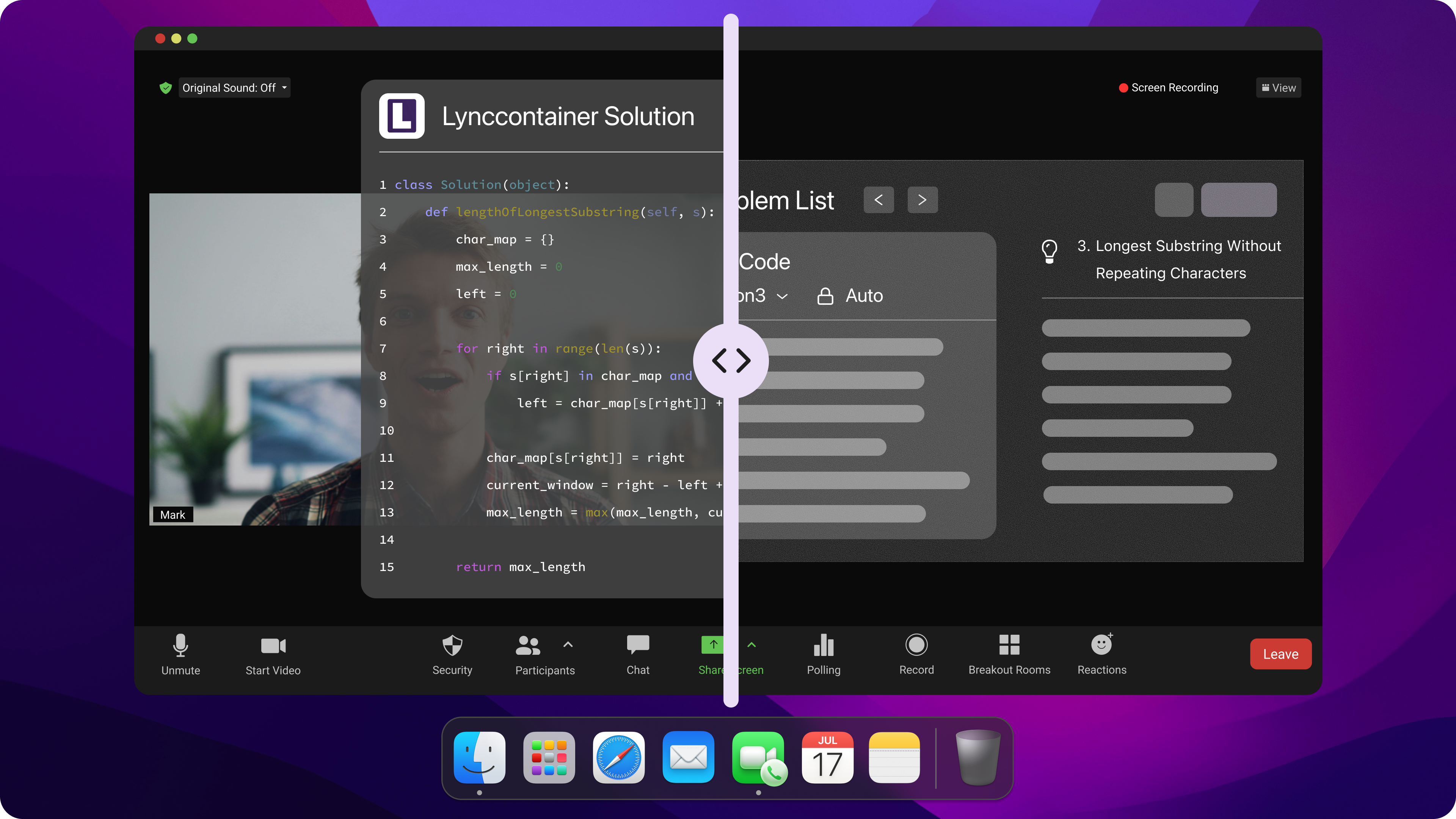
AI Coding Interview Copilot for Codesignal OA
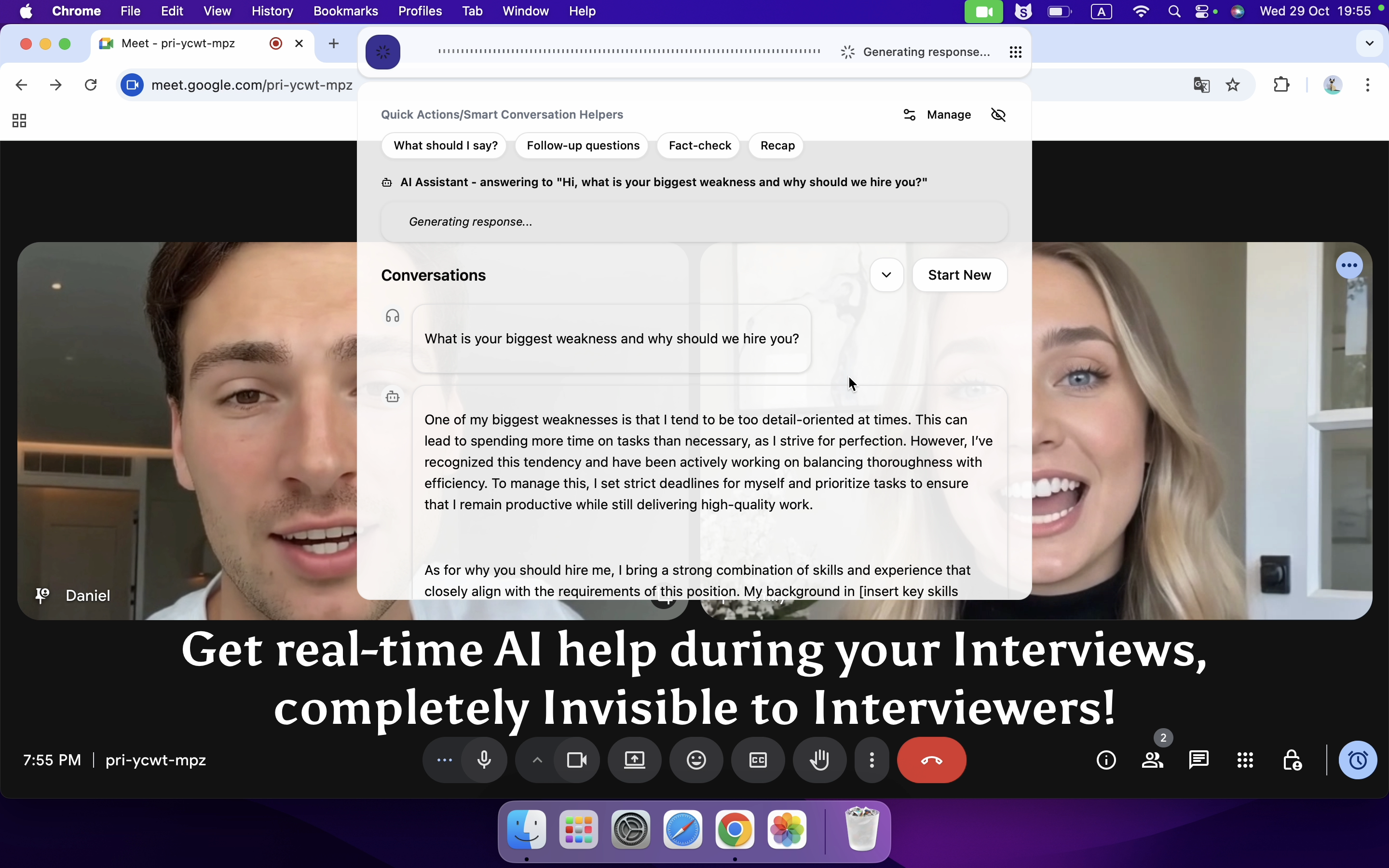
Linkjob AI worked great and I got through my interview without a hitch. It’s also undetectable, I used it and didn't trigger any Codesignal detection.
Okta CodeSignal OA Format, Question Types & Time Management
Common Okta CodeSignal Question Types
Data Structures & Algorithms: Expect problems centered on arrays, strings, hash maps, linked lists, and trees. Common challenges include sorting, searching, dynamic programming, and graph traversal.
Logical Puzzles: Unlike Capital One CodeSignal questions, some questions test your ability to decipher patterns or solve situational logic problems (like the “sneak path” problem discussed earlier, where you navigate a grid while avoiding detection).
String Manipulation: Tasks may involve parsing, formatting, or transforming strings.
Math & Simulation: Problems that require mathematical reasoning or simulating real-world scenarios.
Timing Management
Effective time management is critical to completing the assessment successfully, especially given its single-question structure and 120-minute duration. Here’s how to structure your approach:
Single Question Allocation: Since the Okta Code Signal test consists of one problem with a 120-minute time limit, divide your time into three phases:
Problem Analysis (20–25 minutes): Thoroughly understand the problem statement, identify edge cases, and outline your solution approach.
Coding & Testing (70–80 minutes): Implement your solution, write test cases, and debug incrementally. Leverage the platform’s test case runner to validate your code against sample inputs and edge scenarios.
Final Review (15–20 minutes): Refactor for readability, optimize time/space complexity if needed, and double-check for logical errors or off-by-one mistakes.
Pace Monitoring: Even with 120 minutes, avoid getting stuck in one phase. If you spend over 30 minutes on problem analysis without a clear plan, pivot to coding a basic solution and refine it later. Conversely, if coding takes longer than 80 minutes, prioritize correctness over optimization for the remaining time.
Interface
Code Editor: A full-featured editor with syntax highlighting, auto-completion, and support for languages like Java, Python, C++, and more.
Test Cases: You can run custom test cases and view output directly in the interface. Use this to debug your code incrementally.
Problem Statement & Examples: The problem description, examples, and constraints are displayed prominently, allowing you to reference them as you code.
Other Common Okta CodeSignal Question Types and Coding Patterns
Beyond the question mentioned above, Okta’s assessment pool frequently includes the following types of challenges:
Complex Log Processing
Since Okta’s core business centers on identity security, log analysis is their favorite topic.
Format: You are given a large array where each element represents an entry like
[timestamp, IP_address, action, status_code].Requirements: A typical task might ask you to identify all IP addresses that attempted to log in and failed more than 3 times within any rolling 5-second window.
Why it’s asked: This goes beyond basic algorithms; it tests your ability to write industrial-grade code capable of handling real-world data streams efficiently.
Role & Permission Mapping
This is a direct simulation of Okta’s core product functionality: Role-Based Access Control (RBAC).
Format: You are provided with two JSON-formatted lists: one mapping
User -> Rolesand another mappingRole -> Permissions.Requirements: You must implement a function that takes a
UserIdand aPermissionNameas input and returns whether the user has that specific permission. Note that "Role Inheritance" is often involved (e.g., an "Admin" role inherits all permissions from a "User" role).Why it’s asked: It evaluates your proficiency with HashMaps and your ability to implement recursive logic to traverse permission trees.
String Parsing & Validation
Format: You are given a non-standard or "messy" string, such as
192.168.0.1:8080/path?user=admin.Requirements: You need to extract the IP address, port, path, and parameters, while validating each component. For example, you must ensure the port is within the 1-65535 range and each octet of the IP is between 0-255.
Why it’s asked: While these questions don't require advanced algorithms, they are full of "traps." If you miss a single edge case (like an IP containing letters or an invalid character), you will fail the hidden test cases.
Okta CodeSignal Assessment Preparation Tips
Study Resources
Mixing different study tools helped me learn faster. Here are some resources that worked for me:
Practice coding challenges on platforms like Leetcode. I focused on mid-hard level problems, using real questions on BCG X CodeSignal assessment.
Review system design basics. I learned how different parts of a system work together and why design matters.
Ask questions if a problem seems unclear. During practice, I made sure to clarify anything I did not understand.
Use mock interview tools like Linkjob.ai to practice. These tools offer question sets based on real interview experiences, deliver personalized guidance tailored to your resume and the role you’re applying for, and even follow up with additional questions based on your answers, making your practice sessions highly targeted.
Okta CodeSignal OA Insights Tips and What Worked
Quick Tips
I picked up a few tricks that saved me time and stress:
Read all questions first. Focus on the key points of the problem and make sure you fully understand the requirements before you start answering.
Use the run code feature often. Catch bugs early instead of waiting until the end.
Double-check your answers if you have time left. Small mistakes can cost points.
What Worked
During my okta codesignal assessment, I found that a few strategies made a big difference. I focused on learning more than one programming language. This helped me switch between JavaScript and Python when I needed to solve different problems. I also spent time building my online presence. I shared code on GitHub and connected with other developers on social media. This gave me confidence and helped me learn new tricks.
I researched Okta and the role before the test. I wanted to understand what the company values and what skills they look for. I also practiced how to cheat on CodeSignal proctored tests, and did mock interviews with friends. This helped me get comfortable with talking through my solutions and explaining my thought process.
FAQ
How long after submitting my resume did I receive the OA?
I got the OA the day after I submitted my resume. They gave me seven days to complete it, but in reality, it can be finished in about an hour.
If I submit but not all test cases pass, is there still a chance to move on?
Yes, it’s possible. A friend of mine had this situation. He failed two test cases on the performance section, but a few hours later he received an email scheduling an HR call, which was quite surprising.
What is the interview process after passing Okta’s CodeSignal OA?
Okta’s current hiring process is: first round HR, second round HM, third round OA, fourth round on-site, and fifth round VO.
Does Okta use CodeSignal for interviews?
Yes, Okta uses CodeSignal as part of their technical screening process for software engineering roles. The assessment I took consisted of one coding problem with a two-hour time limit, which is more generous than most OAs I've seen. The question focused on BFS grid traversal and line-of-sight detection—so if you're prepping, definitely brush up on those.
See Also
How I Passed the 2026 TikTok CodeSignal Online Assessment: Tips, Strategies, and Preparation Guide
How I Navigated the Visa CodeSignal Assessment and What I Learned
How I Cracked the Ramp CodeSignal Assessment and What You Can Learn
I Cracked the Coinbase CodeSignal Assessment: My Insider Guide
How I Succeeded in the eBay CodeSignal Assessment Without Stress
Why People Choose Linkjob AI
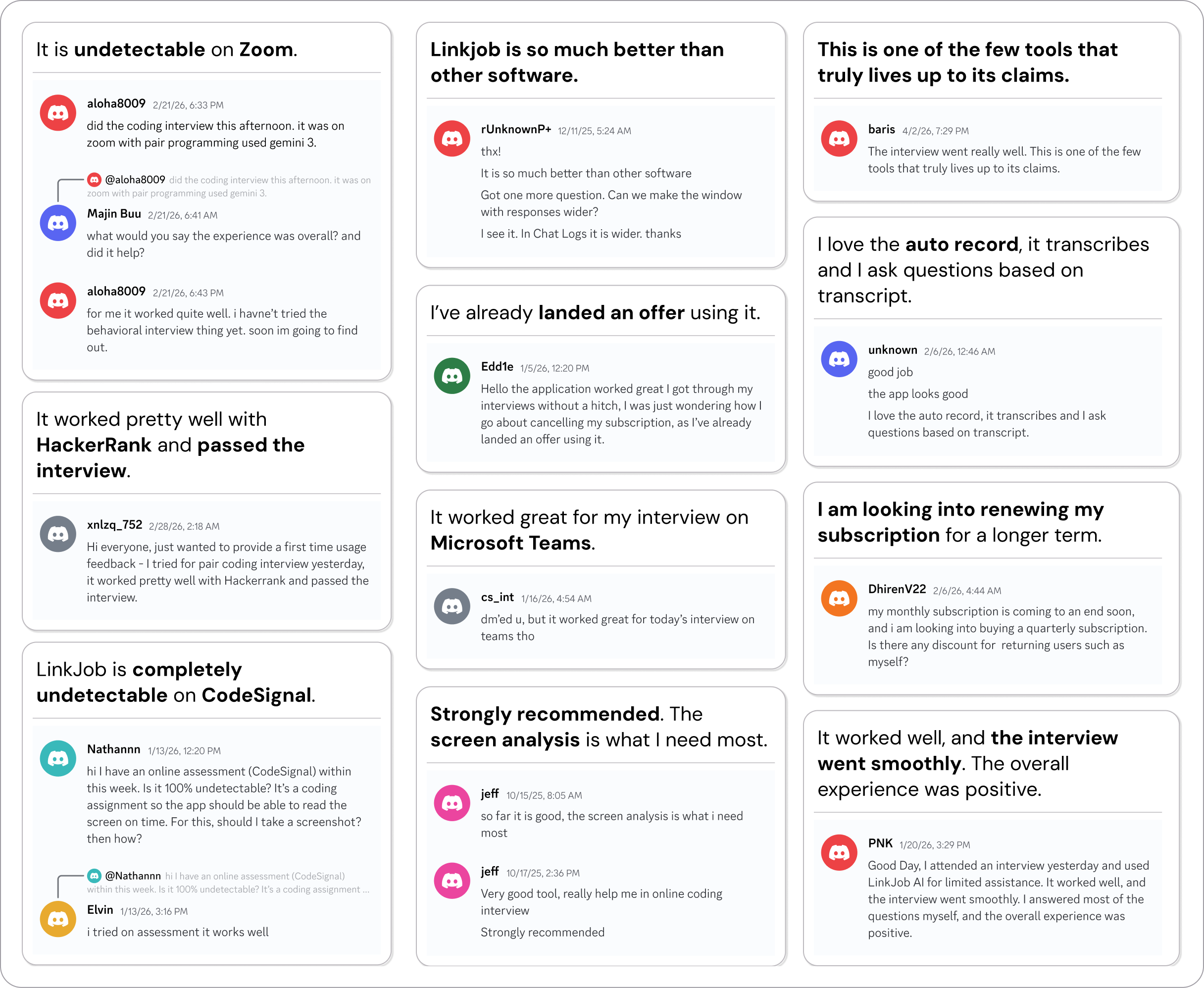
Smoother interviews, coding challenges cleared, and job offers landed. See how users describe their experience with Linkjob AI—in their own words.