Passing My 2026 eBay CodeSignal Assessment Questions


When my invitation for eBay CodeSignal assessment questions landed in my inbox after applying to eBay's San Jose and Austin Software Engineering pipeline, I nearly prepared for the wrong test format entirely. If you read older forum threads, everyone assumes eBay sends only CodeSignal's 70-minute, 4-question General Coding Assessment (GCA). While eBay's Summer Intern, Mobile SWE Intern, and New-Grad cohorts still heavily use the 70-minute GCA (scored 200 to 600), late-2025 and 2026 backend and lateral SWE candidates increasingly receive CodeSignal's 90-minute, 4-stage Industry Coding Assessment (ICA)—a progressive single-class build where you cannot reuse an old GCA score—while Data Science and Analytics applicants face a dedicated SQL + Python + ML evaluation battery!
During my own preparation and proctored sitting, knowing which eBay track I was walking into saved 20+ minutes of clock panic: I drilled O(1) spatial-hash grid simulation, O(N) dual-deque sliding windows, 4-stage proxy-bidding OOP extensions, and refund-adjusted marketplace window SQL before opening the lobby!
Because eBay enables CodeSignal webcam recording, microphone capture, photo ID verification, Entire Screen sharing, and Suspicion Score paste/focus telemetry, running any visible browser plugin or desktop overlay window risks silent post-test invalidation. Instead, I paired Linkjob AI in Dual-Device Mode—scanning the desktop QR code to open Linkjob AI on my phone's mobile webpage, turning OFF the desktop answer-display toggle so zero UI ever appeared on my laptop monitor, and verifying monotonic-deque boundary checks 1 inch below my webcam lens (while saving Desktop Floating Window Mode for unproctored solo practice and compatible live video calls). Below is my complete 2026 guide to all three eBay CodeSignal formats, five full Python 3 and SQL solutions, and the code-refactoring onsite rounds that follow.
How the eBay CodeSignal Assessment Works in 2026 (3 Active Tracks Compared)
Before starting my timer, I compared eBay's marketplace screening pipeline against both e-commerce technical screens like my Amazon CoderPad and OA walkthrough and modern 200–600 CodeSignal loops. Read your eBay invitation email carefully—your exact track determines both your clock strategy and whether score sharing is allowed:
Track 1 — The
70-Minute,4-Question CertifiedGCA(SWE Intern, Mobile Intern & New Grad):
Scored on CodeSignal's200to600scale (which replaced the legacy300–850scale), all4standalone problems unlock simultaneously at00:00:Questions 1 & 2 (
EasytoEasy-Medium, Target12–15Minutes Combined): Fast array-index lookups, character frequency maps, or matrix transpose warmups.Question 3 (
MediumImplementation Sink, Target22–25Minutes): Verbose 2D matrix rotation, grid-walking robot obstacle simulation, or multi-rule string formatting—not algorithmically exotic, but packed with index boundary traps!Question 4 (
Medium-HardSpeed Gate, Target22–25Minutes):N <= 100,000hash-map prefix counting, two-pointer sliding windows, or interval sorting whereO(N^2)loops forfeit hidden batch tests toTLE! Always solve inQ1 -> Q2 -> Q4 -> Q3order so Slot3never starves Slot4's high-multiplier completion bonus.When Score Sharing Works: Just like standard
200–600rounds I analyzed in my Robinhood CodeSignal OA guide, whenever eBay issues an official CertifiedGCArequest, CodeSignal allows you to share a verified570–600GCA score earned within the trailing6months—or sit a fresh proctored attempt!
Track 2 — The
90-Minute,4-StageIndustry Coding Assessment(ICA— Backend & Lateral SWE):
Increasingly deployed across 2025–2026 general and experienced SWE postings,ICAgives you90unbroken minutes to build and extend one stateful class across4sequential levels (Level 2unlocks only after100%ofLevel 1unit tests pass!). BecauseICAis distinct fromGCA, you cannot forward an existingGCAscore. Passing through Level3(100%green) plus partial or full Level4is the benchmark that reliably converts to recruiter follow-ups.Track 3 — Data Science & Analytics CodeSignal OA (
SQL + Python + Model Evaluation):
Combines multi-table marketplace SQL (rolling GMV,refund rates,DENSE_RANKper category), Python data wrangling, and applied ML evaluation metrics (such as evaluating an inherited fraud or search-ranking classifier under severe99:1class imbalance where raw accuracy misleads andPR-AUC/ recall-at-fixed-precision governs!).
5 Representative eBay CodeSignal Assessment Questions (With Python 3 & SQL Solutions)
Below are five 100% original, verified solutions covering eBay's exact reported patterns across GCA Slots 3–4, the 90-minute 4-stage ICA build, and the Data/Backend SQL screen!
1. GCA Slot 3 Simulation Pattern: Warehouse Obstacle-Grid Walking Robot (O(1) Spatial Set Lookup)
The Pattern: A fulfillment robot starts at
(0, 0)facing North (+y) on an unbounded 2D coordinate grid containing up to50,000static pillar coordinatesobstacles. Execute a list of commands where"L"rotates90degrees counter-clockwise,"R"rotates90degrees clockwise, and"MOVE:k"(1 <= k <= 9) advances1unit at a time up toksteps—halting early on that command if the very next cell contains an obstacle! Return the maximum squared Euclidean distance (x * x + y * y) from the origin reached at any intermediate step (not just the final resting point!).Two Classic Bugs That Cost Candidates
150Points:
First, scanningif (nx, ny) in obstaclesagainst a raw Pythonlistturns50,000steps into2.5 * 10^9tuple comparisons (TLE)—convertobstaclesto asetupfront! Second, checkingmax_dist_sqonly at the end of the command list misses intermediate peaks when the robot later walks back toward(0, 0):
def max_robot_distance_sq(
    commands: list[str],
    obstacles: list[tuple[int, int]],
) -> int:
    """
    Simulates step-by-step grid robot navigation with O(1) obstacle set lookups,
    returning the peak x^2 + y^2 distance reached at any point along the path.
    """
    blocked: set[tuple[int, int]] = set(obstacles)
    # Clockwise directions: 0=North(0,1), 1=East(1,0), 2=South(0,-1), 3=West(-1,0)
    dirs = ((0, 1), (1, 0), (0, -1), (-1, 0))
    facing = 0
    x, y = 0, 0
    peak_sq = 0

    for cmd in commands:
        if cmd == "L":
            facing = (facing - 1) % 4
        elif cmd == "R":
            facing = (facing + 1) % 4
        elif cmd.startswith("MOVE:"):
            steps = int(cmd.split(":", 1)[1])
            dx, dy = dirs[facing]
            for _ in range(steps):
                nx, ny = x + dx, y + dy
                # Note: an obstacle at (0, 0) only blocks re-entering (0, 0), not leaving!
                if (nx, ny) in blocked:
                    break
                x, y = nx, ny
                dist_sq = x * x + y * y
                if dist_sq > peak_sq:
                    peak_sq = dist_sq
        else:
            raise ValueError("Unsupported command: " + cmd)

    return peak_sq


def test_walking_robot() -> None:
    cmds = ["MOVE:4", "R", "MOVE:5", "R", "MOVE:2"]
    # Obstacle at (3, 4) stops eastward move at (2, 4) -> peak_sq = 2^2 + 4^2 = 20
    assert max_robot_distance_sq(cmds, obstacles=[(3, 4)]) == 20
2. GCA Slot 4 Speed Pattern (N <= 100,000): Longest Price-Stable Listing Window (O(N) Dual Monotonic Deques)
The Pattern: Given
N <= 100,000chronological sale pricesprices[i]for a collectible sneaker SKU and an integermax_spread >= 0, return the length of the longest contiguous subarrayprices[left .. right]such thatmax(window) - min(window) <= max_spread!Why
O(N)Monotonic Deques CrushN = 100,000WithoutTLE:
Recomputingmax(prices[l:r+1])inside a loop degrades toO(N^2). Maintaining a monotonic decreasing dequemax_dqand a monotonic increasing dequemin_dqkeeps the current window's exact extrema atmax_dq[0]andmin_dq[0]inO(1), advancingleftcleanly wheneverprices[max_dq[0]] - prices[min_dq[0]] > max_spread:
from collections import deque


def longest_stable_price_window(prices: list[int], max_spread: int) -> int:
    """
    Finds the longest contiguous subarray with (max - min) <= max_spread
    in strict O(N) time and O(N) space using two monotonic index deques.
    """
    if not prices or max_spread < 0:
        return 0

    max_dq: deque[int] = deque()
    min_dq: deque[int] = deque()
    left = 0
    best_len = 0

    for right, val in enumerate(prices):
        while max_dq and prices[max_dq[-1]] <= val:
            max_dq.pop()
        max_dq.append(right)

        while min_dq and prices[min_dq[-1]] >= val:
            min_dq.pop()
        min_dq.append(right)

        while prices[max_dq[0]] - prices[min_dq[0]] > max_spread:
            left += 1
            if max_dq[0] < left:
                max_dq.popleft()
            if min_dq[0] < left:
                min_dq.popleft()

        curr_len = right - left + 1
        if curr_len > best_len:
            best_len = curr_len

    return best_len


def test_stable_price_window() -> None:
    assert longest_stable_price_window([82, 85, 83, 91, 86, 87, 85], max_spread=5) == 3
    assert longest_stable_price_window([50, 50, 50], max_spread=0) == 3
3. 90-Minute ICA 4-Stage Progressive Class Pattern: Second-Price Proxy Auction Engine
The Pattern: Across
4sequential levels on CodeSignal's Industry Coding Assessment, buildProxyAuctionHouse:Stage 1 (
create_auction): Register(auction_id, category, reserve_price, increment, close_ts).Stage 2 (
place_proxy_bid): Accept(auction_id, bidder_id, max_bid, ts)only whents < close_tsandmax_bid >= reserve_price(updatingbidder_id's ceiling only if strictly higher than their prior bid).Stage 3 (
get_standing&retract_bid): Under second-price proxy rules, the highestmax_bidwins (ties broken by earliest bid timestamp on that ceiling!), payingreserve_priceif no other qualifying bidder exists, ormin(winner_max, runner_up_max + increment)when2+bidders qualify! Support retracting a bidder beforeclose_tsand dynamically recalculating the live clearing price!Stage 4 (
top_categories_by_gmv): At timestampts, sum clearing prices across all closed (close_ts <= ts) winning auctions percategoryand return the topk"category:gmv"strings sorted by(-gmv, category)!
from collections import defaultdict
from dataclasses import dataclass, field


@dataclass
class AuctionListing:
    auction_id: str
    category: str
    reserve_price: int
    increment: int
    close_ts: int
    # Maps bidder_id -> (max_bid, timestamp_of_that_max_bid)
    bids: dict[str, tuple[int, int]] = field(default_factory=dict)


class ProxyAuctionHouse:
    """
    4-stage progressive second-price proxy auction engine supporting reserve
    floors, earliest-timestamp tie-breaking, bid retractions, and closed GMV rollups.
    """

    def __init__(self) -> None:
        self._listings: dict[str, AuctionListing] = {}

    def create_auction(
        self,
        auction_id: str,
        category: str,
        reserve_price: int,
        increment: int,
        close_ts: int,
    ) -> bool:
        if auction_id in self._listings or reserve_price < 0 or increment <= 0:
            return False
        self._listings[auction_id] = AuctionListing(
            auction_id=auction_id,
            category=category,
            reserve_price=reserve_price,
            increment=increment,
            close_ts=close_ts,
        )
        return True

    def place_proxy_bid(
        self,
        auction_id: str,
        bidder_id: str,
        max_bid: int,
        ts: int,
    ) -> bool:
        item = self._listings.get(auction_id)
        if item is None or ts >= item.close_ts or max_bid < item.reserve_price:
            return False
        prev = item.bids.get(bidder_id)
        if prev is not None and max_bid <= prev[0]:
            return False
        item.bids[bidder_id] = (max_bid, ts)
        return True

    def retract_bid(self, auction_id: str, bidder_id: str, ts: int) -> bool:
        item = self._listings.get(auction_id)
        if item is None or ts >= item.close_ts or bidder_id not in item.bids:
            return False
        del item.bids[bidder_id]
        return True

    def get_standing(self, auction_id: str) -> tuple[str, int] | None:
        item = self._listings.get(auction_id)
        if item is None or not item.bids:
            return None
        # Sort by highest max_bid first, then earliest timestamp, then lexical bidder_id
        ranked = sorted(
            item.bids.items(),
            key=lambda kv: (-kv[1][0], kv[1][1], kv[0]),
        )
        winner_id, (win_max, _) = ranked[0]
        if len(ranked) == 1:
            clearing = item.reserve_price
        else:
            runner_max = ranked[1][1][0]
            clearing = min(win_max, runner_max + item.increment)
        return winner_id, clearing

    def top_categories_by_gmv(self, ts: int, k: int) -> list[str]:
        if k <= 0:
            return []
        gmv_by_cat: dict[str, int] = defaultdict(int)
        for item in self._listings.values():
            if item.close_ts <= ts:
                standing = self.get_standing(item.auction_id)
                if standing is not None:
                    gmv_by_cat[item.category] += standing[1]
        ranked_cats = sorted(gmv_by_cat.items(), key=lambda kv: (-kv[1], kv[0]))
        return [cat + ":" + str(gmv) for cat, gmv in ranked_cats[:k]]


def test_proxy_auction() -> None:
    ah = ProxyAuctionHouse()
    assert ah.create_auction("a1", "watches", reserve_price=100, increment=10, close_ts=50)
    assert ah.place_proxy_bid("a1", "u_alice", max_bid=180, ts=10)
    assert ah.place_proxy_bid("a1", "u_bob", max_bid=150, ts=12)
    # Alice leads at min(180, 150 + 10) = 160!
    assert ah.get_standing("a1") == ("u_alice", 160)
    # Bob retracts before close -> Alice drops back to reserve_price 100!
    assert ah.retract_bid("a1", "u_bob", ts=20)
    assert ah.get_standing("a1") == ("u_alice", 100)
    assert ah.top_categories_by_gmv(ts=50, k=1) == ["watches:100"]
4. Data Science & Analytics OA Pattern: Refund-Adjusted Category Power Sellers (DENSE_RANK Window SQL)
The Pattern: Given
orders(order_id, seller_id, buyer_id, category, gross_amount, status, order_date)wherestatusis'COMPLETED'or'REFUNDED', find the top2sellers percategoryover the window'2026-10-01'through'2026-10-30'who served at least2distinct completed buyers and maintained a strictly below25%order refund rate, ranked bynet_gmv DESC, seller_id ASC:
WITH seller_window AS (
    SELECT
        category,
        seller_id,
        SUM(CASE WHEN status = 'COMPLETED' THEN gross_amount ELSE 0 END) AS net_gmv,
        COUNT(DISTINCT CASE WHEN status = 'COMPLETED' THEN buyer_id END) AS unique_buyers,
        1.0 * SUM(CASE WHEN status = 'REFUNDED' THEN 1 ELSE 0 END) / COUNT(*) AS refund_rate
    FROM orders
    WHERE order_date BETWEEN '2026-10-01' AND '2026-10-30'
    GROUP BY category, seller_id
),
qualified_ranked AS (
    SELECT
        category,
        seller_id,
        net_gmv,
        ROUND(refund_rate, 4) AS refund_rate,
        DENSE_RANK() OVER (
            PARTITION BY category
            ORDER BY net_gmv DESC, seller_id ASC
        ) AS cat_rank
    FROM seller_window
    WHERE unique_buyers >= 2
      AND refund_rate < 0.25
)
SELECT
    category,
    seller_id,
    net_gmv,
    refund_rate,
    cat_rank
FROM qualified_ranked
WHERE cat_rank <= 2
ORDER BY category ASC, cat_rank ASC, seller_id ASC;
Real Interview Questions. Real Candidates. Continuously Updated
Our interview questions come from real job interviews taken by candidates using Linkjob AI. Based on actual interview experiences and continuously updated with new questions
5. Applied ML & Data OA Bonus Pattern: Inherited Fraud-Model Threshold Tuning (O(N log N) Precision-Floor Recall Maximization)
The Pattern: Candidate reports from eBay's Data & ML-adjacent tracks highlight Inherited Model Evaluation—auditing a predecessor's buyer-fraud classifier
(prob_score, is_fraud_label)on heavily skewed marketplace traffic (1%fraud rate) where99%raw accuracy catches zero fraudsters! Given(prob, label)predictions and a minimum required precision floormin_precision(so legitimate buyers are rarely false-blocked), sort predictions descending inO(N log N)and pick the lowest probability thresholdtauachievingprecision >= min_precisionwhile maximizing recall:
def select_optimal_fraud_threshold(
    predictions: list[tuple[float, int]],
    min_precision: float,
) -> tuple[float, float, float]:
    """
    Sweeps distinct probability cutoffs in O(N log N) over imbalanced marketplace
    predictions (prob, actual_label) to maximize recall subject to precision >= min_precision.
    Returns (best_threshold, achieved_precision, achieved_recall), or (1.0, 1.0, 0.0) if none qualify.
    """
    total_positives = sum(label for _, label in predictions)
    if not predictions or total_positives == 0:
        return (1.0, 1.0, 0.0)

    ranked = sorted(predictions, key=lambda item: -item[0])
    tp = 0
    fp = 0
    best_choice: tuple[float, float, float] | None = None
    n = len(ranked)

    for idx, (prob, label) in enumerate(ranked):
        if label == 1:
            tp += 1
        else:
            fp += 1

        # Evaluate cutoff only after processing all tied probabilities at `prob`
        is_tie_boundary = (idx == n - 1) or (ranked[idx + 1][0] < prob)
        if is_tie_boundary:
            prec = tp / (tp + fp)
            rec = tp / total_positives
            if prec >= min_precision:
                # Going further down ranked increases recall monotonically!
                best_choice = (prob, round(prec, 4), round(rec, 4))

    return best_choice if best_choice is not None else (1.0, 1.0, 0.0)


def test_fraud_threshold() -> None:
    preds = [(0.95, 1), (0.85, 1), (0.75, 0), (0.60, 1), (0.30, 0)]
    # At tau=0.60: 3 TP, 1 FP -> precision=0.75 >= 0.75 and recall=3/3=1.0!
    assert select_optimal_fraud_threshold(preds, min_precision=0.75) == (0.6, 0.75, 1.0)
How eBay's CodeSignal Proctoring Works in 2026 (And My Stealth Setup)
eBay's Certified GCA and ICA sessions enforce CodeSignal's full integrity suite—matching every telemetry vector covered in how CodeSignal detects cheating in 2026:
Webcam, Mic, Photo ID &
Entire ScreenShare:
CodeSignal captures your government or university photo ID, records continuous audio/video, and verifies whole-monitorEntire Screencapture (displaySurface === "monitor", pluswindow.screen.isExtendedmulti-monitor checks).Suspicion ScorePaste & Tab-Switch Telemetry:
Everywindow.onblurfocus loss, promptCtrl + Ccopy, and multi-lineinsertFromPastespike feeds directly into your recruiter integrity report alongside keystroke playback.
How I Pair Linkjob AI Across Both Operating Modes Safely
To keep my Entire Screen capture, clipboard log, and eye-line 100% clean across both my CodeSignal OA and eBay's live refactoring/coding rounds, I match an undetectable AI coding interview assistant to the session type:
Mode 1: Dual-Device Mode (My Mandatory Setup for Proctored eBay CodeSignal Links):
First,15minutes before entering CodeSignal's lobby, I unplug external monitors (window.screen.isExtended === false), launch the Linkjob AI desktop client on my laptop, scan the dashboard QR code with my phone camera to open Linkjob AI on my phone's mobile webpage, and turn OFF the desktop answer-display toggle. Zero UI, zero overlays, and zero floating panels ever render on my laptop display—keepingEntire Screencaptures (and locked browsers like LockDown Browser) 100% clean.
Second, whether solvingQ1 -> Q2 -> Q4 -> Q3on the70-minuteGCAor extending Stages1–4of the90-minuteICAauction class, I tap capture silently on my phone's mobile webpage—triggering0laptop hotkeys,0promptCtrl + Ccopies, and0window.onblurfocus drops.
Third, I prop my phone 1 inch directly below my webcam lens. My gaze stays aligned right along my monitor's top bezel while I hand-type clean Python 3 and SQL and verify custom edge cases!Mode 2: Desktop Floating Window Mode (For Unproctored Practice & Compatible Video Superdays):
When practicing timed sprints on unproctored web pads (or joining compatible live Zoom superday rounds where Zoom desktop has"Advanced Capture with Window Filtering"enabled once prior to the call), I finish 100% of my language and prompt settings before opening the browser (never clicking Settings mid-session) and never pressCmd + \orCtrl + \during an active timer.
What Comes After the OA? eBay's Live Refactoring, Java/Spring & System Design Superday
Candidates who advance past CodeSignal highlight three distinctive themes across eBay's Virtual Onsite / Superday (3 to 4 rounds):
Live Code Refactoring & Unfamiliar Repo Debugging (Not Just Blank-Page LeetCode!):
Alongside classic DSA rounds (longest substring without repeating characters,BFS/DFSgraph traversal), multiple 2026 eBay candidates were handed an existing multi-method codebase to debug, clean up, or extend live—such as refactoring brittle business rules, fixing concurrency/null bugs in Java17+ Spring Boot service layers (@Transactionalboundaries, constructor dependency injection), or completing unfinished features inside an iOS / Android sample app! Always read existing interfaces out loud before editing a line.Marketplace System Design (
Mid-Level & Senior SWE):
Prepare concrete designs for Distributed Per-Seller API Rate Limiters, Last-Second Auction"Sniping"Bid Ingestion (monotonic server-side sequencer + optimistic locking), and Near-Real-Time Listing Search Indexing (Kafka -> Flink -> Elasticsearch) with explicit consistency vs. availability trade-offs.Cross-Team Influence Behavioral Round (
Hiring Manager):
eBay managers heavily weight influencing partner teams you do not manage, mitigating cross-service launch risk early, and articulating a grounded"Why eBay?"around recommerce scale and buyer/seller trust.
My 4-Step Pre-Test Checklist Before Launching eBay's CodeSignal OA
Check Your Invite Duration (
70-MinGCAvs.90-MinICA): If you received a CertifiedGCArequest and already hold a575–600verified score from the last6months, decide upfront whether to share it or sit fresh; if your invite saysIndustry Coding Assessment, prepare for90minutes of4-stage OOP design!Execute
Q1 -> Q2 -> Q4 -> Q3on Any4-QuestionGCASitting: Lock in Slot4'sO(N)completion bonus before touching Slot3's wordy grid/matrix simulation.Pair Dual-Device Mode
15Minutes Before the ID Check: Verify single-monitor mode, open Linkjob AI on your phone's mobile webpage via QR scan, confirm the desktop answer-display toggle is OFF, and mount your phone 1 inch below your webcam lens.Review Java
17/ Spring Boot (or Mobile) Code-Reading Habits for Superday: Practice reading and refactoring100lines of unfamiliar service code cleanly before your post-OA virtual onsite!
Frequently Asked Questions About eBay CodeSignal Assessment Questions
Does eBay use the 70-minute GCA or the 90-minute Industry Coding Assessment in 2026?
Both are active in 2026! Most Intern and New-Grad SWE cohorts receive the 70-minute, 4-question Certified GCA, while many Backend and Experienced SWE requisitions issue CodeSignal's 90-minute, 4-stage Industry Coding Assessment (ICA) building a single stateful class. Check your invitation email's exact title and duration before starting.
Can I share an existing CodeSignal GCA score with eBay?
Yes, if and only if eBay sends a standard Certified GCA request—many candidates successfully share a recent 570–600 verified score from another company! However, you cannot share a GCA score if your eBay invite specifies the custom 90-minute Industry Coding Assessment (ICA) or Data Science track.
What CodeSignal score is competitive for eBay in 2026?
eBay publishes no official cutoff, because recruiters evaluate your score alongside resume fit and rolling headcount. On the modern 200 to 600 scale, 550 to 600 on GCA (or clearing Stages 1–3 plus partial/full Stage 4 on the 90-minute ICA) consistently places candidates in the advancing tier.
Is the eBay CodeSignal assessment proctored?
Yes. Certified GCA and proctored eBay assessments require webcam and microphone access, photo ID verification, whole-desktop Entire Screen sharing, and continuous Suspicion Score focus/clipboard monitoring.
What happens after passing the eBay CodeSignal OA?
Advancing candidates typically complete a recruiter (or hiring manager) alignment call followed by a 3-to-4-round Virtual Onsite / Superday mixing DSA coding (sliding windows, BFS/DFS), practical code refactoring or language-specific depth (Java 17 / Spring Boot or iOS/Android), System Design (rate limiters, marketplace APIs), and cross-functional behavioral questions.
See Also
How I Passed the 2026 TikTok CodeSignal Online Assessment: Tips, Strategies, and Preparation Guide
How I Navigated the Visa CodeSignal Assessment and What I Learned
How I Cracked the Ramp CodeSignal Assessment and What You Can Learn
I Cracked the Coinbase CodeSignal Assessment: My Insider Guide
How I Practiced Anthropic Codesignal and Passed the Interview
Why People Choose Linkjob AI
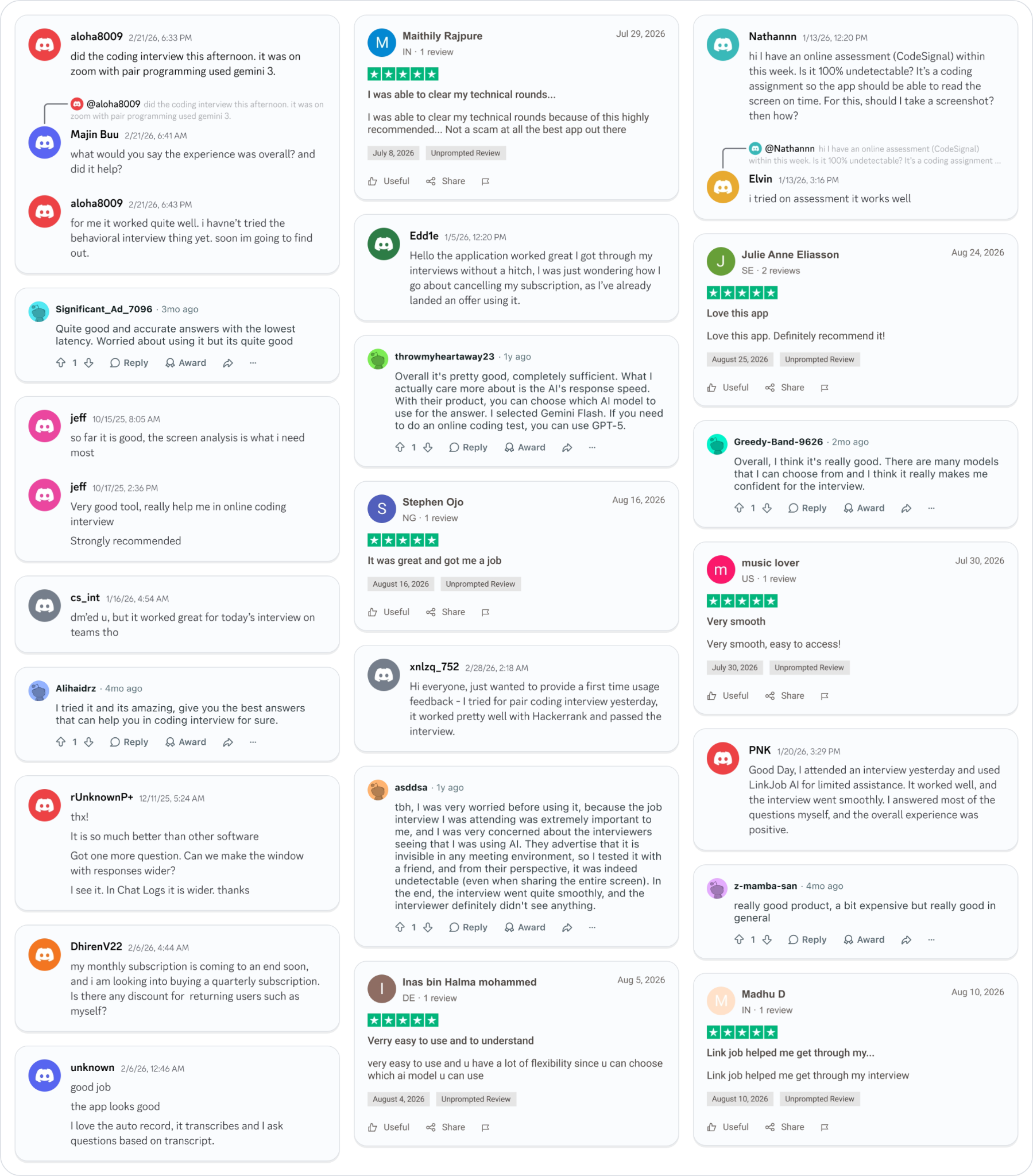
Smoother interviews, coding challenges cleared, and job offers landed. See how users describe their experience with Linkjob AI—in their own words.

© Copyright 2026 Linkjob AI - All Rights Reserved.