How I Get invisible AI Help for Watson Glaser Test In 2026


In recruitment, especially at top firms, thousands of applicants compete for a limited number of roles. One test often plays a major role in that process: the Watson Glaser Critical Thinking Appraisal. This test measures how well you can analyze arguments, identify hidden weaknesses, and make logical conclusions under pressure.
That is also why the test can feel intimidating for many candidates like me. Although the test itself does not detect cheating, the platform used to deliver it may include various anti-cheating systems such as tab-switch detection, webcam monitoring, screen tracking, copy-paste restrictions, randomized test versions, and behavioral analytics. It can be a tough task for all the candidates to achieve a desirable score.
However, with the support of the latest AI tools, I was able to complete the test without any misconduct being detected and achieve a high score. In this article, I will explain what the Watson-Glaser test is, how it detects cheating, and why it is necessary to use an AI tool to help you. Using an undetectable on-screen AI interview assistant during the test truly changed the game.
What is Watson Glaser Test ?
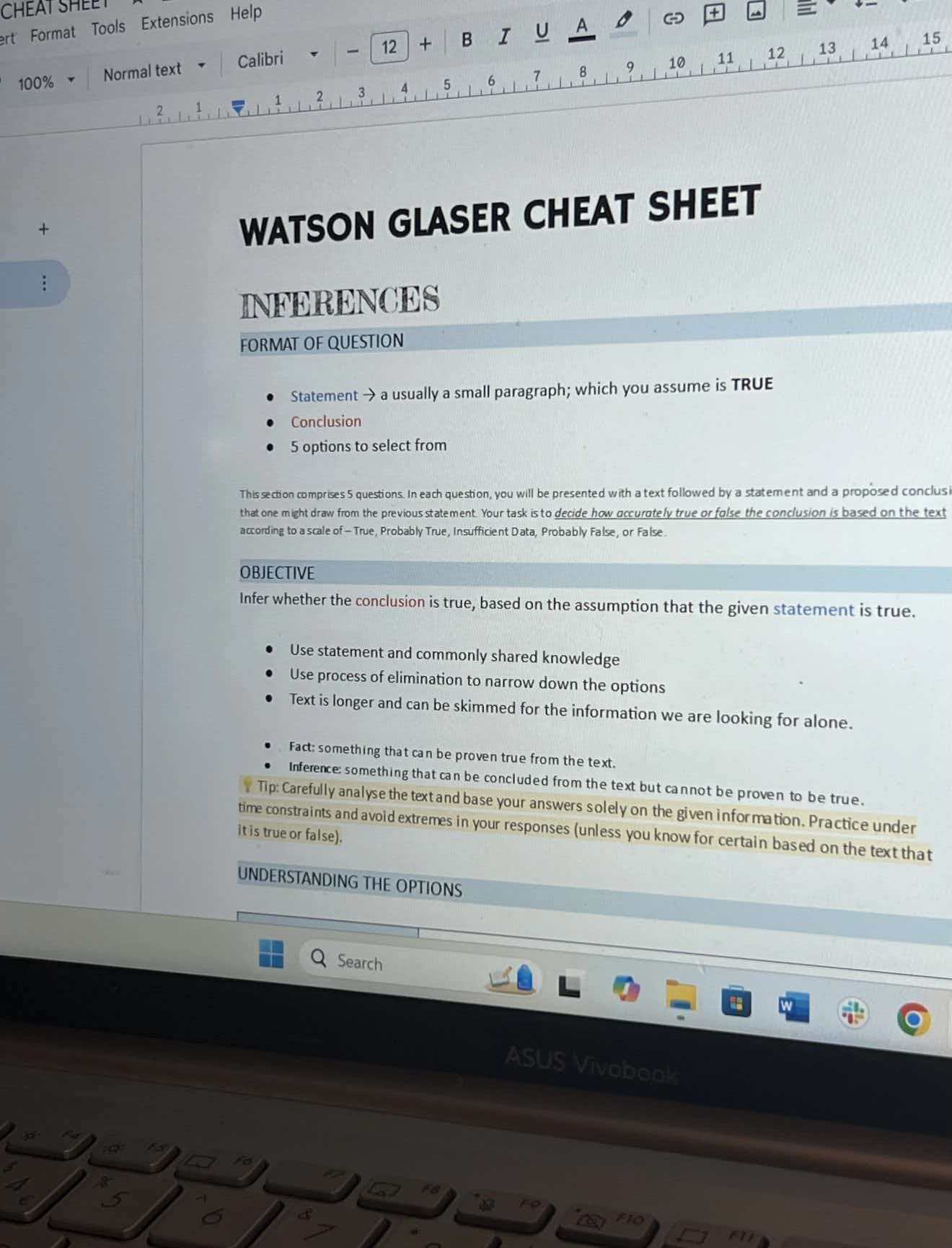
The Watson Glaser Test, also known as the Watson Glaser Critical Thinking Test, is a common pre-interview screening tool used by law firms, consulting firms, and companies in the finance industry to assess your critical thinking and reasoning skills. The test usually consists of 40 questions that must be completed within 30 minutes, although some firms may use an 80-question version with a 60-minute time limit.
To succeed in the Watson Glaser Test, you need to master each question type, practise with realistic examples, manage your time effectively, and benchmark your score. For top firms, achieving 33–34 correct answers can place you around the 80th percentile.
For many job applicants, the Watson Glaser Test serves as a crucial first hurdle in the hiring process, as your performance can determine whether you progress to the next stage, such as an interview or the assessment centre stage.
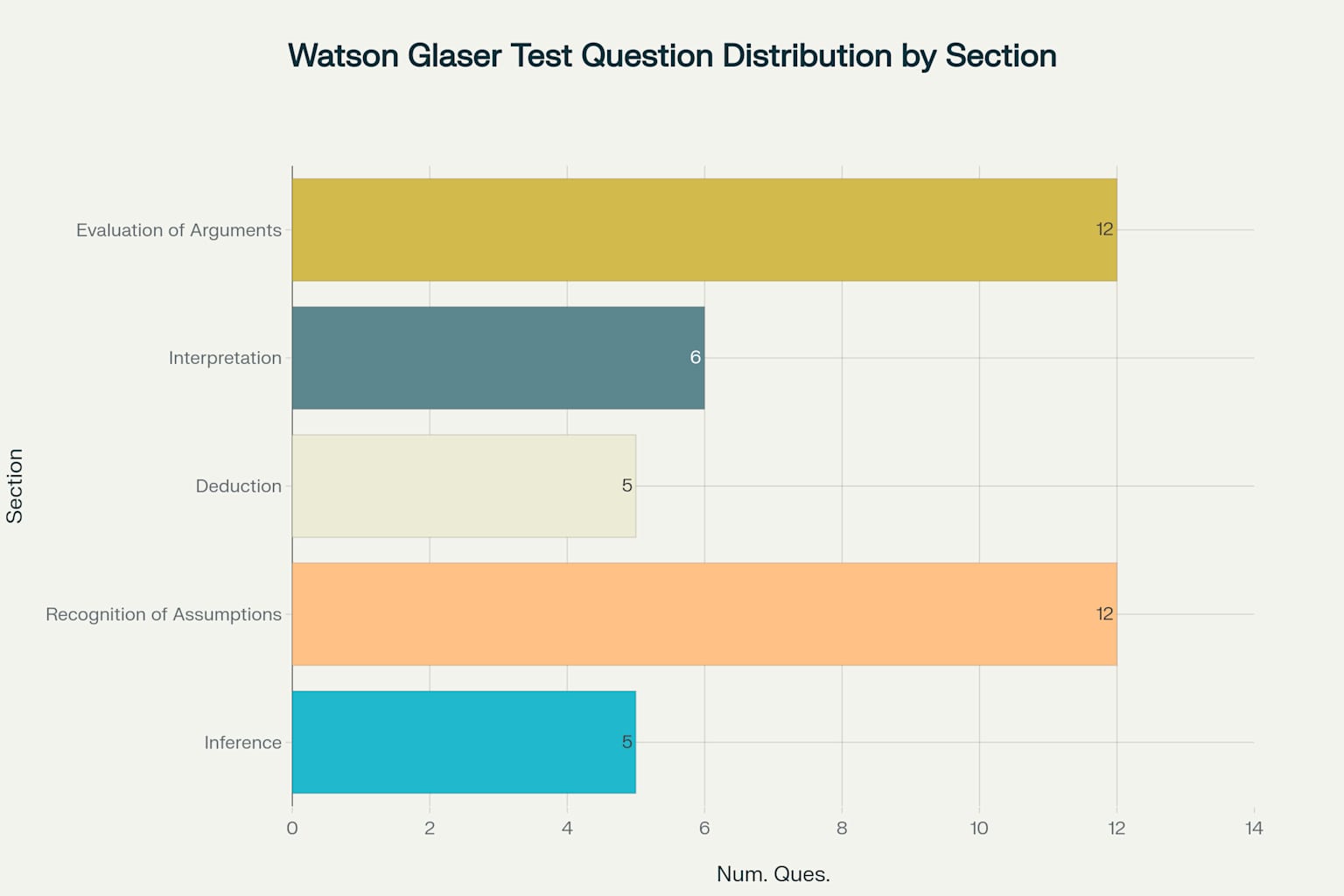
What are the five Watson Glaser Question Types?
The test measures five essential critical thinking skills, including inference, assumption, deduction, interpretation, and evaluation of arguments.
1. Inference
n the Inference section, I had to judge how much I could reasonably conclude from the information given. The statement is supposed to be treated as true, but the tricky part is that you cannot bring in your own assumptions or outside knowledge.
After reading the statement, you will see several possible inferences and decide how strongly each one follows from the information. From my experience, the hardest part is choosing between “Probably True,” “Insufficient Data,” and “Probably False.” Sometimes an inference sounds reasonable at first, but if the statement does not actually support it, you should not treat it as true. A useful tip is to keep asking yourself: “Is this clearly supported by the statement, or am I filling in the gap myself?”
True – The inference clearly follows from the statement.
Probably True – It is more likely to be true than false.
Insufficient Data – There isn’t enough information to decide.
Probably False – It is more likely to be false than true.
False – The inference clearly does not follow from the statement.
Example Question:
Statement: All trainees at the law firm attended a compulsory induction session on Monday. Sarah is a trainee at the law firm.
Inference: Sarah attended the induction session on Monday.
Correct Answer: True.
Reason: Since the statement says all trainees attended the session and Sarah is a trainee, the conclusion must be true.
2. Recognition of assumptions
For me, this part was less about reading the sentence itself and more about reading between the lines. You will see a statement and then a possible assumption. What you need to decide is whether the person making the statement has already taken that idea for granted. If the statement depends on it, choose “Assumption Made.” If the statement can still make sense without it, choose “Assumption Not Made.”
The tricky thing is that some assumptions look very reasonable at first. But in this section, “reasonable” does not always mean “necessary.” I found myself needing to slow down and ask: Does the speaker actually need this assumption for the argument to work, or does it just sound related?
A small trick that helped me was to remove the assumption from the sentence in my head. If the original statement still works without it, then it is probably not an assumption being made.
Example Question:
Statement:
This law firm should introduce more online training sessions so that trainees can learn more flexibly.
Proposed Assumption:
All trainees prefer online training to in-person training.
Correct Answer: Assumption Not Made
Explanation:
The statement says online training may help trainees learn more flexibly, but it does not require the idea that all trainees prefer online training. The argument can still work even if only some trainees prefer it.
3. Deduction questions
I found Deduction to be one of the more rigid parts of the Watson Glaser Test, because there is not much room for interpretation.
You are given a few statements, followed by a conclusion. The key is to decide whether that conclusion is definitely supported by the statements, not whether it simply sounds reasonable. If the conclusion has to be true based on the information given, choose “Conclusion Follows.” If there is even a small gap in the logic, or if you need to assume something extra, choose “Conclusion Does Not Follow.”
What made this section tricky for me was that some conclusions looked very believable at first. But believable is not the same as proven. I had to keep reminding myself to stay inside the information given and not bring in real-world guesses.
Example Question:
Premises:
All trainees who complete the legal research course receive a certificate.
Emma completed the legal research course.
Conclusion: Emma received a certificate.
Correct Answer: Conclusion Follows
Explanation:
The first sentence says that all trainees who complete the course receive a certificate. Since Emma completed the course, the conclusion must be true.
4. Interpretation questions
For me, Interpretation questions felt close to Deduction, but slightly less black-and-white.
You will be given a short piece of information followed by a conclusion. The main thing is to decide whether the conclusion is strongly supported by what is stated. It does not have to be mathematically certain, but it should be clear enough that you would not have much reason to doubt it.
If the conclusion is well supported, choose “Conclusion Follows.” If it feels like a stretch, or if you need to assume extra information, choose “Conclusion Does Not Follow.” The difficult part for me was avoiding “almost right” conclusions. Some answers sound sensible, but they may go one step further than the passage allows. I found it helpful to ask myself: “Is this conclusion really supported, or does it just sound like a reasonable guess?”
Example Question:
Statement:
A law firm surveyed 100 trainees about their preferred training format. 72 trainees said they preferred a mix of online and in-person training, while 18 preferred fully in-person training and 10 preferred fully online training.
Conclusion: Most trainees prefer some form of in-person training.
Correct Answer: Conclusion Follows
Explanation:
This conclusion is strongly supported by the information. The 72 trainees who preferred a mix still wanted some in-person training, and another 18 preferred fully in-person training. That means 90 out of 100 trainees preferred at least some in-person training.
5. Evaluation of arguments
I found this section quite practical, because it tests whether you can tell the difference between a solid argument and one that only sounds convincing.
You will be given a yes-or-no question, followed by an argument supporting one side. The task is to decide whether the argument is strong enough to matter. A strong argument should be relevant to the question and give an important reason. A weak argument may still sound logical at first, but it might be too general, too emotional, based on personal preference, or not directly linked to the question.
The part I had to be careful with was not letting my own view get in the way. Even if I personally agreed with the argument, I still needed to judge whether it was actually useful and relevant. A question I kept asking myself was: “Would this reason genuinely help someone make a decision, or is it just a nice-sounding statement?”
Example Question:
Question:
Should law firms use online assessments as part of their trainee recruitment process?
Argument:
Yes. Online assessments can help law firms screen a large number of applicants more efficiently before inviting them to interviews.
Correct Answer: Strong Argument
Explanation:
This is a strong argument because it is directly related to the question and gives an important practical reason. If a firm receives many applications, using online assessments can make the recruitment process more efficient.
How Does Watson Glaser Test Detect Cheating
After understanding the five question types, the next thing worth knowing is how the Watson Glaser Test prevents cheating. This is something many candidates overlook, but it can directly affect your test experience. Because the test is often used to decide whether you move forward to interviews or assessment centre stages, firms usually have systems in place to make sure the result is fair and reliable.
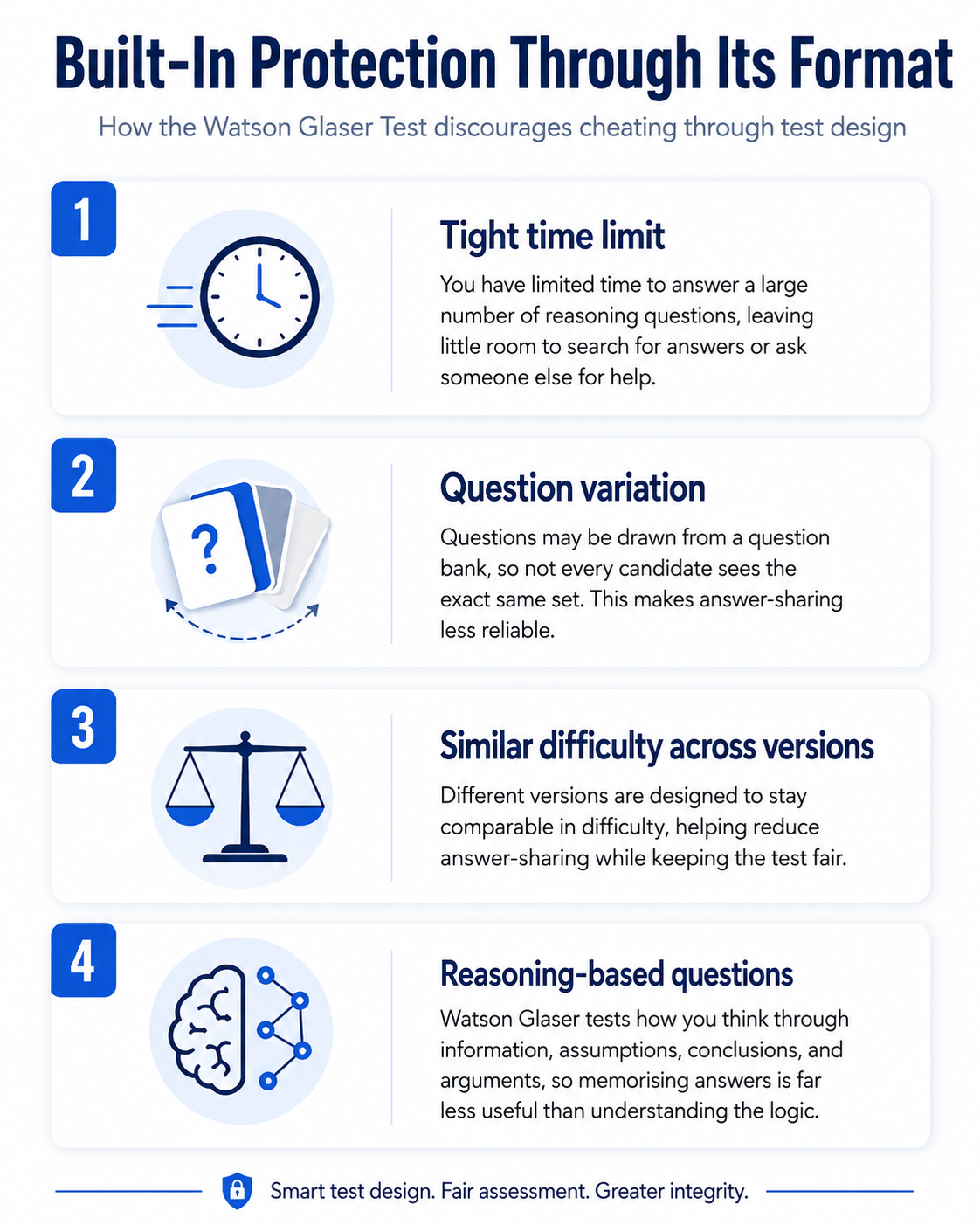
Built-In Protection Through Its Format
1. Tight time limit
One of the most obvious protections is the time limit. The Watson Glaser Test gives you a limited amount of time to answer quite a few reasoning questions, so there is not much room to search for answers or ask someone else for help during the test.
This is also why practising beforehand matters. If you are seeing the question types for the first time during the real test, the time pressure can feel much worse.
2. Question variation
The test may use questions from a question bank, which means not everyone will necessarily get the exact same set of questions. This makes it harder to rely on shared answers from other candidates.
In other words, memorising someone else’s test experience is not a reliable strategy. You still need to understand how each question type works.
3. Similar difficulty across different versions
Even if the questions are different, the test is designed to keep the difficulty level fair across versions. So the purpose of changing questions is not to make one candidate’s test easier or harder, but to reduce answer-sharing while keeping the assessment comparable.
4. Reasoning-based questions
Watson Glaser is not a knowledge test where you can simply look up the answer. It tests how you think through information, assumptions, conclusions, and arguments. That makes cheating less useful in practice, because even if you find a similar question online, you still need to understand the logic behind the answer.
Extra monitoring from the platform
While the Watson Glaser Test itself mainly relies on test design features such as time limits and item-banked questions, stronger anti-cheating controls may come from the platform used to deliver the assessment. According to Pearson TalentLens, it states that its remote proctoring is powered through integration with HirePro, which can provide automated proctoring, suspicious behaviour detection, live candidate warnings, video and audio monitoring, impersonation monitoring, and browser monitoring.
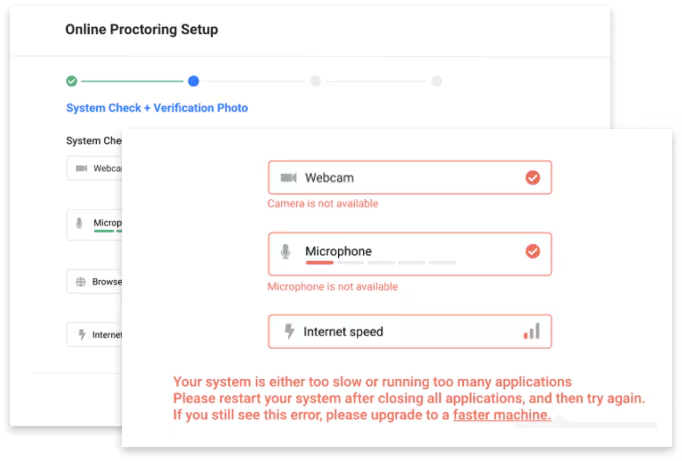
Webcam and Microphone checks
If the employer uses a proctored version of the Watson Glaser Test, the platform may ask for access to your webcam and microphone. This is usually used to check whether you are taking the test alone and whether there is anything unusual happening around you, such as another person speaking, someone appearing on camera, or the candidate moving away from the screen for too long.
Browser and test window monitoring
The platform may also track what happens in your browser during the test. For example, the system might detect if you leave the test page, switch tabs, open another application, or try to access outside resources. Not every test will use the same browser monitoring settings, but if proctoring is enabled, these actions may be flagged.
Keystrokes Track and Copy/Paste Detection
It may monitor things like keyboard activity and copy/paste behavior pretty closely. Repeated shortcuts like Ctrl+C and Ctrl+V can look suspicious and make it obvious that outside help is involved.
Overall, Watson-Glaser’s own anti-cheating protection mainly comes from its time limit, question variation, and reasoning-based question design. The more advanced monitoring features, such as webcam checks, browser tracking, audio monitoring, and identity verification, usually depend on the platform used by the employer. I noticed that this also applies to coding assessments like HackerRank. Time pressure, changing questions, and platform monitoring can make the real test stressful, so preparation matters more than shortcuts. If you are also preparing for a coding test, I recommend reading the related guide on how I used AI to Pass HackerRank test.
Why Linkjob AI is a great choice to help you succeed
After looking at these anti-cheating mechanisms, one thing becomes clear: the Watson Glaser Test is not something you can simply “wing” during the real assessment. This is why I started looking for a better way to do well on the test. I personally find that the best way to cheat the test itself or the platform used to deliver this assessment is using LinkJob AI, an invisible AI tool that could help you outperform in the test. It's quite useful in multiple areas:
Completely Invisible
It stays completely under the radar during screen sharing, tab checks, and webcam monitoring. No Dock icon, no Menu Bar presence, and nothing showing up in Activity Monitor or Task Manager. Even the cursor stays hidden, and the hotkeys are practically impossible to detect.
Real-time AI Helper
Honestly, once you start using it during online exams, it just feels incredibly smooth. It can see what’s on your screen and respond with answers almost instantly, so there’s no awkward waiting or noticeable delay. Everything runs quietly in the background, to the point where it barely feels like anything extra is even there.
High-Quality Answers
I’ve used a bunch of AI tools before, and this feels noticeably smarter and more reliable. It runs on 80+ top models like GPT-5.1 and Claude Opus, so the replies usually feel accurate, natural, and actually relevant to what you’re asking.
From my experience, LinkjobAI is not only helpful for Watson Glaser preparation. It can also support other online assessment scenarios, including Canvas-based quizzes and assignments. Check the blog on how I used AI to pass Canvas quiz.
FAQ
How do I pick the best AI tool for the Watson-Glaser Test?
I look for AI tools that offer practice questions, clear explanations, and chat support. I always test the tool with sample questions first. If it helps me understand my mistakes, I stick with it.
Does Watson Glaser Test Track Eye Movement?
According to its official page, the Watson Glaser Test doesn’t appear to track eye movement. That said, it may still monitor other types of activity during assessments, like keyboard behavior, browser activity, or interaction patterns. These checks are generally used to help maintain test integrity and discourage dishonest behavior.
Can proctoring software catch me using AI help?
Not for Linkjob AI. I’ve used it during exams and live interviews and it’s surprisingly discreet the whole time. Even with screen sharing, tab monitoring, or webcam checks running, nothing noticeable shows up on the screen. The app doesn’t appear in the Dock, Menu Bar, Activity Monitor, or Task Manager, so it just quietly runs in the background. The hidden cursor and subtle hotkeys also make everything feel smooth and natural while you’re using AI assistance in real time.
Besides Watson Glaser Test, can I also use LinkJob AI in other interviews?
Linkjob AI works well across different types of interview rounds. Before the interview starts, you can choose from a variety of built-in prompts, and there’s also the option to customize prompts for specific needs or interview styles. For example, the “Interview Assistant” prompt is a good fit for general or behavioral interviews, while the “Technical Interview Helper” prompt is better suited for coding and technical discussions.
See Also
How to Get Invisible Help for TestGorilla With AI: My 2026 Update
How to Pass the Mercor Interview with Secret Methods in 2026
How to Get Invisible AI Help for Ropes Interview in 2026 without Getting Caught
How to Pass Flowmingo Interview Using AI Interview Copilot
How to Get Invisible AI Help for Mettl Exam in 2026 Without Getting Caught
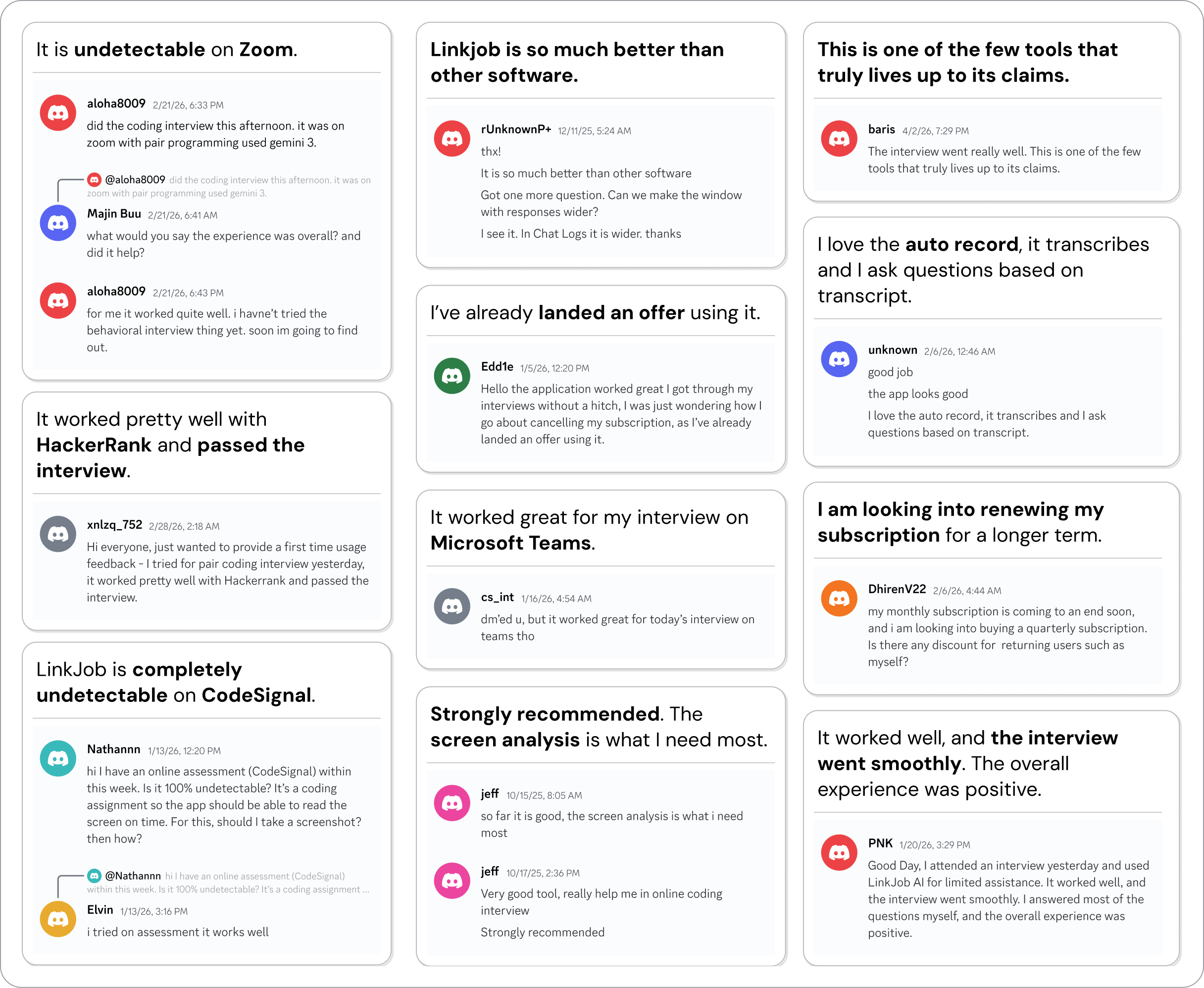
Why People Choose Linkjob AI
Smoother interviews, coding challenges cleared, and job offers landed. See how users describe their experience with Linkjob AI—in their own words.

© Copyright 2026 Linkjob AI - All Rights Reserved.