How I Boost My Grades Using Online AI Exam Assistant in 2026

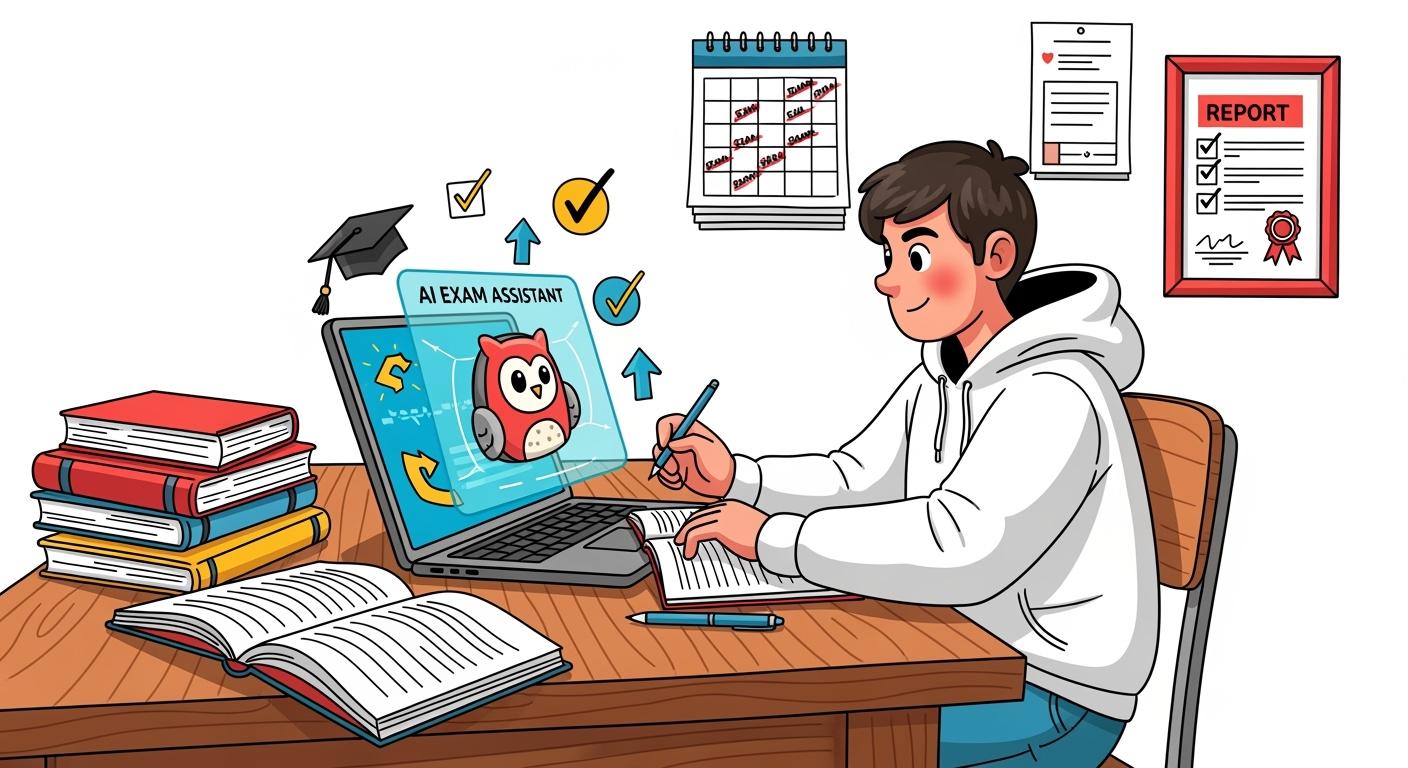
Have you ever heard about using an online exam assistant with AI to help you pass and get higher grades when taking online exams? I am going to tell you that "Online Exam Assistant" is no longer just a luxury.
After reading this article, the only barrier holding you back — disbelief that such a powerful and completely invisible tool actually exists — will vanish for good. This guide serves as a manual on how I personally used an online AI exam assistant, linkjob.ai, to actually skyrocket my grades. If you are facing other online exams, you could read other passages, like my choice of AI oral exam interview assistant, how to cheat on Testlify, and also, how to cheat on Testgorilla.
Choosing An AI Online Exam Assistant
Essential features
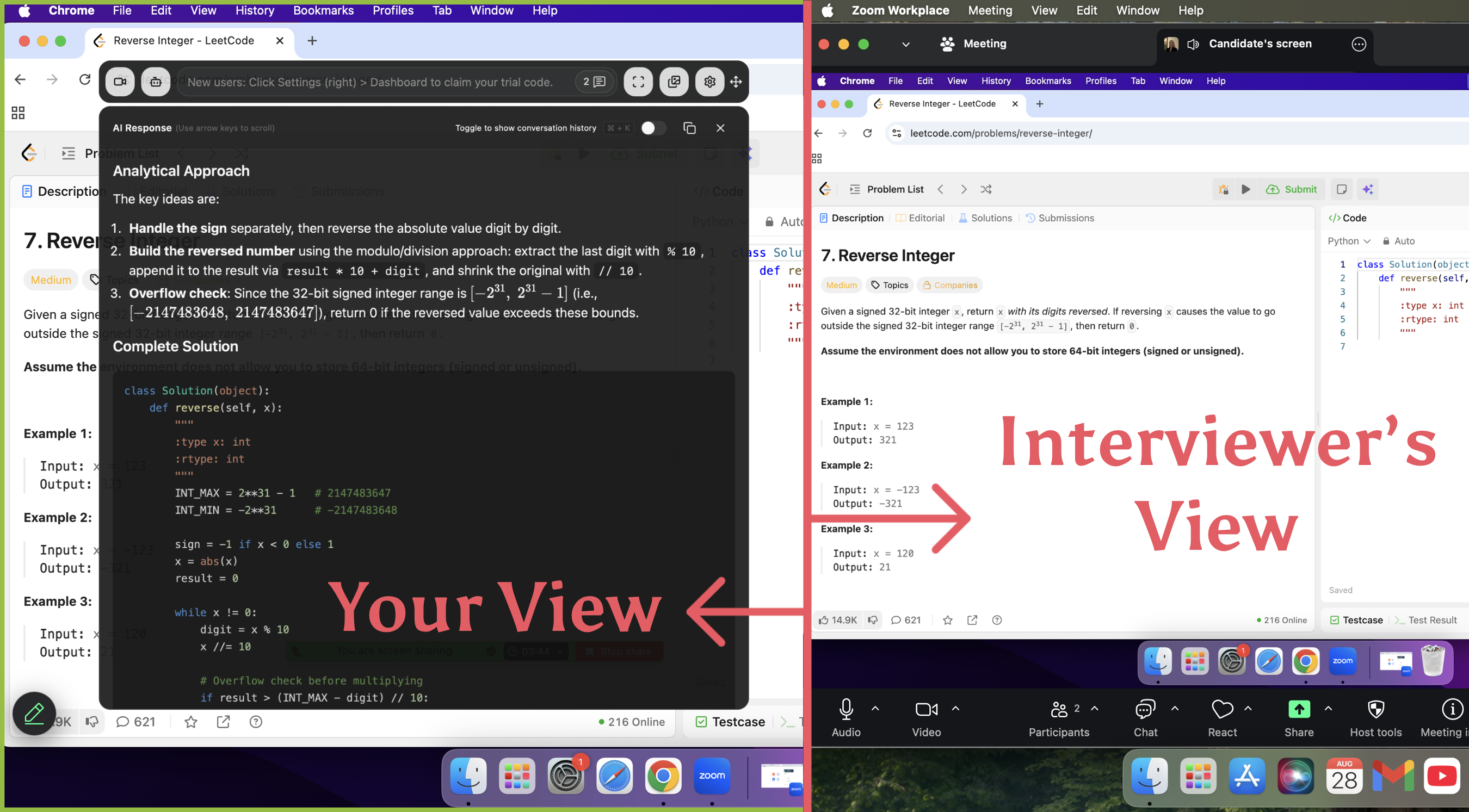
In 2026, the #1 rule for any assistant is invisible. Most "AI helpers" look like flashy billboards, but the best tools for 2026, like Linkjob.ai, are "designed to disappear". You need a Stealth Mode that offers muted styling, no bouncing pop-ups, and a resizable answer box that can be tucked away beside your notes.
Another must-have is context-awareness. You don't have time to copy-paste during a 90-second-per-question quiz. Look for "one-click" features where the AI "reads" your screen via a hotkey. Linkjob.ai supports this feature — and responds in less than a second.
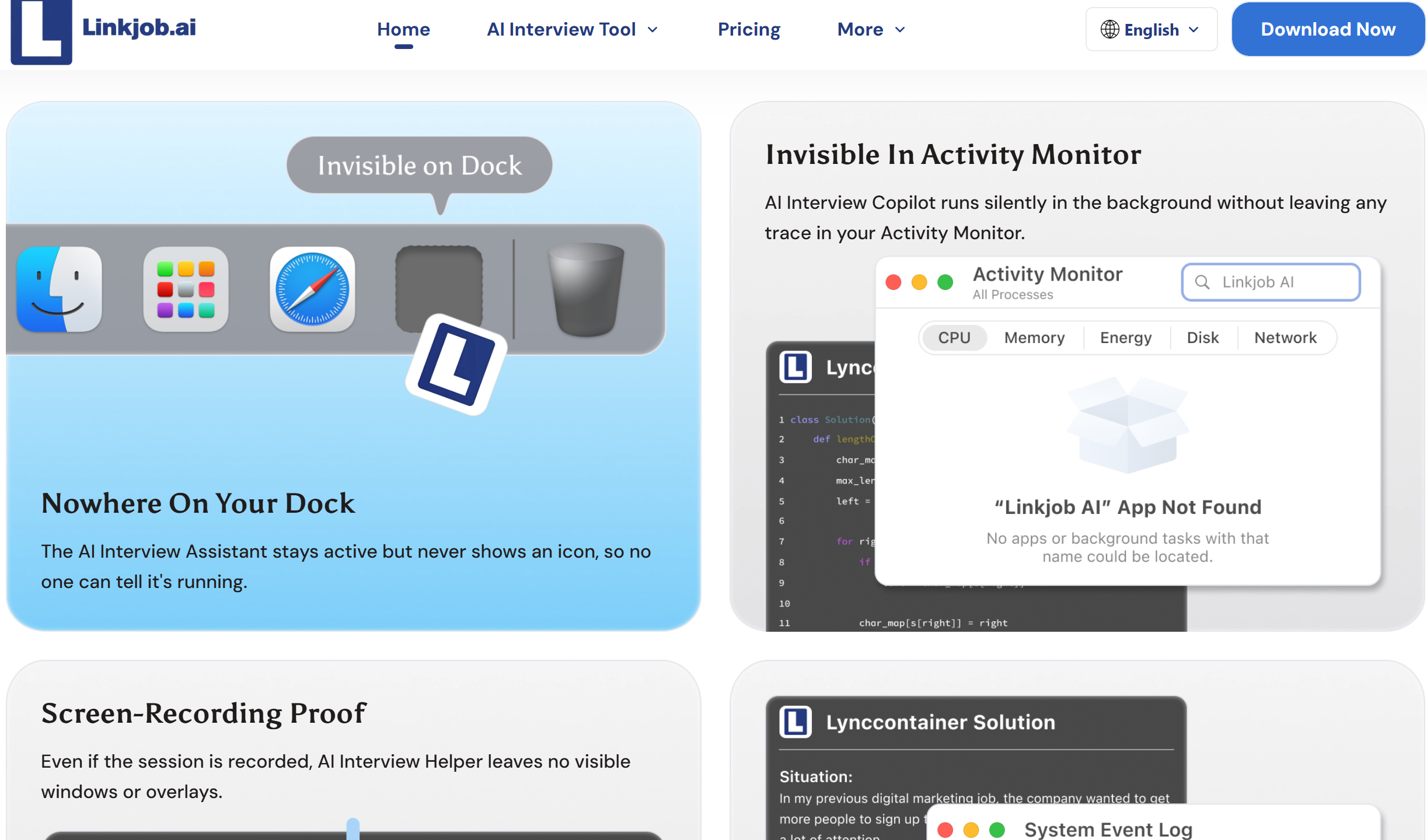
Finally, look for a privacy guarantee; your assistant should never store screenshots or log your questions, so you can be totally innocent.
Matching Your Learning Style
The ideal online exam assistant should adapt to how you process information. For students tackling STEM subjects, the ability to screenshot complex graphs, charts, and math formulas is essential, as these are difficult to retype during an exam.
If your coursework involves humanities or social sciences, look for an online exam assistant that offers "Polishing" features. These tools can take a rough draft and improve its grammar, clarity, and overall readability while ensuring the text remains statistically indistinguishable from human writing.
Comparing Online Exam Assistant Options
In 2026, you generally face three choices:
Chrome Extensions: These offer "one-click" simplicity for browser-based assignments but are often the first to be targeted by proctoring add-ins.
System-Level Desktop Software: This is the gold standard for flexibility, as it functions across all applications—including Zoom calls, PDFs, and lockdown environments—by operating as a system-level overlay.
Technical Expert Methods: For high-stakes professional certifications, some opt for custom-developed software installed by technical experts that proctoring programs cannot detect or close
Setup For An AI Online Exam Assistant
Customizing the Stealth Overlay
Instead of "integrating" with the coursework, your setup should focus on becoming invisible to it. Modern proctoring constantly monitors for Focus Loss Count—the number of times you switch tabs or applications.
A professional-grade online exam assistant, such as Linkjob AI, functions as an invisible system-level layer rather than a standard window. Hitting the button on the floating bar is completely undetectable, even under the most rigorous proctor monitoring.
Bypassing Environment Checks
Before starting the exam, you need to ensure your online exam assistant doesn't trigger "process monitoring." 2026 versions of lockdown browsers scan for "unusual process trees" and "injected DLLs". Your setup should prioritize a tool that runs in a hidden mode invisible to screen-sharing and capture software. This ensures that even if the system performs a "webcam room scan," the AI remains purely a digital phantom on your display, unseen by proctors.
Mastering the 'Non-Suspicious' Behavioral Profile: Grade improvements come from behaving like a "standard" student while receiving AI help. Behavior analytics now groups students into "clusters" based on their interactions.
To stay in the safe zone:
Diminish Text Selection Count: Avoid constantly highlighting the question text, as this is a primary indicator of AI-assisted cheating.
Diminish RCC Right-Click Count: Never use the right-click menu to trigger your assistant; use stealth hotkeys instead to avoid detection by the exam log.
The 'Copy-Type' Strategy for Biometric Safety
The most advanced part of exam prep is mastering the Copy-Type Attack. Even if the system tries to catch AI by looking at my typing patterns, it’s mostly just checking for my physical "motor signals".
When I read the AI’s answer and type it out myself, keystroke by keystroke, I’m producing a real human signal that looks just like I’m composing the text from scratch. These detectors are basically just checking if a human body is present, not where the ideas actually came from. So, the system ends up giving me a green light because it confirms a human is at the keyboard, even though the AI did all the heavy lifting for the content.
Even though there’s a tiny statistical difference between my "thinking" while I type and my just "transcribing," it's totally irrelevant for security because both look completely human compared to the way a bot injects text. At the end of the day, I'm just laundering the AI's words through my own fingers
Real-Time Logic Verification
Instead of using the AI to "summarize articles," use it to verify the reasoning steps of a problem during your practice sessions. Since LLMs can "hallucinate," practicing with the assistant's step-by-step reasoning tools ensures that when the high-stakes exam begins, you can quickly spot-check the AI's logic to guarantee a 40-point score boost without blindly following incorrect feedback.
Study and Exam Prep With AI Online Exam Assistant
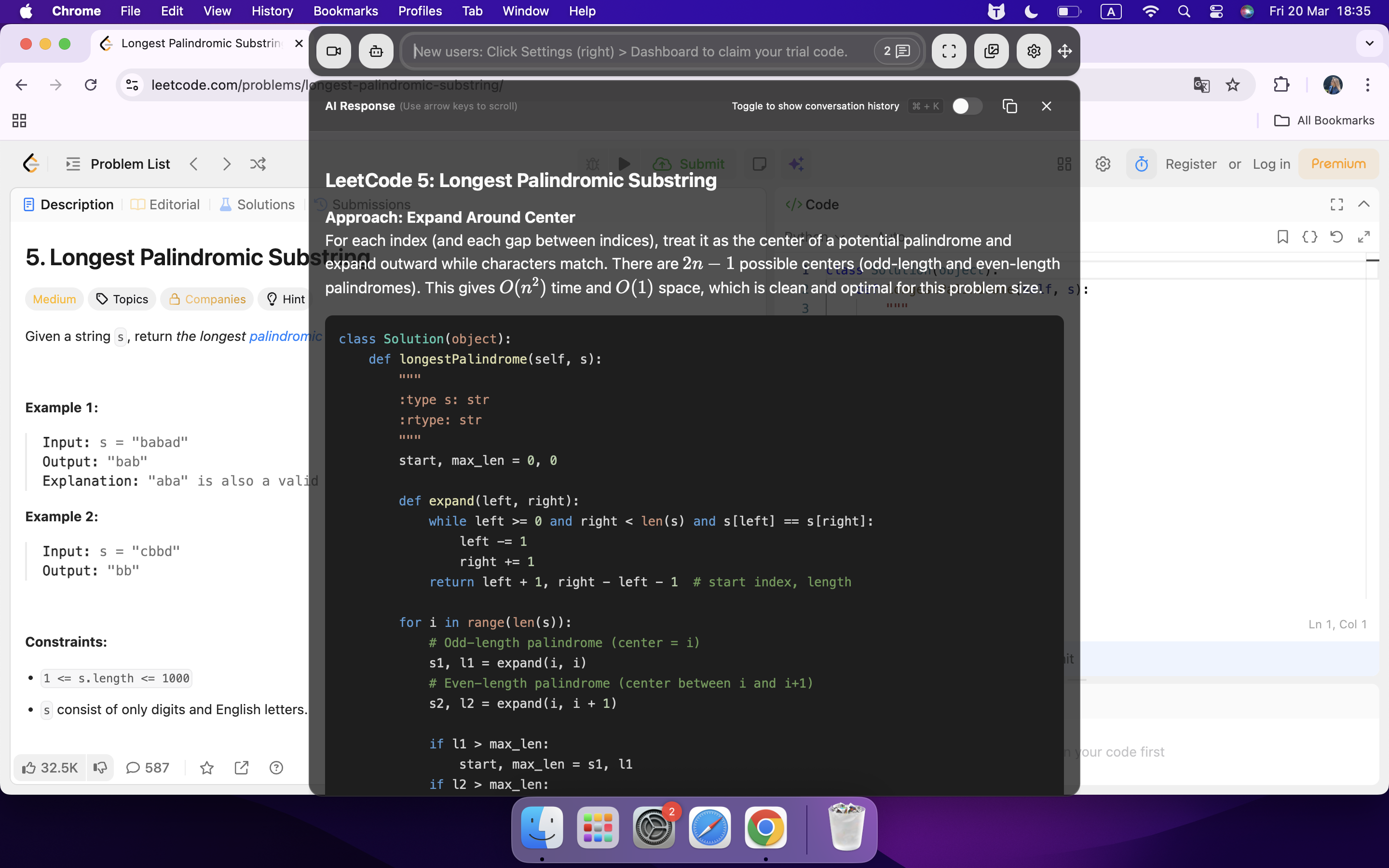
Practice and Feedback Tools
While most people assume our recording and transcription feature is strictly for nailing job interviews, I actually use it for exam-level active recall. I’ll explain a complex concept out loud while the assistant "listens in" and builds a full, searchable transcript of my explanation in real-time. This lets me see exactly where my logic gets fuzzy. Then, I hit it with a "Polishing" prompt to transform my raw brain-dump into a professional, academic response. Comparing my original transcript to the AI’s refined version is the ultimate feedback tool—it helps me spot knowledge gaps and master that high-level "A-grade" tone before I ever sit down for the actual test.
Personalized Prompts
Personalizing specific prompts in 2026 is essential. By giving the AI three or four examples of your actual exam case, you can train it to produce study guides and notes that best fit the specific exam. This makes the material easier to memorize and ensures the AI assistant you use the most is compatible with the model.
Here are some of the personalized aids I used for customization in linkjob.ai:
Study Aid Type | Description |
|---|---|
Claude | I use it for coding exams, and it has very high precision in completing such tasks. |
Gemini | I rely on this model for its advanced reasoning capabilities, particularly when I need to solve complex mathematical problems or handle technical translations. |
Chatgpt | This is my go-to for generating highly coherent, human-like responses that can adapt to a vast array of academic topics and writing styles |
Grok | The provided sources do not contain information regarding this specific model, but it is generally known for its real-time access to data and conversational style |
Ethical Use Of Your Online Exam Assistant and Exam Security
AI Proctoring and Integrity
To stay safe, you must understand how proctors like Honorlock and Respondus operate and how they integrate with Canvas. After knowing these, you would gain a better sense of how to cheat on Canvas. They use AI-powered eye tracking, head movement analysis, and room scans to find "suspicious behavior". Most undelightfully, they use "Honeypots." These are fake websites hosted with search-engine-optimized "answers" to your specific exam questions. If you use a secondary device on the same Wi-Fi to search for answers, the proctor detects your IP range and flags you immediately
Responsible Use
Three "deadly" metrics mentioned in the previous part that should be minimized:
Highlighting the question text as you read it is a major flag.
Using the context menu to trigger a browser extension is easily logged.
Switching tabs or applications is the most common reason students are caught. Research shows that students who exhibit high levels of these behaviors score 30-40 points higher on average, but are at a 33% higher risk of being flagged for a manual review
Maximizing Performance Ethically
Be sure to use physical fingers to produce motor signals, which means my biometric timing signal (δ) is guaranteed to be classified as human. By doing this, I'm producing a genuine motor signal that is indistinguishable from original composition, effectively laundering the AI's words through my own fingers to bypass even the most advanced keystroke-based detectors.
Results and Overcoming Challenges
Grade Improvements
To give you a real-world look at the results, I went from struggling with a 42 on a quiz while working entirely on my own to hitting a 91 on my midterm. This massive jump—nearly 50 points—was possible because I leveraged the assistant to navigate both the complex multiple-choice questions and the short-essay sections in my advertising course.
Common Obstacles
The primary challenge is Frequent Auto-Updates. Software like Respondus LockDown Browser (v2.1.3.08) constantly pushes patches to detect virtual machines, HDMI splitters, and remote access tools like AnyDesk. If you attempt a "DIY" bypass without professional-level understanding of any of these, your system is likely to crash or flag you during the exam.
Solutions and Feedback
To overcome these obstacles, the most reliable strategy is to use an AI online exam assistant to avoid network-snooping honeypots. Especially for high-stakes exams, many students prefer to use online exam assistance. This involves having a technical expert install a dedicated online exam assistant that resides in a hidden layer of the OS, making it invisible to proctoring system checks.
Try an online exam assistant, share your journey, and watch your grades improve!
FAQ
How do I start using an online AI exam assistant?
I signed up on the linkjob.ai website. I start a free trial first and then try out all the functions by following linkob.ai's tutorial.
Can I use the AI assistant on my phone?
Yes! I download the app or use the mobile site. I check if my school allows mobile use during exams. I like studying on the go with quick quizzes and reminders.
What if the AI gives me wrong feedback?
I double-check my answers to make sure. Also, I pre-trained the AI and wrote personalized prompts to ensure it would work exactly the way I wanted.
How do I avoid getting too dependent on the AI?
I set limits for myself. I study with and without the assistant. Also, you could use it for practicing before the exam.
See Also
How I Managed to Get Invisible AI Help foran Online Assessment in 2026
My Experience Getting Invisible AI Help for Respondus to Pass Online Exams in 2026
How I Managed to Get Invisible AI Help for Honorlock Exams in 2026