How I Mastered OpenAI Interview Questions in 2026


I have just successfully passed my OpenAI interview. I put a lot of effort into preparing, including clearly breaking down problems, sharing my thought process, and demonstrating how I build robust solutions. These are all what OpenAI values in candidates for interviews. I thoroughly researched OpenAI's latest projects as well, and completed extensive hands-on coding exercises.
I am really grateful to Linkjob AI for helping me pass my interview, and that's why I’m sharing here my entire interview experience and how I mastered the questions I encountered. Having an undetectable live AI interview assistant during the interview indeed provides a significant edge.
Key Takeaways
Understand the 3 rounds of OpenAI interview, such as coding and ML system design, and focus on the different types of OpenAI interview questions.
Prepare by researching OpenAI's latest projects and aligning my experiences with their mission.
Practice real-world coding by searching the real OpenAI questions in recent years, especially the 8 kinds in 2026. Simulate real interview conditions to build confidence and familiarity.
Use structured frameworks like STAR for behavioral questions. This helped me communicate my thought process clearly.
Embrace feedback as a tool for growth. Reflect on my performance and continuously improve my answers and skills.
Overview of OpenAI Interview Questions and Process
When I started preparing for OpenAI interview questions, I did a research on the OpenAI interview process. I noticed they covered a wide range of topics and concluded that there're 3 main rounds:
Round | Duration |
|---|---|
Coding | 60 mins |
ML System Design | 30 mins |
Hiring Manager Chat | 30 mins |
Recent OpenAI SWE Interview Questions and Experience
OpenAI has always been my dream company, and this was the interview I prepared for the most. The role I interviewed for was software engineer.
Round 1: Coding (60 mins)
Problem: Cellular Automata / Pandemic Simulation
There were 3 progressive parts:
Basic: Given a grid of plants, simulate how a virus spreads day by day (similar to Conway’s Game of Life). A plant gets infected if it has at least T infected neighbors (including diagonals).
Compute how many days the pandemic lasts (ends when all plants are infected).
Add immunity: some plants can’t be infected.
Add recovery: plants recover after being infected for T days, and now the process ends when all plants recover.
I finished all parts in about 50 minutes. Code was clean, logic was clear. The interviewer (Abe) was super nice and we had a good rapport.
Round 2: ML System Design (60 mins)
Problem: Design ChatGPT Enterprise
Enterprise users can upload internal company data and use it to power customized ChatGPT experiences.
My approach:
Retrieval: dense + sparse hybrid retrieval
Pipeline:
Candidate generation → LambdaMART ranking → LLM re-ranking (3 stages)Covered:
Chunking strategy
Metadata extraction
Multi-tenancy & data isolation
Evaluation metrics:
Retrieval recall / precision
End-to-end response quality
Follow-up discussion:
Tradeoff between pointwise vs listwise reranking
I initially suggested pointwise, and the interviewer pushed on its weaknesses
Eventually we discussed how listwise can jointly optimize and capture interdependencies between documents
I was a bit rambling at the beginning. Fortunately, I turned to Linkjob AI for help, which provided me with a crisp answer. This tool is really useful.
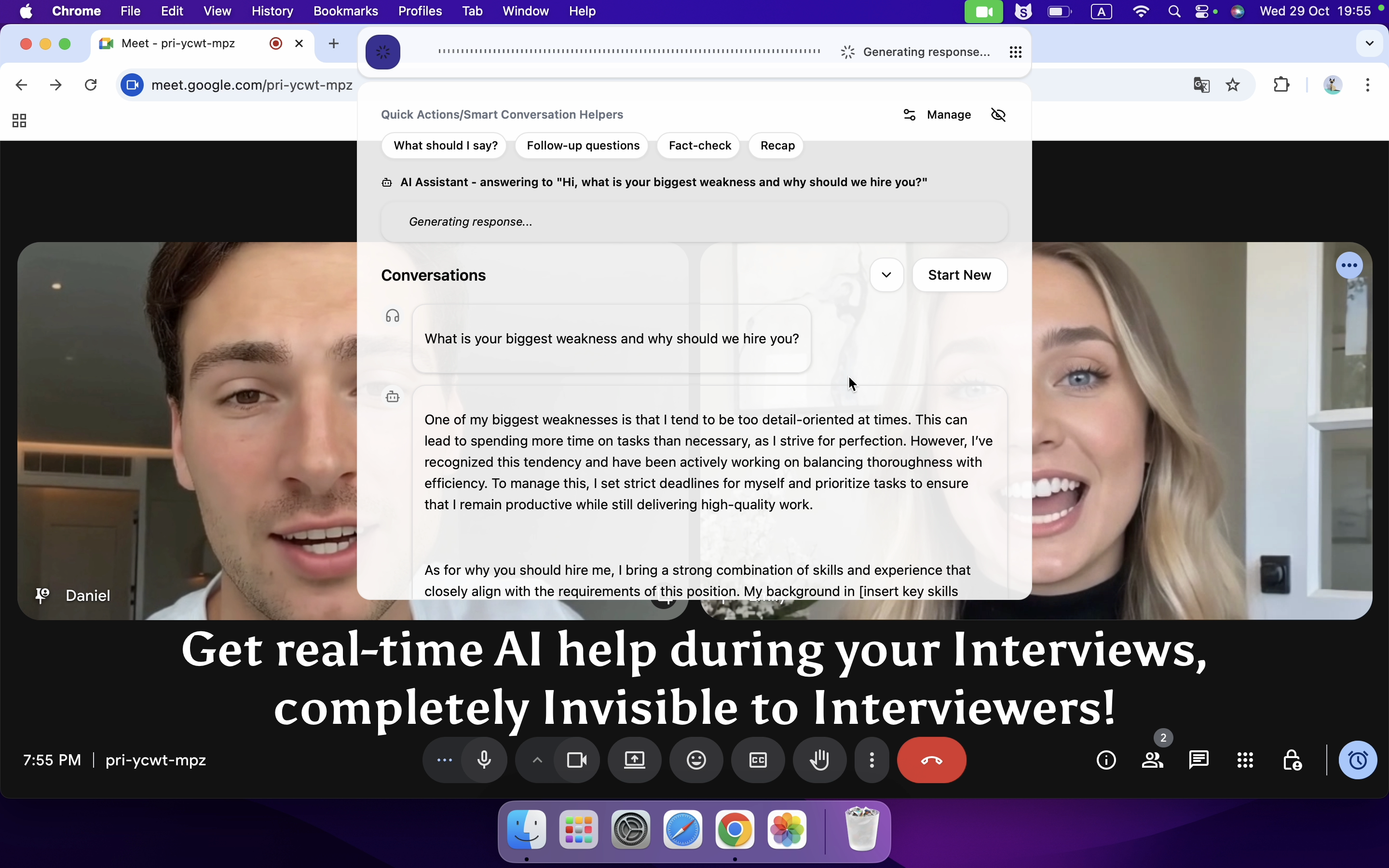
Real-time AI Interview Copilot
Round 3: Behavioral Questions (30 mins)
This was a chat with the hiring manager. He gave an overview of the team and the role.
One important signal:
If the HM is engaged and enthusiastic — actively pitching the team and role, sharing context about why the work matters, asking thoughtful follow-ups, and building on your answers — it usually means they’re excited about you.
If the HM is lukewarm — not really pitching the team, not engaging much, mostly just asking behavioral questions while you do all the talking — it usually means they’re not that excited about you.
Summary of OpenAI Interview Experience
Not only focus on tech, but also build connection with the HM.
Lesson: if the interviewer is quiet, don't just passively answer questions — actively show your passion and understanding of the role.Grinding problems is no longer enough.
For cutting-edge AI companies, they care more about how you think through open-ended problems, not just applying templates.Dataset understanding is super important.
I didn’t just focus on algorithms and system design — I also spent a lot of time preparing ML fundamentals, like data quality, training pipelines, and evaluation.Communication matters as much as technical skills.
Sometimes I knew more than I was able to express. I need to practice explaining complex ideas more clearly.
This experience also changed how I think about interview prep. I prepared with Linkjob AI, my AI interview assistant, and the hit rate was surprisingly high.
The key idea is simple:
Instead of blindly preparing, it helps you understand what interviewers actually care about, based on data.
It gives feedback from the interviewer's perspective — not just pointing out wrong answers, but also highlighting unclear logic and communication issues.
Real OpenAI Coding Interview Questions
In 2026, there are 8 questions that came up, due to space limitations, I'll list 3 of them below, and you may find the rest of them in OpenAI Coding Interview Question Bank. For each question, I gathered some descriptions from discussion threads and used Linkjob AI to help reconstruct them. Some details are still a bit unclear, but they're good enough for practice.
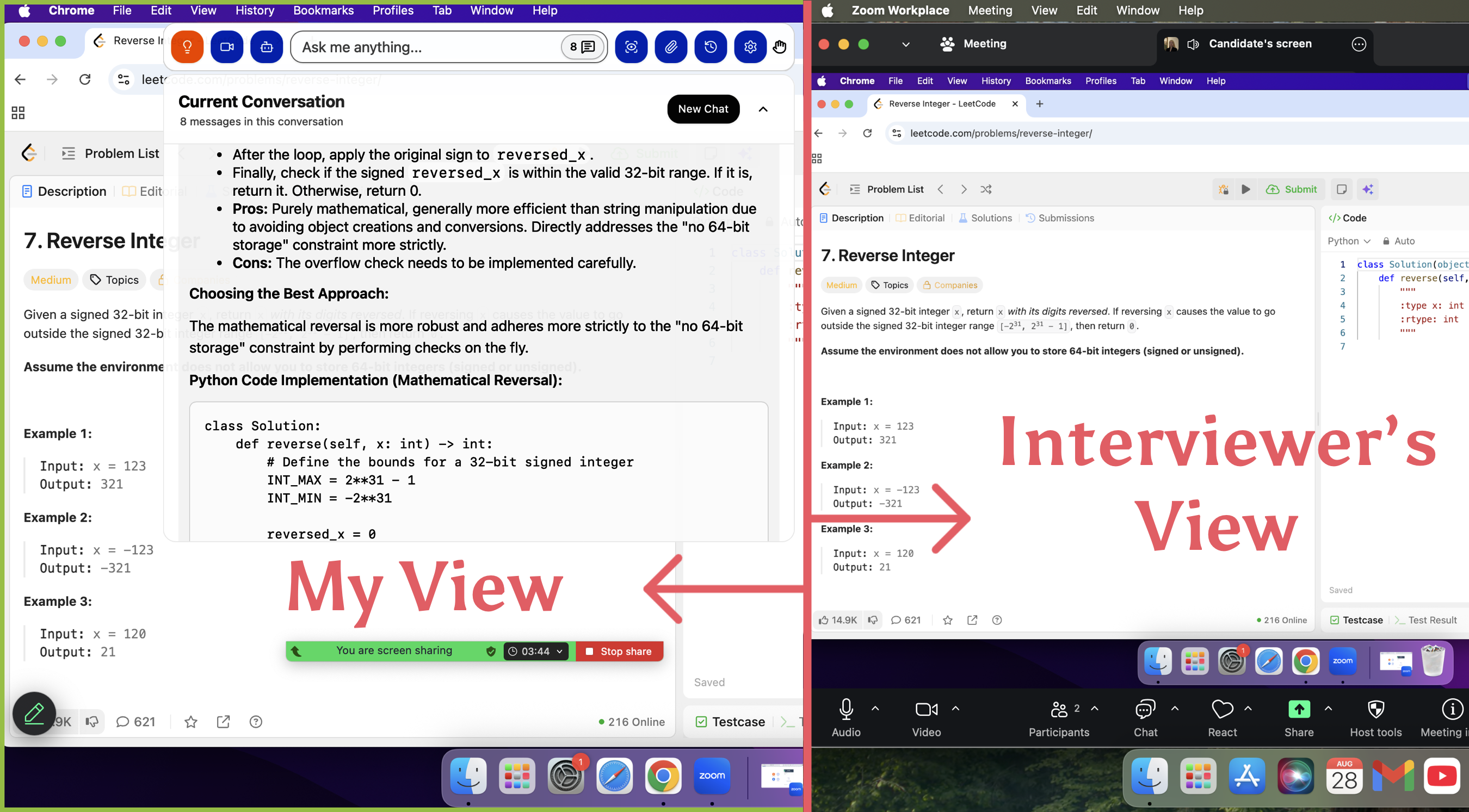
Undetectable AI Interview Assistant
During my coding interview, with the help of Linkjob AI, I handled all the questions.
Coding Interview Question 1: CD directory
Prompt
The following is a poorly-formatted interview question, can you formulated it into a well-structured interview question:
You need to implement cd(current_dir, new_dir) and return the final path. For example:
cd(/foo/bar, baz) = /foo/bar/baz
cd(/foo/../, baz) = /baz
cd(/, foo/bar/../../baz) = /baz
cd(/, ..) = Null
Follow-up: can we support something like ~ (home directory)?
Then increase difficulty: add a third parameter which is a soft link dictionary. For example:
cd(/foo/bar, baz, {/foo/bar: /abc}) = /abc/baz
cd(/foo/bar, baz, {/foo/bar: /abc, /abc: /bcd, /bcd/baz: /xyz}) = /xyz
There may be both short and long matches in the dictionary, and we should always match the longest (more specific) one first. For example:
cd(/foo/bar, baz, {/foo/bar: /abc, /foo/bar/baz: /xyz}) = /xyzAlso need to detect cycles in the dictionary.
Questions / Uncertainties
Not sure if the input path always ends with
/. If not, we probably need to normalize it ourselves.For the second part, not sure where
~(home directory) can appear — at the beginning? middle? in current_dir or new_dir?
When I solved it, I assumed the path may not end with /. I didn’t implement ~ since its behavior wasn’t clearly defined.
Key Points
Be careful when handling soft link condensation in part 3
Always match the longest prefix first
Coding Interview Question 2: Excel sheet
Prompt
The following is a ill-formatted description of an interview question, can you create an interview question that makes sense?
Design a Spreadsheet API. You need to implement getCell and setCell.
setCell can either take a raw value or depend on other cells. For example:
setCell("A", "B+C")
setCell("A", 100)
We need to support Excel-like behavior:
getCell(),setCell()handle cycles
expected to write tests
Part 1: it’s okay if getCell() is not optimized (compute value on the fly).
Part 2: optimize so that getCell() becomes O(1) by updating impacted cells during setCell().
You need to implement both functions and handle cycles. This mainly tests recursion.
Some tests:
spreadsheet = Spreadsheet()
spreadsheet.setCell('A1', '1')
spreadsheet.setCell('A2', '2')
spreadsheet.setCell('A3', '=A1+A2')
spreadsheet.setCell('A4', '=A3+A2')
spreadsheet.setCell('A5', '=A3+A4')
spreadsheet.setCell('B1', '=A1+A2+A3+A4+A5')
Another example:
Cell A = Cell (6, NULL, NULL)
Cell B = Cell (7, NULL, NULL)
Cell C = Cell (13, A, B)

print getCell(C) => 13
A+B = 6+7 = 13
If we later update A:
C depends on A and B, so it should update automatically:
update Cell A = Cell (2, NULL, NULL)
print getCell(C) => 9
A+B = 2+7 = 9
A cell can either be an integer or a formula like (A1 + B1).
A simple DFS works for the basic version.
Then the follow-up is how to optimize for multiple requests — basically how to cache and update efficiently.
Hint:
Implement basic DFS first, then improve with caching, especially figuring out how to invalidate downstream nodes when a cell changes.
Questions / Uncertainties
Not sure if formulas always include
=Not sure if we only need to support summation
I assumed formulas always start with = and only support summation.
Key Points
First part: just use DFS
For optimization (O(1) getCell), you need to update both dependents and dependencies in
setCell— a bit trickyCycle detection: use a set, similar to backtracking
Coding Interview Question 3: KV store
Prompt
The following is the description of an interview question, but it's ill-described. Can you create an interview question that makes sense based on the following description?
Time-based KV store:
use real timestamps as input
how to write tests
how to mock timestamps
ensure timestamps are strictly increasing
handle multithreading and locking
compare different lock implementations
Versioned KV store:
Implement a KVStore class:
support
setandgetpersist to file system and resume later
Keys and values are strings and may contain any characters.
This part mainly tests serialization/deserialization.
Constraints:
cannot use built-in serialization libraries (including JSON)
must implement your own serialization/deserialization
keys/values may contain arbitrary characters (even newlines)
Follow-up:
Ensure update consistency in multithreading
when invoke get, pass in a future timestamp. how do you deal with it, for example:
current timestamp = 10

get("key", 20)

at time 15:
add("key", "value_15")

then get("key", 20) should return "value_15"
Questions / Uncertainties
Not sure what “strictly increasing timestamp” exactly means — I didn’t handle it
Key Points
Choose a good serialization/deserialization approach
Compare global lock vs per-key lock vs optimistic lock
Preparation for OpenAI Interviews
Types of OpenAI Interview Questions
I started by digging into OpenAI's latest research and team news, which helps me understand what the company cares about right now. I check out recent blog posts, papers, and product launches.
I've also collected OpenAI's coding questions from January to March, and concluded that there're 8 kinds of frequent coding questions in total: CD directory, Excel sheet, In-memory DB, KV store, Resumable iterator, Node counting, Type transformation, and GPU credit.
Practicing OpenAI Real-World Coding Questions
Since the OpenAI coding interview question bank isn't very large, I practiced each one of them. Some of the descriptions in the individual posts are vague, making the specific requirements unclear. In the attachment, I've compiled descriptions for each question and fed them into Linkjob AI to generate interview-style questions, which I then practiced myself. I've listed the simple prompts I used, specific points of confusion for each problem (due to unclear descriptions), and key takeaways from my practice sessions.
Strategies to Master OpenAI Interview Questions
Structuring Answers Effectively
I used different frameworks depending on the question. For behavioral questions, I relied on the STAR method. For technical and system design questions, I sometimes used the CAR or PAR frameworks. When I needed to show leadership or strategic thinking, I used SOAR:
Framework | Description | Best Use Case |
|---|---|---|
STAR | Situation, Task, Action, Result | Behavioral interview questions |
CAR | Challenge, Action, Result | Quick, impact-focused answers |
PAR | Problem, Action, Result | Cleaner, focused responses |
SOAR | Situation, Objective, Action, Result | Strategic and leadership questions |
Using Feedback for Improvement
Feedback is my secret weapon. After every mock interview or practice session, I asked for honest feedback. I also used feedback to improve my stories and presentations.
I believed that every challenge is a chance to grow, which encouraged my to go master OpenAI interview questions. 🚀
FAQ
How did I stay motivated during OpenAI interview prep?
I set small goals for myself per week, and whenever I make even a slight progress, I gave myself full encouragement. I kept reminding myself why I wanted to join OpenAI.
What resources helped me the most in OpenAI interview?
I used OpenAI's blog, recent research papers, and GitHub repos. I also practiced and joined mock interview on Linkjob AI, which gave me real feedback and new ideas.
How did I handle tough technical OpenAI interview questions?
I broke problems into steps and expressed my thoughts clearly. If I got stuck, I asked Linkjob AI for help. I stayed calm and focused on my process, not just the answer.
See Also
My 2026 OpenAI Residency Interview Process and Questions
How I Passed the 2026 OpenAI HackerRank Test: Real Questions
Breaking Down My 2026 OpenAI Machine Learning Interview
How I Passed the OpenAI System Design Interview in 2026
My Top Tips from My Real Experience for Passing the OpenAI Behavioral Interview in 2026
© Copyright 2025 Linkjob.ai - All Rights Reserved.