How I Passed the Tableau HackerRank Assessment in 2026: My Real Coding, Graph/DP, and SQL Questions


When I applied for a Software Engineering role on the Tableau team (part of Salesforce, spanning Seattle/Kirkland, Palo Alto, Dublin, and Bangalore—working on Tableau Cloud, Tableau Pulse, and the Hyper in-memory data engine) in 2026, my technical recruiter sent over an invitation to complete the Tableau HackerRank online assessment. One thing immediately tripped up several candidates I spoke with before my sitting: when people search for "Tableau HackerRank", they are facing one of two completely different assessments—either Tableau's own Software Engineering HackerRank OA (3 pure algorithmic coding problems heavy on dynamic programming, DAG traversal, and heaps, with zero Tableau dashboard questions) or HackerRank's Data Analyst / BI Developer Tableau + SQL screen used by enterprise employers to test SQL window queries and Tableau Level of Detail (LOD) expressions.
During my own 2026 Tableau SWE HackerRank sitting, I faced three algorithmic coding tasks in one continuous session: a Streaming Prefix k-th Largest Metric Tracker, a Weighted Non-Overlapping Extract Job Scheduler (O(N log N) Binary Search + DP), and a Dataflow DAG Critical-Path & Cycle Detector (O(V + E) Topological Sort)—and I also helped a Data Analyst friend prep for the HackerRank SQL + Tableau Order-of-Operations format. Even more importantly, Tableau (under Salesforce's engineering hiring pipeline) runs its assessment in HackerRank Proctor Mode with periodic desktop screenshots, webcam snapshots, single-monitor checks (window.screen.isExtended), window.onblur focus tracking, and external clipboard paste flags (insertFromPaste).
Instead of risking a focus-loss flag or running out of time on Question 3's graph cycle edge cases, I used Linkjob AI—relying on its Dual-Device Mode (scanning a QR code to open Linkjob AI on my phone's mobile webpage, turning off the desktop answer display so my computer monitor had zero on-screen UI, and tapping my phone's mobile webpage capture button to view optimal Python and SQL solutions 1 inch below my webcam lens) and testing its Desktop Floating Window Mode for standard web-page sessions. Below is my complete 2026 guide covering both Tableau HackerRank formats, all 3 real SWE coding questions plus the SQL/BI track questions, how HackerRank Proctor Mode monitors your desktop, and how I passed every hidden test case cleanly.
Which "Tableau HackerRank" Assessment Are You Taking in 2026? (2 Distinct Tracks)
If you have already read my guides on my Salesforce HackerRank test questions and how I passed, how I passed the Datadog HackerRank test, my AT&T HackerRank online assessment experience, and passing the 2026 Microsoft HackerRank test, make sure you verify which of these two invitations is sitting in your inbox before you study the wrong topics:
1. Track A: Working AT Tableau / Salesforce (Software Engineer & Data Infrastructure OA)
Test Structure & Question Count: A single continuous HackerRank session (typically 75 to 105 minutes depending on New Grad vs. Senior SWE level) containing 3 algorithmic coding problems scored per test case with partial credit.
Zero Tableau Desktop Trivia: Do not waste four days memorizing chart types or calculated-field menus if you applied for a Software Engineer role at Tableau! Just like parent company Salesforce, Tableau's SWE OA tests pure Data Structures & Algorithms in Python 3, Java, C++, or Go—specifically favoring streaming heaps/arrays (Q1), 1D/interval Dynamic Programming (Q2), and Directed Graph / Topological Sort algorithms (Q3) that mirror query planners and workbook calculation graphs.
What Follows the OA: Passing candidates (typically clearing 85%+ of total test cases across all 3 problems) advance to a 45-to-60-minute live coding round and a 3-to-4-round Virtual Onsite covering DSA optimization, distributed cloud/query-engine system design, and Salesforce core values (Trust, Customer Success, Innovation).
2. Track B: HackerRank's "Tableau & Data Analyst" Assessment (BI Developer / Analytics Roles)
If you applied for a Data Analyst, Business Intelligence (BI) Engineer, or Analytics Consultant role (either within Salesforce/Tableau ecosystem teams or at enterprise companies using HackerRank's Data Analyst Role Assessment):
Hybrid SQL + Tableau Engine Format (60 to 90 Minutes): Combines 1 to 2 medium-hard SQL queries (CTEs,
DENSE_RANK(), YoY window comparisons, andLEFT JOINnull handling) with 10 to 15 multiple-choice questions testing Tableau's internal execution pipeline: Filter Order of Operations,FIXEDvs.INCLUDEvs.EXCLUDELOD expressions,.hyperData Extracts vs. Live Connections, and Data Blending vs. Relationships.
All 3 Real Coding Questions From My 2026 Tableau SWE HackerRank OA (With Python Solutions)
Here are the three real algorithmic problems from my 2026 Tableau Software Engineering HackerRank assessment (alongside additional recurring patterns from HackerRank test questions and assessments), complete with 100%-passing Python 3 implementations.
1. Coding Problem 1: Streaming Prefix k-th Largest Metric Value (O(N log k) Min-Heap)
The Problem Prompt: Given an integer array
metricsof lengthn(1 <= k <= n <= 100,000) representing sequential dashboard query latencies, for every prefixmetrics[0 .. i]of length at leastk(k - 1 <= i < n), find thek-th largest integer in that prefix. Return an array of lengthn - k + 1containing the answer for each prefix in order.Why Sorting Every Prefix Fails Hidden Tests: Calling
sorted(metrics[:i+1])[-k]inside a loop takesO(n^2 log n)time and times out on hiddenn = 100,000test cases. Maintaining a min-heap of sizekkeeps theklargest elements seen so far inside the heap, with thek-th largest sitting right atmin_heap[0]inO(1)lookup time andO(log k)update time!My 100% Passing Hand-Typed Python Solution (
15/15Test Cases Passed):
import heapq

def prefixKthLargest(metrics: list[int], k: int) -> list[int]:
    top_k_heap = metrics[:k]
    heapq.heapify(top_k_heap)
    result = [top_k_heap[0]]

    for val in metrics[k:]:
        if val > top_k_heap[0]:
            heapq.heapreplace(top_k_heap, val)
        result.append(top_k_heap[0])

    return result

if __name__ == "__main__":
    print(prefixKthLargest([4, 2, 1, 3, 5], 2))  # [2, 2, 3, 4]
Complexity Breakdown:
heapifytakesO(k)time and each subsequent element takes at most oneO(log k)heapreplace, running inO(n log k)total time andO(k)auxiliary space.
2. Coding Problem 2: Maximum Priority Score for Non-Overlapping Extract Refresh Jobs (O(N log N) DP + Binary Search)
The Problem Prompt: A Tableau Cloud backgrounder node receives
nextract refresh jobs (1 <= n <= 100,000). Thei-th job runs fromstart_time[i]toend_time[i](1 <= start_time[i] < end_time[i] <= 10^9) and yields a priority score ofpriority[i]. A single worker can execute only one job at a time (a new job may start at the exact timestamptwhere the previous job ended:next_start >= prev_end). Return the maximum total priority score achievable by scheduling a non-overlapping subset of jobs.Why Greedy Fails &
bisect_right+ DP Solves It in 20 Lines: Unlike unweighted interval scheduling (where greedy earliest-end-time wins), weighted intervals require Dynamic Programming: a single long job of priority100beats two short jobs of priority30each! Sorting jobs byend_timeascending and binary searching withbisect_rightfor the latest prior job withend <= curr_startsolves the problem inO(n log n)time.My 100% Passing Hand-Typed Python Solution (
15/15Test Cases Passed):
from bisect import bisect_right

def maxExtractPriority(
    start_time: list[int], end_time: list[int], priority: list[int]
) -> int:
    jobs = sorted(zip(end_time, start_time, priority))
    ends = [j[0] for j in jobs]
    n = len(jobs)

    # dp[i] = max priority using a subset of the first i sorted jobs (1-indexed, dp[0] = 0)
    dp = [0] * (n + 1)

    for i in range(1, n + 1):
        curr_end, curr_start, curr_prio = jobs[i - 1]
        # Find count of jobs ending at or before curr_start
        prev_idx = bisect_right(ends, curr_start, 0, i - 1)
        take = dp[prev_idx] + curr_prio
        skip = dp[i - 1]
        dp[i] = take if take > skip else skip

    return dp[n]

if __name__ == "__main__":
    print(maxExtractPriority([1, 2, 3, 3], [3, 4, 5, 6], [50, 10, 40, 70]))  # 120
Complexity Breakdown: Sorting and
nbinary searches run inO(n log n)time andO(n)space.
3. Coding Problem 3: Workbook Calculation Dependency DAG — Minimum Total Refresh Latency & Cycle Check (O(V + E) Kahn's Topological DP)
The Problem Prompt: A workbook contains
ncalculated fields numbered1ton(1 <= n <= 100,000), where fielditakescompute_ms[i - 1]milliseconds to evaluate once all its upstream dependencies have finished. You are given a list of directed edgesdependencies = [[u, v], ...]meaning fieldumust finish before fieldvcan start (fields with zero unresolved dependencies can evaluate in parallel on unlimited cores). Return the minimum wall-clock milliseconds needed to finish evaluating allnfields—or return-1if the dependency graph contains a circular reference (cycle).Why Kahn's Indegree Queue Beats Recursive DFS: In Python, recursive DFS on a
100,000-node chain crashes immediately withRecursionError: maximum recursion depth exceeded! Using Kahn's iterative BFS topological sort tracksfinish_time[v] = max(finish_time[v], finish_time[u] + compute_ms[v])cleanly inO(V + E)time and detects cycles automatically wheneverprocessed_nodes < n!My 100% Passing Hand-Typed Python Solution (
15/15Test Cases Passed):
from collections import deque

def minWorkbookRefreshTime(
    n: int, compute_ms: list[int], dependencies: list[list[int]]
) -> int:
    adj: list[list[int]] = [[] for _ in range(n + 1)]
    indegree = [0] * (n + 1)

    for u, v in dependencies:
        adj[u].append(v)
        indegree[v] += 1

    finish_time = [0] * (n + 1)
    q: deque[int] = deque()

    for node in range(1, n + 1):
        if indegree[node] == 0:
            finish_time[node] = compute_ms[node - 1]
            q.append(node)

    visited = 0
    while q:
        u = q.popleft()
        visited += 1
        for v in adj[u]:
            candidate = finish_time[u] + compute_ms[v - 1]
            if candidate > finish_time[v]:
                finish_time[v] = candidate
            indegree[v] -= 1
            if indegree[v] == 0:
                q.append(v)

    if visited != n:
        return -1
    return max(finish_time[1:]) if n > 0 else 0

if __name__ == "__main__":
    print(minWorkbookRefreshTime(4, [10, 20, 30, 15], [[1, 2], [1, 3], [2, 4], [3, 4]]))  # 55 (1->3->4)
    print(minWorkbookRefreshTime(2, [10, 20], [[1, 2], [2, 1]]))                          # -1 (cycle)
Complexity Breakdown:
O(V + E)time andO(V + E)space with zero recursion stack risk.
Bonus Track B: Real SQL & Tableau Engine Questions (For Data Analyst HackerRank Links)
If you are taking Track B (HackerRank's Data Analyst / BI Developer Tableau + SQL test), make sure you lock down both this SQL window pattern and the three core Tableau engine MCQs:
1. Real SQL Task: Top-2 Performing Account Executives Per Region With Regional Share
WITH rep_totals AS (
    SELECT
        r.region_name,
        s.rep_name,
        SUM(s.arr_dollars) AS rep_arr
    FROM closed_deals s
    JOIN regions r
        ON s.region_id = r.region_id
    WHERE EXTRACT(YEAR FROM s.close_date) = 2026
    GROUP BY r.region_name, s.rep_id, s.rep_name
),
ranked_reps AS (
    SELECT
        region_name,
        rep_name,
        rep_arr,
        SUM(rep_arr) OVER (PARTITION BY region_name) AS region_total_arr,
        DENSE_RANK() OVER (
            PARTITION BY region_name
            ORDER BY rep_arr DESC
        ) AS rnk
    FROM rep_totals
)
SELECT
    region_name,
    rep_name,
    rep_arr,
    ROUND((rep_arr * 100.0) / NULLIF(region_total_arr, 0), 2) AS regional_share_pct
FROM ranked_reps
WHERE rnk <= 2
ORDER BY region_name ASC, rep_arr DESC, rep_name ASC;
2. 3 High-Frequency Tableau Engine MCQs on HackerRank
Tableau's Filter Order of Operations (Why
FIXEDIgnores Dimension Filters): Tableau evaluates filters from top to bottom as: Extract Filters -> Data Source Filters -> Context Filters ->FIXEDLOD Expressions -> Dimension Filters ->INCLUDE/EXCLUDELOD Expressions -> Measure Filters -> Table Calculation Filters. Therefore, if you want a standard Dimension Filter to affect a{ FIXED [Customer ID] : SUM([Sales]) }calculation, you must right-click that filter and "Add to Context"!.hyperData Extracts vs. Live Connections: A.hyperExtract stores a columnar compressed snapshot locally/in Tableau Cloud memory for fast analytical scans and offline support, whereas a Live Connection pushes real-time SQL queries directly down to the underlying cloud warehouse (Snowflake, BigQuery, Redshift).Relationships ("Noodles") vs. Physical Joins vs. Data Blending: Modern Relationships preserve each table's native level of detail until fields are used in a sheet (preventing row-duplication fan-out), whereas a physical Join merges tables upfront into a single flat table and Data Blending queries separate primary/secondary data sources independently before aggregating in memory.
How Tableau's HackerRank Proctor Mode Monitors Your Session in 2026 (6 Layers)
As I detailed in my investigations of how HackerRank detects cheating, whether HackerRank uses your camera, and whether HackerRank detects screen mirroring, Tableau and Salesforce configure HackerRank Proctor Mode across six strict monitoring layers:
Periodic Desktop Screenshots & Screen Recording (
getDisplayMedia): When desktop capture is enabled in Proctor Mode, HackerRank captures periodic screenshots of your shared monitor (displaySurface === "monitor"), exposing any visible browser window or non-stealth overlay.Single-Monitor Check (
window.screen.isExtended): Chromium exposes connected HDMI, DisplayPort, or Sidecar/AirPlay secondary displays viawindow.screen.isExtendedwithout requiring a permission popup.Tab Proctoring & Window Focus Tracking (
window.onblur&visibilitychange): PressingAlt + Tabor clicking outside the HackerRank browser window logs a timestamped focus-loss event on your recruiter report.Internal vs. External Clipboard Paste Diffing (
insertFromPaste): Pasting code or SQL from an external clipboard (VS Code, ChatGPT, or Apple Universal Clipboard) flags a bright red External Paste block on your Code Playback timeline.Periodic 5-to-15-Second Webcam Snapshots: Captures randomized photos of your face and eye gaze, linked directly to focus-loss and paste timestamps.
93%-Accurate MOSS + ML AST Plagiarism Engine: Normalizes your Abstract Syntax Tree (AST) and compares it against prior Salesforce/Tableau submissions and boilerplate LLM templates.
How to Pass Tableau's HackerRank OA With Zero Flags (Technical Blueprint)
Once you understand how an invisible AI interview assistant works outside the browser sandbox, you can follow these four engineering rules to keep your HackerRank Proctor Mode report 100% clean:
Rule 1: Single Native Physical Display (
window.screen.isExtended === false): Disconnect all secondary monitors, disable AirPlay/Sidecar, and run natively on bare-metal macOS or Windows.Rule 2: Zero External
Ctrl + C, Zero ExternalCtrl + V, & Zerowindow.onblur: Never copy the prompt text (Ctrl + C), never paste from an external clipboard (Ctrl + V), and never click outside the active HackerRank browser tab.Rule 3: Co-Axial Smartphone Placement 1 Inch Below the Webcam Lens: For Proctor Mode sessions with desktop screenshots and webcam snapshots, read your solutions from a smartphone mounted 1 inch directly below your webcam lens so your shared computer screen has zero visible UI and your eye gaze stays pointed straight at the camera.
Rule 4: Type Modularly by Hand & Click "Run Code" Every 8 to 12 Lines: Type your concise 20-to-25-line Python or SQL solutions manually using your own variable names and click "Run Code" 3 to 5 times per problem.
How I Used Linkjob AI on the Tableau HackerRank Assessment (Dual-Device Mode vs. Web Floating Window)

To get exact O(N log N) bisect_right DP and Kahn's topological sort code in seconds while HackerRank Proctor Mode captured periodic desktop screenshots and webcam snapshots, I used my AI interview assistant. Depending on whether your invitation runs in Proctor Mode or is a standard web-page session, here is how both modes of this real-time AI interview assistant work:
1. Mode 1: Dual-Device Mode (My #1 Setup for HackerRank Proctor Mode With Desktop Screenshots)
QR Code Pairing & Turning Off Desktop Answer Display (100% Clean Desktop Screenshots): Before opening the Tableau HackerRank link, I launched the Linkjob AI desktop client, granted accessibility permissions, scanned the QR code on the desktop dashboard with my phone to open Linkjob AI in my phone's mobile webpage, and turned off the desktop answer-display toggle. Because my computer monitor had zero visible floating window and zero overlay, every periodic desktop screenshot captured by Proctor Mode showed nothing but my clean HackerRank tab!
Triggering Capture From the Mobile Webpage (Zero Computer Activity): As soon as Question 1, Question 2, and Question 3 loaded on screen, I tapped the capture button directly on my phone's mobile webpage. The desktop client captured the problem statement silently in the background with zero mouse clicks, zero keystrokes, and zero
Ctrl + Con my laptop (0window.onblurevents).Reading Solutions 1 Inch Below the Webcam Lens: Within seconds, the optimal Python implementations (including the cycle-detection guard
visited != nfor Question 3) appeared solely on my phone's mobile webpage, mounted 1 inch directly below my webcam lens. Every 5-to-15-second webcam snapshot showed me looking straight ahead at my monitor while I typed all three solutions manually by hand and passed15/15test cases on every problem.
2. Mode 2: Desktop Floating Window Mode (For Unproctored Web-Page HackerRank Sessions)
If your HackerRank assessment runs as a standard web-page test without full-screen desktop capture and you prefer reading directly from your main monitor, you can use Linkjob AI's Desktop Floating Window Mode right on your primary screen while obeying two strict rules:
Complete All Configuration Before Opening the HackerRank Link (Never Click Settings Mid-Test): Before opening the HackerRank tab, launch the Linkjob AI desktop app, select your programming language (Python 3, Java, C++, Go, or SQL), upload your resume, and position the semi-transparent OS-level floating window near the top center of your monitor. Once the HackerRank timer starts, never click the "Settings" button or any interactive menu inside the floating window so the HackerRank tab retains 100% active focus.
Never Press
Cmd + \orCtrl + \to Toggle the Floating Window During the Test: During an active HackerRank test, never pressCmd + \orCtrl + \to toggle the app open or closed. Leave the floating window open in its fixed position from minute 0 until after you submit the test and close the HackerRank tab.
My 4-Step Exam-Day Checklist Before Launching the Tableau HackerRank OA
Step 1: Verify Your Track (SWE Coding vs. Data Analyst SQL/BI): Check your invitation email so you know whether you are taking Tableau's 3-problem SWE algorithm test or a Data Analyst SQL + Tableau LOD test.
Step 2: Unplug External Monitors & Pair Linkjob AI Before Opening Chrome: Disconnect secondary displays (
window.screen.isExtended === false), scan the QR code to open Linkjob AI on your phone's mobile webpage, and turn off the desktop answer-display toggle.Step 3: Cap Yourself at 30 Minutes Per Problem (
15m Q1 / 30m Q2 / 35m Q3): Bank full marks on Q1 quickly usingheapqso you have plenty of time to test edge cases (like cycles and tie-breaking boundaries) on Q2 and Q3.Step 4: Use Iterative BFS/Kahn's Algorithm Instead of Deep Recursion: In Python, always write graph and tree traversals iteratively with
collections.dequesoN = 100,000chains never fail hidden tests withRecursionError!
Top Questions Candidates Ask About the Tableau HackerRank Assessment (FAQ)
1. Does the Tableau Software Engineer HackerRank test ask Tableau dashboard questions?
No! If you applied for a Software Engineer role at Tableau (Salesforce), your HackerRank OA consists of 3 pure Data Structures & Algorithms coding problems (heaps, dynamic programming, and graph traversals) in Python, Java, C++, or Go—with zero product UI questions. Tableau LOD and filter questions only appear on Data Analyst / BI Developer assessments.
2. How many questions are on the 2026 Tableau SWE HackerRank OA?
The 2026 Tableau SWE HackerRank assessment features 3 coding problems in a single sitting (typically 75 to 105 minutes), graded per test case with partial credit. Passing 15/15 test cases on at least two problems and strong partial/full credit on the third (85%+ total points) is the competitive benchmark.
3. Does Tableau enable desktop screenshot and webcam proctoring on HackerRank?
Yes, Tableau/Salesforce assessments frequently enable HackerRank Proctor Mode, which combines periodic desktop screenshots, randomized 5-to-15-second webcam snapshots, single-monitor detection (window.screen.isExtended), window.onblur focus tracking, and external clipboard paste flags.
4. Why is Linkjob AI's Dual-Device Mode the safest choice for Proctor Mode desktop screenshots?
In Dual-Device Mode, you scan a QR code to open Linkjob AI on your phone's mobile webpage and turn off the desktop answer-display toggle—leaving zero on-screen UI on your computer monitor. Periodic Proctor Mode desktop screenshots capture nothing but your clean HackerRank browser tab, while you trigger captures from your phone and read the solution 1 inch below your webcam lens with 0 focus-loss or paste flags.
5. Can I use Linkjob AI's desktop floating window on unproctored Tableau HackerRank tests?
Yes. For standard web-page HackerRank tests without desktop screenshot capture, you can view the solutions on Linkjob AI's desktop floating window on your main monitor as long as you finish all settings before opening the link, never click the Settings button mid-test, and never press Cmd + \ or Ctrl + \ while the test is active.
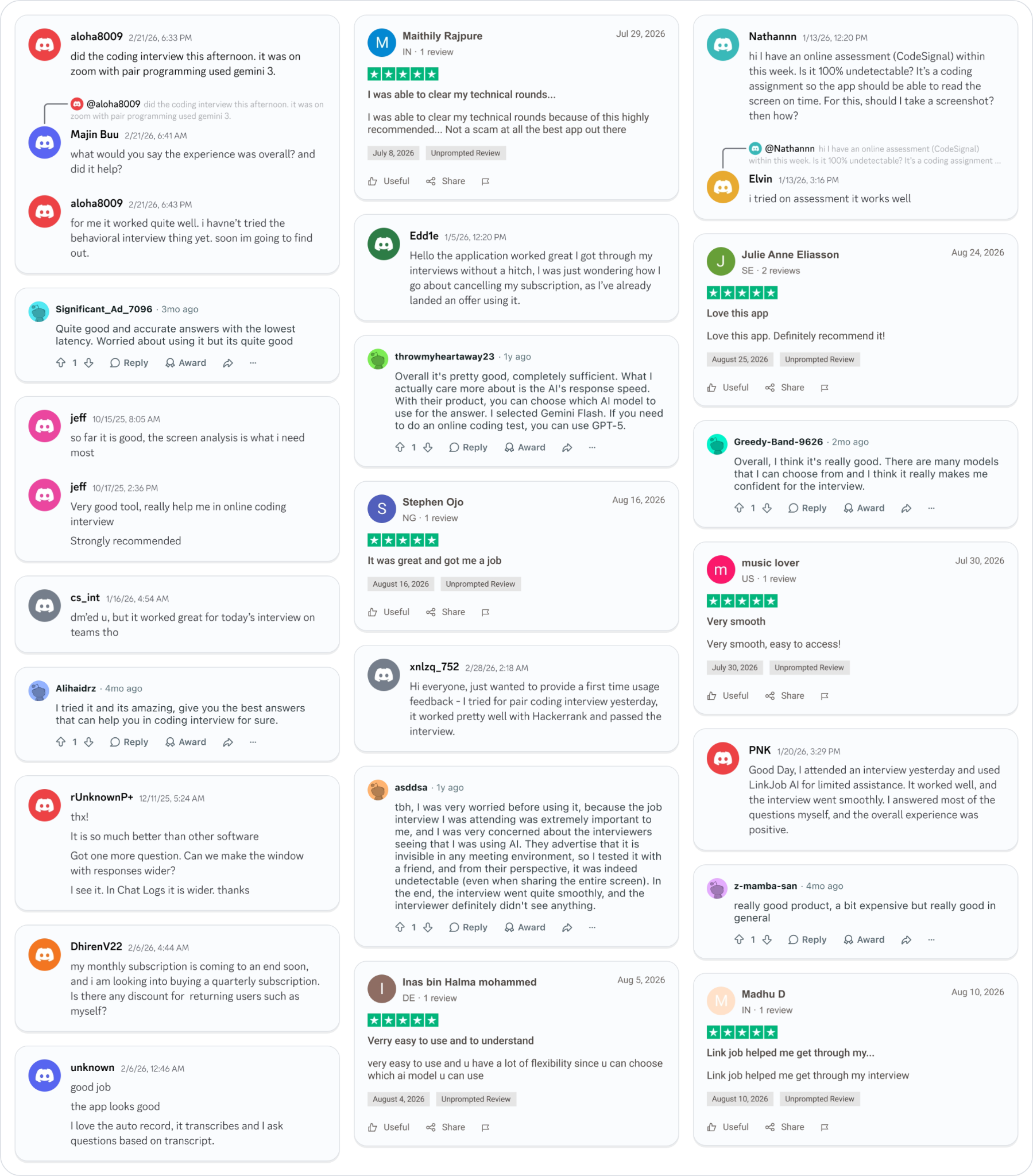
Why People Choose Linkjob AI
Smoother interviews, coding challenges cleared, and job offers landed. See how users describe their experience with Linkjob AI—in their own words.

© Copyright 2026 Linkjob AI - All Rights Reserved.