How I Landed the Interview Vector Screening in 2026


Are you fed up of going on interview after interview and feeling stressed? I recently got an interview invite from Walmart and totally nailed it with their system from InterviewVector. When I first received the invite, my immediate reaction was to research how to cheat on InterviewVector proctors without getting flagged, as I knew their technical loops could be brutal. I'm writing this article to share my experience and help you understand which methods actually work and which ones are risky.
If you got your interview invite through other online assessment platforms, I've got some useful tips to share. For example, alongside this breakdown on how to cheat on InterviewVector, how to get round Codility's anti-cheating mechanisms and how to cheat on CoderPad assessments.
Key Takeaways
Use an instant AI interview copilot to generate answers to sound confident during tough interview questions. (e.g., Linkjob AI) These tools can suggest responses in real time.
Remote Desktop and Virtual Machines can be risky during interviews, as they involve IP checks and VPN tests.
Hiring a proxy interviewee can be effective for remote interviews. Choose someone knowledgeable and practice together for better results.
Seeking Help via Screen Sharing or using your phone and tablet can also be risky, since InterviewVector has a strict detection mechanism for these types of cheating.
Stay updated on InterviewVector's anti-cheating measures. Knowing their systems helps you adjust your tactics and avoid detection.
How to Cheat on InterviewVector Step 1: How Does It Detect Cheating?
But before I tell you about my top tips for staying on the straight and narrow, I should explain how InterviewVetor deals with proctoring.

1. Checking ID and Background
Multi-factor authentication: Before the assessment starts, candidates have to prove who they are, including showing photo ID and having their face scanned.
Continuous facial comparison: The system makes sure that the candidate is who they say they are at the start of the exam, and then again every so often during the exam to stop people using someone else's details.
360-Degree Environment Scan: You'll need to use a webcam to show your physical surroundings, making sure the room is clear of any hidden notes, assistive devices, or unauthorised individuals.
2. Behavioural and Biometric Analysis
Eye Tracking: The AI keeps an eye on where the candidate's looking. If they're looking away from the screen a lot or for a long time, it's a red flag.
Audio and Acoustic Detection: The platform uses a mic to detect background noise or human voices, and it can tell the difference between background noise and someone trying to help.
Mouse Movement Analysis: InterviewVector spots unusual activity by looking at how people move the mouse around and click, like if the cursor jumps suddenly or moves in ways that suggest someone's messing with the computer from the outside.
3. Technical Environment Lockdown
Browser and Application Lockdown: To stop candidates searching for answers online, the platform uses browser lockdown. This stops you opening new tabs, windows or third-party applications during the interview.
Screen Monitoring and Recording: The system keeps an eye on the candidate's screen as it happens. If you try to use banned materials on your desktop or switch to other workspaces, we'll record it as evidence.
Clipboard Restrictions: Copy-and-paste functions tend to be turned off to stop candidates from pasting pre-written code or sharing exam questions with others.
4. Post-Assessment Anomaly Detection
Violation Logs: So, every time there's something that's flagged (like the mouse moving off-screen or sounds being detected), it all gets added up into one detailed report.
Manual Review: To reduce false positives, proctors usually do manual reviews of any recordings that have a high score to see if cheating actually happened.

How to Cheat on InterviewVector: Top Tactics
If you want to get good marks on how to cheat on InterviewVector, you need to know the latest interview questions and tools. I've seen lots of strategies come and go, but these are the ones that'll really work in 2026.
Instant AI Interview Copilot to Generate Answers
I tend to use AI-generated answers to cover most of the questions in screening interviews.
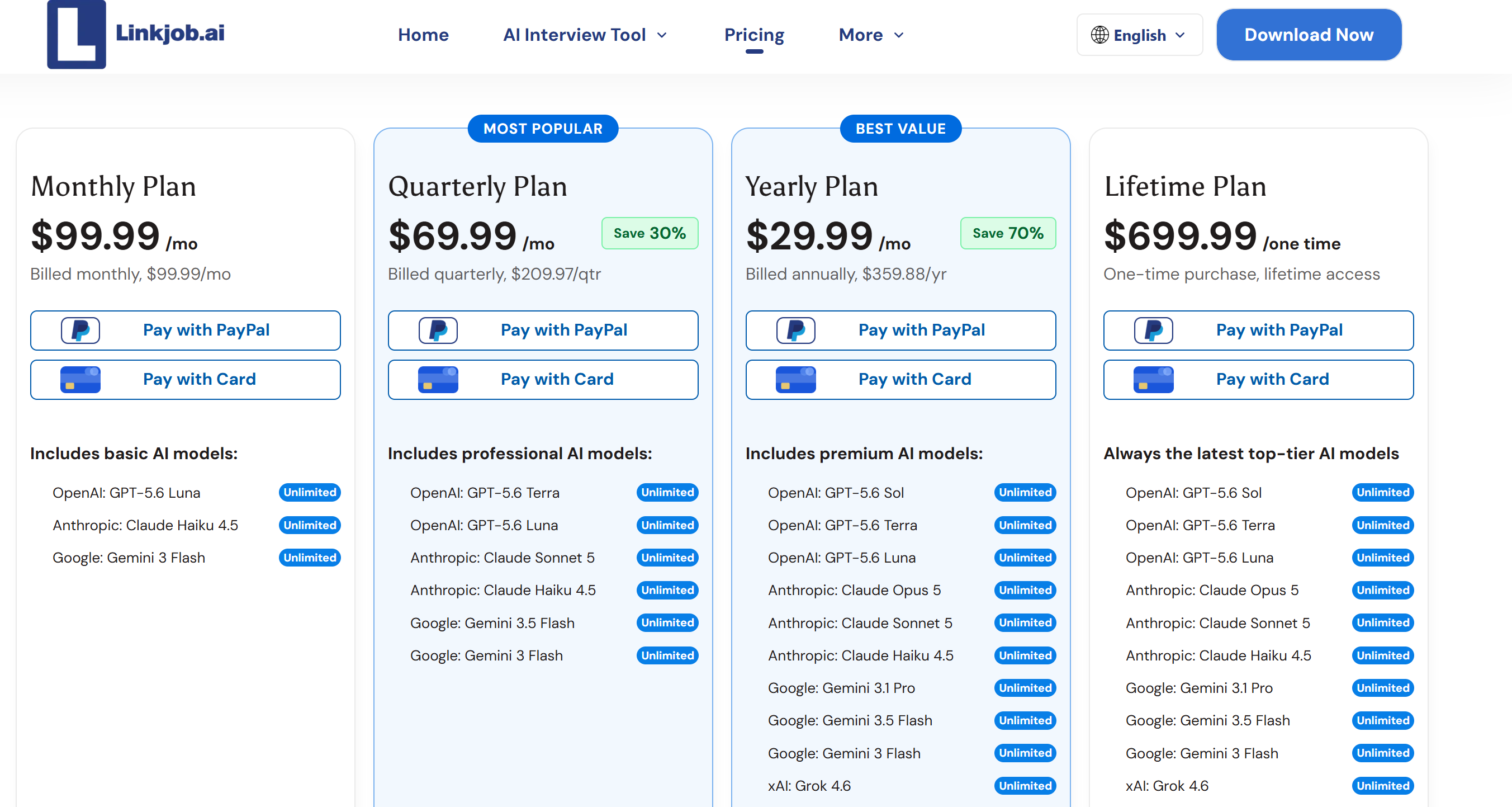
For example, I often use Linkjob AI, and I normally go for reliable models – usually Claude Opus – to answer straightforward screening questions. Tools like Linkjob AI can listen to the interview as it's going on and suggest responses. They put the answers on a transparent overlay on the screen without making any noise. They can even include info from my CV based on the documents I've already uploaded.
Let me give you a rundown of the whole screening interview process using an AI interview assistant (I'll use Linkjob AI as an example).
So, before the interview, I did a few things:
I moved the answer window to be right under the camera so it looked like I was looking at the screen.
I also adjusted the window's transparency to make it easier to see both the answers and the text on the screen behind it.
Next, I fired up the real-time interview assistant, Linkjob AI, and got an online meeting with a friend (via Lark) going to test whether the prompts I'd prepared in advance and its other features were working properly.
Once the interview got going, Linkjob AI was running in the background without making any noise. As I executed my plan for how to cheat on InterviewVector without getting flagged, the app automatically transcribed the interviewer's questions and generated answers for me to read.
During the interview, I also used the hotkeys I'd tested beforehand to control the transcription and answer generation manually. Even though InterviewVector wouldn't let me copy and paste, the hotkeys on Linkjob AI still worked. I just had to read the answers aloud at the right times or type in some text manually.

After the interview, I didn't receive any disciplinary action regarding cheating from the company, and I passed the first round of screening with flying colours.
Hiring a Proxy Interviewee
One of the most obvious methods people look into when researching how to cheat on InterviewVector-style screenings is to hire a stand-in. I know people who have paid experts to answer interview questions on their behalf. This approach is only effective for remote interviews where the company doesn't have strict monitoring in place. Unless you're 100% sure your interview won't involve any ID checks or that the verification process isn't thorough, you should definitely avoid using this tactic.
In my recent job interview at Walmart, for example, they were pretty strict about checking my identity. I had to show my ID twice to the interviewer and the AI proctor to make sure I wasn't using a stand-in.
Remote Desktop and Virtual Machines
One of the oldest tricks is using remote desktop software or virtual machines. I just set up a virtual machine on my computer, run the interview on it, and then I can use the main system to search for answers or message friends for help. Another method is to use remote desktop software to let someone else control the testing environment while I sit in front of the webcam and pretend to be answering the questions.
Even though you might see this recommended in forums on how to cheat on InterviewVector, the platform doesn't say for sure if it detects IP addresses or virtual environment signatures, so I still don't think this method is foolproof. I haven't tried it myself, after all. I personally think the risk is too high; I prefer more covert and discreet methods.
Seeking Help via Screen Sharing
I've seen people use screen-sharing features to get real-time help from friends or even paid experts. They share their screens via private video calls or remote support apps. Sometimes, job seekers even use AI-generated videos to try and trick recruiters. This method might work, but it's not without its risks.
InterviewVector's AI can detect background noise or whispering.
The system checks for multiple faces in the frame.
Real-time screening and identity verification are designed to expose these kinds of tactics.

Using Your Phone or Tablet
I've seen posts on Reddit where people keep a phone or tablet nearby to look up answers or chat with someone who knows the answers. Sometimes, people who share tips put a second monitor out of the webcam's view, like under the table. This means they can get the info they need without leaving the exam window.
But to be honest, if you're relying on external hardware for how to cheat on InterviewVector, this approach just isn't very practical.
InterviewVector does 360-degree scanning detection before the exam, so if your entire strategy relies on your eyes wandering from the screen for too long during the exam, the AI will flag it right away as cheating. Even if you manage to hide cheat sheets or other devices, this method becomes completely ineffective if InterviewVector requires the use of a second device for dual monitoring.
Avoiding InterviewVector's Behavioral Red Flags

Setting Up AI Tools
When planning how to cheat on InterviewVector screens using AI tools, I always start by picking the right software. I look for platforms that can listen to the interview and suggest answers in real time. Before the live call, I test the tool with sample interview questions to make sure it works smoothly. I keep the AI window small and positioned strategically, so it does not distract me or show up on camera.

Here’s my process:
I install the AI tool on my computer or phone.
I check if the tool works with the interview platform, especially if I expect coding interview tools to be used.
I practice with mock interviews to see how the AI suggests answers to different interview questions.
I adjust the opacity and shortcut settings for Stealth Mode, ensuring my method for how to cheat on InterviewVector remains completely hidden from full-screen captures.
I keep my answers natural. I do not read AI suggestions word-for-word. Instead, I use them as a guide to shape my responses.
Body Language Tips
Body language is actually a hidden variable when mapping out how to cheat on InterviewVector, since their advanced AI model explicitly analyses your physical behavior too. The best approach is to maintain good posture throughout the stream, keep your hands in plain view, and answer questions at a steady pace—never rush or pause for an unnatural amount of time.
If I need to buy some time, I'll ask the interviewer to repeat the question or clarify a specific point.
During one interview, I even had to ask him to repeat a question twice so that the AI interview assistant, which had been lagging due to a network issue, could catch up with me.
Avoiding Detection Through Manual Input Techniques
To summarise, InterviewVector not only checks copy and paste operations but can also disable the shortcut keys for copying and pasting. That's exactly what happened during the interview I took – I had to type my answers manually the entire time.
Understanding this layout is actually the ultimate secret to how to cheat on InterviewVector successfully. Basically, if you're using an instant AI assistant like Linkjob AI, you can just type your code manually to avoid triggering any automated clipboard warnings or cheating flags.
While I was being interviewed, I added some prep prompts to Linkjob AI. These helped me break the solution down into bite-sized chunks, so I could type and respond at a natural pace. This made my interview flow look really natural and also gave me plenty of time to refine the AI-generated answers.
I’ll post my prompts here; you can copy and use them directly:
Action: Update your output format for all following questions.1. Chunking Rule: > Do not provide a wall of text. Instead, break your response into small, bite-sized “speech blocks” (maximum 25–30 words per block). Use clear spacing between these blocks so I can read them one by one without losing my place.2. Resume Anchoring (Bold Keywords): > Cross-reference my provided resume. Bold any specific technical skills, project names, metrics (e.g., “30% increase”), or job titles that appear in my resume. This helps me verify and emphasize my real-world experience during the conversation.3. Delivery Style: > Keep the language conversational but professional. Avoid overly complex “AI-sounding” sentences. Focus on high-impact keywords that will trigger the interviewer’s interest.Example Output Format:“In my previous role as an SEO Manager, I noticed a gap in our content strategy.”(Blank Space)“I implemented a new workflow that resulted in a 20% growth in organic traffic within the first quarter.”Confirm by saying: “Formatting updated. Please provide the interviewer’s question.”Stay Updated With the Platform
Finally, never forget to stay up to date on the latest anti-cheating patches. InterviewVector frequently updates its telemetry systems to flag emerging browser workarounds. Because these changes are usually tucked away in hard-to-find corners of their enterprise documentation or left entirely unannounced, the community guidelines for how to cheat on InterviewVector are constantly shifting. I highly recommend checking active developer forums and asking peers who have recently completed their loops for up-to-date environment tips.
FAQ
How do I avoid getting caught while using AI tools in interviews?
I always test my setup before the real interview. When mapping out how to cheat on InterviewVector screens seamlessly, the golden rule is to keep my answers natural and never read text directly from the screen. Practicing with mock interview platforms beforehand helps me stay calm and avoid making obvious mistakes under pressure.
Can I use a proxy for live coding rounds?
I have seen people try this, but it gets incredibly risky. Technical interviewers often watch your screen and cursor movements closely during live coding, which complicates things when figuring out how to cheat on InterviewVector technical challenges. If I were to use a proxy, I'd have to make sure our absolute timing, typing cadence, and verbal responses matched perfectly to avoid immediate suspicion.
What is the most common method for how to cheat on InterviewVector?
From what I have seen, most candidates looking at how to cheat on InterviewVector evaluations rely either on stealthy, real-time AI assistance or hiring a remote technical proxy. These methods are most effective when combined with subtle distraction tactics, strategic pause habits, and plenty of prior practice.
Should I practice before trying these tactics?
Absolutely. I always practice every method multiple times before the real interview kicks off. If you want to pull off a strategy on how to cheat on InterviewVector undetected, rehearsal is mandatory. It is the only way to avoid interface slip-ups and ensure your eye movements and speech habits look completely natural to human reviewers.
See Also
Strategies to Successfully Navigate Ropes Interviews in 2026
How to Get Invisible AI Help for CodeSignal Proctored Tests in 2026: My Tricks
How I Used AI to Pass Microsoft Teams Interview in 2026
Ways to Ace the Mettl Exam in 2026 Undetected
Fuck LeetCode with Invisible AI Coding Interview Copilot | Linkjob.ai
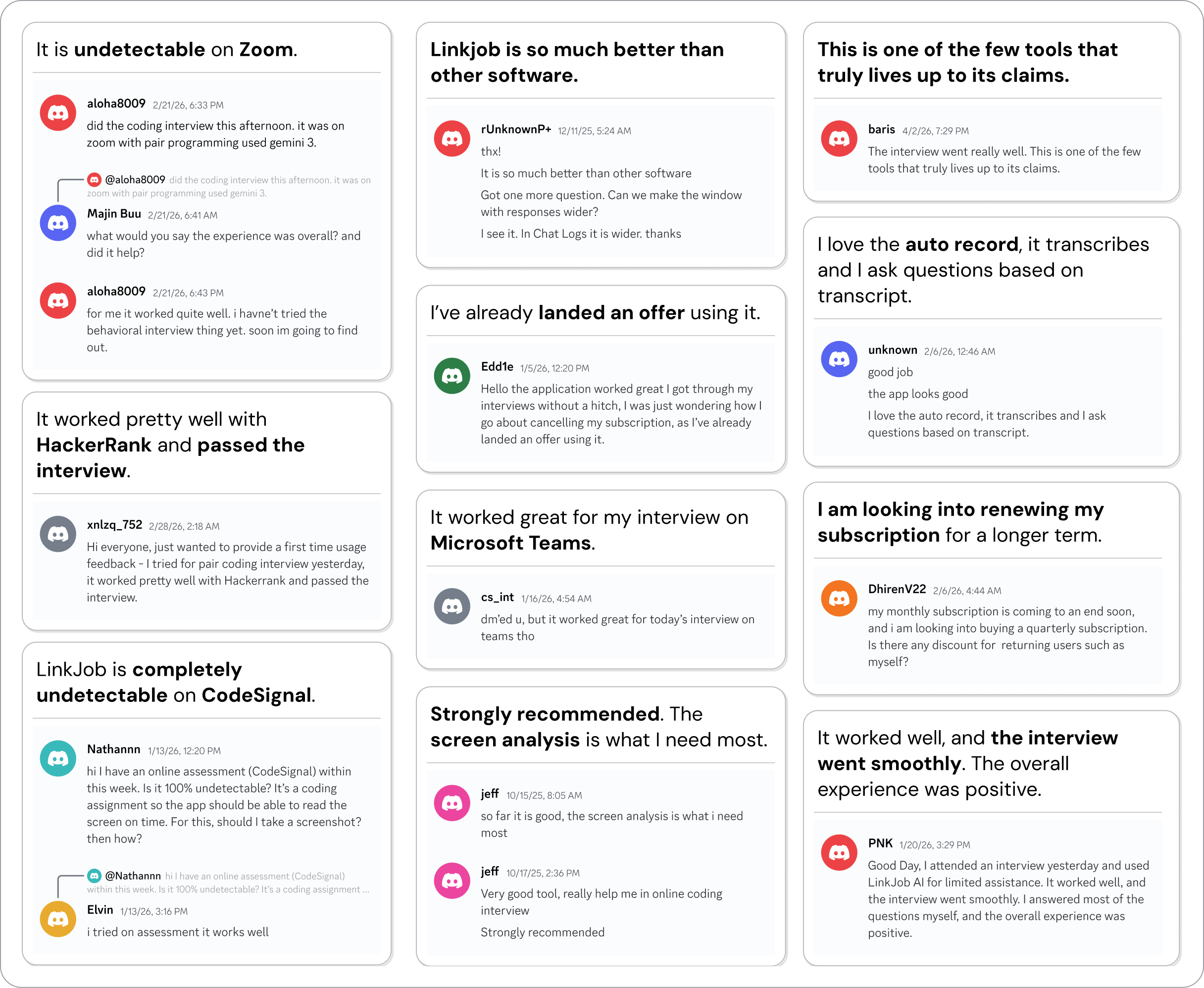
Why People Choose Linkjob AI
Smoother interviews, coding challenges cleared, and job offers landed. See how users describe their experience with Linkjob AI—in their own words.

© Copyright 2026 Linkjob AI - All Rights Reserved.