StealthCoder Review: Tested for Live Code Interviews

Coding interviews were the reason I started experimenting with AI interview copilots in the first place.
My first serious attempt was InterviewMan. I liked the idea—a discreet AI layer that could understand what was happening and surface help without forcing me to constantly jump between ChatGPT and the interview window—but the actual experience was frustrating enough that I eventually wrote a full InterviewMan review about it.
After that, I kept looking for a better InterviewMan alternative. One afternoon, while I was having a read of some comparison reviews, I came across an article by InterviewMan comparing its own product to StealthCoder. It's obvious that InterviewMan had an incentive to make its product look better, but I was really interested in StealthCoder. It's a coding assistant for Mac/Windows that supports system design, has keyboard-based code analysis, a seven-day trial and an annual subscription fee of about $15 a month.
So, I went to StealthCoder's website and thought I'd give it a go. And that's exactly what makes this StealthCoder review different – I never actually got round to testing its code suggestions.
After starting the free trial, the system directed me to Stripe's subscription process, which clearly stated that the subscription would auto-renew at $40 per month. My payment and registration process never completed successfully, so I was unable to access the product. I also had difficulty confirming or cancelling my subscription.
For the purposes of this review, I investigated everything I could verify and compared this experience with the interview-assistance tools I've chosen to use, including Linkjob AI.
Before StealthCoder Review: What Is StealthCoder?
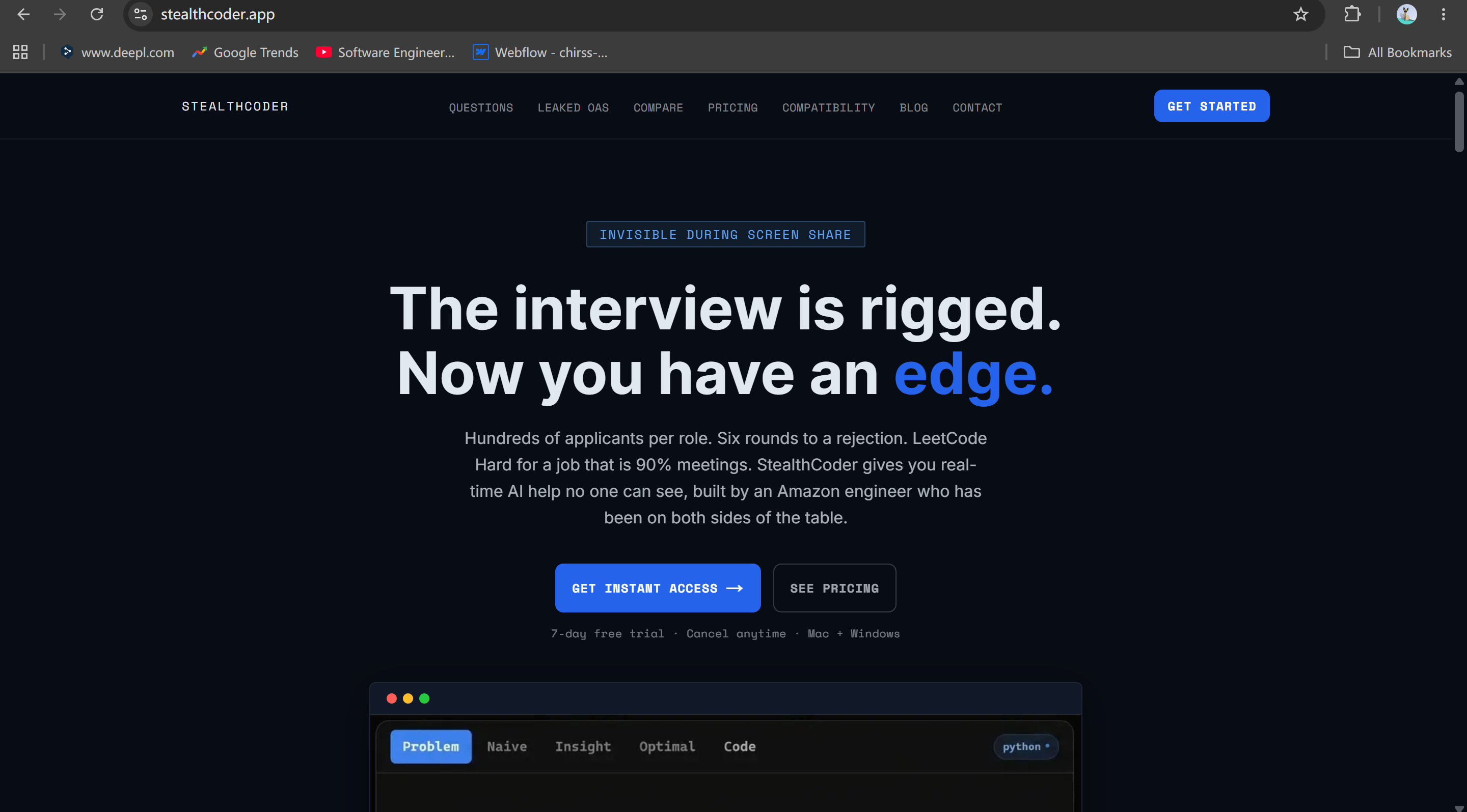
StealthCoder is a native desktop AI assistant focused specifically on coding interviews and system-design interviews.
Unlike browser extensions, it runs as a Mac or Windows application. Its main workflow is unusually simple: you keep the coding problem visible, press a keyboard shortcut, and StealthCoder captures the primary screen, analyzes the problem, and displays a solution in an overlay.
The Basic StealthCoder Workflow
According to the current documentation:
Download and run the Mac or Windows application.
Open the coding assessment normally.
Press
Ctrl + Alt + 1to scan the visible problem.Receive code, an explanation, and complexity analysis.
Use keyboard shortcuts to move through answer tabs or hide/show the overlay.
Switch into StealthDesign when the interview changes to system design.
That is much narrower than a product such as Final Round AI or Linkjob AI. StealthCoder is not primarily trying to handle every recruiter screen, behavioral interview, mock session, HireVue question, or phone interview.
Its pitch is essentially: coding + architecture + screen analysis + a discreet desktop overlay.
What StealthCoder Claims To Support
Sub-2-Second Response Engine: Automated recognition of coding problems on screen, delivering runnable code, time/space complexity analysis, and step-by-step explanations instantly.
Invisible Desktop Overlay: A native application for macOS and Windows designed to remain hidden from screen-sharing software, including Zoom, Microsoft Teams, and Google Meet.
Coding and System Design Support: Coverage for standard LeetCode-style algorithmic challenges as well as high-level architectural and system design diagrams.
Keyboard-Driven Workflow: Triggered via shortcut keys (such as
Ctrl + Alt + 1), allowing candidates to analyze questions without touching the mouse or switching active application windows.7-Day Free Trial Offer: Promoted as a risk-free trial allowing job seekers to test the software before committing to a paid tier.
StealthCoder Review: My Trial Experience Was the First Red Flag
At first, StealthCoder's pricing seems pretty good:
7-day free trial
Monthly Pro Plan: $40/month
Annual Pro Plan: $180/year (that's $15/month)
For a professional coding tool, paying $15 a month is a bargain. But to be honest, signing up was a bit of a nightmare:
I went for the 7-day free trial option.
The system took me to Stripe's subscription page, where it was clear that the renewal fee is $40 per month.
The setup process got stuck and failed to complete, so I couldn't access a fully functional version of the app.
I couldn't do any real coding performance tests.
I tried getting in touch with customer support to see if they could help me avoid being charged. I found contact and chat options on the website, but there wasn't a dedicated community platform like Discord where I could get more help with my account issue.
I never did get a clear answer about my account status, and the issue never got sorted.
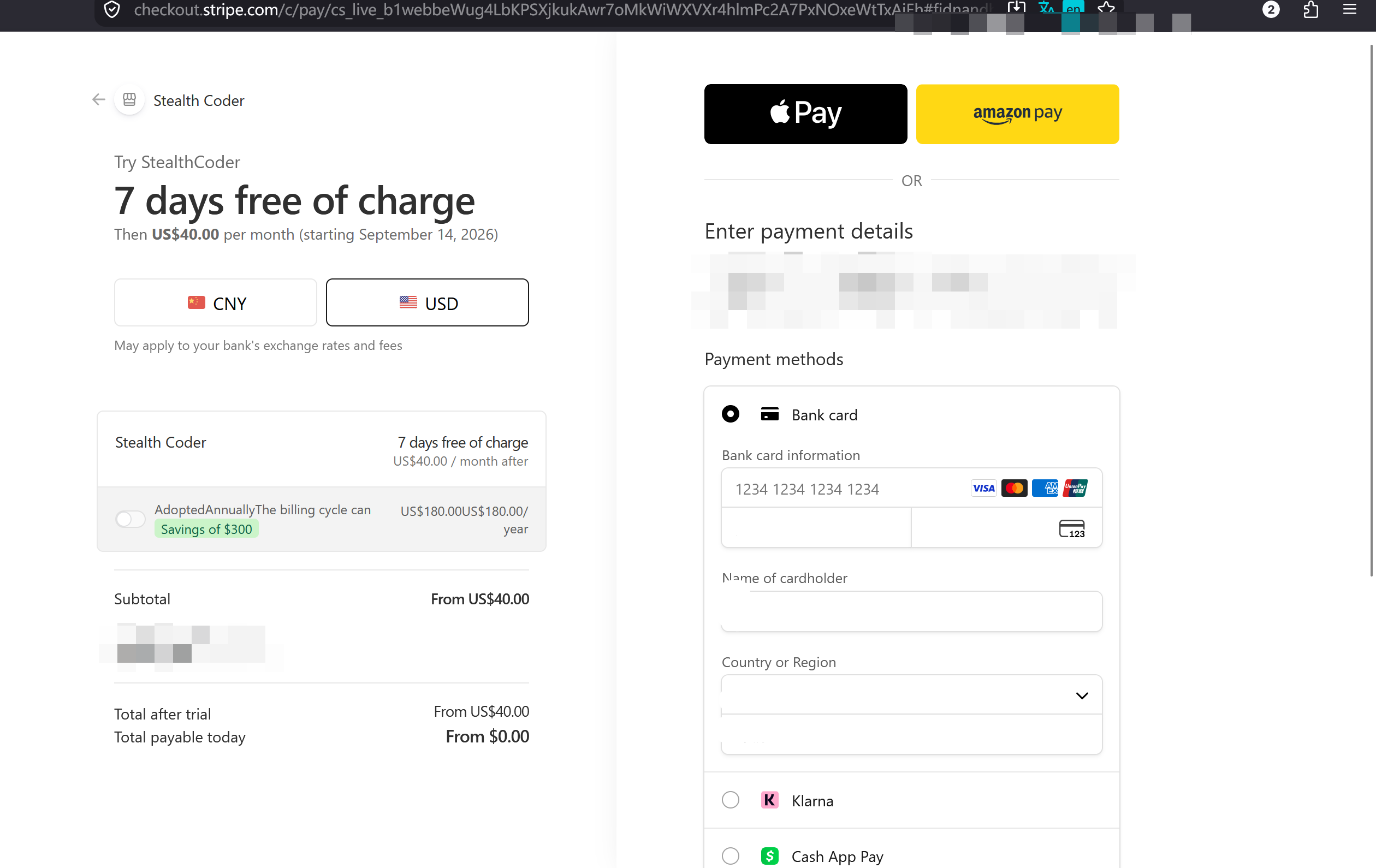
StealthCoder's free trial requests a $180/yr subscription on Stripe automatically
To be completely clear: StealthCoder did not end up charging me $40. The issue was the sheer uncertainty attached to a trial that automatically rolls into a paid monthly plan.
So, StealthCoder's website does say you can cancel with one click, but it also makes it clear that no refunds. They do say you should check your screen-sharing settings before you buy, though.
If you're thinking of giving it a go, my advice is: check the renewal price, find the cancel button straight away, check your billing status, and don't assume that a "free trial" is risk-free.
Did I Find StealthCoder Creator’s Public GitHub Repository? Yes, and No.
If you search for "StealthCoder" on Google, you'll easily find another video with a very similar cover and title:
While searching through the creator’s YouTube content, I found a public repo under RaheesAhmed/StealthCoder.
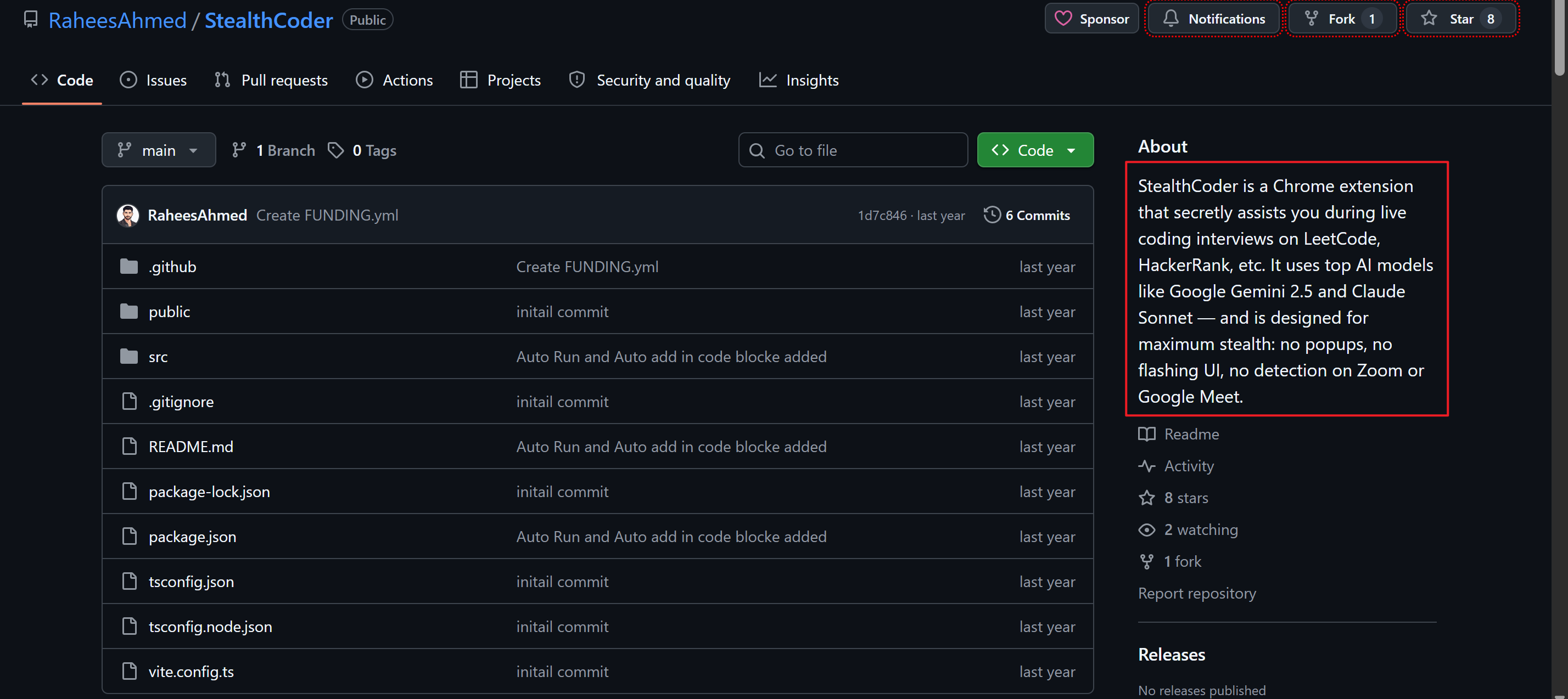
At first, I thought I'd found the original creator's open-source version or something like that. After all, a public source code repository can be a pretty reliable trust signal, since I can take a look at how the program actually runs and see how closely StealthCoder's marketing matches up to reality.
So, this repository does actually contain the source code. It's a TypeScript/React codebase licensed under the MIT License, with a complete `src` directory, a Chrome manifest file, a background service worker, content scripts, a settings interface, and API handling logic.
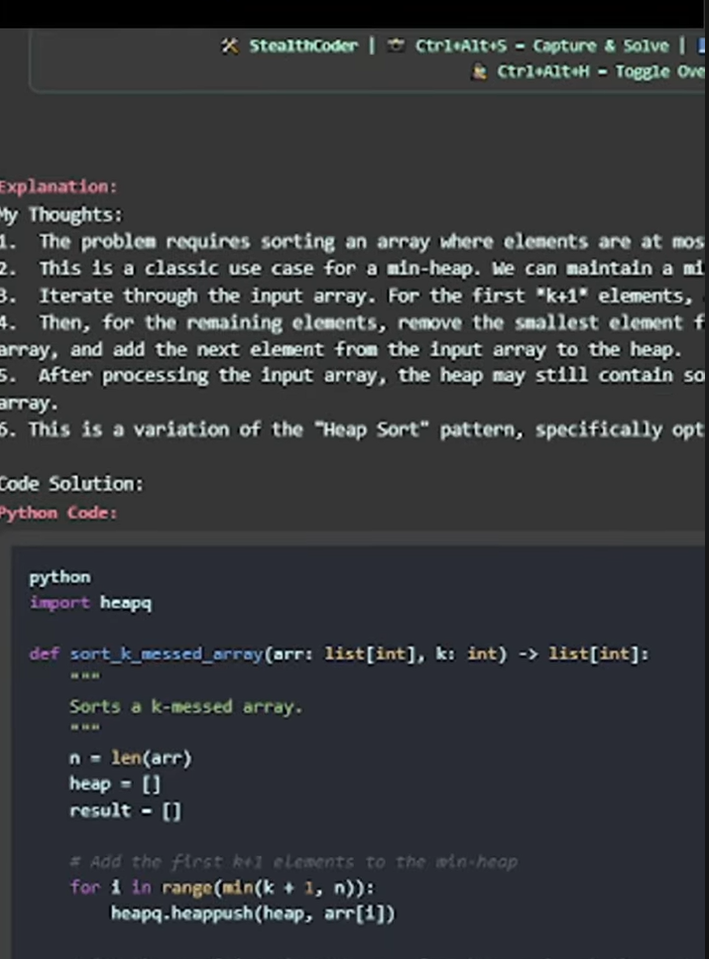
But after taking a closer look, I can say this isn't the source code for the current StealthCoder desktop application. To add to that, the two apps are basically the same, and they were released pretty close together. The StealthCoder by Rahees came out in September 2025, and the standalone, paid StealthCoder was released in November 2025. I'm talking about the latter today, even though Google hasn't quite figured out which is which.
StealthCoder Review: What I Found After the Coincidence
After I cleared up this small misunderstanding about the name, I found out as much information as I could about StealthCoder. I noticed some strange details in the few YouTube Shorts and the small number of documents on the stealthcoder.app website.
1. The “Invisible” Claim Has Limits
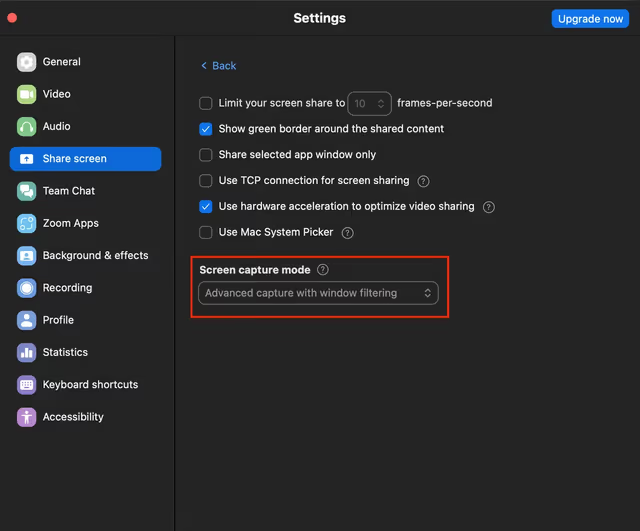
StealthCoder markets itself as completely invisible on Zoom, Teams, Google Meet, HackerRank, and CodeSignal. However, its own fine-print documentation admits setup caveats:
Zoom Setup: You must manually enable "Advanced capture with Window filtering" in Zoom settings for the overlay to stay hidden.
Mac Full-Screen Sharing: Certain WebRTC and full-screen sharing configurations on macOS can still expose the overlay window.
It is designed to stay outside standard capture layers, but it is not universally undetectable across every operating system setup.
2. Confusing LLM Transparency
StealthCoder’s messaging around its underlying AI models is contradictory. The marketing landing pages claim the app is powered by "the latest Claude models." Yet, its official FAQ explicitly states that provider and model names are kept private as proprietary managed systems.
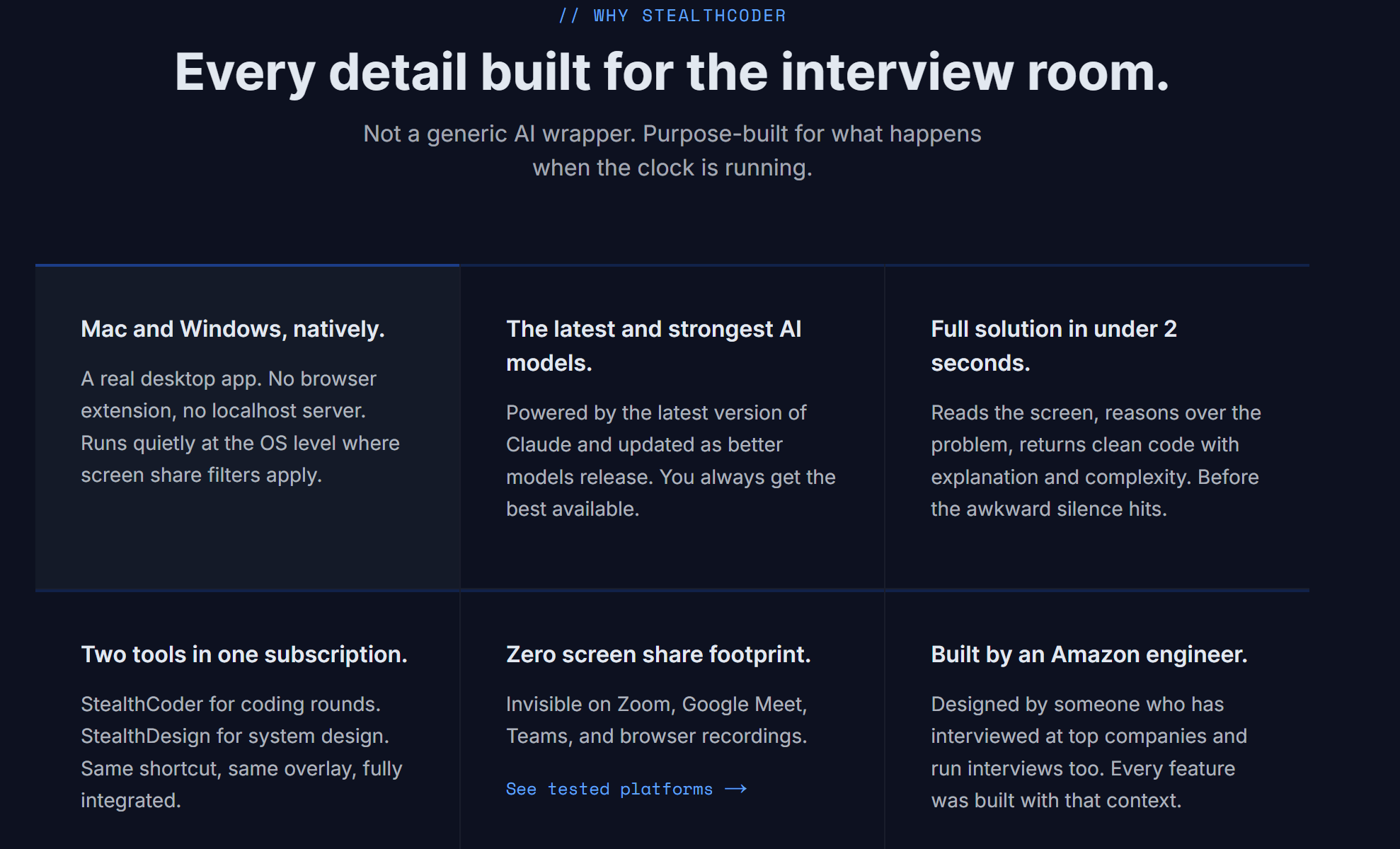
When solving dynamic programming edge cases or distributed systems trade-offs, knowing whether you are using a lightweight model or a flagship reasoning engine like Claude 3.5 Sonnet or Opus matters immensely.

3. Absence of Community Channels and Transparent Support
When setting up StealthCoder for this review, I looked for community channels like an official Discord server, a Slack workspace, or a public user forum to ask questions about setting up and using the platform. Most trustworthy interview tools offer a community hub where users can report bugs, seek technical support and read feedback from other users.
However, StealthCoder does not offer any community channels at all. There is no user forum, no active Discord group, and no way to contact online support directly. I was left in the dark about whether other people had also had technical issues or screen-sharing leaks, especially as there were hardly any reviews and it was difficult to find out about these things through website ratings.
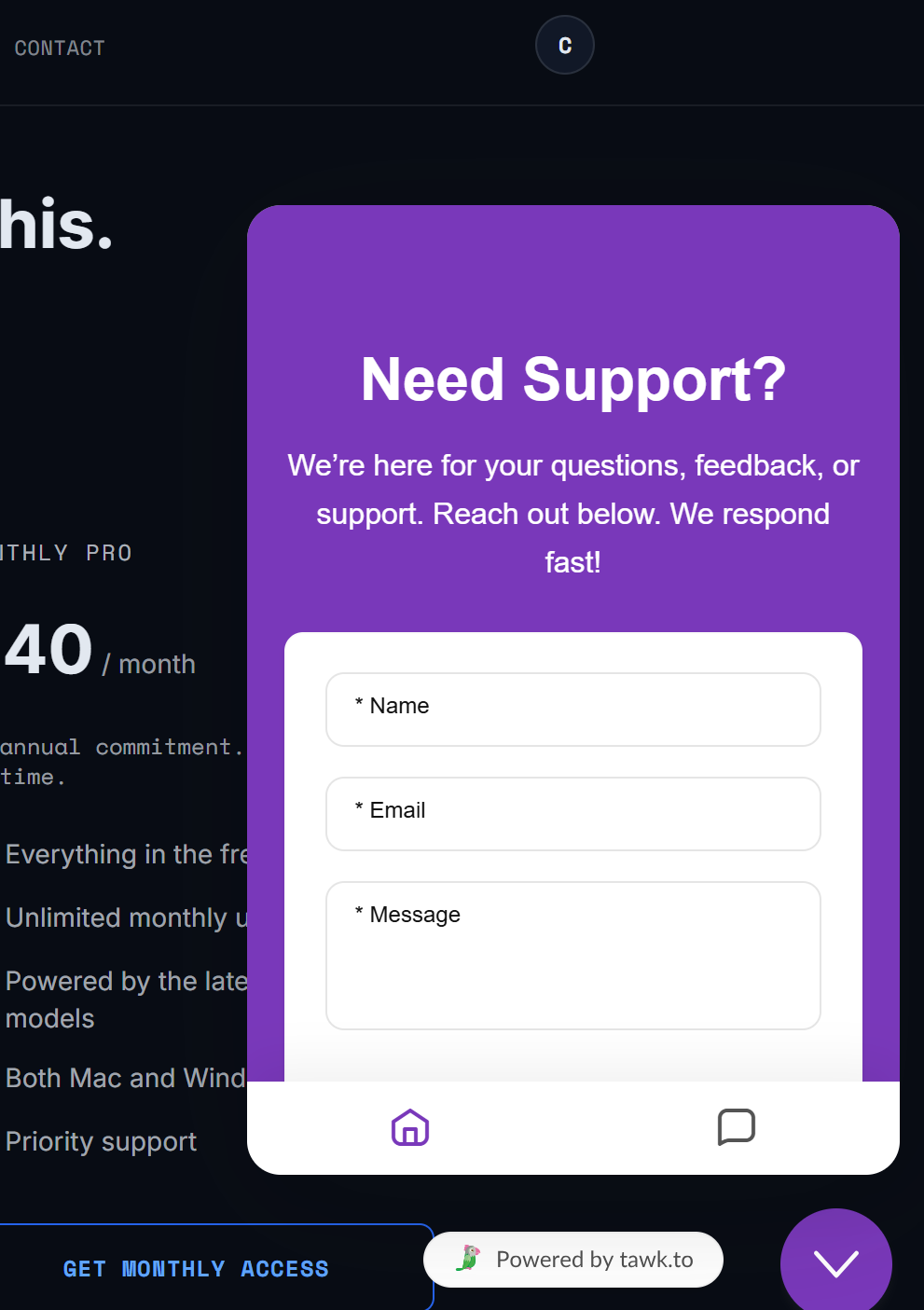
Overall, I find it hard to believe that this would automatically start a subscription for you during the free trial (even though you can cancel it). This is especially true since the model isn't publicly available and there's no way to be sure that the invisible interview copilot is better than older versions or other more advanced AI interview assistants.
Even though the monthly fee isn't high, you can get better models, services, and products with real-time updates for the same or slightly higher price. This means that there is not much competition for this price.
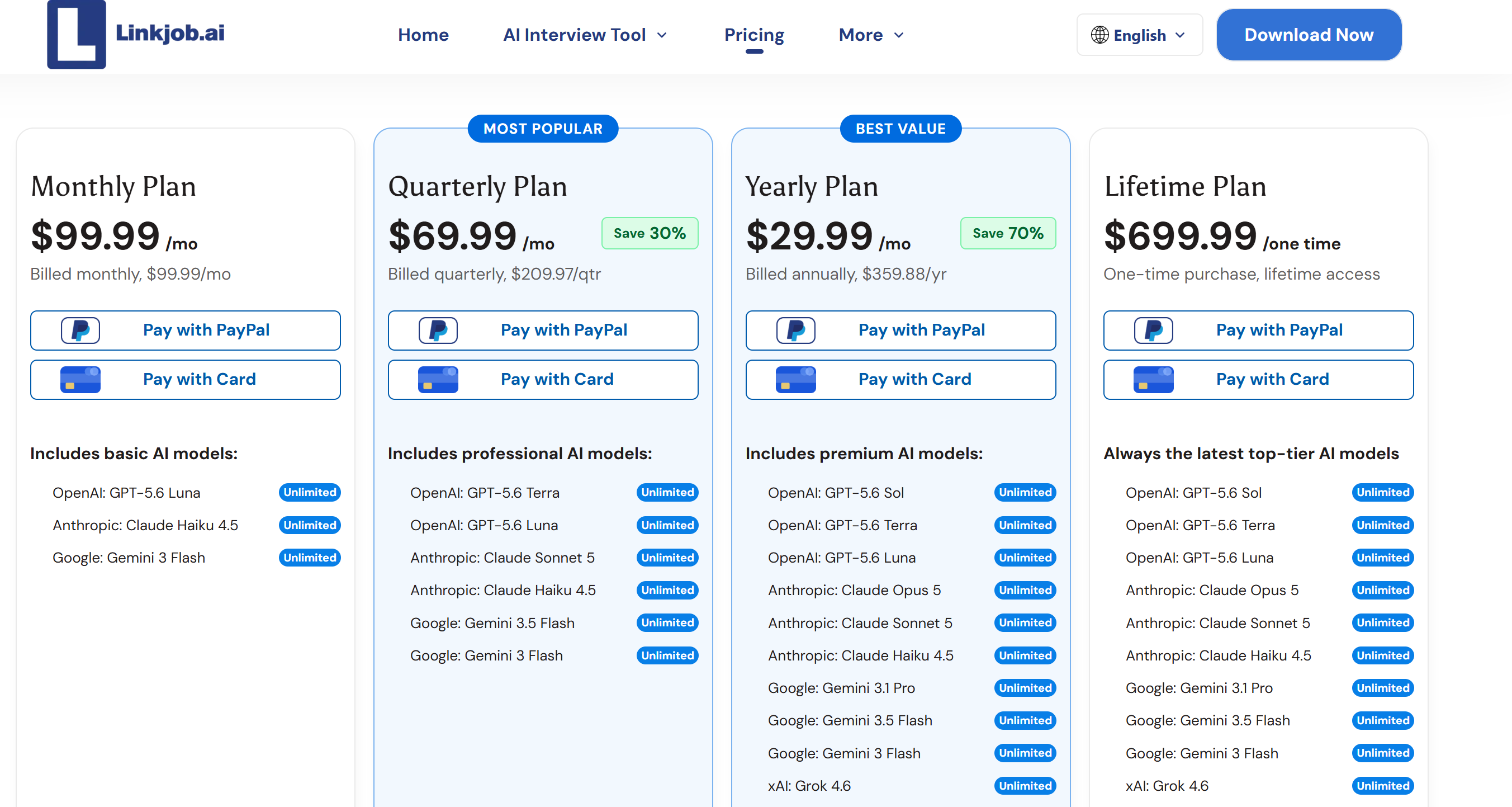
StealthCoder Review vs Alternatives: Linkjob AI, Beyz AI, and Final Round AI
To put this StealthCoder review into proper market context, we must benchmark it against leading AI interview assistants. Candidates deserve a clear understanding of how different architectures compare in terms of stealth, focus protection, model selection, and overall return on investment (ROI).
For deeper context on industry standards, reviewing our comprehensive guide on AI interview tools or reading my hands-on Beyz AI review provides valuable insights into candidate experiences across different platforms.
The comparison table below details how StealthCoder stacks up against top competitors:
Metric / Feature | StealthCoder | Linkjob AI (Top Recommendation) | Beyz AI | Final Round AI |
Stealth Architecture | Basic Window Overlay | OS Driver-Level Stealth | Browser / Basic Overlay | Desktop App Overlay |
Focus Theft Protection | ❌ Standard Click Capture | Mechanical Pass-Through (0 | ❌ Focus Loss Risk | ❌ Standard Window Focus |
LLM Tier & Transparency | ❌ Undisclosed / Fixed Model | 120+ Top LLMs (Claude Opus 5, GPT-5.6 Sol) | Standard GPT Models | Proprietary Managed Pipeline |
Screenshot Integration | Single Capture Hotkey | Fluid Multi-Region Capture | Manual Image Upload | Integrated Screen Snapping |
Audio Processing Latency | ~2.0 Seconds | Ultra-Fast (1.1 - 1.8s) | Moderate (3 - 5s) | Fast (2 - 4s) |
Onboarding & Support | ❌ Dark Pattern / No Discord | Transparent Pricing & 24/7 Support | Standard SaaS Flow | Structured Onboarding |
Pricing & ROI | $40/mo (Forced Billing Trap) | $29.99/mo (Flat Annual Tier) | $19–$49/month | $25–$35+/mo (Annual Tiers) |
+---------------------------------------------------------------------------+
|                        COPILOT ARCHITECTURE COMPARISON                      |
+---------------------------------------------------------------------------+
|  LINKJOB AI ARCHITECTURE:                                                   |
|  [ OS Driver Stealth Layer ] ---> Below Capture Pipeline (100% Invisible)   |
|  [ Mechanical Pass-Through ] --> Zero Cursor Focus Switch (Safe on CodeSignal)    |
|  [ 120+ Model Routing Engine] -> Instant Access to Claude Opus 5 & GPT-5.6 Sol   |
|                                                                             |
|  STEALTHCODER ARCHITECTURE:                                                 |
|  [ Standard Window Overlay ] --> Risk of Screen Capture Leaks on App Updates      |
|  [ Standard Click Capture ] ---> Risk of `onblur` Tab-Switch Flags          |
|  [ Undisclosed Fixed LLM ] ----> Unpredictable Code Optimization & Reasoning      |
+---------------------------------------------------------------------------+
Why Linkjob AI Outperforms StealthCoder Across Every Category
As demonstrated throughout this StealthCoder review, relying on budget tools with dark-pattern subscriptions introduces unacceptable risks during high-stakes job searches. Linkjob AI solves every architectural limitation found in less polished assistants:
True OS Driver-Level Stealth: Linkjob AI operates beneath display capture layers at the operating system driver level on macOS and Windows. It remains completely invisible during full-desktop screen sharing across Zoom, Microsoft Teams, Google Meet, HackerRank, and CodeSignal.
Mechanical Pass-Through (Zero Focus Theft): Linkjob AI uses a transparent click pass-through overlay. You can click, scroll, and type directly inside VS Code or your browser tab through the assistant without transferring window focus, preventing dangerous
window.onblurtab-switch flags on proctored portals.120+ Premier Reasoning Engines: Instead of forcing you onto an undisclosed, fixed model, Linkjob AI gives you instant access to over 120 world-class LLMs, including Claude Opus 5, Claude 5 Sonnet, GPT-5.6 Sol, and Gemini 3.1 Pro. You can choose the exact reasoning engine needed to solve LeetCode Hard algorithms and system design trade-offs with optimal time and space complexity.
Transparent Pricing & Superior ROI: Linkjob AI offers clear, straightforward pricing ($29.99/month on the flat annual tier) without hidden recurring traps, forced monthly renewals, or unhelpful support channels.
Final Verdict: Is It Worth the Risk After This StealthCoder Review?
To conclude this StealthCoder review, while the platform's marketing promises an appealing, low-cost shortcut for technical coding interviews, the actual product experience falls well short of enterprise standards.
+-----------------------------------------------------------------------------------+
|                               FINAL VERDICT MATRIX                          |
+-----------------------------------------------------------------------------------+
|  StealthCoder Score: 4.0 / 10                                               |
|  - Pros: Advertises coding and system design coverage, simple shortcut triggers.  |
|  - Cons: Dark pattern $40/mo forced trial trap, unhelpful support, standard |
|          overlay detection risks, lack of LLM transparency.                 |
|                                                                             |
|  Recommendation:                                                             |
|  - Avoid StealthCoder due to subscription trap risks and unverified stealth.     |
|  - Choose Linkjob AI for true driver stealth, 120+ top LLMs, and zero focus theft. |
+-----------------------------------------------------------------------------------+
A candidate's career trajectory depends on passing high-stakes engineering loops. Risking a top-tier job offer on a platform with dark-pattern subscription billing, unverified overlay stealth, and absent customer support introduces unnecessary danger into your job search.
For serious developers who require true OS driver-level stealth, zero cursor focus theft, and instant access to premier reasoning models like Claude Opus 5 and GPT-5.6 Sol, Linkjob AI is the definitive, professional choice for technical interviews in 2026.
StealthCoder Review: FAQ
Is StealthCoder completely free to try?
No, clicking the "7-Day Free Trial" button redirects users to a Stripe checkout page that auto-subscribes them to a recurring $40/month tier.
Does StealthCoder work on proctored coding portals like CodeSignal?
No, interacting with its overlay risks transferring window focus, which can trigger window.onblur focus-switch flags on proctored portals.
Does StealthCoder offer an official Discord community?
No, StealthCoder does not maintain a Discord server, user forum, or public community channel for support.
Is StealthCoder's overlay guaranteed to remain invisible on Zoom?
No, because it uses standard window-hiding properties, updates to Zoom or Microsoft Teams display capture layers can expose the overlay.
Which AI model powers StealthCoder?
StealthCoder does not publicly disclose its underlying LLM engine or allow users to switch models during interviews.
How do I cancel my StealthCoder subscription?
You must submit a message through the contact form on their website, as there is no automated self-serve cancellation toggle in the user dashboard.
What is the best alternative to StealthCoder for coding interviews?
Linkjob AI is the top alternative, offering true OS driver-level stealth, mechanical click pass-through (zero focus theft), and access to 120+ premier LLMs.
See Also
Is Shadecoder Really Stealth My Honest In Depth Review
A 2026 Review Of Interview Coder Pros Cons And Gaps
Top Alternatives To Interview Coder For Coding Interview Copilot
Chiku AI Review: Pros, Cons, and My Experience
I have tested 20+ Lockedin AI Alternatives and Here are my top 5 picks in 2026
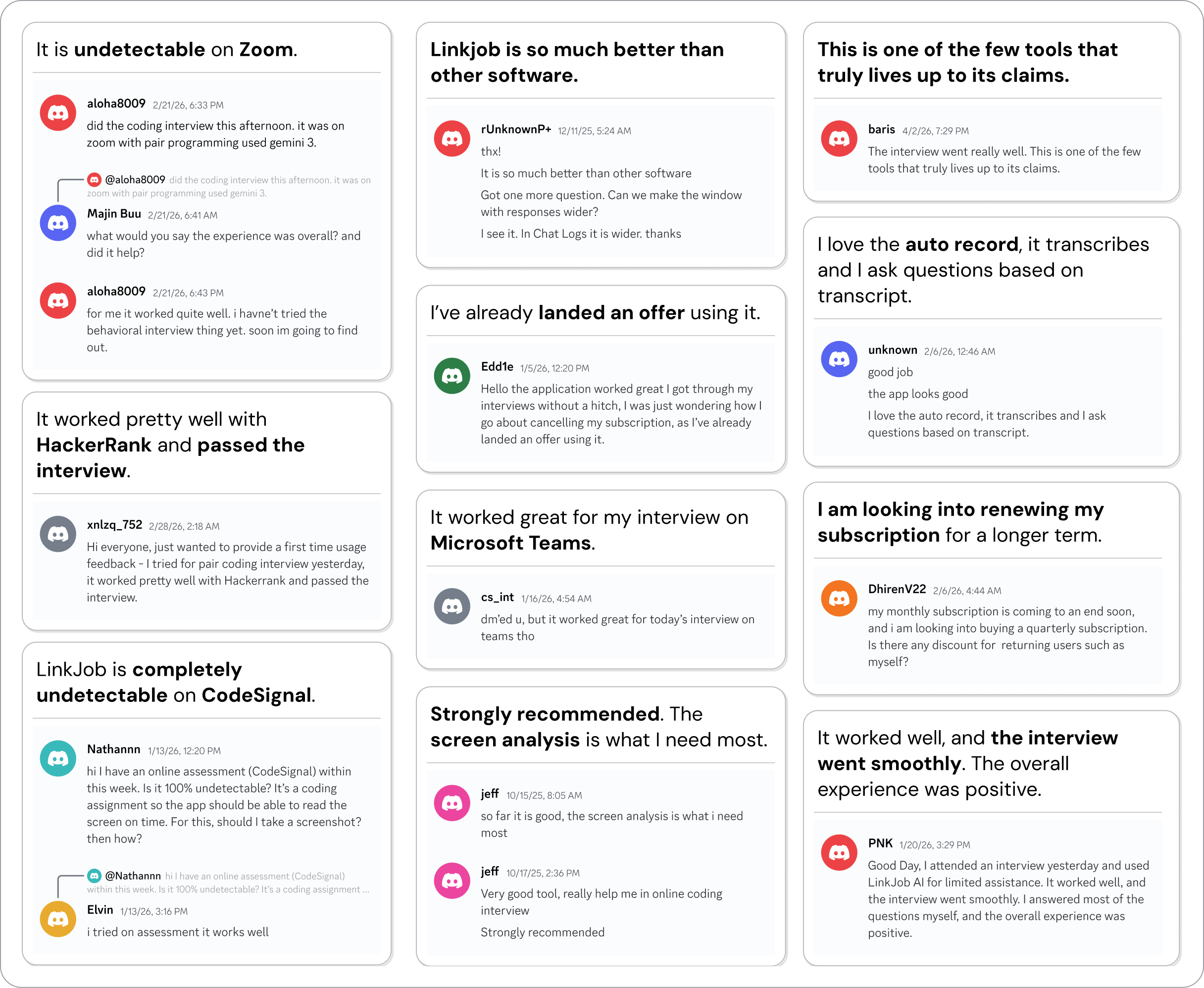
Why People Choose Linkjob AI
Smoother interviews, coding challenges cleared, and job offers landed. See how users describe their experience with Linkjob AI—in their own words.

© Copyright 2026 Linkjob AI - All Rights Reserved.