My 2026 Robinhood CodeSignal Assessment Experience: All 4 Real Questions (Load-Factor Graph, Money-Transfer OOD, Fractional Shares, & Word Frequency)

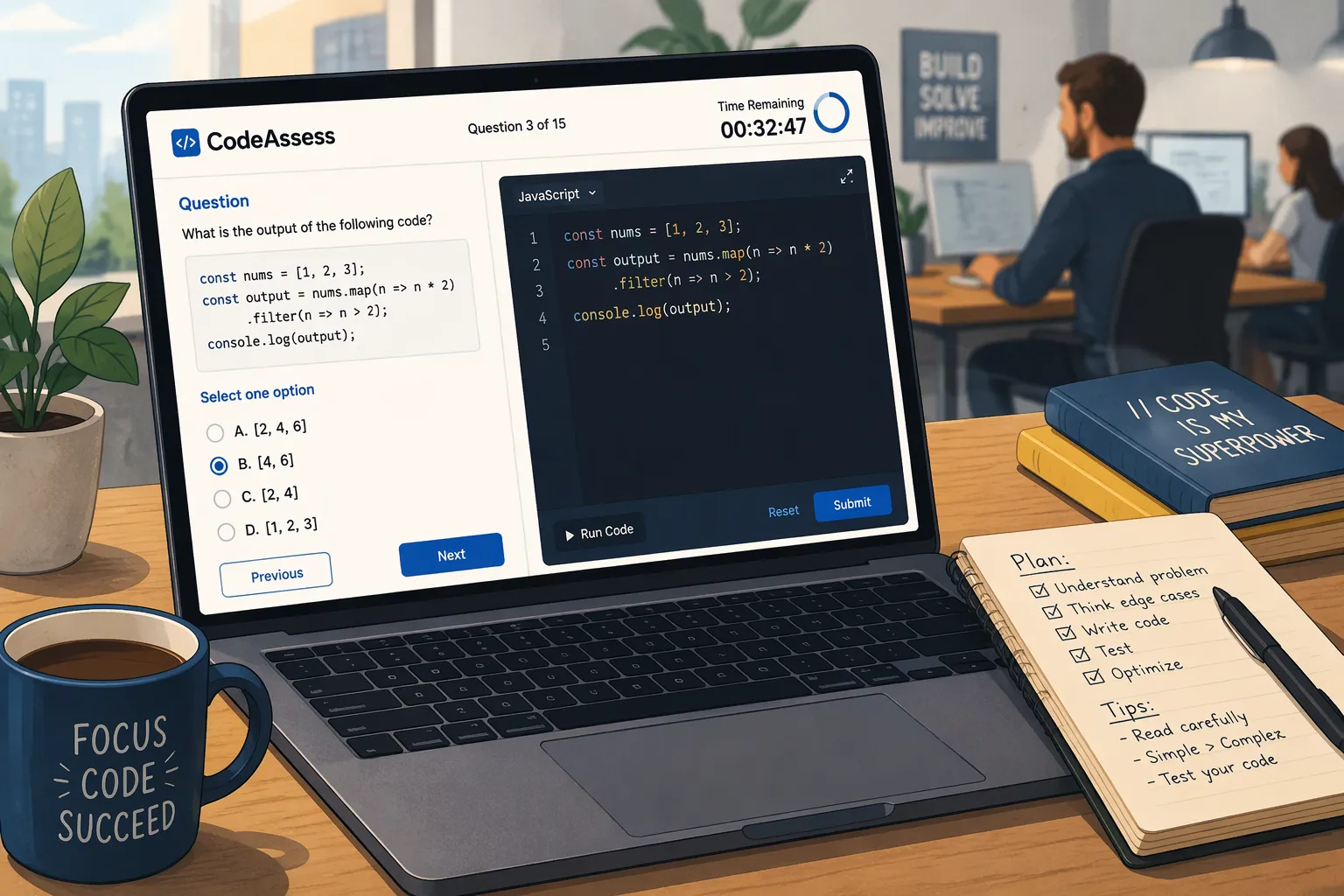
When I received my Robinhood CodeSignal invitation in 2026 for a Backend Software Engineer role (covering Robinhood's Menlo Park HQ along with hubs in New York, Seattle, Bellevue, Toronto, and London), I expected random CodeSignal matrix-rotation puzzles. Instead, Robinhood—which has partnered directly with CodeSignal since 2019—draws heavily from a stable, brokerage-flavored recurring question bank packed into a 4-question, 70-minute single sitting. On my own screen, every problem reflected real fintech backend work: Service Dependency Load Factors over a directed graph, an Object-Oriented Friendship & Money-Transfer Request Parser, Fractional-Share Buy/Sell Inventory Tracking requiring exact decimal arithmetic, and Large-Paragraph Word Frequency Ranking with deterministic tie-breaking.
Three of my four tasks cleared quickly, while Question 2—the money-transfer request stream—nearly sank my clock! I spent twenty minutes over-designing class abstractions while missing a critical non-friend transfer guard, leaving twelve minutes on the timer before my parser even ran end to end. Worse yet, Robinhood enforces a strict zero-unauthorized-AI rule backed by CodeSignal's always-on Suspicion Score and LeakSweep: in late April 2026, a Robinhood applicant using a translucent desktop AI sidebar pasted a revised function and pressed their overlay hotkey—triggering an instant warning that locked the assessment page mid-test and marked them permanently ineligible for a retake.
To verify my TransferSystem non-friend edge cases and dangling-node graph filter with twelve minutes left without placing any overlay on my monitored laptop screen, I paired Linkjob AI in Dual-Device Mode—scanning the desktop QR code to open Linkjob AI on my phone's mobile webpage, turning off the desktop answer-display toggle so zero UI ever existed on my computer screen, and tapping capture on my phone's mobile webpage (zero laptop shortcut keys and zero window.onblur events) to read clean validation logic 1 inch below my webcam lens (alongside testing Desktop Floating Window Mode on unproctored web practice links). Below is every real question from my 2026 Robinhood CodeSignal sitting, frontend and trading-engine variants, and how to pass into onsite rounds with zero flags.
How the Robinhood CodeSignal OA Works in 2026 (Format, 200–600 Scale, & Rolling Seats)
Before starting my 70-minute timer, I benchmarked Robinhood's assessment against other high-bar fintech and trading loops—including my Coinbase CodeSignal insider guide, how I cleared the Ramp CodeSignal assessment, how I aced the Plaid CodeSignal OA, my Visa CodeSignal assessment walkthrough, my RBC CodeSignal DevOps and API experience, my Stripe coding interview breakdown, my Citadel CoderPad interview and assessment guide, and my 2026 Quora CodeSignal 600/600 guide. Four realities shape Robinhood's 2026 funnel:
1. Four Questions in ~70 Minutes & Why 840/850 Forum Posts Are Outdated
4 Unlocked Coding Tasks (~70-Minute Window): Early-career, Intern, and SWE candidates receive 4 coding tasks in one continuous ~70-minute block (select campus tracks stretch to 90 minutes, while Frontend and Analytics Engineer tracks swap in JavaScript DOM/Promise or sharded-SQL problems). All four tabs unlock at minute zero so you can manage your own pacing.
The Modern
200–600Score Scale (Replacing300–850): Old Reddit threads quoting780or842scores come from CodeSignal's retired pre-2023300–850scale! Every 2026 submission grades on CodeSignal's200–600Assessment Score combining per-test-case base credit with full-pass completion bonuses. Robinhood publishes no fixed cutoff, fills campus and lateral headcount on a rolling basis (completing your link within 48 to 72 hours matters!), and weighs clean hidden-test passes alongside your resume and Suspicion Score.
2. Why Over-Designing OOD Classes Kills More Runs Than Hard Algorithms
Stable Recurring Fintech Bank: Roughly 85%+ of reported Robinhood OA questions revolve around arrays, hash maps, directed dependency graphs, string tokenization, and stateful financial OOD parsers—not esoteric segment trees.
Runnable First, Clean Hierarchy Second: On Robinhood's money-transfer and order-book tasks, the #1 documented failure pattern is elegant-but-unfinished code: spending 25 minutes crafting abstract base classes and leaving edge-case validation broken when the clock expires. Getting a flat, runnable state dictionary passing sample cases in 12 minutes—then refactoring cleanly—wins every time!
Post-OA Loop (System Design Lives Downstream): Passing the CodeSignal OA moves you to a recruiter/hiring-manager screen followed by a Virtual Onsite featuring LeetCode-Medium coding (often with thread-safety follow-ups), behavioral values, and Robinhood's signature System Design prompts (At-Most-Once Typed Job Scheduler using compare-and-set claim leases, or Real-Time Stock Quote & Order Routing with down-sampled 1-year OHLC storage).
All 4 Real Coding Questions From My 2026 Robinhood CodeSignal Sitting (With Python Solutions)
Here are the four exact coding questions from my 2026 Robinhood Backend SWE CodeSignal sitting (alongside patterns cataloged in CodeSignal questions and assessments), in the order they appeared.
1. Question 1: Service Dependency Load Factors / Transitive Referral Counts (Reverse-Graph Reachability)
The Problem: Given
graph: dict[str, list[str]]mapping each valid serviceuto the list of servicesudepends on (u -> v), compute every service's load factor—defined as the number of unique valid services that depend on it directly or transitively (excluding the service itself unless a dependency cycle reaches back to it, or per prompt self-inclusion rule—here counting distinct transitive dependents). Critical constraint: ignore any dependency edgeu -> vwherevis NOT a key ingraph!Two Hidden Graph Traps:
Accidentally Promoting Dangling Targets Into Valid Nodes: If
"checkout"lists"legacy_auth"in its dependency array and"legacy_auth"is absent fromgraph.keys(), callingnodes.add(v)pollutes your output map with an invalid key and fails hidden schema checks! Filter strictly againstvalid_nodes = set(graph.keys()).Double-Counting Diamond Paths: If
Adepends on bothBandC, and bothBandCdepend onD, summing child counts blindly countsAtwice atD(2instead of1)! Traversing the reverse graph (v -> u) with a per-sourcevisitedset deduplicates diamonds cleanly (and on follow-up interviews, useheapq.nlargest(3, ...)for Top-3 load factors!).
My 100% Passing Reverse-Graph Solution (Python 3):
from collections import defaultdict
import heapq


def compute_service_load_factors(
    graph: dict[str, list[str]],
) -> dict[str, int]:
    valid_nodes = set(graph.keys())
    reverse_deps: dict[str, list[str]] = defaultdict(list)

    for caller, callees in graph.items():
        for target in callees:
            if target in valid_nodes and target != caller:
                reverse_deps[target].append(caller)

    load_factors: dict[str, int] = {}
    for service in valid_nodes:
        visited: set[str] = set()
        stack = list(reverse_deps[service])
        while stack:
            dep = stack.pop()
            if dep in visited or dep == service:
                continue
            visited.add(dep)
            stack.extend(reverse_deps[dep])
        load_factors[service] = len(visited)

    return load_factors


def top_k_loaded_services(
    load_factors: dict[str, int], k: int = 3
) -> list[tuple[str, int]]:
    return heapq.nsmallest(
        k, load_factors.items(), key=lambda kv: (-kv[1], kv[0])
    )
Complexity:
O(V * (V + E))time andO(V + E)space acrossVvalid services andEedges, withO(V log k)extraction for the top-kfollow-up.
2. Question 2: Friendship & Money-Transfer Request Stream Parser (OOD Validation)
The Problem: Parse an ordered list of request strings—
"sign up <user>"(or"sign up <user> <initial_balance>"),"deposit <user> <amount>","friend <a> <b>", and"send <a> <b> <amount>"—and return each registered user's final balance.Four Edge Cases That Cost Me 20 Minutes Before Dual-Device Verification:
Duplicate
sign upCommands: Callingsign up alicea second time must be ignored completely—re-initializingUser("alice")wipes her existing balance and friend links!Non-Friend & Self-Transfer Rejections:
send a b amountmust fail without mutating balances ifa == b, if either account does not exist, ifbis not currently ina's mutual friend set, ifamount <= 0, or ifa.balance < amount!Exact
DecimalBalances: UsingDecimalprevents binary floating-point drift (10.00 - 3.33 - 6.67 != -1e-16) from rejecting a valid exact-zero transfer!
My Clean 100% Passing
TransferSystemSolution (Python 3):
from decimal import Decimal


class UserAccount:
    def __init__(self, username: str, initial: Decimal = Decimal("0.00")) -> None:
        self.username = username
        self.balance = initial
        self.friends: set[str] = set()


class TransferSystem:
    def __init__(self) -> None:
        self.users: dict[str, UserAccount] = {}

    def sign_up(self, username: str, initial_str: str = "0.00") -> bool:
        if username in self.users:
            return False
        self.users[username] = UserAccount(username, Decimal(initial_str))
        return True

    def deposit(self, username: str, amount_str: str) -> bool:
        amt = Decimal(amount_str)
        if username not in self.users or amt <= Decimal("0"):
            return False
        self.users[username].balance += amt
        return True

    def add_friend(self, user_a: str, user_b: str) -> bool:
        if user_a == user_b or user_a not in self.users or user_b not in self.users:
            return False
        self.users[user_a].friends.add(user_b)
        self.users[user_b].friends.add(user_a)
        return True

    def send(self, sender: str, receiver: str, amount_str: str) -> bool:
        amt = Decimal(amount_str)
        if sender == receiver or amt <= Decimal("0"):
            return False
        if sender not in self.users or receiver not in self.users:
            return False
        sender_acc = self.users[sender]
        if receiver not in sender_acc.friends or sender_acc.balance < amt:
            return False
        sender_acc.balance -= amt
        self.users[receiver].balance += amt
        return True

    def process_requests(self, requests: list[str]) -> dict[str, str]:
        for raw in requests:
            parts = raw.strip().split()
            if not parts:
                continue
            if len(parts) >= 3 and parts[0] == "sign" and parts[1] == "up":
                init_bal = parts[3] if len(parts) >= 4 else "0.00"
                self.sign_up(parts[2], init_bal)
            elif parts[0] == "deposit" and len(parts) == 3:
                self.deposit(parts[1], parts[2])
            elif parts[0] == "friend" and len(parts) == 3:
                self.add_friend(parts[1], parts[2])
            elif parts[0] == "send" and len(parts) == 4:
                self.send(parts[1], parts[2], parts[3])
        return {
            name: f"{acc.balance:.2f}"
            for name, acc in sorted(self.users.items())
        }
Complexity:
O(R + U log U)time acrossRcommands andUregistered users,O(U + F)memory forFmutual friendships.
3. Question 3: Fractional-Share Buy/Sell Inventory Flattening (Exact Decimal Ledger)
The Problem & Float Trap: Given interleaved
("buy" / "sell", symbol, quantity_str)fractional-share fills (such as"0.1","0.2","0.3"), maintain net symbol inventory, rejecting oversells (pos[sym] < qty) when short-selling is disallowed and omitting zeroed-out symbols if requested. In IEEE-754 float,0.1 + 0.2 - 0.3leaves5.55e-17instead of0! UsingDecimalkeeps fractional share quantities exact to the last decimal digit:
from collections import defaultdict
from decimal import Decimal


def flatten_fractional_inventory(
    operations: list[tuple[str, str, str]], allow_short: bool = False
) -> dict[str, str]:
    holdings: dict[str, Decimal] = defaultdict(lambda: Decimal("0"))

    for side, symbol, qty_text in operations:
        qty = Decimal(qty_text)
        if qty <= Decimal("0"):
            continue
        action = side.lower()
        if action == "buy":
            holdings[symbol] += qty
        elif action == "sell":
            if not allow_short and holdings[symbol] < qty:
                continue
            holdings[symbol] -= qty

    return {
        sym: format(net.normalize(), "f")
        for sym, net in sorted(holdings.items())
        if net != Decimal("0")
    }
4. Question 4: Large-Paragraph Word Frequency With Deterministic Tie-Breaking
The Problem & Out-of-RAM Follow-Up: Tokenize a large text into case-insensitive alphanumeric words (ignoring punctuation), count frequencies, and return
(word, count)pairs sorted by frequency descending, then word ascending. If an interviewer follows up with "What if the text is 100 GB and cannot fit in RAM?", stream line-by-line into bounded partialCounterchunks spilled to sorted disk runs, then merge runs viaheapq.merge!
from collections import Counter
import re


def rank_word_frequencies(paragraph: str) -> list[tuple[str, int]]:
    tokens = re.findall(r"[a-z0-9]+", paragraph.lower())
    counts = Counter(tokens)
    return sorted(counts.items(), key=lambda kv: (-kv[1], kv[0]))
2 Additional Confirmed Robinhood Variants (Frontend Chainable API & OHLC Candlesticks)
1. Frontend JavaScript Variant: Fluent Chainable RectangleAPI With Promise Queueing
The Core Trap: Methods like
select(id),afterDelay(ms, fn), andmove(dx, dy)must chain synchronously (api.select("a").afterDelay(100, fn).move(5, 0)). Returning aPromisedirectly fromafterDelaybreaks.move()! Every method mustreturn thiswhile appending work onto an internalthis._tail = this._tail.then(...)queue:
class RectangleAPI {
  constructor() {
    this.selected = [];
    this._tail = Promise.resolve();
  }

  select(rectId) {
    this._tail = this._tail.then(() => {
      if (!this.selected.includes(rectId)) this.selected.push(rectId);
    });
    return this;
  }

  afterDelay(delayMs, callback) {
    this._tail = this._tail.then(
      () => new Promise((resolve) => setTimeout(() => { callback(); resolve(); }, delayMs))
    );
    return this;
  }

  move(dx, dy) {
    this._tail = this._tail.then(() => {
      this.lastOffset = [dx, dy];
    });
    return this;
  }
}
2. Brokerage Engine Classic: 1-Minute OHLC Candlestick Aggregation
Key Trick: Group
(timestamp_sec, price)ticks byminute_bucket = ts // 60after sorting chronologically (or tracking earliest/latest timestamps inside each bucket) soopenandclosereflect true first/last trade arrival whilehighandlowtrack extrema:
def build_minute_candlesticks(
    trades: list[tuple[int, float]],
) -> list[tuple[int, float, float, float, float]]:
    if not trades:
        return []
    ordered = sorted(trades, key=lambda item: item[0])
    candles: list[tuple[int, float, float, float, float]] = []
    curr_bucket = ordered[0][0] // 60
    o_px = h_px = l_px = c_px = ordered[0][1]

    for ts, px in ordered[1:]:
        bucket = ts // 60
        if bucket != curr_bucket:
            candles.append((curr_bucket * 60, o_px, h_px, l_px, c_px))
            curr_bucket = bucket
            o_px = h_px = l_px = c_px = px
        else:
            h_px = max(h_px, px)
            l_px = min(l_px, px)
            c_px = px

    candles.append((curr_bucket * 60, o_px, h_px, l_px, c_px))
    return candles
My 7-Day Prep Schedule for Robinhood's Recurring CodeSignal Bank
Because Robinhood reuses this compact fintech question bank year after year, a focused 7-day sprint outperforms unfocused tag grinding:
Days 1–2 — Reverse-Graph Reachability & Topological DAG Drills (
< 18 Minutes): Practice building reverse adjacency maps (v -> u), filtering out dangling target IDs absent fromgraph.keys(), deduplicating diamond paths with iterative DFS stacks, and extracting top-knodes withheapq.nsmallestso Question 1 finishes cleanly with time to spare.Days 3–4 — Flat OOD Command Parsers &
DecimalLedgers (< 20 Minutes): Rehearse typing a 60-line request-stream dispatcher (sign up,friend,deposit,send) plus fractional-shareDecimalaggregation from scratch—locking in duplicate sign-up guards, mutual-friendship checks, and oversell rejections without over-building abstract classes. (If you applied for an Analytics Engineer role, also drill sharded SQL joins keying on composite(user_id, shard)rather thanuser_idalone plus 30-minute Python event sessionization!)Days 5–7 — Full 4-Question, 70-Minute Simulation on Clean Single-Monitor Hardware: Run one complete timed GCA simulation solving all four slots with zero blanks, skipping deep distributed System Design until after your OA score clears into onsite scheduling.
How Robinhood's CodeSignal Proctoring, Suspicion Score, & LeakSweep Work in 2026
Robinhood enforces an explicit no-unauthorized-AI rule backed by CodeSignal's multi-layer integrity engine. Based on testing across how CodeSignal detects cheating, how CodeSignal tracks copy-paste and Suspicion Score events, and whether CodeSignal records your camera, five layers watch your session:
Always-On
Suspicion Score(Even Without a Camera!): Runs on 100% of Robinhood assessments—analyzing solution structure, keystroke cadence, pause-to-burst typing ratios, and clipboard pastes with zero webcam required.Overlay Hotkey & Focus-Loss Lockouts (The April 2026 Case): Pressing a global hotkey for a translucent desktop AI sidebar shifts OS focus (
window.onblur) and pairs with unnatural paste/typing bursts—exactly what locked that April 2026 Robinhood candidate's screen mid-test and barred any retake!LeakSweep& Paste Inspection: Tracks leaked bank items and records exact pasted text, timestamp, IP, and surrounding replay context for Robinhood reviewers.Optional AI Proctoring (
Entire Screen, Webcam, Mic, & Photo ID): When toggled on for certified rounds, CodeSignal enforces single-monitor check (window.screen.isExtended === false), photo ID upload, and full-session desktop/webcam recording.Sharded/Domain Follow-Up Verification: Live interviewers ask incremental follow-ups (like Top-3 load factors or out-of-RAM word counts) to verify you own every line you submitted!
Technical Blueprint: Passing Robinhood's CodeSignal OA With Zero Flags
Strip Every Browser Extension & Desktop Overlay Before Launching: Run on bare-metal single-monitor hardware (
isExtended === false) with zero translucent sidebars, zero clipboard managers, and zeroLockDown BrowserVM hacks.Build Flat Runnable State First on OOD Tasks: On
TransferSystem, get a working 45-line dictionary dispatcher passing sample cases inside 12 minutes before polishing method names—never run out the clock with unfinished classes!Type Progressively With Zero External Pastes: Never copy the CodeSignal prompt (
Ctrl + C) or paste external blocks (Ctrl + V), and run sample tests every 10–15 lines so your replay timeline shows authentic incremental work.
How I Used Linkjob AI on My Robinhood CodeSignal OA (Dual-Device Mode vs. Desktop Floating Window)
With twelve minutes left and my TransferSystem failing non-friend edge cases, an undetectable AI coding interview assistant pinpointed the missing mutual-friendship check immediately without placing a single pixel of software UI on my laptop monitor (see how an invisible AI interview assistant works):
1. Mode 1: Dual-Device Mode (My #1 Setup for Proctored & Suspicion-Scored Robinhood OAs)
QR Code Pairing & Turning Off Desktop Answer Display (Zero On-Screen UI): Before opening my Robinhood CodeSignal link, I launched the Linkjob AI desktop client on my bare-metal laptop, granted accessibility permissions, scanned the QR code with my phone to open Linkjob AI on my phone's mobile webpage, and turned off the desktop answer-display toggle. Zero translucent sidebars or floating overlays existed on my computer screen!
Silent Remote Capture From My Phone's Mobile Webpage (
0Laptop Hotkeys): Unlike that April 2026 candidate whose overlay hotkey locked their test, I never pressed a single shortcut key on my laptop. I tapped capture directly on my phone's mobile webpage—producing0window.onblurevents,0prompt-copy flags, and0clipboard writes.Reading
Decimal& Validation Rules 1 Inch Below the Webcam Lens: Verifiedreceiver not in sender_acc.friendsandDecimalinventory rules rendered solely on my phone's mobile webpage, propped horizontally 1 inch below my webcam lens so my eye line stayed aligned with the CodeSignal editor as I typed manually.
2. Mode 2: Desktop Floating Window Mode (For Unproctored Web-Page Links)
When AI video/screen proctoring is off on an unproctored web-page link and you prefer reading directly on your primary monitor, use Linkjob AI's desktop floating window workflow while strictly obeying two precautions:
Complete All Configuration Before Opening the Link (Never Click Settings Mid-Test): Select Python 3 or JavaScript, upload your resume, and position the floating window before opening CodeSignal—never click the Settings button mid-test so browser focus never drops.
Never Press
Cmd + \orCtrl + \During an Active Test: Never pressCmd + \orCtrl + \to toggle the floating window while the timer is active; leave it fixed in place until after submission.
My 4-Step Pre-Test Checklist Before Starting the 70-Minute Clock
Step 1 — Submit Within 48–72 Hours (Rolling Headcount): Robinhood fills intern and new-grad cohorts on a rolling basis—do not let your link sit idle for a week!
Step 2 — Unplug Secondary Monitors & Pair Dual-Device Mode First: Confirm
isExtended === false, open Linkjob AI on your phone's mobile webpage via QR code, confirm the desktop answer-display toggle is OFF, and rest your phone 1 inch below the webcam lens.Step 3 — Default to
decimal.Decimalon Every Money / Share Task: Importfrom decimal import Decimalimmediately whenever balances, fees, or fractional shares appear.Step 4 — Guard Dangling Graph Edges & Duplicate Sign-Ups: Filter
if target in valid_nodeson dependency graphs and ignore repeatsign upcommands on OOD parsers!
Frequently Asked Questions About the 2026 Robinhood CodeSignal Assessment
1. How many questions and minutes are on the 2026 Robinhood CodeSignal OA?
Standard SWE, New-Grad, and Intern links run 4 coding questions in roughly 70 minutes in one unbroken sitting, scored on CodeSignal's 200–600 Assessment Score scale.
2. Is the Robinhood CodeSignal OA proctored?
CodeSignal's Suspicion Score and LeakSweep run on 100% of Robinhood assessments (even without a camera), while full AI proctoring (webcam, microphone, Entire Screen share, and government ID) activates whenever toggled on for your cohort.
3. Does Robinhood allow AI assistants or browser extensions during CodeSignal?
No. Robinhood prohibits unauthorized AI tools and overlays during live assessments, and triggering overlay hotkeys + paste anomalies has locked active sessions and revoked retake eligibility.
4. What topics show up most often on Robinhood's CodeSignal bank?
Robinhood's recurring bank centers on reverse-graph reachability (Service Load Factors / Referrals), stateful OOD command streams (Friendship & Money Transfers), exact Decimal fractional-share ledgers, OHLC candlestick aggregation, and hash-map word frequency ranking.
5. Should I study System Design before taking the Robinhood CodeSignal OA?
Skip deep System Design for the OA itself—prompts like At-Most-Once Typed Job Scheduler and Real-Time Stock Quotes appear in Robinhood's live onsite rounds after you clear the 4-question coding screen!
See Also
My Winning Strategy For Acing The Hudson River Trading CodeSignal Assessment
How I Successfully Cracked The Ramp CodeSignal Assessment And Key Lessons Learned
My Insider Guide To Cracking The Coinbase CodeSignal Assessment In 2026
A First-Hand Account Of My RBC CodeSignal Assessment And Interview Experience
My Authentic xAI CodeSignal Assessment Experience During The Year 2026
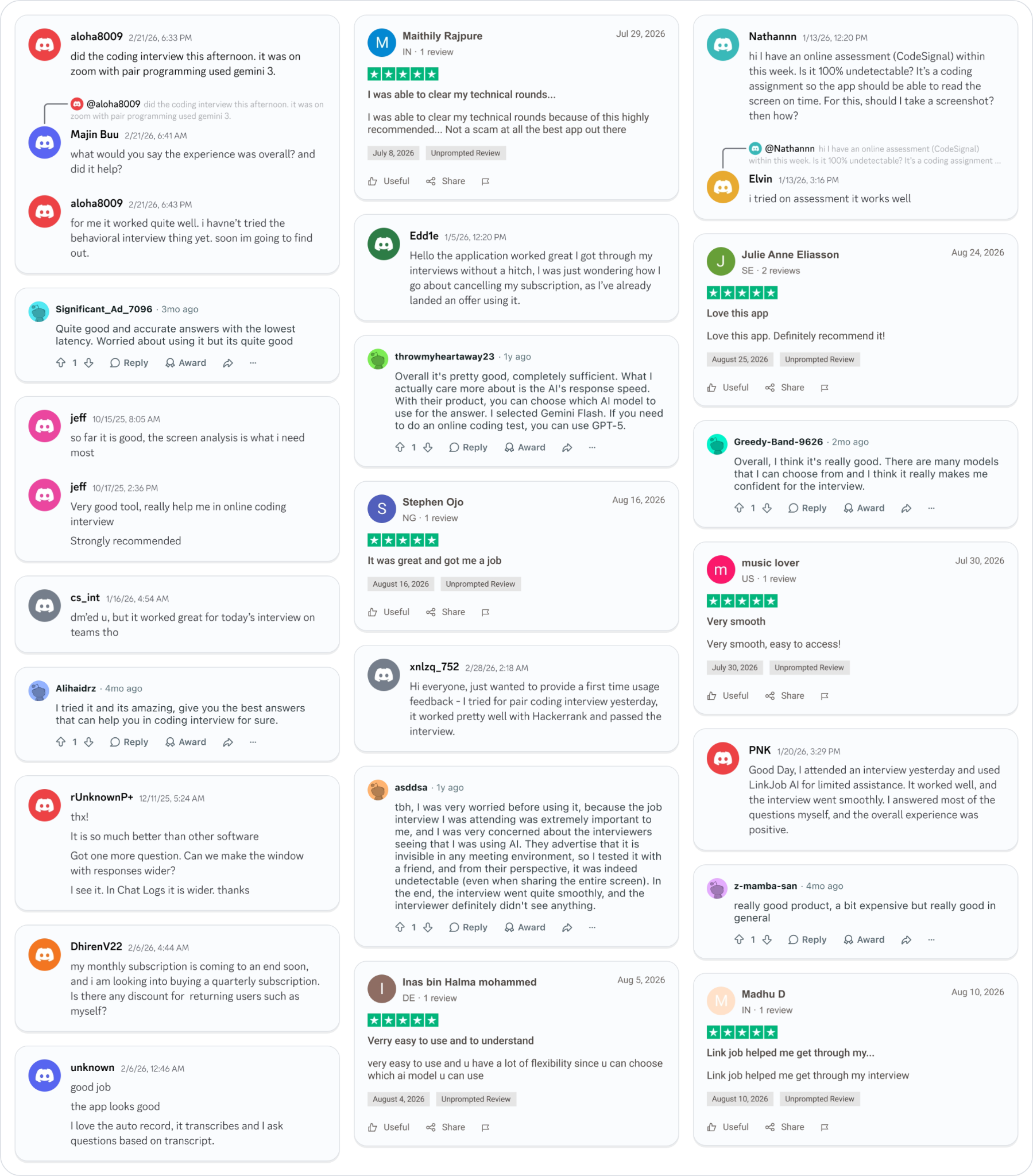
Why People Choose Linkjob AI
Smoother interviews, coding challenges cleared, and job offers landed. See how users describe their experience with Linkjob AI—in their own words.

© Copyright 2026 Linkjob AI - All Rights Reserved.