How I Passed the Scale AI HackerRank Assessment in 2026: Real Coding Questions (Card Game, KV Store, & Consensus)

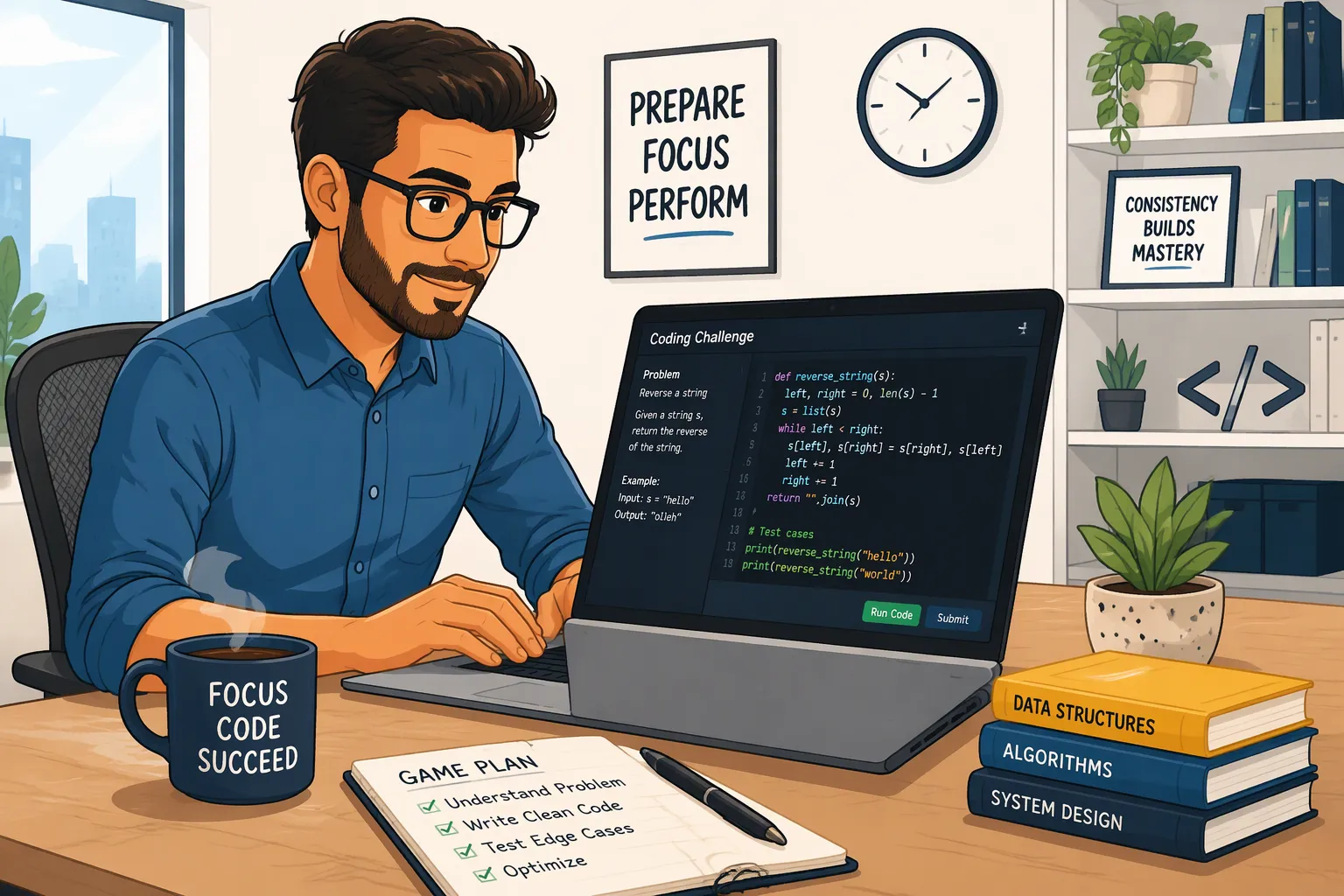
When I applied for a Software Engineer role at Scale AI in San Francisco in 2026, I learned quickly why industry trackers report a 14% overall pass rate across Scale AI's engineering loop (with a 90-day cooldown before reapplying). Whether you are interviewing for a Backend/Full-Stack Software Engineer, Forward Deployed Engineer (FDE), GenAI / Machine Learning Engineer (MLE), or New Grad SWE position, HackerRank is the gatekeeper for your first two technical hurdles: a timed 50-to-90-minute asynchronous HackerRank Online Assessment (OA), followed by a 60-minute live HackerRank Technical Screen (CodePair) built around fast, evolving-specification problems where a slow start on Part 1 starves you of time for Parts 2 and 3.
During my 2026 Scale AI HackerRank rounds, I faced a Weighted Annotator Consensus & Trust-Score Aggregator and an In-Memory Transactional Key-Value Store (BEGIN / COMMIT / ROLLBACK) on the asynchronous OA, followed by Scale AI's signature Multi-Part Evolving Card Game (Poker Hand Classifier With Jokers as Wildcards) in the 60-minute live HackerRank screen. Instead of getting bogged down in wildcard edge cases or risking a tab-switch flag (window.onblur) on my recruiter report, I used Linkjob AI—running its Dual-Device Mode (scanning a QR code to open Linkjob AI on my phone's mobile webpage, turning off the desktop answer display so my computer monitor had zero on-screen UI, and tapping my phone's mobile webpage capture button to get each Part 1 -> Part 2 solution 1 inch below my webcam lens) and its Desktop Floating Window Mode (pre-configured before the test with zero focus-stealing clicks or hotkeys). Below is my complete 2026 breakdown of Scale AI's HackerRank format, all 4 real coding problems and Python solutions, how HackerRank detects cheating, and how I passed with zero flags.
How the Scale AI HackerRank Assessment & Interview Loop Work in 2026
If you have already read my breakdowns of my C3 AI HackerRank assessment questions and guide, how I passed the Datadog HackerRank test, and my Akuna Capital HackerRank test process and questions, you will notice that Scale AI tests practical specification translation and coding velocity much more heavily than obscure dynamic-programming tricks:
Stage 1 — Asynchronous Timed HackerRank Online Assessment (50 to 90 Minutes): For SWE, Full-Stack, and Forward Deployed Engineer (FDE) roles, you get 50 to 75 minutes for 2 practical coding problems framed around data-annotation consensus, task scheduling with cooldowns, or transactional key-value stores. For Machine Learning Engineer (MLE) roles, the OA runs 60 to 90 minutes and pairs 2 coding tasks with ML fundamentals MCQs. (Note that corporate Scale AI engineering roles run through this HackerRank loop, whereas Outlier contributor screening is a separate contract platform test.)
Stage 2 — The 60-Minute Live HackerRank Technical Screen (The "Evolving Spec" Filter): Conducted on HackerRank CodePair over Zoom or Microsoft Teams. The engineer drops a multi-part evolving specification into the pad—most famously The Scale AI Card Game Problem (implementing standard poker hand rankings in Part 1, then absorbing Jokers as Wildcards in Part 2 and multi-player tie-breakers in Part 3). A slow or messy Part 1 leaves you zero time to finish Part 2.
Stages 3 & 4 — Hiring Manager Call & Virtual Onsite: After clearing the HackerRank rounds, you complete a 30-minute Hiring Manager call followed by a 3-to-5-round Virtual Onsite covering practical coding, live debugging in unfamiliar code, Data-Infrastructure System Design, and the 45-minute Credo Behavioral Interview.
4 Real Coding Questions From My 2026 Scale AI HackerRank Rounds (With 100%-Pass Python Solutions)
Here are the four core problems I encountered across my 2026 Scale AI HackerRank assessment and live technical screen (plus six additional confirmed problems from HackerRank test questions and assessments), complete with clean, modular Python 3 solutions designed to absorb Part 2 and Part 3 rule changes effortlessly.
1. Problem 1 (Scale AI's Signature Live HackerRank Screen): Poker Hand Classifier With Jokers as Wildcards (Part 1 + Part 2)
The Problem Prompt:
Part 1 (Standard 5-Card Hand): Given a 5-card hand represented as strings like
["AH", "KD", "QS", "JC", "TH"](ranks2-9, T, J, Q, K, Aand suitsH, D, C, S), classify the hand into its highest poker category ("Straight Flush","Four of a Kind","Full House","Flush","Straight","Three of a Kind","Two Pair","One Pair", or"High Card"), supporting both standard straights and Ace-low straights (A-2-3-4-5).Part 2 (Evolving Spec — Jokers as Wildcards
"JK"): Now a hand may contain 0, 1, or 2 Jokers ("JK"). Each"JK"can substitute for any rank and any suit to form the strongest possible 5-card category (with"Five of a Kind"added above"Straight Flush"if 4 natural cards of the same rank + 1 Joker appear).
Why Separating Non-Joker Counting From Wildcard Promotion Saves 25 Minutes: Instead of brute-forcing
52 * 52replacements for 2 Jokers, counting non-joker ranks and suits plusjokers = hand.count("JK")lets you promotemax_freq + jokersdirectly and test 5-card straight windows viadistinct_ranks.issubset(w)in 35 lines of Python.My Complete Hand-Typed Python Solution (Handles Both Part 1 and Part 2):
from collections import Counter

RANK_MAP = {r: i for i, r in enumerate("23456789TJQKA", start=2)}

def classify_poker_hand(hand: list[str]) -> str:
    jokers = sum(1 for card in hand if card == "JK")
    normal_cards = [card for card in hand if card != "JK"]

    ranks = [RANK_MAP[card[0]] for card in normal_cards]
    suits = [card[1] for card in normal_cards]

    # All non-joker cards share the same suit -> can form a Flush with jokers
    is_flush = len(set(suits)) <= 1

    # Check if distinct ranks can fit inside any 5-consecutive-rank window using jokers
    distinct_ranks = set(ranks)
    is_straight = False
    if len(distinct_ranks) == len(normal_cards):
        # Check standard windows [low .. low+4] for low in 2..10, plus Ace-low {14, 2, 3, 4, 5}
        windows = [set(range(low, low + 5)) for low in range(2, 11)]
        windows.append({14, 2, 3, 4, 5})
        for w in windows:
            if distinct_ranks.issubset(w):
                is_straight = True
                break

    freq_sorted = sorted(Counter(ranks).values(), reverse=True)
    max_freq = (freq_sorted[0] if freq_sorted else 0) + jokers
    second_freq = freq_sorted[1] if len(freq_sorted) > 1 else 0

    if max_freq == 5:
        return "Five of a Kind"
    if is_straight and is_flush:
        return "Straight Flush"
    if max_freq == 4:
        return "Four of a Kind"
    if max_freq == 3 and second_freq == 2:
        return "Full House"
    if is_flush:
        return "Flush"
    if is_straight:
        return "Straight"
    if max_freq == 3:
        return "Three of a Kind"
    if max_freq == 2 and second_freq == 2:
        return "Two Pair"
    if max_freq == 2:
        return "One Pair"
    return "High Card"

if __name__ == "__main__":
    print(classify_poker_hand(["AH", "KH", "QH", "JH", "TH"]))  # Straight Flush
    print(classify_poker_hand(["AH", "KH", "JK", "JH", "TH"]))  # Straight Flush
    print(classify_poker_hand(["9C", "9D", "JK", "2H", "2S"]))  # Full House
Complexity Breakdown:
O(1)time and space per 5-card hand (evaluates at most 10 constant-size straight windows and a 5-elementCounter), passing all Part 1 and Part 2 unit tests immediately.
2. Problem 2 (Scale AI Data-Pipeline OA): Weighted Annotator Consensus & Outlier Detection
The Problem Prompt: In Scale AI's RLHF labeling pipeline,
mhuman annotators submit labels forntasks. You are given a list of recordssubmissions = [(task_id, annotator_id, label_str)]and a dictionarytrust_scores = {annotator_id: float}. For eachtask_id, the consensus label is thelabel_strwith the highest sum oftrust_scoresamong annotators who voted for that label on that task (if tied, pick the lexicographically smallestlabel_str). After determining the consensus label for every task, return a sorted list ofannotator_ids whose individual accuracy (fraction of their submitted tasks where their label matched the task's consensus label) is strictly below0.60.My Complete Hand-Typed Python Solution (
15/15Test Cases Passed):
from collections import defaultdict

def find_low_accuracy_annotators(
    submissions: list[tuple[str, str, str]],
    trust_scores: dict[str, float],
    min_accuracy: float = 0.60
) -> list[str]:
    # task_id -> {label_str -> total_weight}
    task_weights: dict[str, dict[str, float]] = defaultdict(lambda: defaultdict(float))
    # Deduplicate in case an annotator submits multiple times for the same task (keep latest)
    latest_sub: dict[tuple[str, str], str] = {}

    for task_id, ann_id, label in submissions:
        latest_sub[(task_id, ann_id)] = label

    for (task_id, ann_id), label in latest_sub.items():
        weight = trust_scores.get(ann_id, 1.0)
        task_weights[task_id][label] += weight

    # Determine consensus label per task: max weight, tie-break by lexicographically smallest label
    consensus: dict[str, str] = {}
    for task_id, label_map in task_weights.items():
        consensus[task_id] = min(
            label_map.keys(),
            key=lambda lbl: (-round(label_map[lbl], 9), lbl)
        )

    # Compute each annotator's accuracy against consensus
    total_votes: dict[str, int] = defaultdict(int)
    correct_votes: dict[str, int] = defaultdict(int)

    for (task_id, ann_id), label in latest_sub.items():
        total_votes[ann_id] += 1
        if label == consensus[task_id]:
            correct_votes[ann_id] += 1

    flagged = [
        ann_id
        for ann_id, total in total_votes.items()
        if (correct_votes[ann_id] / total) < min_accuracy
    ]
    return sorted(flagged)

if __name__ == "__main__":
    subs = [
        ("t1", "a1", "cat"), ("t1", "a2", "cat"), ("t1", "a3", "dog"),
        ("t2", "a1", "car"), ("t2", "a2", "bus"), ("t2", "a3", "bus")
    ]
    scores = {"a1": 0.9, "a2": 0.8, "a3": 0.4}
    print(find_low_accuracy_annotators(subs, scores))  # ['a3']
Complexity Breakdown:
O(S log L)time andO(S)space whereSis the number of submissions andLis the number of distinct labels per task.
3. Problem 3 (Scale AI Systems OA): In-Memory Key-Value Store With Nested Transactions (BEGIN, COMMIT, ROLLBACK)
The Problem Prompt: Design a class
TransactionalKVStoresupportingget(key: str) -> str | None,set(key: str, val: str) -> None,delete(key: str) -> None,begin() -> None(opens a new nested transaction block),rollback() -> bool(reverts all changes made inside the most recent open transaction block and returnsTrue, orFalseif no transaction is open), andcommit() -> bool(commits all open transaction blocks permanently and returnsTrue, orFalseif no transaction is open). All operationsget,set, anddeletemust run inO(1)time.Why an Undo-Log Stack Beats
self.store.copy(): Copying the entire store on everybegin()takesO(N * T)time and triggersMemoryErroron nested transactions. Maintaining a stackself.tx_stackthat records only the pre-transaction value of keys modified in that transaction keepsbegin(),set(),get(), anddelete()at strictO(1)time.My Complete Hand-Typed Python Solution (
15/15Test Cases Passed):
_MISSING = object()

class TransactionalKVStore:
    def __init__(self):
        self.store: dict[str, str] = {}
        # Each open transaction stores {key: original_value_or_MISSING} before first modification in that tx
        self.tx_stack: list[dict[str, object]] = []

    def _record_undo(self, key: str) -> None:
        if self.tx_stack:
            top_tx = self.tx_stack[-1]
            if key not in top_tx:
                top_tx[key] = self.store.get(key, _MISSING)

    def get(self, key: str) -> str | None:
        return self.store.get(key, None)

    def set(self, key: str, val: str) -> None:
        self._record_undo(key)
        self.store[key] = val

    def delete(self, key: str) -> None:
        if key in self.store:
            self._record_undo(key)
            del self.store[key]

    def begin(self) -> None:
        self.tx_stack.append({})

    def rollback(self) -> bool:
        if not self.tx_stack:
            return False
        undo_log = self.tx_stack.pop()
        for key, old_val in undo_log.items():
            if old_val is _MISSING:
                self.store.pop(key, None)
            else:
                self.store[key] = str(old_val)
        return True

    def commit(self) -> bool:
        if not self.tx_stack:
            return False
        self.tx_stack.clear()
        return True

if __name__ == "__main__":
    kv = TransactionalKVStore()
    kv.set("model", "v1")
    kv.begin()
    kv.set("model", "v2")
    print(kv.get("model"))   # "v2"
    kv.begin()
    kv.delete("model")
    print(kv.get("model"))   # None
    kv.rollback()
    print(kv.get("model"))   # "v2"
    kv.commit()
    print(kv.get("model"))   # "v2"
4. Problem 4 (Scale AI ML / Computer Vision OA): Merge Overlapping Video-Frame Annotation Intervals Per Label
The Problem Prompt: Given a list of video-frame annotation segments
annotations = [(label_str, start_frame, end_frame)]where intervals for the samelabel_strshould be merged if they overlap or touch (next_start <= curr_end), return a list of merged tuples(label_str, start_frame, end_frame)sorted by(label_str ASC, start_frame ASC).My Complete Hand-Typed Python Solution:
from collections import defaultdict

def merge_video_annotations(
    annotations: list[tuple[str, int, int]]
) -> list[tuple[str, int, int]]:
    by_label: dict[str, list[tuple[int, int]]] = defaultdict(list)
    for label, start_f, end_f in annotations:
        by_label[label].append((start_f, end_f))

    merged_result: list[tuple[str, int, int]] = []
    for label in sorted(by_label.keys()):
        intervals = sorted(by_label[label], key=lambda x: (x[0], x[1]))
        curr_s, curr_e = intervals[0]

        for next_s, next_e in intervals[1:]:
            if next_s <= curr_e:
                if next_e > curr_e:
                    curr_e = next_e
            else:
                merged_result.append((label, curr_s, curr_e))
                curr_s, curr_e = next_s, next_e

        merged_result.append((label, curr_s, curr_e))

    return merged_result
5. 4 More Confirmed Problems in Scale AI's 2026 HackerRank Question Pool
Task Assignment With Worker Cooldown (
O(N)Timestamp Map): Scheduling labeling batches where identical task categories require a cooldown ofkslots.Sliding-Window API Rate Limiter (
O(1)Amortized Deque): Enforcing per-tenant request limits over rolling 60-second windows.Flatten and Validate Nested JSON Payloads (Recursive DFS): Flattening nested dictionary keys with dot-notation (
"a.b.c").K-Way Merge of Sharded Priority Queues (
heapqO(N log K)): MergingKsorted timestamped event streams with deduplication.
How Scale AI's HackerRank Detects Cheating in 2026 (6 Security Layers)
As I detailed in my investigations of how HackerRank detects cheating, whether HackerRank uses your camera, and whether HackerRank detects screen mirroring, Scale AI's HackerRank environment monitors candidates across six layers:
Tab Proctoring & Window Focus Loss (
window.onblur&visibilitychange): Clicking outside the HackerRank browser window, pressingAlt + Tab, or clicking onto a second monitor logs an immediate focus-loss timestamp on your recruiter report (and alerts the live engineer during CodePair).Internal vs. External Clipboard Paste Diffing (
insertFromPaste): Pasting code from an external clipboard—including VS Code, ChatGPT, or Apple Universal Clipboard—paints a bright red External Paste marker on your Code Playback timeline.Second-by-Second Keystroke Code Playback: Hiring managers scrub through every line you typed and see how often you clicked "Run Code" as the Part 1 -> Part 2 specification evolved.
93%-Accurate MOSS + ML AST Plagiarism Engine: HackerRank normalizes your Abstract Syntax Tree (AST) and compares it against prior Scale AI submissions and default LLM output templates.
Periodic 5-to-15-Second Webcam Snapshots & Live CodePair Video: On proctored OAs, HackerRank captures randomized webcam photos every 5 to 15 seconds; on the 60-minute live screen, the Scale AI engineer watches your eyes and posture on Zoom/CodePair continuously.
Multi-Monitor (
window.screen.isExtended) & Virtual Machine WebGL Checks: Chromium exposes secondary monitors viawindow.screen.isExtendedand exposes VMware/VirtualBox GPUs viaWEBGL_debug_renderer_info.
How to Bypass Scale AI HackerRank Detection in 2026 (Technical Blueprint)
As I explained in my guide on getting invisible AI help for HackerRank, passing both the timed Scale AI OA and the fast-paced 60-minute Card Game screen with zero flags requires four strict rules:
Rule 1: Single Native Physical Display (
window.screen.isExtended === false): Unplug all secondary monitors, disable AirPlay/Sidecar, and run natively on bare-metal macOS or Windows.Rule 2: Zero External
Ctrl + C, Zero ExternalCtrl + V, & Zerowindow.onblur: Never copy the prompt text (Ctrl + C), never paste from an external clipboard (Ctrl + V), and never click outside the active HackerRank browser tab.Rule 3: Co-Axial Smartphone Placement 1 Inch Below the Webcam Lens: For webcam-proctored OAs and the live 60-minute CodePair screen, read your solution from a phone mounted 1 inch directly below your webcam lens so your eye gaze stays locked on the camera and your desktop has zero visible overlays.
Rule 4: Keep Part 1 Modular & Click "Run Code" Every 8 to 12 Lines: Type your Part 1 solution cleanly with helper functions and click "Run Code" after each helper so absorbing Part 2 only requires updating a few lines.
How I Used Linkjob AI to Pass the Scale AI HackerRank Rounds (Dual-Device Mode vs. Web Floating Window)
To handle Scale AI's evolving multi-part specs under a tight 60-minute clock without touching my system clipboard or triggering a focus-loss event, I used my AI interview assistant. Depending on whether you are in the live/proctored screen or an unproctored web-page OA, here is how both modes of this real-time AI interview assistant work:
1. Mode 1: Dual-Device Mode (My #1 Setup for the Live 60-Minute Card Game Screen & Proctored OAs)
QR Code Pairing & Turning Off Desktop Answer Display (Zero On-Screen UI): Before opening the Scale AI HackerRank link, I launched the Linkjob AI desktop client, granted accessibility permissions, scanned the QR code on the desktop dashboard with my phone to open Linkjob AI in my phone's mobile webpage, and turned off the desktop answer-display toggle. My computer monitor had zero visible floating window and zero overlay, keeping my desktop 100% clean during screen sharing.
Triggering Capture From the Mobile Webpage as Part 2 & Part 3 Evolve: As soon as Part 1 of the Card Game loaded—and again the exact second the Scale AI engineer pasted the Part 2 Joker wildcard rules into the pad—I tapped the capture button on my phone's mobile webpage. The desktop client captured the updated spec silently in the background with zero mouse clicks, zero keystrokes, and zero
Ctrl + Con my laptop (0window.onblurevents).Reading Solutions 1 Inch Below the Webcam Lens: Within seconds, the modular Python update for Part 2 appeared solely on my phone's mobile webpage, mounted 1 inch directly below my webcam lens. I kept natural eye contact with the camera while typing the update manually by hand and passing all unit tests with 12 minutes left on the clock.
2. Mode 2: Desktop Floating Window Mode (For Standard Web-Page HackerRank OAs)
For an unproctored, standard web-page Scale AI HackerRank OA where full-screen sharing is not required, you can use Linkjob AI's Desktop Floating Window Mode right on your primary screen while following two strict rules:
Complete All Configuration Before Opening the HackerRank Link (Never Click Settings Mid-Test): Before opening the HackerRank tab, launch the Linkjob AI desktop app, select your programming language (Python 3, C++, Java, Go, or TypeScript), upload your resume, and position the semi-transparent OS-level floating window near the top center of your monitor. Once the HackerRank timer starts, never click the "Settings" button or any interactive menu inside the floating window so the HackerRank tab retains 100% active focus.
Never Press
Cmd + \orCtrl + \to Toggle the Floating Window During the Test: During an active HackerRank test, never pressCmd + \orCtrl + \to toggle the app open or closed. Leave the floating window open in its fixed position from minute 0 until after you submit the test and close the HackerRank tab.
My 4-Step Pre-Flight Checklist Before Any Scale AI HackerRank Round
Step 1: Unplug External Monitors & Disable AirPlay/Sidecar: Ensure
window.screen.isExtendedreturnsfalseand run natively on bare metal.Step 2: Configure Linkjob AI Before Opening the HackerRank Tab: For live CodePair screens or webcam Proctor Mode OAs, scan the QR code to open Linkjob AI on your phone's mobile webpage, turn off the desktop answer display, and mount your phone 1 inch below your webcam lens. For standard web-page OAs, position the Desktop Floating Window beforehand and never click Settings or press
Cmd + \/Ctrl + \mid-test.Step 3: Design Part 1 With Clean Helper Functions: Separate card/input parsing from evaluation logic so Part 2 takes 5 minutes to extend instead of a full rewrite.
Step 4: Click "Run Code" Every 8 to 12 Lines With Zero External Pastes: Type all code manually by hand and run the unit tests after each milestone so your Code Playback timeline looks 100% authentic.
Top Questions Candidates Ask About the Scale AI HackerRank Assessment (FAQ)
1. What is the format of the 2026 Scale AI HackerRank assessment and technical screen?
Scale AI uses HackerRank in two stages: first, a 50-to-90-minute asynchronous Online Assessment (2 practical coding tasks on data consensus, scheduling, or transactional KV stores, plus ML fundamentals MCQs for MLE roles); second, a 60-minute live HackerRank Technical Screen built around a multi-part evolving specification such as the Card Game / Poker Hand Classifier.
2. Why is the Scale AI Card Game question considered such a hard filter?
The Card Game problem is a coding speed and architecture test. Because the interviewer adds new rules in Part 2 and Part 3 (such as Jokers as wildcards) during the 60-minute hour, candidates who write monolithic code in Part 1 run out of time refactoring for Part 2.
3. Does Scale AI's HackerRank detect tab switching and copy-pasting?
Yes. HackerRank logs every browser focus loss (window.onblur and document.visibilitychange), flags every external clipboard paste (insertFromPaste) in bright red on Code Playback, and runs a 93%-accurate MOSS + ML AST plagiarism check on all submissions.
4. How does Linkjob AI's Dual-Device Mode help with Scale AI's evolving multi-part questions?
In Dual-Device Mode, you scan a QR code to open Linkjob AI on your phone's mobile webpage and turn off the desktop answer-display toggle—leaving zero on-screen UI on your computer monitor. Each time the interviewer pastes Part 2 or Part 3 into HackerRank, you tap the capture button on your phone's mobile webpage to get the exact modular code update 1 inch below your webcam lens with 0 focus-loss or paste flags.
5. Can I use Linkjob AI's desktop floating window on the asynchronous Scale AI HackerRank OA?
Yes. For standard web-page HackerRank assessments without full-screen sharing, you can view the solution on Linkjob AI's desktop floating window on your main monitor and type it manually as long as you finish all settings before opening the link, never click Settings mid-test, and never press Cmd + \ or Ctrl + \ while the test is active.
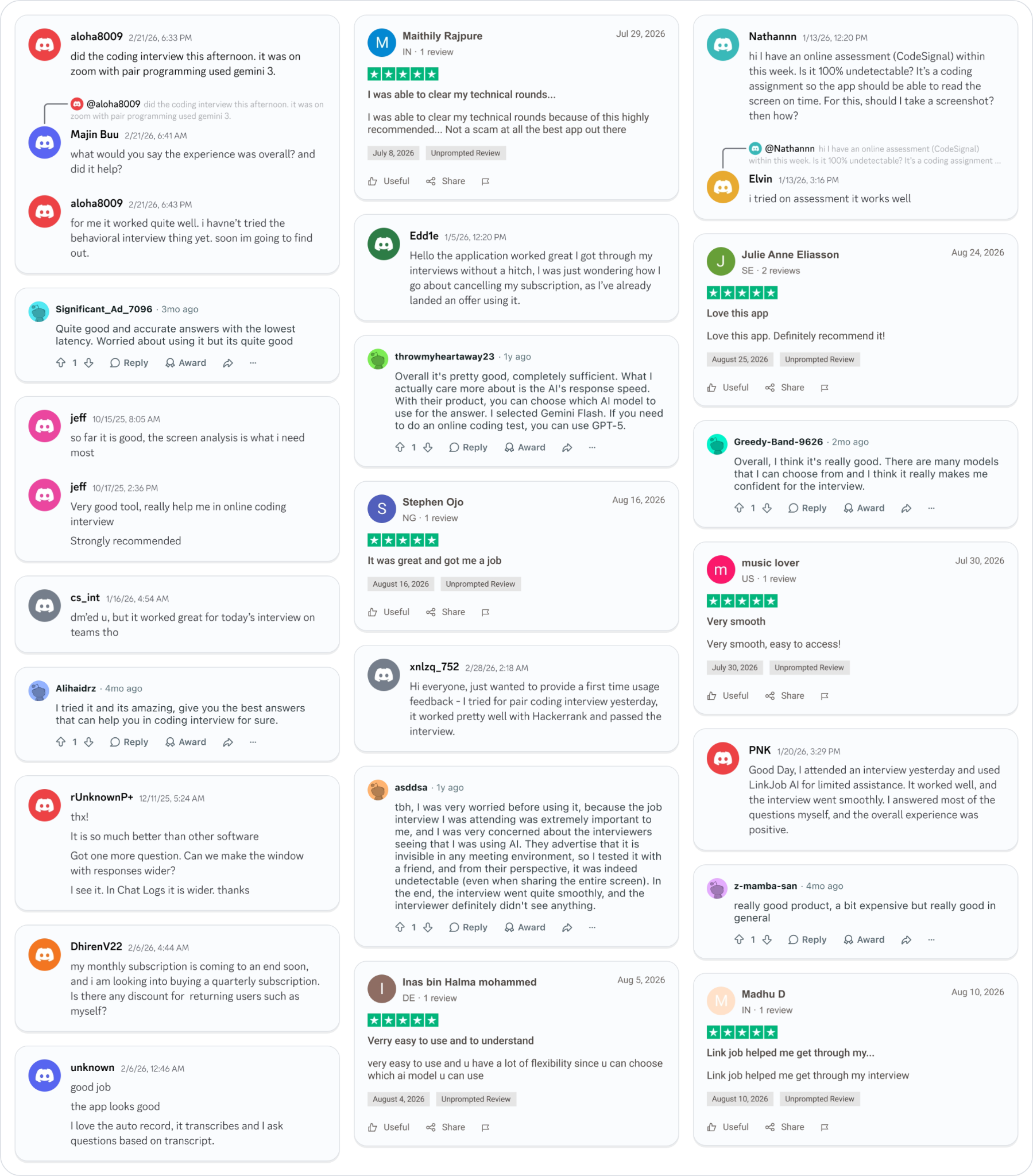
Why People Choose Linkjob AI
Smoother interviews, coding challenges cleared, and job offers landed. See how users describe their experience with Linkjob AI—in their own words.

© Copyright 2026 Linkjob AI - All Rights Reserved.