90 Minutes and 4 Medium-Hard Problems: How I Earned a Certified D. E. Shaw CodeSignal Score in 2026

When D. E. Shaw & Co., L.P. sent my D. E. Shaw CodeSignal invitation in 2026—spanning New York, London, Hyderabad/Bengaluru (DESIS), Singapore, and Hong Kong—two details stood out immediately. Instead of a 70-minute GCA warm-up, D. E. Shaw's recruiter-sent CodeSignal gives 90 continuous minutes for 4 Medium-Hard problems (coding only, bonus points paid only at 100% module completion). Worse, high raw scores mean nothing if your attempt comes back Uncertified—recruiters only see Not Verified, ending your candidacy silently with zero appeal.
During my own 90-minute D. E. Shaw CodeSignal sitting, I tackled four classic quantitative-engineering shapes where O(N^2) brute force dies instantly at N = 100,000 to 200,000: Coordinate-Compressed Lamp Sweep-Line Coverage, Precomputed Matrix Cross Optimization, String Suffix-Pair Frequency Counting (where duplicate strings double-count naive scans), and Binary Subsequence Counting Equal to K With Leading Zeros (O(N * log K) DP). Even more sobering were the integrity horror stories I read beforehand: one candidate left a low-opacity desktop copilot window open and watched the final score screen lock into review 10 minutes before the deadline, while another pressed a laptop capture shortcut at minute 72 and ended up with an uncertified score!
To secure both 100% module completion and a Certified Score, I paired Linkjob AI in Dual-Device Mode—scanning a QR code to open Linkjob AI on my phone's mobile webpage, turning off the desktop answer display so zero window existed on my recorded laptop, and tapping capture on my phone's mobile webpage (zero laptop shortcut keys!) to view O(N) solutions 1 inch below my webcam (plus testing Desktop Floating Window Mode on unproctored pads). Below are all 3 D. E. Shaw OA shapes, all 4 real 90-minute tasks, and how I reached the 6-stage loop.
Why "D. E. Shaw OA" Actually Means 3 Different Tests in 2026 (Check Your Invite First!)
Before I wrote a single line of practice code, I compared D. E. Shaw's process against the other elite quantitative hedge funds and market makers I had interviewed with—including how I crushed the Susquehanna International Group CodeSignal assessment, how I passed the Citadel Software Engineer interview, my Citadel SWE New Grad interview process, my Citadel CoderPad OA and interview questions, what I got on my Virtu Financial HackerRank test, and my Marshall Wace Codility test breakdown. Most prep blogs flatten D. E. Shaw into one generic test, which is a dangerous mistake because three completely different OA products carry the D. E. Shaw name in 2026:
1. Shape 1: The Recruiter-Sent D. E. Shaw CodeSignal OA (90 Minutes, 4 Coding Problems)
This is the global Software Developer (SDE), Quantitative Developer (QD), and SWE Intern assessment I took:
90 Minutes, Single Clock, 14-Day Invite Window: Your link stays valid for 14 days by default, and the 90-minute un-pausable clock starts only after you finish government photo ID, webcam, microphone, open-window sweep, and Entire-Screen share setup. All 4 coding tasks unlock together with no aptitude MCQs.
Two-Tier 200–600 Scoring & Full-Module Bonus: CodeSignal scores the test from 200 to 600, paying full module completion bonuses only when a task passes 100% of visible and hidden test cases. D. E. Shaw publishes no official cutoff or retake rule—verification takes 1 to 3 business days, and your sole target is a clean Certified Score with all 4 tasks solved or 3 aced plus high partial credit on the 4th.
2. Shape 2: The India On-Campus DESIS HackerRank OA (3 DSA Tasks With Non-Carrying Section Timers)
If you are sitting on-campus for D. E. Shaw India (DESIS) in labs with external proctors, you do not get a single 90-minute flexible clock—you get 3 hard DSA questions on HackerRank with fixed, non-carrying per-question timers (reported splits such as 20 / 30 / 40 or 20 / 25 / 35 minutes). Unused minutes on Question 1 never roll forward to Question 2, and once a section clock expires you can never reopen that problem!
3. Shape 3: Specialized Front-End OA & Non-Coding Quant Tracks
Front-End Engineering applicants receive a dedicated 2-part HackerRank test (1 front-end UI task + 1 algorithm task), whereas PhD Quantitative Researcher/Analyst candidates often skip the OA straight into a First-Round Technical Phone Screen, and Discretionary/Macro Prop Trader applicants complete a 48-hour macro case-study write-up with zero coding.
All 4 Real Problems From My 90-Minute D. E. Shaw CodeSignal Set (With 100%-Pass Python Code)
Here are the four recurring algorithmic tasks that anchor D. E. Shaw's 90-minute CodeSignal assessment (alongside verified patterns in CodeSignal questions and assessment practice), ordered from fastest points to the 2026 complexity-gated final slot.
1. Problem 1: Coordinate-Compressed Lamp Sweep-Line Coverage (O((N + Q) log N))
The Problem Prompt: Along a 1D number line spanning
[-10^9, 10^9],lamps[i] = [center, radius](1 <= len(lamps) <= 10^5) illuminates the closed interval[center - radius, center + radius]. Givenpoints: list[int](1 <= len(points) <= 10^5), return an array giving how many lamps illuminate each query point (or, in the tie-break variant, find the smallest integer coordinate illuminated by the maximum number of lamps!).Why Array Difference Tables Crash & Coordinate Sweep Wins: Allocating
diff = [0] * (2 * 10^9)crashes RAM immediately! Instead, record+1atcenter - radiusand-1atcenter + radius + 1inside a hash mapdeltas, sort the unique event coordinates once, build prefix step values(coord, active_lamps), and answer every querypinO(log N)viabisect_right!
from bisect import bisect_right
from collections import defaultdict

def query_lamp_coverage(
    lamps: list[list[int]], points: list[int]
) -> tuple[list[int], int]:
    deltas: dict[int, int] = defaultdict(int)
    for center, radius in lamps:
        deltas[center - radius] += 1
        deltas[center + radius + 1] -= 1

    coords: list[int] = []
    counts_at_coord: list[int] = []
    running = 0
    best_cov = -1
    best_pos = 0

    for x in sorted(deltas.keys()):
        running += deltas[x]
        coords.append(x)
        counts_at_coord.append(running)
        if running > best_cov:
            best_cov = running
            best_pos = x

    ans: list[int] = []
    for p in points:
        idx = bisect_right(coords, p) - 1
        ans.append(counts_at_coord[idx] if idx >= 0 else 0)

    return ans, best_pos

if __name__ == "__main__":
    cov, peak_x = query_lamp_coverage([[-2, 3], [1, 2], [4, 1]], [-5, 0, 1, 3, 5])
    print(cov, peak_x)  # [1, 2, 2, 1, 1], peak_x = -1 (covered by [-5,1] and [-1,3])
2. Problem 2: Nearly-Regular & Maximum Matrix Crosses (O(R * C) Row/Column Precomputation)
The Problem Prompt: Given an
R x Cinteger matrixgrid(1 <= R * C <= 10^5), a cross centered at(r, c)consists of every cell in rowrand every cell in columnc. Count how many crosses(r, c)are nearly regular—meaning every cell in the cross other than the intersection(r, c)itself holds the exact same integer value (while(r, c)may match or differ)!Why
O(R * C * (R + C))Scans Fail & Frequency Precomputation Runs inO(R * C): Re-scanning rowrand columncfor every cell takesO(R * C * (R + C))(TLEon316 x 316or1,000 x 100matrices!). Precompute aCounterper row (row_freq[r]) and per column (col_freq[c]): excluding(r, c), rowrhasC - 1remaining cells and columnchasR - 1remaining cells. Testing at most1candidate valuev(any element of rowroutside colc, or colcoutside rowr) checks inO(1)time whetherrow_count_excluding_center(r, c, v) == C - 1andcol_count_excluding_center(r, c, v) == R - 1!
from collections import Counter

def count_nearly_regular_crosses(grid: list[list[int]]) -> int:
    rows = len(grid)
    cols = len(grid[0])
    if rows == 1 and cols == 1:
        return 1

    row_freq = [Counter(grid[r]) for r in range(rows)]
    col_freq = [Counter(grid[r][c] for r in range(rows)) for c in range(cols)]

    valid_crosses = 0
    for r in range(rows):
        for c in range(cols):
            center_val = grid[r][c]
            # Pick the single required arm value v from any non-center neighbor
            if cols > 1:
                v = grid[r][1] if c == 0 else grid[r][0]
            else:
                v = grid[1][c] if r == 0 else grid[0][c]

            r_cnt = row_freq[r][v] - (1 if center_val == v else 0)
            c_cnt = col_freq[c][v] - (1 if center_val == v else 0)
            if r_cnt == cols - 1 and c_cnt == rows - 1:
                valid_crosses += 1

    return valid_crosses

if __name__ == "__main__":
    mat = [
        [1, 1, 1],
        [2, 9, 2],
        [3, 1, 3]
    ]
    print(count_nearly_regular_crosses(mat))  # 0 (row 1 arms are 2, col 1 arms are 1)
    print(count_nearly_regular_crosses([[2, 1, 2], [1, 9, 1], [2, 1, 2]]))  # 1 at (1, 1) where all 4 arm cells == 1
3. Problem 3: String Suffix-Pair Counting (O(Total_Characters) Exact + Proper-Suffix Hash Map)
The Problem Prompt: Given
words: list[str](1 <= len(words) <= 10^5, sum of string lengths<= 5 * 10^5), count unordered index pairs(i, j)(0 <= i < j < len(words)) such thatwords[i]is a suffix ofwords[j]ORwords[j]is a suffix ofwords[i].The Duplicate-Word Double-Counting Trap: If
words = ["alpha", "alpha"],"alpha"is a suffix of"alpha"in both directions—naive suffix loops count that single pair twice! Group exact word countsfreq = Counter(words)first:Every distinct word
wwith countccontributesc * (c - 1) // 2identical pairs.For every proper non-empty suffix
suf = w[k:](1 <= k < len(w)), ifsufexists infreq, addc * freq[suf]unordered pairs (each(long_word, strictly_shorter_suffix)pair is counted exactly once with zero risk of double-counting!):
from collections import Counter

def count_suffix_pairs(words: list[str]) -> int:
    freq = Counter(words)
    total_pairs = 0

    for word, cnt in freq.items():
        # 1. Pairs where both strings are identical
        total_pairs += cnt * (cnt - 1) // 2

        # 2. Pairs where a strictly shorter string in freq is a proper suffix of word
        wlen = len(word)
        for cut in range(1, wlen):
            suf = word[cut:]
            if suf in freq:
                total_pairs += cnt * freq[suf]

    return total_pairs

if __name__ == "__main__":
    print(count_suffix_pairs(["shaw", "aw", "shaw", "w"]))  # ("shaw","shaw")=1 + 2*("shaw","aw")=2 + 2*("shaw","w")=2 + ("aw","w")=1 -> 6
4. Problem 4 (2026 Complexity-Gated Hard Slot): Count Binary Subsequences Equal to K (N <= 2 * 10^5, Leading Zeros Allowed!)
The Problem Prompt: Given a binary string
sof lengthn(1 <= n <= 2 * 10^5) and a non-negative integerk(0 <= k <= 10^9), return the number of non-empty subsequences ofswhose binary value equalsk, modulo10^9 + 7. Leading'0'characters are allowed and count as distinct subsequences (fors = "010"andk = 2, both"10"at indices(1, 2)and"010"at indices(0, 1, 2)evaluate to2, returning2!).How
O(N * log K)Bit-Prefix DP BeatsO(2^N)Enumeration:Special Case
k == 0: A non-empty binary subsequence equals0if and only if it consists purely of'0'characters! Withztotal'0's ins, return(pow(2, z, MOD) - 1) % MODinO(N)time!General Case
k > 0: Writekin binary without leading zeros:bits = bin(k)[2:]of lengthB <= 30(bits[0]is guaranteed'1'). Trackzero_prefixes= number of ways to pick0or more'0's before the leading'1'(initialized to1for choosing zero'0's; every'0'seen insdoubleszero_prefixes!). Maintaindp[j](1 <= j <= B) = ways to have matchedbits[0 .. j - 1]. When charactercharrives, updatej = Bdown to2wheneverbits[j - 1] == ch, and ifch == '1'(bits[0]), addzero_prefixesintodp[1]!
def count_subsequences_equal_to_k(s: str, k: int) -> int:
    MOD = 10**9 + 7
    if k == 0:
        zeros = s.count("0")
        return (pow(2, zeros, MOD) - 1) % MOD

    bits = bin(k)[2:]  # Length B <= 30, bits[0] == '1'
    b_len = len(bits)
    dp = [0] * (b_len + 1)
    zero_prefixes = 1  # Represents choosing empty leading-zero prefix "" (and grows on '0's)

    for ch in s:
        # Update lengths b_len down to 2 so current char isn't reused twice in one step
        for length in range(b_len, 1, -1):
            if bits[length - 1] == ch:
                dp[length] = (dp[length] + dp[length - 1]) % MOD

        if ch == "1":
            # bits[0] is always '1': pair this '1' with any subset of preceding '0's
            dp[1] = (dp[1] + zero_prefixes) % MOD
        else:
            # Each '0' can either be included or excluded in a leading-zero prefix
            zero_prefixes = (zero_prefixes * 2) % MOD

    return dp[b_len]

if __name__ == "__main__":
    print(count_subsequences_equal_to_k("010", 2))   # 2 ("10" and "010")
    print(count_subsequences_equal_to_k("001", 0))   # 3 ("0" at 0, "0" at 1, "00")
Why D. E. Shaw CodeSignal Attempts Come Back Uncertified (4 Suspicion Signals)
As I documented across how CodeSignal detects cheating, whether CodeSignal records your camera, whether CodeSignal detects copy paste in 2026, and getting invisible AI help on CodeSignal proctored exams, CodeSignal assigns every question a Suspicion Score (None to High) and an integrity status (Yes, No, Pending). When an attempt fails verification, D. E. Shaw recruiters only see Not Verified—never an appealable explanation:
Low-Opacity Desktop Copilot Windows on the Recorded Screen: CodeSignal records your Entire Screen (
displaySurface === "monitor") from minute00:00to90:00. In documented internship-cycle sittings, candidates who left a low-opacity desktop copilot window open watched their final score screen withhold results and route straight to uncertified status—even after closing the app in the final 10 minutes!Laptop Capture Hotkeys & Open Background Apps: Step 3 of CodeSignal's pre-timer setup explicitly orders you to close every unrelated tab, window, and desktop app—and pressing global capture shortcut keys on your monitored laptop mid-test generates OS focus/keyboard telemetry that puts sessions on hold.
Clipboard Paste Events (
insertFromPaste) & AI Pattern Scanning: CodeSignal logs paste volume, timing, and external clipboard text alongside generative-AI structural code fingerprints (35%of proctored assessments in CodeSignal's entry-level benchmarks carried at least one integrity signal!).Webcam Frame Exits & Off-Screen Speaking Telemetry: Stepping out of camera view, muttering prompts aloud, or rotating toward a second monitor (
window.screen.isExtended === true) triggers human review holds.
My Technical Blueprint to Guarantee a Certified D. E. Shaw CodeSignal Score
Applying the architecture from how an invisible AI interview assistant works, I followed four strict habits:
Rule 1: Close Every Unrelated App & Unplug Secondary Monitors: Treat CodeSignal's pre-test window sweep seriously (
window.screen.isExtended === false)—the 90-minute timer does not start until setup finishes, so take 3 calm minutes to clean your workspace and camera framing.Rule 2: Zero On-Screen Overlays & Zero Laptop Shortcut Keys: Never leave a low-opacity window on your recorded monitor and never press capture shortcuts,
Ctrl + C, orCtrl + Von your laptop!Rule 3: Budget
22 MinutesPer Problem & Capture Full-Module Bonuses First: Because CodeSignal's two-tier score only awards module completion bonuses at 100% pass, lock in100%on the two cleanest tasks inside 35 minutes before tackling theO(N * log K)DP or coordinate sweep-line tasks.Rule 4: Hand-Type Idiomatic Code & Test
N = 200,000Edge Cases: Use natural variable names (zero_prefixes,deltas), avoid LLM docstrings, and testk == 0, duplicate strings, and negative coordinates inside CodeSignal's custom runner.
How I Used Linkjob AI to Earn a Certified D. E. Shaw CodeSignal Score (Dual-Device vs. Floating Window)
Seeing competitors admit their 90-minute D. E. Shaw attempts came back uncertified after using low-opacity windows or pressing laptop hotkeys at minute 72 proved why architecture decides everything. Here is how I used my AI interview assistant across both modes of this invisible coding interview assistant:
1. Mode 1: Dual-Device Mode (Mandatory for Proctored 90-Minute D. E. Shaw CodeSignal Links)
Because CodeSignal records your Entire Screen and flags both low-opacity windows and laptop hotkeys (and Dual-Device Mode also works seamlessly under LockDown Browser and DESIS proctored environments), Dual-Device Mode was my non-negotiable setup:
QR Code Pairing to My Phone's Mobile Webpage & Turning Off Desktop Display: Before starting CodeSignal's ID, camera, and window-sweep setup, I launched the Linkjob AI desktop app, granted accessibility permissions, scanned the dashboard QR code with my phone camera to open Linkjob AI in my phone's mobile webpage, and turned off the desktop answer-display toggle. Zero low-opacity windows, zero overlays, and zero UI existed on my laptop display for all 90 minutes!
Zero-Laptop-Keystroke Capture Directly From My Phone's Mobile Webpage: Unlike tools that force you to press a keyboard shortcut on your monitored laptop at minute 72, I triggered every screen capture by tapping the button directly on my phone's mobile webpage—producing zero laptop keystrokes, zero focus exits (
0window.onblur), and0clipboard pastes!Reading
O(N * log K)Binary DP & Suffix Math 1 Inch Below My Webcam: Within seconds, thezero_prefixesdoubling transition on Question 4 and the duplicate-safecnt * (cnt - 1) // 2suffix formula appeared solely on my phone's mobile webpage, mounted 1 inch directly below my webcam lens. I kept natural eye alignment with my camera, typed clean Python 3 code manually, hit 100% across all four modules with 8 minutes left, and received my Certified Score in 48 hours!
2. Mode 2: Desktop Floating Window Mode (For Unproctored Practice & Non-Recorded Links)
When practicing timed 90-minute sets or taking an unproctored web-page link where Entire-Screen recording is not active and you prefer viewing solutions on your primary monitor, use Linkjob AI's Desktop Floating Window Mode with two strict rules:
Complete All Configuration Before Opening the Link (Never Click Settings Mid-Test): Launch Linkjob AI, select Python 3 or C++20, and position the floating window before opening the coding tab. Once the timer starts, never click the "Settings" button or any interactive menu inside the floating window so Chrome never triggers
window.onblur.Never Press
Cmd + \orCtrl + \During the Session: Never pressCmd + \orCtrl + \to toggle the floating window open or closed while an active test tab is open. Leave it fixed in place until you submit and close the browser tab.
My 4-Step Pre-Test Checklist Before Launching D. E. Shaw's CodeSignal OA
Step 1: Verify Which of the 3 D. E. Shaw OA Shapes Is in Your Inbox: Confirm whether you hold the 90-minute 4-question CodeSignal link, the non-carrying per-question HackerRank link, or the 2-part Front-End link before planning your pacing.
Step 2: Leave a 3-Day Buffer Inside the 14-Day Window for Verification: Proctoring certification takes 1 to 3 business days, and D. E. Shaw reviews rolling cohorts quickly—submit by Day 10 or 11 at the latest!
Step 3: Pair Linkjob AI via QR Code With Desktop Display OFF Before Setup: Open Linkjob AI on your phone's mobile webpage, confirm the desktop answer-display toggle is OFF, close all unrelated desktop apps, and mount your phone 1 inch below your webcam.
Step 4: Drill Discrete Probability &
ceil(3n/2) - 2Min-Max Math for Round 2: Even pure SWE candidates at D. E. Shaw get surprised by expected-value dice stopping games, regression/variance trivia, and20-minute deep resume probing in the Technical Phone Screen and Virtual Onsites (VO1&VO2)!
Frequently Asked Questions About the D. E. Shaw CodeSignal Assessment (FAQ)
1. How many questions and minutes are on the 2026 D. E. Shaw CodeSignal OA?
On the recruiter-sent Software Developer (SDE), Quant Developer (QD), and SWE Intern path, the D. E. Shaw CodeSignal OA runs 90 continuous minutes with 4 Medium-to-Hard coding questions (coding only, no aptitude section, single shared clock, 14-day default invite validity). India on-campus DESIS drives separately use a 3-question HackerRank test with fixed non-carrying per-question timers.
2. What CodeSignal score do you need to pass D. E. Shaw's screen?
D. E. Shaw has never published a numeric cutoff. CodeSignal scores the assessment from 200 to 600, awarding full module bonuses only at 100% test-case completion—so earning a clean Certified Score with 3 to 4 fully completed modules (550 to 600) is the benchmark to reach the technical phone screen.
3. Why do some D. E. Shaw CodeSignal scores come back uncertified?
CodeSignal records your webcam, mic, and Entire Screen, computing a per-question Suspicion Score from low-opacity desktop windows, laptop shortcut telemetry, clipboard pastes, and AI code patterns. Uncertified results reach D. E. Shaw as Not Verified without explanation, ending your candidacy silently.
4. How does Linkjob AI's Dual-Device Mode prevent an uncertified D. E. Shaw CodeSignal score?
Scanning the desktop QR code opens Linkjob AI on your phone's mobile webpage, and turning off the desktop answer-display toggle ensures zero low-opacity windows or UI ever exist on your laptop screen—while tapping capture directly on your phone's mobile webpage presses zero shortcut keys on your monitored laptop.
5. What interview rounds follow passing the D. E. Shaw CodeSignal OA?
Software and Quant Developers face a 6-stage funnel: after CodeSignal comes a 45–60 minute Technical Phone Screen (20-minute project grilling + coding), Virtual Onsite 1 (3 conditional rounds of coding, probability/expectation, and modeling), and Virtual Onsite 2 (2 senior SVP/manager rounds).
See Also
My Successful 2026 TikTok CodeSignal Assessment: Tips, Strategies, and Preparation Guide
My Winning Approach to the 2026 BCG X CodeSignal Assessment
How I Conquered the Ramp CodeSignal Assessment and Key Lessons You Can Learn
A Complete Guide to Preparing for Capital One Data Analyst CodeSignal Questions
My Proven Strategy for Acing the Hudson River Trading CodeSignal Assessment
Why People Choose Linkjob AI
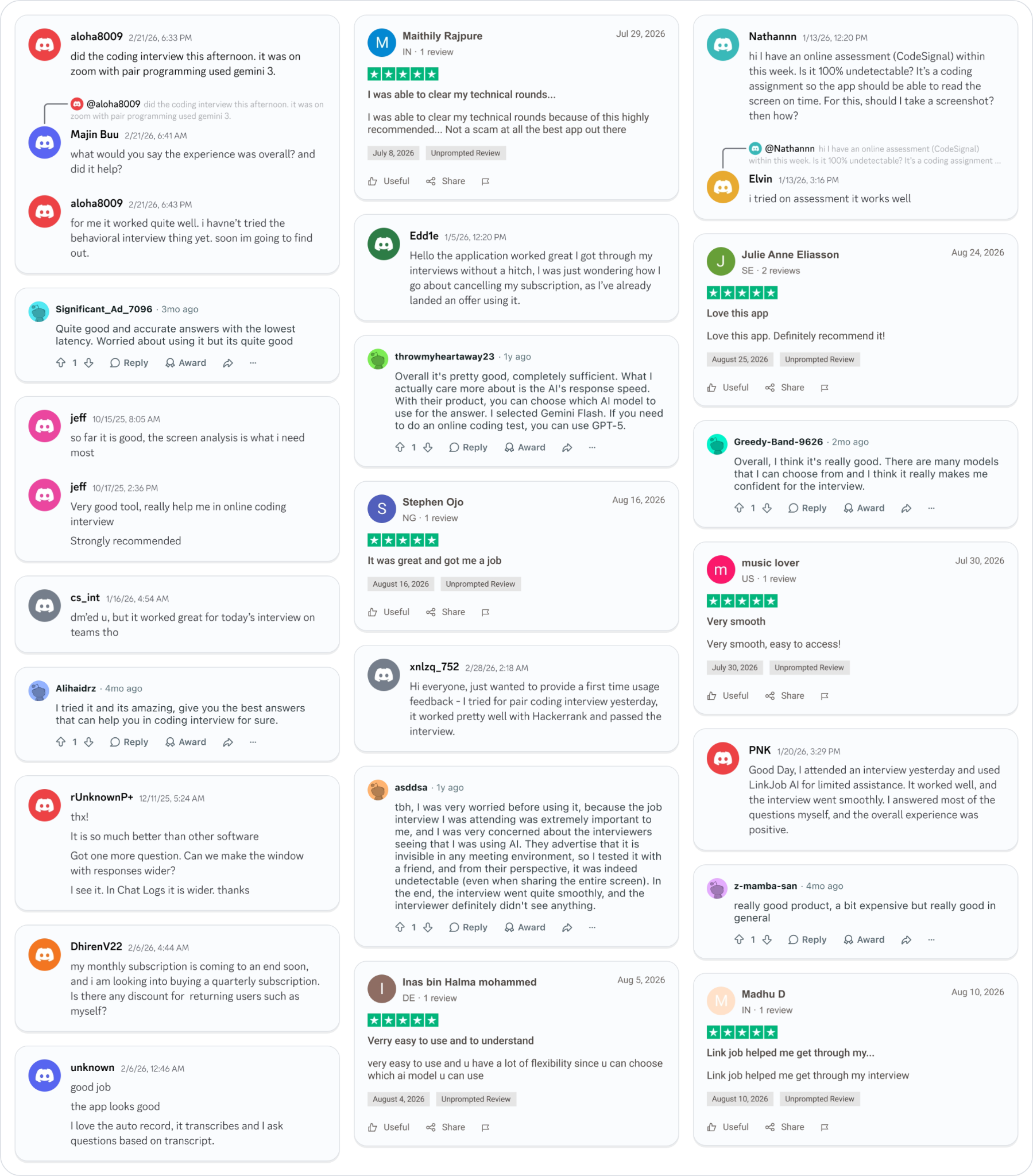
Smoother interviews, coding challenges cleared, and job offers landed. See how users describe their experience with Linkjob AI—in their own words.

© Copyright 2026 Linkjob AI - All Rights Reserved.