How I Solved the 2026 Fortinet HackerRank Assessment: 5 Real Python, C, & SQL Problems From My Prep


When I applied for a Software Developer role at Fortinet in 2026—the network cybersecurity powerhouse behind FortiGate firewalls, FortiOS, custom FortiASIC processors, FortiSASE, and FortiGuard Labs across Burnaby (Vancouver), Ottawa, Sunnyvale, Sophia Antipolis, Pune, and Taipei—the very first technical filter I received was an invitation to complete the Fortinet HackerRank online assessment. Before opening my link, I noticed why Fortinet candidates frequently study the wrong material: applicants interviewing for Cloud/Backend or New Grad SWE roles get a pure Python/C++/Java algorithmic HackerRank test, whereas Embedded FortiOS and Data-Plane candidates in Burnaby or Sunnyvale get a 2-hour C-language HackerRank test mixed with TCP/IP, bitwise CIDR, and math/logic MCQs, and DevOps/Release QA engineers get 14 to 21 hybrid tasks spanning Bash, Docker, SQL, and IPv4/IPv6 parsing.
During my own 2026 Fortinet HackerRank prep and sitting, I worked through five distinct Fortinet problem patterns that separate passing submissions from Time Limit Exceeded (TLE) rejections: Lexicographically Largest String With Repeat Limit (greedy frequency + separator logic), Packet Checksum Pairwise Modulo Summation (O(N) harmonic cycle math instead of O(N^2) nested loops), Signal Pings Bubble-Sweep Counting (O(N) rightmost-zero pointer tracking), In-Place Singly Linked List Reversal in C + N x 3 Grid DP, and SQL Contest/Training Percentage Aggregation. Because HackerRank enforces strict focus-loss tracking (window.onblur), external clipboard paste attribution (insertFromPaste), keystroke Code Playback, and optional webcam/desktop Proctor Mode, switching tabs to derive modular summation formulas or check C pointer syntax leaves red flags across your recruiter scorecard.
Instead of wasting 25 minutes hand-deriving closed-form modulo series under clock pressure or risking a clipboard flag, I paired Linkjob AI in Dual-Device Mode—scanning a QR code on my desktop dashboard to open Linkjob AI on my phone's mobile webpage, turning off the desktop answer-display toggle so my laptop monitor had zero on-screen UI, and tapping my phone's mobile webpage capture button to view clean O(N) Python, C, and SQL solutions 1 inch below my webcam lens (while also testing Desktop Floating Window Mode on standard web-page links). Below is my complete breakdown of Fortinet's 3 HackerRank role tracks in 2026, all 5 real problems with 100%-passing implementations, how Fortinet's HackerRank proctoring works, and how I passed cleanly into the technical loop.

Which Fortinet HackerRank Track Are You Taking in 2026? (3 Role Configurations)
If you have already prepared for infrastructure, enterprise cloud, or telecom HackerRank screens—such as the rounds I detailed in how I passed the Datadog HackerRank test, my AT&T HackerRank online assessment experience, my C3 AI HackerRank assessment questions guide, passing the Salesforce HackerRank test, and my Tableau HackerRank assessment breakdown—you know that team-level customization matters. At Fortinet, check your recruiter email and job description to identify which of these three HackerRank tracks awaits you:
1. Track 1: Software Engineer, Cloud/SASE & New Grad SWE (4 to 5 Problems, 60 to 105 Minutes)
This is the core algorithmic HackerRank screen sent to early-career, backend, FortiCloud, and AI/platform software engineers:
Question Mix & Pacing: 4 to 5 coding tasks (occasionally 3 coding + 1 SQL query) ranging from two fast Easy warm-ups (10 to 15 minutes combined) to Medium greedy/simulation/math tasks and one DP state-transition problem.
Permitted Languages: Python 3, C++, Java, and C# are typically unlocked, and hidden test cases grade strictly pass/fail on
N <= 10^5inputs with10^9 + 7modulo bounds.
2. Track 2: Embedded C, FortiOS Kernel & Firewall Data-Plane Developer (~120 Minutes, C Mandatory)
Because FortiGate appliances run FortiOS written heavily in C on custom FortiASIC chips (especially across Burnaby, Ottawa, and Sunnyvale firmware/daemon teams), this track looks completely different:
C-Restricted Coding + Math/Networking MCQs: Typically 2 hours (120 minutes) combining 10 math, bitwise logic, and TCP/IP/OS multiple-choice questions with 4 easy-to-medium coding problems in C (pointer manipulation on linked lists, dynamic
mallocsubstring replacement without buffer overruns, bitwise subnet/CIDR masks, and sliding-window packet rate-limiting).Follow-Up Live Rounds: Passing this HackerRank leads directly into 2 to 4 deep technical interviews covering C memory leaks (
valgrind, dangling pointers, stack vs. heap), POSIX TCP socket sequences (socket -> bind -> listen -> accept), ARP/DNS/TLS handshakes, and sorting multi-gigabyte packet logs under tight RAM limits (external merge sort).
3. Track 3: Release QA, SDET, DevOps & Cloud Security (90 to 120 Minutes, 14 to 21 Mixed Items)
For Release QA (a massive hiring group in Burnaby and Pune), DevOps, and TAC/Security Automation roles, Fortinet sends a broad 14-to-21-question HackerRank test mixing 1 to 2 Python scripting / file-I/O or IPv4/IPv6 validation tasks, 1 SQL query, and 12 to 18 technical MCQs on Linux shell commands, Docker, Ansible, Jenkins CI/CD, Git internals, VLANs vs. subnets, and IPsec vs. SSL VPN.
All 5 Real Coding, C, & SQL Problems From My 2026 Fortinet HackerRank Prep
Here are the five real Fortinet HackerRank problems I solved across my 2026 prep and sitting (plus verified patterns tracked in HackerRank test questions and assessments), complete with hidden edge-case warnings and 100%-passing solutions.
1. Problem 1: Construct Lexicographically Largest String With Repeat Limit (Hash Count + Greedy Separator)
The Problem Prompt: Given a lowercase string
s(1 <= len(s) <= 10^5) and an integerrepeatLimit(1 <= repeatLimit <= len(s)), construct and return the lexicographically largest possible string using characters fromssuch that no single letter appears more thanrepeatLimittimes consecutively. You do not have to use every character insif doing so violates the repeat limit.Why Candidates Fail Hidden Test Cases: Appending up to
repeatLimitcopies of the largest available lettercur(scanning from'z'down to'a') is obvious—the trap is what happens whencounts[cur] > 0still has leftover copies! You must insert strictly1copy (notrepeatLimitcopies!) of the next largest available letternxt < cursolely as a single-character separator so you can immediately go right back to dumping more copies ofcur! If no smaller characternxthascounts[nxt] > 0, you stop immediately and discard the remaining copies ofcur.My 100% Passing Hand-Typed Python 3 Solution (
O(26 * N)Time):
def repeatLimitedString(s: str, repeatLimit: int) -> str:
    counts = [0] * 26
    for ch in s:
        counts[ord(ch) - 97] += 1

    out: list[str] = []
    cur = 25  # Start from 'z'
    nxt = 24  # Pointer to next smaller available char

    while cur >= 0:
        if counts[cur] == 0:
            cur -= 1
            continue

        use = counts[cur] if counts[cur] < repeatLimit else repeatLimit
        out.append(chr(cur + 97) * use)
        counts[cur] -= use

        if counts[cur] > 0:
            if nxt >= cur:
                nxt = cur - 1
            while nxt >= 0 and counts[nxt] == 0:
                nxt -= 1
            if nxt < 0:
                break
            # Insert strictly 1 separator char so cur can resume next iteration
            out.append(chr(nxt + 97))
            counts[nxt] -= 1

    return "".join(out)

if __name__ == "__main__":
    print(repeatLimitedString("cczazcc", 3))  # "zzcccac"
    print(repeatLimitedString("aababab", 2))  # "bbabaa"
2. Problem 2: Packet Checksum Pairwise Modulo Aggregator (O(N) Harmonic Cycle Formula)
The Problem Prompt: Two network packet IDs
(i, j)(1 <= i <= n,1 <= j <= n) produce a pairwise checksumC(i, j) = (i mod j) + (j mod i). Givenn(1 <= n <= 10^6), compute the sum ofC(i, j)over alln^2ordered pairs(i, j), modulo10^9 + 7. (Forn = 3, the expected answer is10.)Why
O(N^2)Loops Hit TLE & How theO(N)Closed Form Works: AnO(n^2)double loop runs10^12operations atn = 10^6and times out immediately. Instead, use two observations:Symmetry: Over all ordered pairs
(i, j),sum(i mod j) == sum(j mod i), so the total checksum equals2 * sum_{j=1..n} sum_{i=1..n} (i mod j)!Cyclic Remainder Blocks: Fix divisor
j. Asiruns1, 2, ..., n, the remaindersi mod jrepeatfull_cycles = n // jcomplete periods of1, 2, ..., j - 1, 0(each period summing toj * (j - 1) // 2), followed by one leftover partial prefix1, 2, ..., remwhererem = n % j(summing torem * (rem + 1) // 2)! When I checkedn = 3by hand:j = 1contributes0;j = 2has1full cycle (1) +rem = 1(1) =2;j = 3has1full cycle (1 + 2 = 3) +rem = 0(0) =3. Summing0 + 2 + 3 = 5and doubling gives10in one linear pass!
My 100% Passing Hand-Typed Python 3 Solution:
def checksum_aggregator(n: int) -> int:
    MOD = 10**9 + 7
    half_sum = 0

    for j in range(1, n + 1):
        full_cycles = n // j
        rem = n % j
        cycle_total = full_cycles * (j * (j - 1) // 2)
        tail_total = rem * (rem + 1) // 2
        half_sum = (half_sum + cycle_total + tail_total) % MOD

    return (2 * half_sum) % MOD

if __name__ == "__main__":
    print(checksum_aggregator(3))       # 10
    print(checksum_aggregator(100000))  # Instant O(N) execution
3. Problem 3: Signal Pings Bubble-Sweep Counter (O(N) Rightmost-Zero Pointer)
The Problem Prompt: An array of
n(1-indexed,1 <= n <= 2 * 10^5) firewall signal slots starts at all0s. Pings arrive in a permutation arraypingof[1 .. n], where stepkflips slotping[k]from0to1. After each ping, a hardware sorter runs left-to-right passes swapping adjacent(1, 0)pairs whenever encountered, halting after the first pass that makes zero swaps. Return an array of lengthngiving the number of passes executed after each ping (forping = [1, 2, 4, 3], return[2, 3, 3, 1]).The
O(N)Rightmost-Zero Insight: Simulating bubble passes after every ping takesO(N^2)and fails hidden stress tests. Notice that any1already sitting inside the suffix[rightmost_zero + 1 .. n](to the right of the largest indexrightmost_zerostill holding0) is already in its final sorted spot! Every1sitting to the left ofrightmost_zeromust crossrightmost_zero, advancing the sweep count by1each, plus1final zero-swap verification pass! Afterktotal pings (1 <= k <= n), exactlyn - rightmost_zeroones lie to the right ofrightmost_zero, sok - (n - rightmost_zero)ones lie to its left—givingsweeps = 1 + k - (n - rightmost_zero)inO(1)per ping!My 100% Passing Hand-Typed Python 3 Solution:
def count_signal_sweeps(ping: list[int]) -> list[int]:
    n = len(ping)
    active = [False] * (n + 1)
    rightmost_zero = n
    ans: list[int] = []

    for step, pos in enumerate(ping, start=1):
        active[pos] = True
        while rightmost_zero > 0 and active[rightmost_zero]:
            rightmost_zero -= 1
        ones_in_sorted_suffix = n - rightmost_zero
        ones_left_of_zero = step - ones_in_sorted_suffix
        ans.append(1 + ones_left_of_zero)

    return ans

if __name__ == "__main__":
    print(count_signal_sweeps([1, 2, 4, 3]))  # [2, 3, 3, 1]
4. Problem 4: Embedded C Pointer Reversal & N x 3 Grid 2-State DP
Depending on whether you get Fortinet's Embedded C track or SWE Hard DP slot, keep both of these concise templates ready:
Embedded C Singly Linked List Reversal (
0 <= N <= 5,000, Zero Memory Leaks): Always guardhead == NULLand advancenext_nodebefore redirectingcurr->next:
struct SinglyLinkedListNode* reverse(struct SinglyLinkedListNode* llist) {
    struct SinglyLinkedListNode* prev_node = NULL;
    struct SinglyLinkedListNode* curr = llist;
    while (curr != NULL) {
        struct SinglyLinkedListNode* next_node = curr->next;
        curr->next = prev_node;
        prev_node = curr;
        curr = next_node;
    }
    return prev_node;
}
SWE Hard Slot — Ways to Paint
N x 3Grid (O(N)2-Pattern State Compression): Every valid 3-color row falls into eitherABA(2-color symmetric,6ways atN = 1) orABC(3-color distinct,6ways atN = 1). AnABArow transitions to3ABAs and2ABCs; anABCrow transitions to2ABAs and2ABCs:
def numOfWays(n: int) -> int:
    MOD = 10**9 + 7
    aba, abc = 6, 6
    for _ in range(n - 1):
        aba, abc = (3 * aba + 2 * abc) % MOD, (2 * aba + 2 * abc) % MOD
    return (aba + abc) % MOD
5. Problem 5: SQL Contest / Security Module Attendance Percentage (Tie-Break Ordering Trap)
Prompt & Floating-Point Division Trap: Given
Users(user_id, user_name)andRegister(contest_id, user_id), calculate the percentage of total users registered in eachcontest_idrounded to 2 decimal places, ordered bypercentage DESC, contest_id ASC. Multiply by100.0(never integer100, which truncates integer division to0in SQL Server / PostgreSQL!) and guard zero-user edge cases withNULLIF:
SELECT
    r.contest_id,
    ROUND(
        COUNT(r.user_id) * 100.0 / NULLIF((SELECT COUNT(u.user_id) FROM Users u), 0),
        2
    ) AS percentage
FROM Register r
GROUP BY r.contest_id
ORDER BY percentage DESC, r.contest_id ASC;
How Fortinet's HackerRank Proctoring Flags Candidates in 2026 (5 Layers)
As I tested across my guides on how HackerRank detects cheating, whether HackerRank uses your camera, whether HackerRank detects screen mirroring, whether HackerRank can detect a virtual machine, and passing the Scale AI HackerRank assessment, Fortinet's HackerRank portal combines always-on browser telemetry with recruiter-configured integrity modes:
Always-On Tab-Switch & Window Focus Logging (
window.onblur&visibilitychange): Even when webcam proctoring is off, HackerRank records every browser focus exit—whether youAlt + Tabto a local GCC terminal or click a second monitor—with exact away-duration timestamps.Always-On Clipboard Diffing (
insertFromPaste) & Keystroke Code Playback: HackerRank compares pasted strings against its internal Monaco copy buffer, flagging external pastes in bright red along your keystroke Code Playback timeline.Proctor Mode Webcam Snapshots & Periodic Desktop Screenshots: On proctored links, HackerRank captures webcam photos and full-screen snapshots every 10 to 15 seconds while enforcing full-screen mode.
Multi-Monitor (
window.screen.isExtended) & Virtual Machine GPU Detection: Chromium detects docked secondary monitors (isExtended === true) and exposes VMware/VirtualBox GPUs viaWEBGL_debug_renderer_info—ironic but fatal if you try taking a cybersecurity company's OA inside a Linux VM!MOSS + AST Structural Similarity Engine: Normalizes C, C++, and Python Abstract Syntax Trees to flag recycled GitHub templates and unedited LLM boilerplate.
My Technical Blueprint to Pass Fortinet HackerRank With Zero Flags
Following the core rules from how to use invisible AI tools safely on HackerRank, I kept my Fortinet Candidate Report 100% clean with four habits:
Rule 1: Bare-Metal Single Monitor (
window.screen.isExtended === false): Never launch HackerRank inside a VMware/VirtualBox Linux guest, and unplug all external HDMI/USB-C displays beforehand.Rule 2: Zero
Ctrl + Con Prompts, Zero ExternalCtrl + V, & Zero Tab Exits: Never copy problem descriptions, never paste from a local C/Python IDE, and never leave the active HackerRank tab—even across 20-question QA/Embedded hybrid tests.Rule 3: Keep Helper Output Off the Monitored Desktop: Under Proctor Mode or full-screen lockdown, read solutions and TCP/IP MCQ explanations from a smartphone mounted 1 inch directly below your webcam lens.
Rule 4: Hand-Type Clean Code & Test Boundary Cases in the Console: Type manually in your own variable style (
prev_node,rightmost_zero), checkNULLpointers in C (N = 0linked list) and10^9 + 7modulo wraps in Python, and click "Run Code" 2 to 4 times per problem.
How I Used Linkjob AI on My Fortinet HackerRank OA (Dual-Device Mode vs. Desktop Floating Window)
Whether deriving the O(N) harmonic cycle checksum formula on Track 1 or double-checking C pointer bounds and networking MCQs on Track 2, using my AI interview assistant saved over 35 minutes of trial-and-error without touching browser focus. Here is how both modes of this invisible coding interview assistant work:
1. Mode 1: Dual-Device Mode (My #1 Setup for Proctored Fortinet HackerRank Links)
Because Fortinet engineers scrutinize proctoring logs closely (and Dual-Device Mode also works seamlessly under LockDown Browser and live screen-shared technical rounds), Dual-Device Mode was my exact setup:
QR Code Pairing to My Phone's Mobile Webpage & Turning Off Desktop Display: Before clicking my Fortinet HackerRank link, I opened the Linkjob AI desktop app, granted accessibility permissions, scanned the dashboard QR code with my phone camera to open Linkjob AI in my phone's mobile webpage, and turned off the desktop answer-display toggle. My laptop monitor stayed 100% free of any overlay or floating UI.
Silent Remote Screen Capture From My Phone's Mobile Webpage: As each coding prompt and networking MCQ loaded, I tapped the capture button directly on my phone's mobile webpage. The desktop service captured the screen silently with zero mouse clicks, zero keystrokes, zero
Ctrl + C, and0window.onblurfocus losses on my laptop.Reading
O(N)Python, C, & SQL Logic 1 Inch Below My Webcam: Within seconds, therightmost_zeropointer proof, the closed-form checksum formula, and leak-free C pointer code appeared exclusively on my phone's mobile webpage, mounted 1 inch below my webcam lens. I typed every line manually, testedn = 1andNULLedge cases, and submitted early with 100% hidden tests passed.
2. Mode 2: Desktop Floating Window Mode (For Unproctored Standard Web-Page Links)
If your Fortinet HackerRank link runs as a standard web-page session without full-screen desktop capture and you prefer reading directly on your primary monitor, use Linkjob AI's Desktop Floating Window Mode with two strict focus rules:
Complete All Configuration Before Opening the Link (Never Click Settings Mid-Test): Launch Linkjob AI, select C, C++, Python 3, or SQL, and position the semi-transparent floating window near the top center of your monitor before opening HackerRank. Once the timer starts, never click the "Settings" button or any interactive menu inside the floating window so Chrome never triggers
window.onblur.Never Press
Cmd + \orCtrl + \During the Assessment: Never pressCmd + \orCtrl + \to toggle the floating window open or closed while an active HackerRank tab is open. Leave the floating window untouched in its fixed spot until you submit and close the browser tab.
My 4-Step Pre-Test Checklist Before Launching a Fortinet HackerRank Link
Step 1: Confirm Your Track Language With Your Recruiter Email: Check whether your link is C-mandatory (Embedded/FortiOS), Python/C++/Java (Cloud/SWE), or Bash/Docker/SQL/Networking (QA/DevOps) before starting the clock.
Step 2: Run Bare-Metal Single Display & Pre-Pair Linkjob AI: Quit all Linux VMs, unplug extra monitors, and either pair Dual-Device Mode via QR code to your phone's mobile webpage (desktop display OFF) or pre-set the Desktop Floating Window without clicking Settings or pressing
Cmd + \/Ctrl + \.Step 3: Spend Under 15 Minutes Combined on the Easy Gatekeepers: Clear linked-list/palindrome/SQL warm-ups briskly so you bank 40+ calm minutes for greedy separator strings, math series, or C memory allocation tasks.
Step 4: Prep TCP Sockets, Pointers, & Packet Rate-Limiting for Round 2: Passing Fortinet's HackerRank leads straight to live technical rounds—review
socket/bind/listen/accept,valgrindleak debugging, and sliding-window IP rate limiters (> 1,000 req/min) right after submitting!
Frequently Asked Questions About the Fortinet HackerRank Assessment (FAQ)
1. What language is used on the Fortinet HackerRank test in 2026?
Embedded, Firmware, and FortiGate/FortiOS Developer tracks (especially in Burnaby, Ottawa, and Sunnyvale) frequently require C (or C/C++), whereas General SWE, FortiCloud, AI, and New Grad tracks allow Python 3, C++, Java, and C#, and QA/DevOps links mix Python, Bash, and SQL.
2. How long is the Fortinet HackerRank online assessment?
Most candidates receive 60 to 120 minutes depending on the track: ~60 to 90 minutes for 4-problem SWE algorithmic sets, 120 minutes for Embedded C sets (10 math/logic/networking MCQs + 4 C coding tasks), and 90 to 120 minutes for 14-to-21-question QA/DevOps hybrid screens.
3. What happens if I get a mediocre score on Fortinet's HackerRank?
While scoring 85% to 100% fast-tracks you into technical interviews, Fortinet hiring managers review full Candidate Reports holistically—some Burnaby and support/QA candidates with strong networking or FortiGate fundamentals still receive a manual technical assessment + HR screen if their code playback and fundamentals look clean.
4. Why is Linkjob AI's Dual-Device Mode ideal for Fortinet's HackerRank OA?
Scanning the desktop QR code opens Linkjob AI on your phone's mobile webpage, and turning off the desktop answer-display toggle leaves zero UI on your computer monitor—capturing C pointer prompts, Python math tasks, and TCP/IP MCQs silently from your phone with 0 window.onblur switches and 0 external clipboard flags.
5. What interview rounds come after the Fortinet HackerRank test?
Passing candidates typically complete 2 to 4 technical interviews (live C/C++ or Python coding and bug/memory-leak debugging, TCP/IP/DNS/ARP/TLS socket fundamentals, and packet rate-limiting or external-sort system design) followed by a Hiring Manager / Director round focused on past systems projects and team fit.
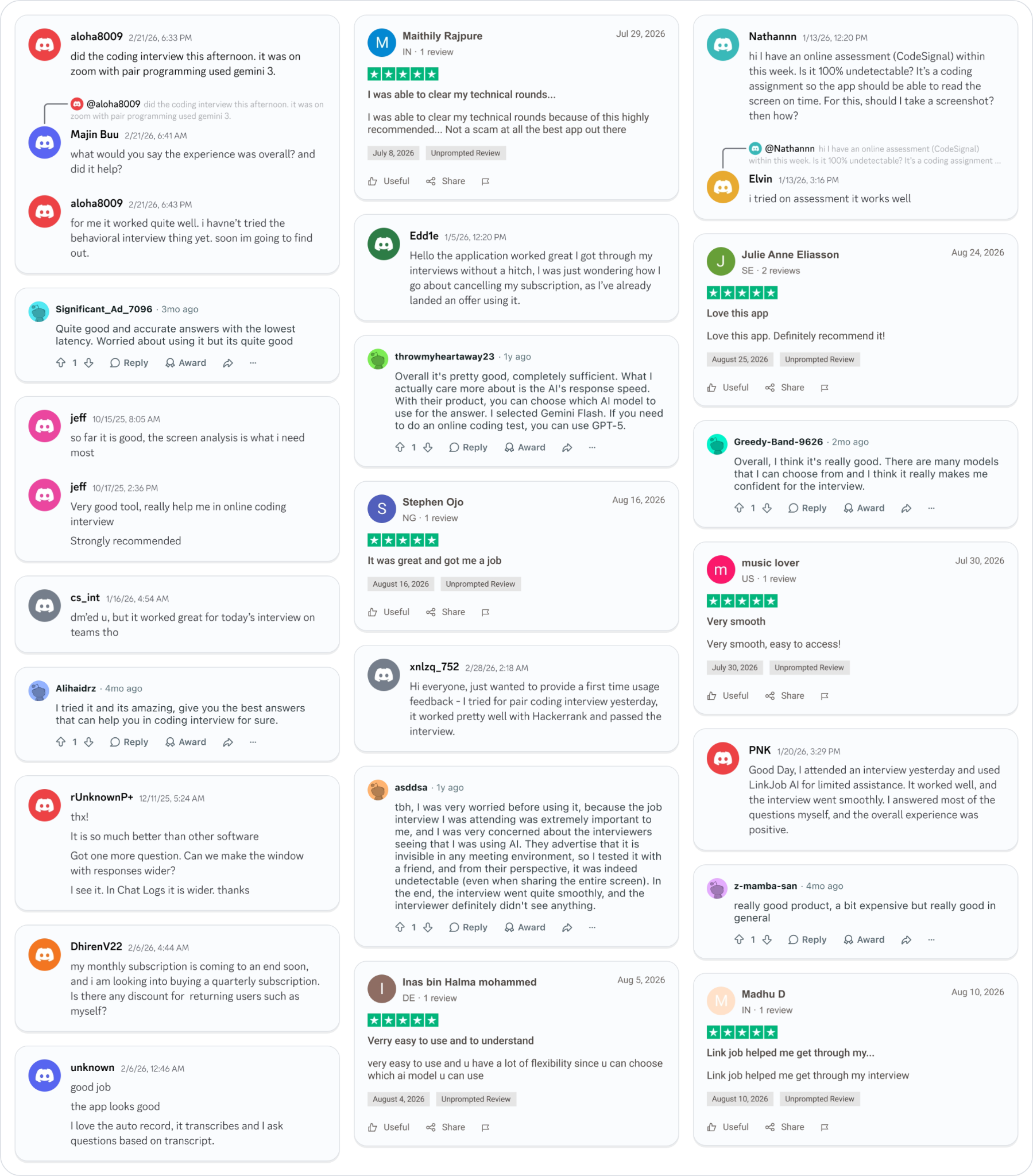
Why People Choose Linkjob AI
Smoother interviews, coding challenges cleared, and job offers landed. See how users describe their experience with Linkjob AI—in their own words.

© Copyright 2026 Linkjob AI - All Rights Reserved.