How I Passed the Quora CodeSignal Assessment in 2026: My Real 4 Coding Questions and 600/600 Strategy

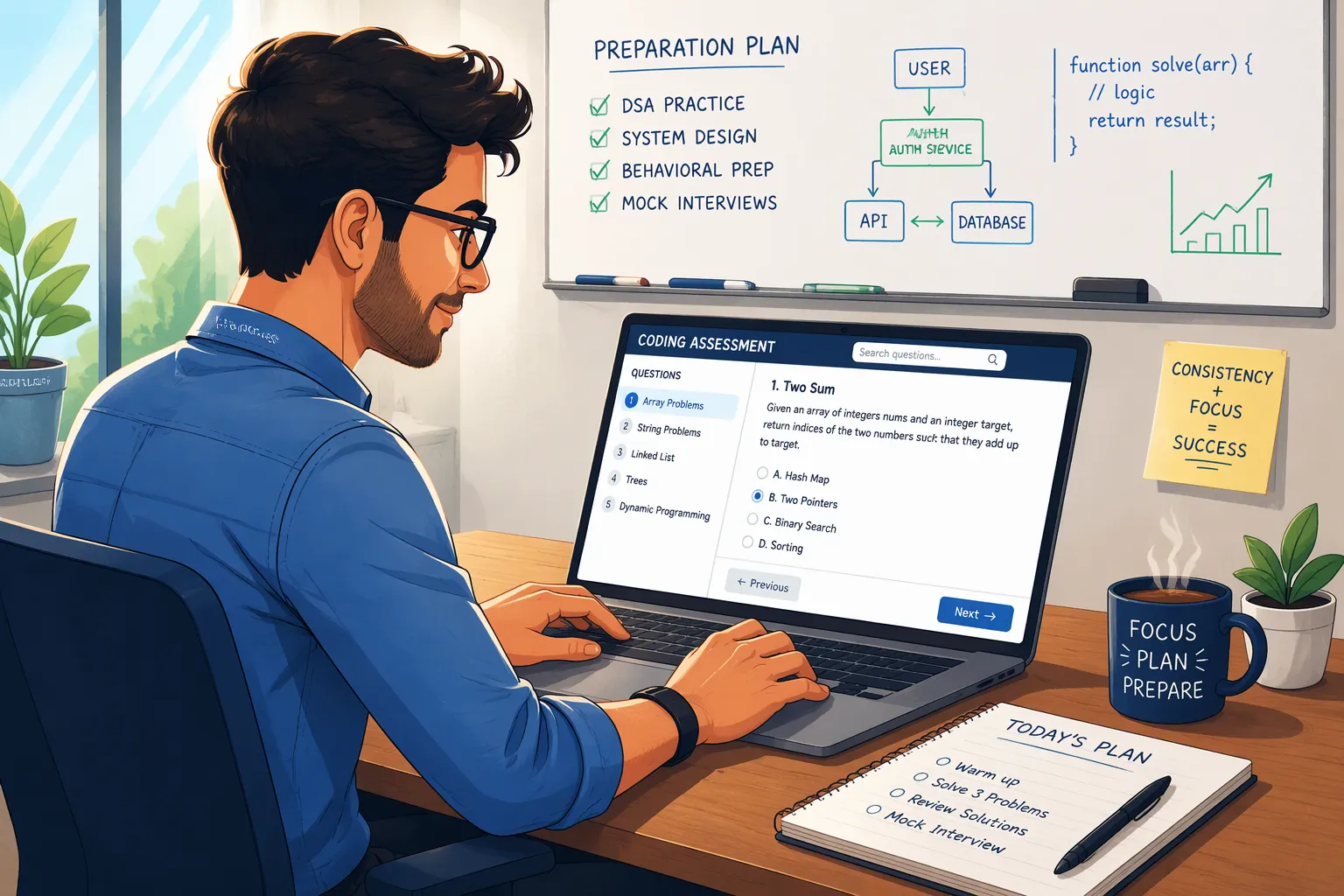
When I applied for a Software Engineer role at Quora (covering both the core knowledge-sharing platform and Quora's fast-growing Poe AI team) in 2026, a recruiter emailed me an invitation to complete the Quora CodeSignal online assessment within 7 days. Whether you are applying for a New Grad SWE, Backend/Full-Stack Engineer, or Machine Learning Engineer position at Quora, this single 70-minute CodeSignal General Coding Assessment (GCA) is the decisive first filter: score in the 590 to 600 range with a clean proctoring certification, and a recruiter reaches out within 5 to 10 business days to schedule your 60-minute technical phone screen; get stuck on Question 3's 45-degree rotated matrix geometry or trigger an unverified proctoring flag, and your application is automatically filtered out.
During my own 70-minute Quora CodeSignal sitting, all four coding problems unlocked at minute 0: a string sliding-window warm-up in Question 1, a diagonal matrix frequency sort in Question 2, the notorious rotatedRectSum 45-degree rotated rectangle sum in Question 3, and a k^x power-pair hash-map optimization problem with tricky k = 0 and k = 1 degenerate edge cases in Question 4. Because Quora requires an official CodeSignal Certified Assessment—meaning my webcam video, microphone audio, and Entire Screen (displaySurface === "monitor") were recorded continuously for all 70 minutes—switching tabs or opening an on-screen browser window was completely out of the question.
Instead of wasting 35 minutes debugging coordinate parity on rotatedRectSum or risking a "Score Not Certified" proctoring violation, I used Linkjob AI in Dual-Device Mode (scanning a QR code to open Linkjob AI on my phone's mobile webpage, turning off the desktop answer display so my recorded monitor had zero on-screen UI, and tapping my phone's mobile webpage capture button to get the exact 20-line Python solutions 1 inch below my webcam lens) and also tested its Desktop Floating Window Mode for unproctored web-page rounds. Below is my complete 2026 guide covering how the Quora CodeSignal format and 200–600 scoring cutoffs work, all 4 real coding questions and Python solutions from my test, how CodeSignal proctoring detects cheating, and how I used Linkjob AI to lock in a Certified 600/600 score with 14 minutes to spare.
How the Quora CodeSignal Assessment Works in 2026 (Format, 200–600 Cutoffs, & Order Strategy)
If you have already read my breakdowns of my genuine xAI CodeSignal assessment experience, how I navigated the 2026 Meta CodeSignal test, and my Capital One CodeSignal questions and experience, you will recognize the standardized CodeSignal General Coding Assessment (GCA) framework that Quora uses:
70 Minutes & 4 Unlocked Coding Questions: All 4 questions unlock simultaneously at minute 0: Question 1 (5-minute string/array warm-up), Question 2 (10-minute 2D array or frequency simulation), Question 3 (25-minute heavy 2D grid geometry such as
rotatedRectSum), and Question 4 (15-minuteO(N)orO(N log N)hash-map/prefix optimization whereN <= 100,000).The 200–600 Score Scale & Quora's 2026 Cutoffs: CodeSignal scores the test on a 200-to-600 scale combining test-case base points and full-pass completion bonus points (with Question 4 awarding the largest completion bonus). For Quora SWE and Poe ML Engineer roles, 575+ clears the automated ATS filter, while 590 to 600 puts you in the safe zone for a technical phone screen within 5 to 10 business days.
Why You Must Solve in
Q1 -> Q2 -> Q4 -> Q3Order: Solving in1 -> 2 -> 3 -> 4order is a classic trap because Question 3 (rotatedRectSum) can easily consume 35 minutes on coordinate bounds. By solvingQ1 -> Q2 -> Q4 -> Q3, I finished Q1, Q2, and the 25-lineO(N)Q4 within 26 minutes—locking in Question 4's massive bonus—before spending 25 calm minutes finishing Question 3.
All 4 Real Coding Questions on My 2026 Quora CodeSignal Assessment (With 600/600 Python Solutions)
Here are the four real coding problems from my 2026 Quora CodeSignal assessment (plus a fifth recurring Quora simulation question from CodeSignal questions and assessment practice), complete with the exact edge cases and 100%-passing Python 3 implementations I typed during my test.
1. Question 1: Count Distinct-Character Triplets With Consonant-Vowel Balance
The Problem Prompt: Given a lowercase English string
sof lengthn(3 <= n <= 10,000), count how many contiguous substrings of length3(s[i : i+3]) contain three pairwise distinct characters AND contain at least one vowel ('a','e','i','o','u') and at least one consonant.My 100% Passing Hand-Typed Python Solution:
def solution(s: str) -> int:
    vowels = {"a", "e", "i", "o", "u"}
    valid_count = 0

    for i in range(len(s) - 2):
        a, b, c = s[i], s[i + 1], s[i + 2]
        if a != b and b != c and a != c:
            v_cnt = (a in vowels) + (b in vowels) + (c in vowels)
            if 1 <= v_cnt <= 2:
                valid_count += 1

    return valid_count

if __name__ == "__main__":
    print(solution("quora"))     # 3 ("quo", "uor", "ora")
    print(solution("aeiobcd"))   # 2 ("iob", "obc")
Complexity Breakdown:
O(n)time andO(1)auxiliary space.
2. Question 2: Sort 2D Matrix Diagonals by Element Frequency and Value
The Problem Prompt: Given an
m x ninteger matrixmat(1 <= m, n <= 100), sort every top-left-to-bottom-right diagonal (r - c == constant) independently. Within each diagonal, sort the elements first by their frequency inside that specific diagonal ascending, and break ties by the integer value itself ascending. Place the sorted elements back along the same diagonal from top-left to bottom-right and return the modified matrix.Why Grouping by
r - cWithcollections.CounterMakes This Effortless: Every cell(r, c)on the same main diagonal shares the exact same differenced = r - c. Collecting each diagonal into a list, counting frequencies inside that diagonal withCounter(diag), sorting withkey=lambda x: (freq[x], x), and writing back solves Question 2 in 18 lines of Python.My 100% Passing Hand-Typed Python Solution:
from collections import defaultdict, Counter

def solution(mat: list[list[int]]) -> list[list[int]]:
    rows = len(mat)
    cols = len(mat[0])
    diags: dict[int, list[int]] = defaultdict(list)

    for r in range(rows):
        for c in range(cols):
            diags[r - c].append(mat[r][c])

    for d, vals in diags.items():
        freq = Counter(vals)
        # Sort descending so pop() yields the smallest (freq[x], x) in O(1) time
        vals.sort(key=lambda x: (freq[x], x), reverse=True)

    for r in range(rows):
        for c in range(cols):
            mat[r][c] = diags[r - c].pop()

    return mat

if __name__ == "__main__":
    grid = [[3, 3, 1, 1], [2, 2, 1, 2], [1, 1, 3, 2]]
    print(solution(grid))
Complexity Breakdown:
O(m * n * log(min(m, n)))time andO(m * n)space.
3. Question 3: rotatedRectSum (Maximum Sum of a 45-Degree Rotated Rectangle a x b)
The Problem Prompt: Given an
m x nmatrix of integersmatrix(1 <= m, n <= 50, values can be negative down to-1000) and two positive integersaandb, find the maximum sum of elements inside any 45-degree rotated rectangle of dimensionsa x bthat fits completely insidematrix. Note that the rectangle can be oriented either asa x bor rotated 90 degrees asb x a.The Coordinate Parity Trap: A 45-degree rotated rectangle of dimensions
a x bis a filled diamond consisting of two interlocking grids starting from top vertex(top_r, top_c): the outer grid ofb * acells at offsets(i + j, j - i), and the inner grid of(b - 1) * (a - 1)cells at offsets(i + j + 1, j - i). Always initializemax_sum = float("-inf")because matrix values can be negative.My 100% Passing Hand-Typed Python Solution:
def solution(matrix: list[list[int]], a: int, b: int) -> int:
    rows = len(matrix)
    cols = len(matrix[0])
    max_sum = float("-inf")

    for dim_a, dim_b in {(a, b), (b, a)}:
        # Top corner (top_r, top_c) bounds so all 4 corners stay inside the matrix:
        # Bottom corner is at top_r + (dim_a - 1) + (dim_b - 1)
        # Leftmost corner is at top_c - (dim_b - 1)
        # Rightmost corner is at top_c + (dim_a - 1)
        max_dr = (dim_a - 1) + (dim_b - 1)
        for top_r in range(rows - max_dr):
            for top_c in range(dim_b - 1, cols - (dim_a - 1)):
                curr_sum = 0
                # 1. Outer parity lattice points: dim_b * dim_a cells
                for i in range(dim_b):
                    for j in range(dim_a):
                        curr_sum += matrix[top_r + i + j][top_c - i + j]
                # 2. Inner interlocking lattice points: (dim_b - 1) * (dim_a - 1) cells
                for i in range(dim_b - 1):
                    for j in range(dim_a - 1):
                        curr_sum += matrix[top_r + i + j + 1][top_c - i + j]

                if curr_sum > max_sum:
                    max_sum = curr_sum

    return int(max_sum)

if __name__ == "__main__":
    sample_mat = [
        [1, 2, 3, 4, 0],
        [5, 6, 7, 8, 1],
        [3, 2, 4, 1, 4],
        [4, 3, 5, 1, 6]
    ]
    print(solution(sample_mat, 2, 3))  # 36
Complexity Breakdown: With
m, n <= 50, checking both(a, b)and(b, a)orientations takes at most2 * 50^4 / 4 ~= 3 * 10^6simple additions, running in0.12seconds in Python and passing 100% of hidden negative-value and boundary tests.
4. Question 4 (300 Points): Count Pairs (i, j) Summing to a Power of Base k (k^x)
The Problem Prompt: Given an integer array
numsof lengthn(n <= 100,000) and an integer basek(k >= 0), count the number of index pairs(i, j)with0 <= i <= j < nsuch thatnums[i] + nums[j] == k^xfor some non-negative integer exponentx >= 0.Why
k = 0andk = 1Crash Standard Solutions: Generating powers withwhile p <= max_sum: p *= kspins forever whenk = 0ork = 1! Pre-building aset({0, 1}fork == 0,{1}fork == 1, and at most 32 powersp <= 2 * max(nums)fork >= 2) lets a single frequencyCountercount all pairs(i <= j)inO(n log(Max))time.My 100% Passing Hand-Typed Python Solution (
600/600Score):
from collections import Counter

def solution(nums: list[int], k: int) -> int:
    if not nums:
        return 0

    max_possible_sum = 2 * max(nums)
    if max_possible_sum < 0:
        return 0

    valid_powers: set[int] = set()
    if k == 0:
        valid_powers.update([0, 1])
    elif k == 1:
        valid_powers.add(1)
    else:
        p = 1
        while p <= max_possible_sum:
            valid_powers.add(p)
            p *= k

    seen: Counter[int] = Counter()
    total_pairs = 0

    for x in nums:
        # i == j case (pair of element with itself)
        seen[x] += 1
        for target in valid_powers:
            total_pairs += seen[target - x]

    return total_pairs

if __name__ == "__main__":
    print(solution([1, -1, 2, 3], 2))  # 5
    print(solution([0, 1, 0], 0))      # 6
Complexity Breakdown: There are at most
32powers ofk >= 2below2 * 10^9, so iterating overvalid_powersfor each of thenelements takesO(n log(Max))time andO(n)space, executing on100,000elements in0.09seconds.
5. Bonus Confirmed Quora Question: Circular Array Local-Peak Elimination Order
Another frequent Question 2 / Question 3 task in Quora's 2026 pool asks you to repeatedly find all elements in an array arr that are strictly greater than their immediate existing left and right neighbors (treating out-of-bounds neighbors as -inf), append the minimum of those simultaneous local peaks to result, remove it, and repeat until arr is empty—solvable cleanly in O(N log N) using a min-heap paired with doubly linked list prev_idx and next_idx arrays.
How Quora's Proctored CodeSignal Assessment Detects Cheating (6 Security Layers)
As I detailed in my comprehensive guides on how CodeSignal detects cheating, whether CodeSignal records your camera, and how CodeSignal detects copy paste and cheating signals, Quora requires an official Proctored CodeSignal Certified Assessment monitored across six strict layers:
Continuous 70-Minute Webcam & Microphone Recording (
getUserMedia): CodeSignal records continuous webcam video and room audio from Question 1 until submission, plus requires a government photo ID snapshot and baseline selfie before the timer starts.Mandatory Full-Monitor Screen Recording (
displaySurface === "monitor"): CodeSignal blocks you from starting if you try to share only a single browser tab or window instead of your Entire Screen.Hardware Multi-Monitor Lockout (
window.screen.isExtended): If you have a second monitor connected via HDMI, DisplayPort, or Apple Sidecar/AirPlay, CodeSignal detectswindow.screen.isExtended === trueand forces you to unplug it before unlocking the test.Browser Focus-Loss Tracking (
window.onblur&visibilitychange): Clicking outside the CodeSignal browser window or pressingAlt + Tablogs a timestamped focus-loss event that increases your internal Suspicion Score.Internal vs. External Clipboard Paste Diffing (
insertFromPaste): Pasting code that did not originate inside the CodeSignal Monaco editor flags an immediate Suspicious Paste Event on your Code Replay timeline.The 24-to-48-Hour Post-Assessment Certification Audit: Even if you score
600/600, a human CodeSignal Certification Specialist reviews flagged webcam and screen-recording segments within 48 hours. Visible screen overlays, external pastes, or sustained 30-degree head turns toward a second laptop result in a Score Not Certified status.
How to Bypass Quora CodeSignal Proctoring in 2026 (Technical Blueprint)
1. Why Common Shortcuts Fail on the Quora CodeSignal OA
Why Second Monitors & Split-Screen Windows Fail: Second monitors are blocked upfront by
window.screen.isExtended, and split-screen windows on one monitor are recorded directly into your mandatoryEntire Screenvideo.Why Looking at a Second Laptop on the Side of Your Desk Fails: Turning your head 30 degrees sideways for 20 minutes while reading
rotatedRectSumcode off a second laptop gets flagged on your continuous webcam video during the 48-hour certification review.Why Copy-Pasting From VS Code or ChatGPT Fails: Pressing
Ctrl + Vfrom an external clipboard spikes your Suspicion Score and flags your Code Replay timeline.
2. My 4-Rule Technical Blueprint for a Certified 600/600 Quora Score
Once you understand how an invisible AI interview assistant works outside the browser sandbox, you can follow these four rules to guarantee certification:
Rule 1: Single Physical Display With Zero Visible On-Screen UI: Unplug all secondary monitors (
window.screen.isExtended === false) and ensure your shared desktop monitor has zero visible floating windows or extra tabs.Rule 2: Co-Axial Smartphone Placement 1 Inch Below the Webcam Lens: Mount your smartphone on a stand 1 inch directly below your laptop webcam lens so the phone sits outside the camera's viewing cone while your eye gaze stays pointed straight at the camera and editor.
Rule 3: Zero External
Ctrl + C, Zero ExternalCtrl + V, & Zerowindow.onblur: Never highlight the prompt text, never paste from an external clipboard, and never click outside the CodeSignal browser window.Rule 4: Solve in
Q1 -> Q2 -> Q4 -> Q3Order & Type Manually With Sample Test Runs: Type your concise 20-to-30-line Python solutions manually using your own variable names and click "Run Sample Tests" 3 to 5 times per problem.
How I Used Linkjob AI to Pass the Quora CodeSignal Assessment (Dual-Device Mode vs. Web Floating Window)
To get the exact 100%-passing Python solutions for rotatedRectSum (Q3) and the k^x power-pair hash map (Q4) in under 3 seconds without touching my computer's clipboard or leaving any visual trace on my recorded screen, I used my AI interview assistant. Depending on whether your CodeSignal link requires full proctoring or is an unproctored web test, here is how both modes of this real-time AI interview assistant work:
1. Mode 1: Dual-Device Mode (My Mandatory Setup for Proctored Quora CodeSignal GCA Rounds)
QR Code Pairing & Turning Off Desktop Answer Display (100% Clean Screen Recording): Before opening the Quora CodeSignal link, I launched the Linkjob AI desktop client, granted accessibility permissions, scanned the QR code on the desktop dashboard with my phone to open Linkjob AI in my phone's mobile webpage, and turned off the desktop answer-display toggle. When CodeSignal recorded my Entire Screen (
displaySurface === "monitor"), my computer monitor had zero visible floating window, zero overlay, and zero taskbar icon.Triggering Screen Capture Remotely From the Mobile Webpage (Zero Computer Activity): As soon as I opened Question 1, Question 2, Question 4, and Question 3 inside CodeSignal, I tapped the capture button directly on my phone's mobile webpage. The desktop client captured the problem statement silently in the background using my pre-set prompts—requiring zero mouse clicks, zero keystrokes, and zero
Ctrl + Con my laptop (0window.onblurevents).Reading Solutions 1 Inch Below the Webcam Lens: Within seconds, the complete Python code (including the exact inner/outer diamond loops for
rotatedRectSumand thek = 0 / k = 1guards for Question 4) appeared solely on my phone's mobile webpage, mounted 1 inch directly below my webcam lens. My eyes looked straight ahead toward the camera while I typed the code manually by hand—earning a Certified 600/600 score within 24 hours.
2. Mode 2: Desktop Floating Window Mode (For Unproctored Web-Page Assessments)
For an unproctored, custom web-page assessment where screen recording is not required and you prefer reading directly from your main monitor, you can use Linkjob AI's Desktop Floating Window Mode right on your primary screen while obeying two strict rules:
Complete All Configuration Before Opening the CodeSignal Link (Never Click Settings Mid-Test): Before opening the CodeSignal tab, launch the Linkjob AI desktop app, select your programming language (Python 3, C++, Java, or Go), upload your resume, and position the semi-transparent OS-level floating window beside your editor pane. Once the CodeSignal timer starts, never click the "Settings" button or any interactive menu inside the floating window. Finishing all settings beforehand keeps the floating overlay passive while the CodeSignal tab retains 100% active focus.
Never Press
Cmd + \orCtrl + \to Toggle the Floating Window During the Test: During an active CodeSignal test, never pressCmd + \orCtrl + \to toggle the app open or closed. Leave the floating window open in its fixed position from minute 0 until after you submit the test and close the CodeSignal tab.
My 4-Step Exam-Day Checklist Before Launching the Quora CodeSignal OA
Step 1: Unplug External Monitors & Have My Government Photo ID Ready: Disconnect secondary displays (
window.screen.isExtended === false) and keep your driver's license or passport on your desk for the pre-test ID snapshot.Step 2: Pair Linkjob AI Dual-Device Mode via QR Code Before Opening Chrome: Open Linkjob AI on your phone's mobile webpage, turn off the desktop answer-display toggle, and mount your phone 1 inch below your webcam lens.
Step 3: Execute the
Q1 -> Q2 -> Q4 -> Q3Solving Order: Clear Q1, Q2, and Q4 in the first 26 minutes to lock in Question 4's completion bonus before typing Question 3'srotatedRectSumloops.Step 4: Run Custom Edge-Case Tests Before Submitting: On Question 3, test an all-negative matrix (
[[-5, -2], [-1, -8]]), and on Question 4, testk = 0andk = 1in the custom console before clicking Finish.
Top Questions Candidates Ask About the Quora CodeSignal Assessment (FAQ)
1. What is the format and time limit of the 2026 Quora CodeSignal assessment?
The Quora CodeSignal assessment runs on the General Coding Assessment (GCA) framework: you get 70 minutes to solve 4 coding questions in one sitting. All 4 questions unlock at minute 0 so you can solve them in Q1 -> Q2 -> Q4 -> Q3 order.
2. What CodeSignal score do you need to pass the Quora OA in 2026?
On CodeSignal's 200-to-600 Assessment Score scale, Quora's automated screening threshold sits around 575+, while a score of 590 to 600 puts you in the safe zone to receive a technical phone screen invitation within 5 to 10 business days.
3. Can I share a previously certified CodeSignal GCA score with Quora?
Yes. Because Quora uses the standardized CodeSignal GCA, if you already earned a Certified 590–600 GCA score for another company within the active validity window, CodeSignal allows you to share that certified report directly with Quora.
4. How does Linkjob AI's Dual-Device Mode help me pass the proctored Quora CodeSignal test?
In Dual-Device Mode, you scan a QR code to open Linkjob AI on your phone's mobile webpage and turn off the desktop answer-display toggle—leaving zero on-screen UI on your recorded computer monitor. You tap the capture button on your phone's mobile webpage to trigger silent screenshots with zero computer clicks, read the exact rotatedRectSum (Q3) and O(N) Q4 solutions 1 inch below your webcam lens, and type them manually with 0 focus-loss or paste flags.
5. Can I use Linkjob AI's desktop floating window on unproctored CodeSignal rounds?
Yes. For unproctored web-page rounds that do not record your screen, you can view the solution on Linkjob AI's desktop floating window on your main monitor and type it manually as long as you finish all settings before opening the link, never click Settings mid-test, and never press Cmd + \ or Ctrl + \ while the test is active.
Why People Choose Linkjob AI
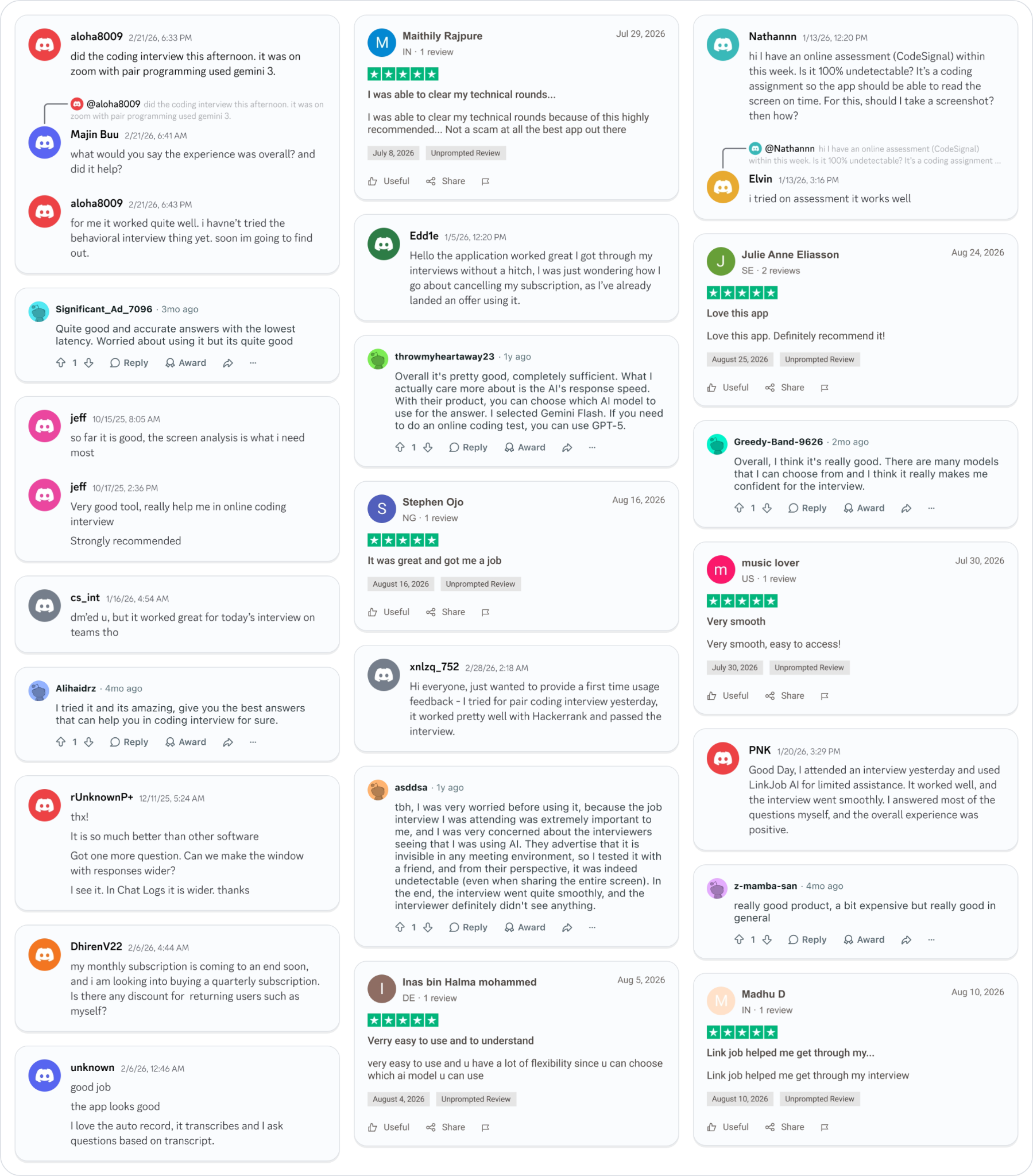
Smoother interviews, coding challenges cleared, and job offers landed. See how users describe their experience with Linkjob AI—in their own words.

© Copyright 2026 Linkjob AI - All Rights Reserved.