My 2026 Twitch CodeSignal Assessment Experience: Custom JSON + API Tasks, Helper Debugging, Amazon Work-Style Rules, and How I Passed Cleanly
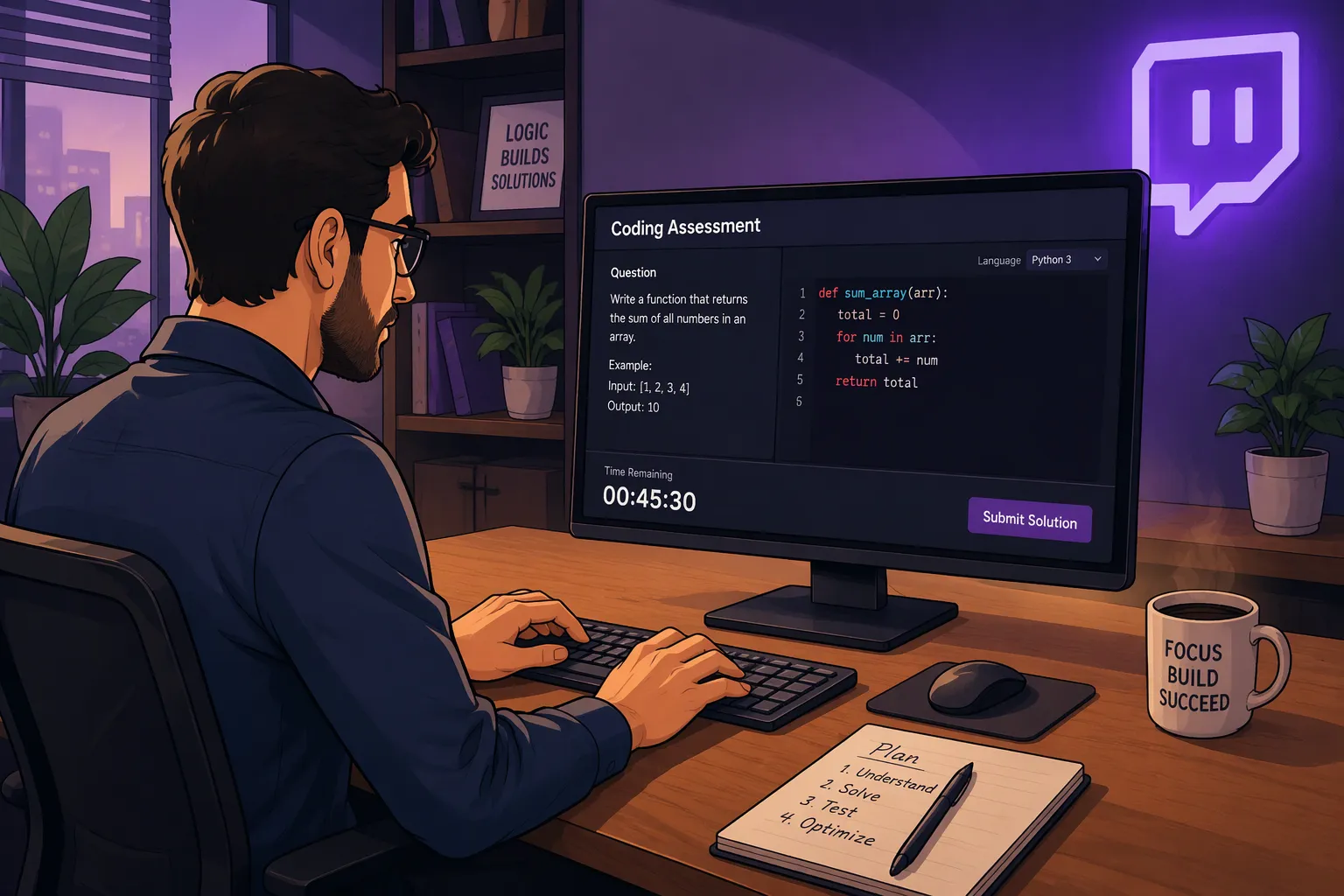
When a recruiter sent my Twitch CodeSignal online assessment in 2026 for a Backend Software Engineer opening (spanning Twitch's 350 Bush Street HQ in San Francisco plus engineering hubs in Seattle, Irvine, and London), I initially braced for CodeSignal's stock 4-question, 70-minute General Coding Assessment. Halfway through reading the instructions, I realized Twitch does not use the stock GCA. Because Twitch operates as an Amazon subsidiary with its own live-streaming engineering culture, Twitch deploys a custom CodeSignal battery: typically 2 to 3 practical coding/debugging problems paired with a Behavioral & Work-Style Questionnaire modeled on Amazon's Leadership Principles (alongside a two-part Design & Helper-Debugging variant on experienced SWE loops and a rapid 45-minute pre-screen on select internship tracks).
On my own sitting, the centerpiece problem was pure backend data plumbing rather than a LeetCode puzzle: merging a local products JSON file with a live ?page=N HTTP endpoint using Python standard libraries only (urllib.request + json, no requests!), deduplicating by product_id, enforcing a strict 5-page pagination ceiling, and writing sorted JSON to output.json. Forgetting that 5-page ceiling burned half my clock before I caught the early-exit bug! Worse yet, CodeSignal's integrity engine flagged 35% of all proctored assessments (and 40% of entry-level sittings) via its Suspicion Score—and in January 2026, a friend running a click-through desktop overlay behind his Twitch CodeSignal tab watched his portal flip to Pending Integrity Review ten minutes before submission, voiding his entire application.
To verify my urllib.request empty-page break and deduplication precedence without placing any software UI on my recorded monitor, I paired Linkjob AI in Dual-Device Mode—scanning the desktop QR code to open Linkjob AI on my phone's mobile webpage, turning off the desktop answer-display toggle so zero UI ever appeared on my computer screen, and tapping capture on my phone's mobile webpage (zero laptop shortcut keys and zero window.onblur events) to read clean standard-library Python 1 inch below my webcam lens (alongside testing Desktop Floating Window Mode on unproctored web practice links). Below is every confirmed 2026 Twitch CodeSignal question, how the Work-Style section and "Boss Fight" hiring-manager round work, and how to clear proctoring with zero flags.
Why the 2026 Twitch CodeSignal OA Is NOT the Stock 4-Question GCA
Before clicking start, I compared Twitch's custom battery against standardized CodeSignal sittings I had studied—including my 2026 Quora CodeSignal 600/600 walkthrough, my Dropbox CodeSignal OA guide, how I aced the Plaid CodeSignal assessment, my Instacart CodeSignal experience, my RBC CodeSignal DevOps and API breakdown, and how I navigated the Visa CodeSignal assessment. Four structural differences set Twitch apart:
1. Three Confirmed Twitch CodeSignal Battery Shapes in 2026
Custom SWE / New-Grad Battery (
2–3 Coding Tasks+Work-Style Questionnaire): Instead of four GCA geometry/matrix puzzles, you face 2 or 3 practical backend/algorithmic tasks (such as stdlib JSON + HTTP pagination merging, interval merging, or probability DP) followed by CodeSignal's Behavioral & Work-Style Questionnaire evaluating Amazon-aligned ownership, bias for action, and customer obsession.Two-Part Design & Helper-Debugging Assessment (Experienced SWE): Reported on April 2026 SWE loops, this CodeSignal screen splits into Part 1 (implementing clean domain classes/methods) and Part 2 (debugging a pre-written buggy helper class). Candidates who rush or treat "debug the helper" as a bonus side quest get rejected even when Part 1 passes!
Campus Pre-Screen Sprint (
45 Minutes,5 Fast Coding Tasks): High-volume internship pre-screens occasionally serve five bite-sized implementation tasks in 45 minutes testing clean syntax speed and boundary guards.
2. The 200–600 Score Model & Twitch's "Boss Fight" Post-OA Pipeline
Two-Tier
200–600Scoring (Base Points + 100% Completion Bonus): CodeSignal evaluates your code across Basic Coding, Data Manipulation, Ease of Implementation, and Problem-Solving, combining per-case base credit with a module-completion bonus unlocked only when 100% of hidden cases pass. Because Twitch uses a custom battery, you cannot share a previously certified stock GCA score—each CodeSignal link is bound directly to your invited email address, and Twitch publishes no fixed numeric cutoff.From CodeSignal Into the
"Boss Fight"& Bar Raiser Loop: Passing the OA advances you within days into a 45-minute Hiring Manager Chat (internally nicknamed the"Boss Fight"at Twitch) mixing career fit with spontaneous technical logic, followed by a 45-to-60-minute Technical Phone Screen and a 4-to-5-round Virtual Onsite Loop (DSA coding, Modular Low-Level Design or high-concurrency System Design—such as authenticated chunked File Sharing with revocable links or live video watch/like fan-out—an external Bar Raiser, and 15 to 20 minutes of Amazon's 16 Leadership Principles behavioral probing inside every single round!).
Real & Confirmed Coding Questions From the 2026 Twitch CodeSignal Battery (With Python Solutions)
Here are the exact problem from my 2026 backend sitting plus the four highest-frequency confirmed Twitch CodeSignal tasks (alongside patterns tracked in CodeSignal questions and assessments).
1. My Real 2026 Task: Merging Local JSON & Paginated HTTP API Under a 5-Page Cap (Python Stdlib Only)
The Problem: Given
local_path(a JSON file containing{"products": [...]}) andapi_base(a live HTTP endpoint paginated viapage=1, 2, ...also returning{"products": [...]}), merge both sources into a single deduplicated list keyed byproduct_id, sort ascending byproduct_id, write formatted JSON tooutput.json, and return the list. Two hard constraints: you may never fetch more than 5 API pages, and only Python's standard library is permitted (requestsis unavailable/disallowed!).Three Hidden Traps That Burn the Clock:
Missing the Hard
page <= 5Ceiling or Empty-Page Break: If an API mock serves 50 pages and you paginate until[], you violate the 5-page rule and hit execution timeout; conversely, if Page 3 returns{"products": []}, you mustbreakimmediately rather than wasting HTTP round-trips on Pages 4 and 5!Query-String Separator Collisions (
?vs.&): Hidden test URLs sometimes already contain query parameters (https://mock.internal/items?region=us)—blindly appending"?page=1"produces a malformed URL! Always pick"&" if "?" in api_base else "?".Deterministic Deduplication Precedence: Both
local_pathand a single API page can contain duplicateproduct_identries. Loading local records first and callingmerged.setdefault(pid, item)(or updating per the prompt's stated tie-break rule) guarantees deterministic output before sorting keys.
My 100% Passing Standard-Library Solution (Python 3):
import json
from urllib.error import HTTPError, URLError
from urllib.parse import urlencode
import urllib.request


def combine_lists(
    local_path: str, api_base: str, output_path: str = "output.json"
) -> list[dict[str, object]]:
    merged_by_id: dict[object, dict[str, object]] = {}

    with open(local_path, "r", encoding="utf-8") as local_fh:
        local_payload = json.load(local_fh)

    for product in local_payload.get("products", []):
        pid = product["product_id"]
        if pid not in merged_by_id:
            merged_by_id[pid] = product

    for page_num in range(1, 6):
        sep = "&" if "?" in api_base else "?"
        page_url = api_base + sep + urlencode({"page": page_num})
        try:
            req = urllib.request.Request(
                page_url, headers={"Accept": "application/json"}
            )
            with urllib.request.urlopen(req, timeout=8) as resp:
                api_payload = json.load(resp)
        except (HTTPError, URLError, TimeoutError, ValueError):
            break

        page_items = api_payload.get("products", [])
        if not isinstance(page_items, list) or not page_items:
            break

        for product in page_items:
            pid = product["product_id"]
            merged_by_id.setdefault(pid, product)

    sorted_products = [
        merged_by_id[pid] for pid in sorted(merged_by_id.keys())
    ]

    with open(output_path, "w", encoding="utf-8") as out_fh:
        json.dump(sorted_products, out_fh, indent=2)

    return sorted_products
Complexity:
O(N + U log U)time andO(U)memory overNscanned items andUuniqueproduct_idkeys, bounded strictly to at most 5 HTTP requests.
2. Confirmed April 2026 Track: Two-Part Stream Session Design & Helper Debugging
The Problem Shape: Part 1 asks you to implement a clean in-memory service class (such as tracking live streamers, categories, and concurrent viewer counts in
O(1)per event), and Part 2 hands you a buggy companion helper (CategoryStatsHelper) where category totals drift negative or leak across instances!Classic Part 2 Helper Bugs to Spot Immediately:
Mutable Default Arguments (
def __init__(self, buckets={}):): Shares the exact same dictionary across every test case in CodeSignal's single-process test runner!Forgetting Old-Category Subtraction on Category Switches: When an online streamer switches from
"Just Chatting"(4,000viewers) to"Valorant"(4,000viewers) without going offline first, failing to subtract the old viewer count from"Just Chatting"leaves phantom viewers behind!
Clean Reference Implementation + Fixed Helper (
O(1)Updates, Python 3):
class CategoryStatsHelper:
    def __init__(self, initial_totals: dict[str, int] | None = None) -> None:
        # Copy into a fresh dict per instance so state never leaks across tests.
        self._totals: dict[str, int] = dict(initial_totals) if initial_totals else {}

    def apply_delta(self, category: str, viewer_delta: int) -> None:
        updated = self._totals.get(category, 0) + viewer_delta
        if updated <= 0:
            self._totals.pop(category, None)
        else:
            self._totals[category] = updated

    def category_views(self, category: str) -> int:
        return self._totals.get(category, 0)


class LiveStreamRegistry:
    def __init__(self) -> None:
        self._active: dict[str, tuple[str, int]] = {}
        self._helper = CategoryStatsHelper()

    def streamer_online(self, streamer: str, viewers: int, category: str) -> None:
        if streamer in self._active:
            prev_cat, prev_views = self._active[streamer]
            self._helper.apply_delta(prev_cat, -prev_views)
        self._active[streamer] = (category, viewers)
        self._helper.apply_delta(category, viewers)

    def update_views(self, streamer: str, viewers: int, category: str) -> bool:
        if streamer not in self._active:
            return False
        prev_cat, prev_views = self._active[streamer]
        if prev_cat != category:
            return False
        self._active[streamer] = (category, viewers)
        self._helper.apply_delta(category, viewers - prev_views)
        return True

    def streamer_offline(self, streamer: str) -> bool:
        prev = self._active.pop(streamer, None)
        if prev is None:
            return False
        prev_cat, prev_views = prev
        self._helper.apply_delta(prev_cat, -prev_views)
        return True

    def views_in_category(self, category: str) -> int:
        return self._helper.category_views(category)
Complexity:
O(1)average time per event mutation andO(1)per category query.
3. Confirmed Twitch OA Problem: Merging Overlapping Broadcast Intervals (O(n log n))
The Problem & Nested-Interval Trap: Given unsorted
[start, end]stream windows, return minimal disjoint intervals. Always sort bystartascending, treat touching endpointsstart <= merged[-1][1]as overlapping, and updatemerged[-1][1] = max(merged[-1][1], end)so[1, 10]cleanly absorbs[3, 6]:
def merge_intervals(intervals: list[list[int]]) -> list[list[int]]:
    if not intervals:
        return []
    ordered = sorted(intervals, key=lambda pair: (pair[0], pair[1]))
    merged: list[list[int]] = [[ordered[0][0], ordered[0][1]]]
    for start, end in ordered[1:]:
        if start <= merged[-1][1]:
            if end > merged[-1][1]:
                merged[-1][1] = end
        else:
            merged.append([start, end])
    return merged
4. Confirmed Twitch SWE Problems: Toss Strange Coins (O(n * k) DP) & Trapping Rain Water (O(1) Space)
Toss Strange Coins(Non-Uniform Probability DP): Givenprobs[i](probability coinilands heads) and integerk, compute the exact probability of gettingkheads across allncoins. Iteratingjdownward frommin(i + 1, k)to1updates a 1D DP array in-place without overwritingdp[j - 1]:
def probability_of_k_heads(probs: list[float], k: int) -> float:
    n = len(probs)
    if k < 0 or k > n:
        return 0.0
    dp = [0.0] * (k + 1)
    dp[0] = 1.0
    for idx, p_head in enumerate(probs):
        upper = min(idx + 1, k)
        for heads in range(upper, 0, -1):
            dp[heads] = dp[heads] * (1.0 - p_head) + dp[heads - 1] * p_head
        dp[0] *= (1.0 - p_head)
    return dp[k]
Trapping Rain Water(Two-PointerO(n)Time,O(1)Space): Stepping whichever side has the smaller boundary height (height[left] < height[right]) avoids allocating two auxiliary prefix/suffix arrays:
def trap_rain_water(height: list[int]) -> int:
    left, right = 0, len(height) - 1
    left_max = right_max = total_water = 0
    while left < right:
        if height[left] < height[right]:
            left_max = max(left_max, height[left])
            total_water += left_max - height[left]
            left += 1
        else:
            right_max = max(right_max, height[right])
            total_water += right_max - height[right]
            right -= 1
    return total_water
My Focused 7-Day Prep Plan for Twitch's Custom CodeSignal Battery
Because Twitch skips stock GCA diagonal-matrix puzzles in favor of practical JSON/API plumbing, helper debugging, and medium DSA, a focused 7-day plan covers every confirmed topic without wasted motion:
Days 1–2 — Standard-Library
urllib.request+jsonDrills Under a 20-Minute Timer: Practice merging local JSON files with paginated?page=NHTTP endpoints from a blank editor without importingrequests. Rehearse handling"?" in api_base, enforcing hard page caps (range(1, 6)), breaking on emptyproductsarrays, deduplicating byproduct_id, and writing cleanoutput.jsonfiles until a fresh variant finishes inside 18 minutes.Days 3–4 — Two-Part Class Debugging,
LRU Cache,Merge Intervals, & 1D DP: Spend one sprint auditing buggy Python helper classes for mutable defaults, off-by-one cache evictions, and stale state deltas, and spend the second sprint timingMerge Intervals,Trapping Rain Water,LRU Cache, andToss Strange Coinsfrom memory.Days 5–7 — Full-Screen 3-Problem Mock + Amazon Leadership Principles Alignment: Skip high-level distributed system design for the OA itself (save chunked File Sharing and 5,000-RPS URL shorteners for onsite rounds!), sit one unbroken proctoring-style simulation on a single monitor, and draft four concise STAR stories so you are ready when your
"Boss Fight"hiring-manager invite lands days after submitting!
How Twitch's Work-Style Questionnaire Maps to Amazon's Leadership Principles
Do not rush blindly through the short questionnaire attached to Twitch's CodeSignal battery! Because Twitch grades behavioral alignment against Amazon's 16 Leadership Principles, keep three consistent anchors across forced-choice sliders:
Ownership & Customer Obsession Over Silos: Prefer statements investigating root causes across team boundaries and protecting viewer/creator experience over waiting passively for ticket handoffs.
Bias for Action Balanced With Data: Choose reversible, measured iteration backed by telemetry rather than weeks of analysis paralysis or reckless unverified hotfixes.
Internal Consistency Across Paired Prompts: Work-style batteries re-ask similar trade-offs from opposite angles—answering consistently beats swinging wildly between extreme poles!
How Twitch's CodeSignal Proctoring & Suspicion Score Work in 2026 (6 Layers)
With CodeSignal flagging 35% of proctored sittings (and 40% of entry-level runs), understanding all six layers—which I verified across how CodeSignal detects cheating, how CodeSignal tracks copy-paste and Suspicion Score signals, what CodeSignal records from your camera, and stealth behavior on CodeSignal proctored exams—keeps you out of Pending Integrity Review:
Entire-Screen Share (
displaySurface === "monitor"), Webcam, Mic, & Photo ID: Before Question 1 unlocks, you upload a government ID and share your entire desktop monitor, webcam video, and microphone audio for AI plus human review.Desktop Overlay & Focus-Shift Detection (The January 2026 Voided Run): Clicking or pressing global hotkeys for a click-through desktop overlay leaves focus/rendering traces on the recorded monitor—turning completed Twitch sittings into
Pending Integrity Reviewdisqualifications!Suspicion Score Signal 1 — External Paste & Description-Copy Telemetry: Copying problem text (
Ctrl + C) or pasting blocks from outside the browser spikes your Suspicion Score on the coding replay timeline.Suspicion Score Signal 2 — Typing Cadence & Cursor Trajectory Analysis: CodeSignal tracks incremental top-to-bottom typing rhythm, pause ratios, and mouse movement linearity to flag robotic transcription after long idle gaps.
Suspicion Score Signal 3 & 4 — Solution Similarity & Pattern Detection: Compares normalized syntax structures against historical CodeSignal submissions and LLM boilerplate.
Multi-Monitor & Virtual Machine Blocking: Rejects extended displays (
window.screen.isExtended === true) during lobby onboarding.
Technical Blueprint: Clearing Twitch's CodeSignal OA With Zero Flags
Run on Single-Monitor Bare Metal (
isExtended === false): Unplug external displays, clear tablets/notes from your desk, and close Slack, Discord, and AI notetakers before entering the lobby.Keep Zero On-Screen Overlay UI on Your Shared Monitor: Never run click-through windows over CodeSignal's full-screen capture, never copy problem descriptions, and never paste from external clipboards.
Practice Python
urllib.request& Staged Debugging: Build yourcombine_listsfile loader first, click Run on sample cases, then add the 5-pageurlopenloop so your coding replay reflects genuine incremental engineering!
How I Used Linkjob AI on My Twitch CodeSignal OA (Dual-Device Mode vs. Desktop Floating Window)
When my 5-page urllib.request merge ate into my buffer, an undetectable AI coding interview assistant surfaced the empty-page break and query-separator check in seconds while keeping my shared monitor 100% spotless (compare architectures in how an invisible AI interview assistant works):
1. Mode 1: Dual-Device Mode (My Setup for Screen- & Camera-Proctored Twitch OAs)
QR Code Pairing & Disabling Desktop Answer Display (Zero On-Screen UI): Fifteen minutes before entering the CodeSignal lobby, I launched Linkjob AI on my single-screen laptop, granted accessibility permissions, scanned the dashboard QR code with my phone to open Linkjob AI on my phone's mobile webpage, and turned off the desktop answer-display toggle. My recorded
Entire Screenfeed showed nothing except Chrome and the CodeSignal IDE—zero chance of a January-2026-stylePending Integrity Reviewflag!Silent Remote Capture From My Phone's Mobile Webpage (
0Laptop Hotkeys): Pressing zero laptop shortcut keys, I tapped capture directly on my phone's mobile webpage—producing0window.onblurevents,0description-copy flags, and0clipboard writes.Reading Verified
urllibCode 1 Inch Below the Webcam Lens: Complete stdlib pagination and helper-debugging fixes appeared solely on my phone's mobile webpage, mounted horizontally 1 inch below my webcam lens—outside the camera cone while keeping my eye gaze naturally centered on the CodeSignal editor as I typed manually.
2. Mode 2: Desktop Floating Window Mode (For Unproctored Web-Page Links)
If you receive an unproctored CodeSignal practice or pre-screen link that does not record your screen or camera (LockDown Browser and screen-share inactive) and prefer reading on your main monitor, use Linkjob AI's desktop floating window workflow with two strict precautions:
Finish All Settings Before Opening the Link (Never Click Settings Mid-Test): Select Python 3, upload your resume context, and position the floating window before opening CodeSignal—never click the Settings button mid-test so browser focus never drops.
Never Press
Cmd + \orCtrl + \During an Active Test: Never pressCmd + \orCtrl + \to toggle the floating window once the timer starts; leave it open in place until after submission.
My 4-Step Pre-Test Checklist Before Launching the Twitch CodeSignal OA
Step 1 — Rehearse Python Stdlib
urllib.request+jsonOffline: Verify you can fetch?page=1..5, handle"?" in api_base, and writeoutput.jsonwithout importingrequests!Step 2 — Unplug External Monitors, Have Your Photo ID Ready, & Pair Dual-Device Mode: Confirm
isExtended === false, open Linkjob AI on your phone's mobile webpage via QR code, confirm the desktop answer-display toggle is OFF, and place your phone 1 inch below the webcam lens.Step 3 — Give Equal Respect to Part 2 Helper Debugging: On two-part Design & Debugging links, reserve at least 40% of your clock for auditing mutable defaults and state-transition deltas in the helper class.
Step 4 — Save 8 Calm Minutes for the Work-Style Questionnaire: Answer consistently around ownership, data-backed action, and creator/viewer focus.
Frequently Asked Questions About the 2026 Twitch CodeSignal Assessment
1. Is the Twitch CodeSignal OA the standard 4-question, 70-minute GCA?
No. Twitch uses a custom CodeSignal battery—typically 2 to 3 coding/debugging problems plus a Behavioral & Work-Style Questionnaire (or a 45-minute 5-problem campus pre-screen), meaning you cannot reuse a previously certified stock GCA score.
2. Can I import requests on Twitch's JSON + HTTP API CodeSignal question?
On the confirmed combine_lists JSON + API merge task, only Python standard libraries (urllib.request, urllib.parse, json) are permitted, and pagination must stop at 5 pages maximum (or earlier on an empty page).
3. Is the Twitch CodeSignal assessment proctored?
Yes. Full SWE sittings require government photo ID verification plus continuous entire-screen recording, webcam video, and microphone audio, evaluated by CodeSignal's AI Suspicion Score and human reviewers.
4. What CodeSignal score do I need to pass Twitch's OA?
CodeSignal grades on its 200–600 Coding Score scale (base test-case points plus full-pass completion bonuses), and Twitch publishes no fixed numeric cutoff. Passing 100% of hidden cases (unlocking completion bonuses) with zero Suspicion Score flags is the safest path into the "Boss Fight" hiring-manager round.
5. What happens after passing the Twitch CodeSignal OA?
Shortlisted candidates advance to a 45-minute Hiring Manager Chat ("Boss Fight"), a 45-to-60-minute Technical Phone Screen, and a 4-to-5-round Virtual Onsite Loop combining DSA, Modular/System Design, an external Bar Raiser, and Amazon Leadership Principles behavioral questions.
See Also
My Strategy for Tackling Common Uber CodeSignal Questions in 2026
My Tricks to Obtain Invisible AI Help for CodeSignal Proctored Tests in 2026
My Tips, Strategies, and Preparation Guide for Passing the 2026 TikTok CodeSignal Assessment
My Guide to Preparing for Capital One Data Analyst CodeSignal Questions
How I Cracked the Ramp CodeSignal Assessment and Lessons You Can Learn
Why People Choose Linkjob AI
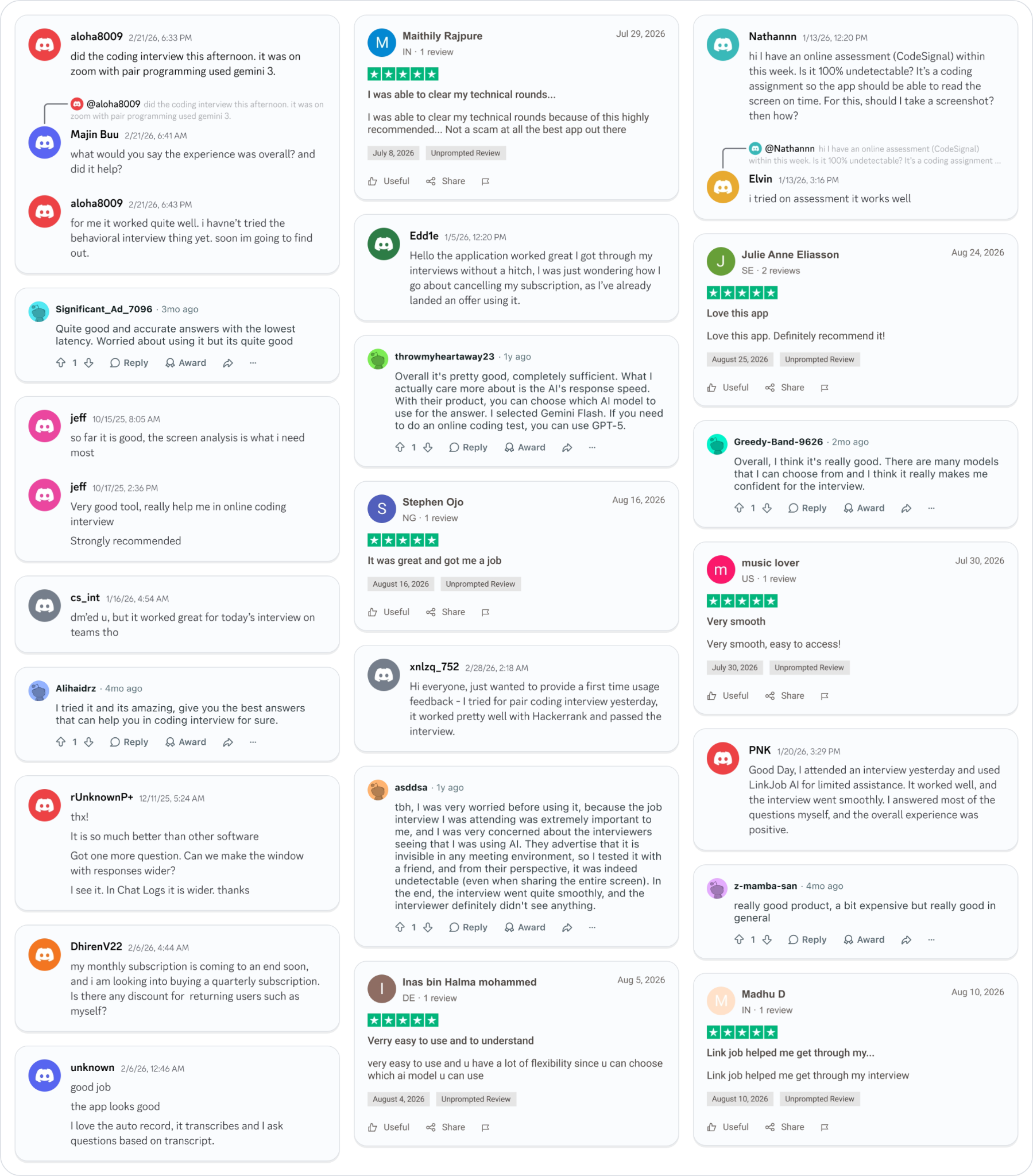
Smoother interviews, coding challenges cleared, and job offers landed. See how users describe their experience with Linkjob AI—in their own words.

© Copyright 2026 Linkjob AI - All Rights Reserved.