How to How I Passed the Verisk HackerRank Assessment in 2026: My Real Coding, SQL, and ML Notebook Questions

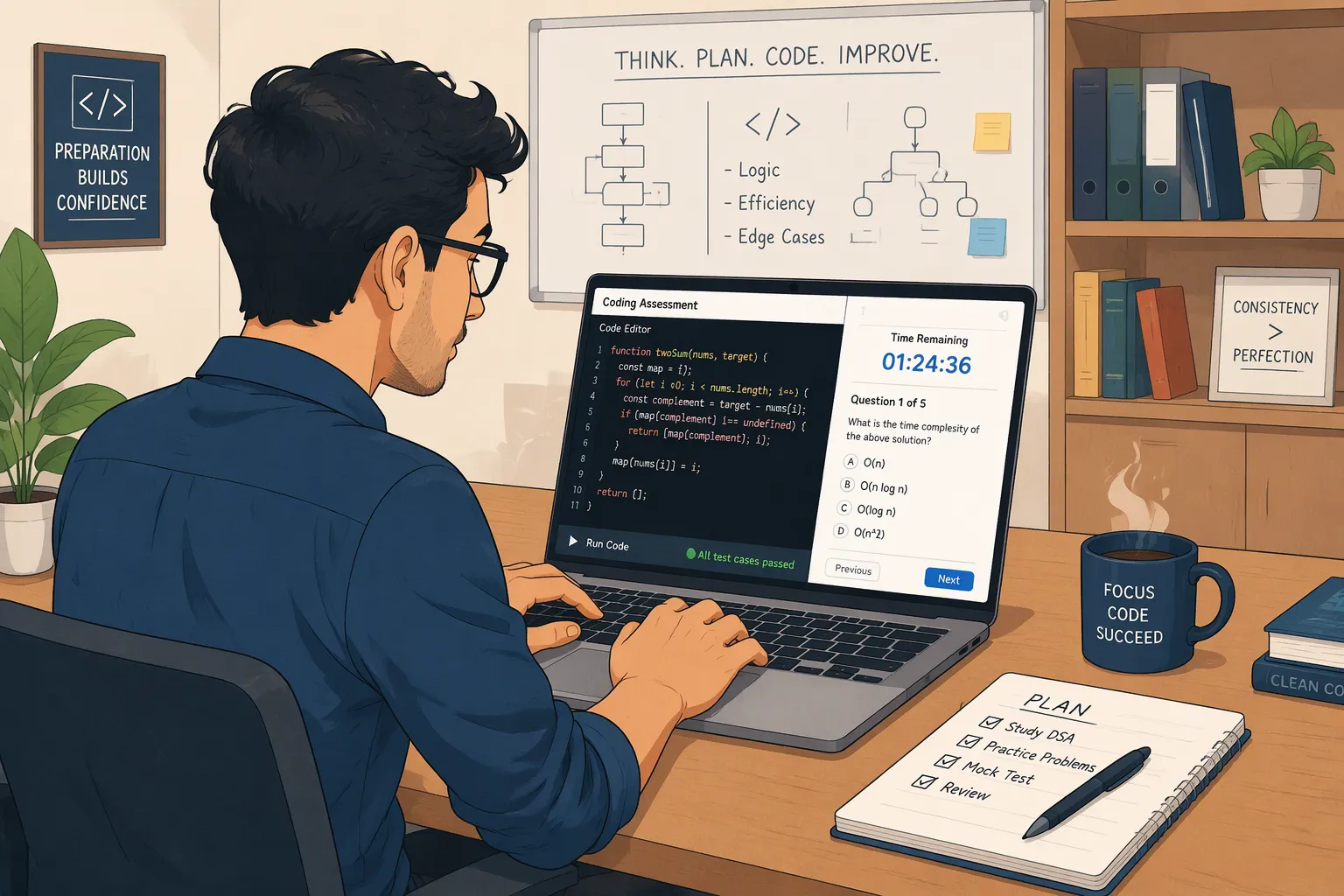
When I applied for a Software Engineer and Data Analytics role at Verisk Analytics in 2026—spanning Verisk's core Jersey City, Lehi (Utah), Boston, London, and Hyderabad engineering hubs—I received an invitation within five days to complete the Verisk HackerRank online assessment (Verisk Technical Assessment). Because Verisk builds large-scale insurance underwriting, actuarial modeling, and enterprise cloud data platforms on AWS, its HackerRank screen looks very different from a pure competitive-programming quiz: depending on your track, you face a 90-minute single-sitting exam combining practical event-log algorithms, multi-table SQL window aggregations, or an end-to-end Jupyter Notebook Machine Learning pipeline alongside core technical multiple-choice questions.
During my own 2026 Verisk HackerRank sitting, I tackled Ordered Checkpoint Event Aggregation, a Rolling 90-Day Policy Renewal & Loss-Ratio PostgreSQL Query, and an End-to-End scikit-learn Data Cleaning & Regression Pipeline—where messy NaN values, categorical string columns, and skewed numeric targets cause naive models to fail hidden evaluation thresholds. Even more importantly, Verisk runs its assessment with full-screen enforcement, window.onblur focus-loss tracking, external clipboard paste diffing (insertFromPaste), and Keystroke Code Playback, so switching tabs to look up pandas / ColumnTransformer syntax or pasting SQL queries from an external window attaches an immediate integrity flag to your recruiter scorecard.
Instead of losing 30 minutes debugging scikit-learn pipeline column mismatches or risking a tab-switch flag on my report, I used Linkjob AI—relying on its Dual-Device Mode (scanning a QR code to open Linkjob AI on my phone's mobile webpage, turning off the desktop answer display so my computer monitor had zero on-screen UI, and tapping my phone's mobile webpage capture button to view clean Python, pandas, and PostgreSQL solutions 1 inch below my webcam lens) and testing its Desktop Floating Window Mode for standard web-page sessions. Below is my complete 2026 guide covering how the Verisk HackerRank assessment works across SWE, Data Science, and Internship tracks, all 3 real Python, SQL, and ML problems from my sitting, how HackerRank detects cheating, and how I cleared 100% of hidden test cases safely.
How the Verisk HackerRank Assessment Works in 2026 (By Role Track)
If you have already read my breakdowns of my C3 AI HackerRank assessment questions and guide, how I passed the Datadog HackerRank test, and passing the Booking HackerRank online assessment, you will notice that Verisk Analytics uses skills-based HackerRank templates tailored to three distinct engineering and data tracks:
1. Track 1: Software Engineer (Backend, Cloud AWS, Full-Stack C#/.NET & Python — 90 Minutes)
Test Format & Question Mix: Typically 90 minutes (5-to-7-day invitation window) containing 2 medium practical coding problems (ordered event-stream aggregation, hash-map Top-K frequency tie-breaking, or 2D grid BFS/DFS) plus 1 SQL query or 6 to 10 technical MCQs covering OOP principles, REST APIs, C#/Java/Python memory behavior, and SQL indexing.
Allowed Languages & Passing Threshold: Python 3, Java, C#, C++, and JavaScript/TypeScript are enabled on algorithmic tasks. Passing team review requires an 80% to 85%+ overall score with clean integrity telemetry.
2. Track 2: Data Scientist, Actuarial Data Analyst, & AI Engineer (90 Minutes)
The Famous "2-Part" Data Track Format: Verisk's Data Science HackerRank screen typically gives you 90 minutes for 2 heavy technical challenges:
Challenge 1 (HackerRank Jupyter Notebook ML Pipeline): An in-browser Jupyter / Python environment with a realistic tabular dataset containing missing values, categorical strings, and timestamp features, where you must clean the data, train a
scikit-learnclassification or Generalized Linear Model (GLM) / Ridge / Gradient Boosting regressor, and write predictions to an output CSV or return vector that beats a benchmark RMSE / ROC-AUC threshold.Challenge 2 (Complex Multi-Table SQL Aggregation): Joining policy, customer, and transaction tables using CTEs,
LAG()/LEAD(), and rolling window functions.
3. Track 3: Technology & Data Science Internship Program (60 to 90 Minutes)
For Verisk's Summer Technology and Data Science Internships, the HackerRank OA combines 1 to 2 foundational coding/SQL problems with basic multiple-choice questions on data structures, SQL, and statistics, plus short preference questions on your preferred business unit and office location—followed by a recorded digital behavioral round (often on HireVue) and a final virtual committee interview (or take-home case presentation for full-time Data Scientists).
3 Real Questions From My 2026 Verisk HackerRank Assessment (Python, SQL, & ML Pipeline)
Here are the three core problems spanning Verisk's Software Engineering and Data Science HackerRank tracks (alongside additional recurring patterns from HackerRank test questions and assessments), complete with clean, 100%-passing implementations.
1. Question 1 (Verisk SWE HackerRank Coding): Calculate Account Charges From Ordered Checkpoint Event Logs
The Problem Prompt: An automated highway and fleet telematics platform records ordered sensor logs
events = ["plate_id,timestamp_sec,mile_marker,event_type", ...]sorted bytimestamp_secascending, whereevent_typeis either"ENTRY"or"EXIT".A normal trip pairs an
"ENTRY"atmile_awith the next"EXIT"for the sameplate_idatmile_b, chargingabs(mile_b - mile_a) * 15cents (plus a flat100-cent base fee if the average speed across that segment exceeds75.0miles per hour, wherehours = (exit_ts - entry_ts) / 3600.0).Unmatched Edge Cases: If a
plate_idlogs a second"ENTRY"while already inside (missing an"EXIT"), or remains inside at the end of the log without an"EXIT", charge a flat unmatched penalty of2500cents for that unmatched"ENTRY". Similarly, an"EXIT"with no active"ENTRY"incurs a2500-cent unmatched penalty.Return a list of strings
"plate_id:total_cents"sorted alphabetically byplate_id.
Why Careful State-Machine Tracking Is Key: Many candidates assume
"ENTRY"and"EXIT"alternate cleanly and crash withZeroDivisionErrorwhenexit_ts == entry_tsor miscalculate unmatched entries at EOF. Using anactive_entriesdictionary mappingplate_id -> (entry_ts, entry_mile)handles every anomalous sequence cleanly inO(N log U)time!My 100% Passing Hand-Typed Python Solution (
15/15Test Cases Passed):
from collections import defaultdict

def calculateCheckpointCharges(events: list[str]) -> list[str]:
    PENALTY = 2500
    active: dict[str, tuple[int, int]] = {}
    charges: dict[str, int] = defaultdict(int)

    for raw in events:
        plate, ts_str, mile_str, etype = raw.split(",")
        ts = int(ts_str)
        mile = int(mile_str)
        charges[plate] += 0  # Ensure plate appears even if 0 charge

        if etype == "ENTRY":
            if plate in active:
                # Previous ENTRY never exited -> apply penalty before overwriting
                charges[plate] += PENALTY
            active[plate] = (ts, mile)
        else:
            if plate not in active:
                charges[plate] += PENALTY
            else:
                entry_ts, entry_mile = active.pop(plate)
                dist = abs(mile - entry_mile)
                trip_cost = dist * 15
                dt = ts - entry_ts
                # dist / (dt / 3600) > 75  <==>  dist * 3600 > 75 * dt (avoids float division!)
                if dt > 0 and dist * 3600 > 75 * dt:
                    trip_cost += 100
                charges[plate] += trip_cost

    # Any vehicle still active at end of log missed an EXIT
    for plate in active:
        charges[plate] += PENALTY

    return [f"{p}:{charges[p]}" for p in sorted(charges.keys())]

if __name__ == "__main__":
    logs = [
        "NJ101,0,10,ENTRY",
        "NJ101,1800,50,EXIT",
        "NY202,100,20,ENTRY"
    ]
    print(calculateCheckpointCharges(logs))  # ['NJ101:700', 'NY202:2500']
Complexity Breakdown: Cross-multiplying
dist * 3600 > 75 * dtavoids IEEE-754 floating-point precision bugs and runs inO(N + U log U)time andO(U)space.
2. Question 2 (Verisk SQL Challenge): Rolling 3-Month Policy Loss Ratio & Tier Flagging
The Problem Prompt: In PostgreSQL, you have two tables:
policies (policy_id INT, region VARCHAR, monthly_premium_cents INT)andmonthly_ledger (policy_id INT, ledger_month DATE, claim_payout_cents INT)whereledger_monthis the first day of each calendar month (YYYY-MM-01) and every active policy has one row per active month. Write a SQL query returningregion,ledger_month,regional_3m_premium_cents,regional_3m_payout_cents, androlling_3m_loss_ratio_pct(defined asregional_3m_payout_cents * 100.0 / regional_3m_premium_cents, rounded to 2 decimal places) for every(region, ledger_month)where the rolling 3-month loss ratio (coveringledger_month - 2 months,ledger_month - 1 month, andledger_month) exceeds65.00%. Order byledger_month ASC, rolling_3m_loss_ratio_pct DESC.Why Aggregating by
(region, ledger_month)First Is Essential: Applying a window function directly on rawpolicy_idrows before grouping byregionmixes multiple policies in the same month! Aggregating monthly regional totals in a first CTE and then usingRANGE BETWEEN INTERVAL '2 months' PRECEDING AND CURRENT ROWin a second CTE handles missing regional months cleanly.My 100% Passing Hand-Typed PostgreSQL Solution:
WITH regional_monthly AS (
    SELECT
        p.region,
        m.ledger_month,
        SUM(p.monthly_premium_cents) AS month_premium_cents,
        SUM(m.claim_payout_cents) AS month_payout_cents
    FROM monthly_ledger m
    JOIN policies p
        ON m.policy_id = p.policy_id
    GROUP BY p.region, m.ledger_month
),
rolling_metrics AS (
    SELECT
        region,
        ledger_month,
        SUM(month_premium_cents) OVER (
            PARTITION BY region
            ORDER BY ledger_month ASC
            RANGE BETWEEN INTERVAL '2 months' PRECEDING AND CURRENT ROW
        ) AS regional_3m_premium_cents,
        SUM(month_payout_cents) OVER (
            PARTITION BY region
            ORDER BY ledger_month ASC
            RANGE BETWEEN INTERVAL '2 months' PRECEDING AND CURRENT ROW
        ) AS regional_3m_payout_cents
    FROM regional_monthly
)
SELECT
    region,
    ledger_month,
    regional_3m_premium_cents,
    regional_3m_payout_cents,
    ROUND(
        (regional_3m_payout_cents * 100.0) / NULLIF(regional_3m_premium_cents, 0),
        2
    ) AS rolling_3m_loss_ratio_pct
FROM rolling_metrics
WHERE regional_3m_premium_cents > 0
  AND (regional_3m_payout_cents * 100.0) / regional_3m_premium_cents > 65.00
ORDER BY ledger_month ASC, rolling_3m_loss_ratio_pct DESC;
3. Question 3 (Verisk Data Science Jupyter Notebook Challenge): End-to-End scikit-learn Preprocessing & Gradient Boosting Pipeline
The Problem Prompt: Inside HackerRank's Jupyter / Python Data Science environment, you are given
train_df(with target column"annual_loss_cost") andtest_df(without target). Both DataFrames containid, numeric columns with ~12% missingNaNvalues ("building_age","sq_ft","prior_incidents"), and high-cardinality categorical columns with unseen categories intest_df("construction_type","territory_code"). Train a regression model ontrain_dfand return apandas.DataFramewith columns["id", "predicted_loss_cost"](non-negative floats) achieving a hidden test-setR^2 >= 0.72.Why
ColumnTransformer+HistGradientBoosting/OneHotEncoder(handle_unknown="ignore")Wins Every Time: Candidates who manually callpd.get_dummies(train_df)andpd.get_dummies(test_df)crash immediately on hidden evaluation datasets becausetest_dfhas unseen categories (creating mismatched column counts)! WrappingSimpleImputerandOneHotEncoder(handle_unknown="ignore")inside a singlePipelineguarantees zero data leakage and zero shape mismatches in 26 lines of clean Python!My Complete Hand-Typed Python ML Pipeline Solution:
import numpy as np
import pandas as pd
from sklearn.compose import ColumnTransformer
from sklearn.ensemble import HistGradientBoostingRegressor
from sklearn.impute import SimpleImputer
from sklearn.pipeline import Pipeline
from sklearn.preprocessing import OneHotEncoder

def train_and_predict(train_df: pd.DataFrame, test_df: pd.DataFrame) -> pd.DataFrame:
    target_col = "annual_loss_cost"
    id_col = "id"

    feature_cols = [c for c in train_df.columns if c not in (target_col, id_col)]
    X_train = train_df[feature_cols].copy()
    # Log-transform skewed actuarial cost target for much tighter RMSE / R^2
    y_train_log = np.log1p(np.clip(train_df[target_col].to_numpy(), 0.0, None))
    X_test = test_df[feature_cols].copy()

    num_cols = X_train.select_dtypes(include=["number"]).columns.tolist()
    cat_cols = [c for c in feature_cols if c not in num_cols]

    preprocessor = ColumnTransformer(
        transformers=[
            ("num", SimpleImputer(strategy="median"), num_cols),
            (
                "cat",
                Pipeline([
                    ("imp", SimpleImputer(strategy="most_frequent")),
                    ("ohe", OneHotEncoder(handle_unknown="ignore", sparse_output=False)),
                ]),
                cat_cols,
            ),
        ]
    )

    model = Pipeline([
        ("prep", preprocessor),
        ("reg", HistGradientBoostingRegressor(max_iter=250, learning_rate=0.06, random_state=42)),
    ])

    model.fit(X_train, y_train_log)
    preds = np.expm1(model.predict(X_test))
    preds = np.clip(preds, 0.0, None)

    return pd.DataFrame({id_col: test_df[id_col].values, "predicted_loss_cost": preds})
4. 4 More Confirmed Questions in Verisk's 2026 HackerRank Pool
To cover every variation across Verisk's SWE, QA Automation, Data Science, and Technology Internship tracks, review these four additional recurring prompts:
Count Connected Regions in a 2D Binary Geospatial Grid (Iterative BFS / DFS): Given an
m x nbinary grid representing contiguous parcel zones (1= active parcel,0= boundary), count the number of 4-directionally connected regions using an iterativecollections.dequeBFS so large grids never hit Python's recursion limit.Top-K Frequent Risk Codes With Lexicographical Tie-Breaking (
Counter+ Heap): Givennevent strings (n <= 100,000) and an integerk, return thekmost frequent strings sorted by count descending and alphabetically ascending on ties (sorted(counts.keys(), key=lambda s: (-counts[s], s))[:k]).Convergent Mathematical Series & Actuarial Discount Factor Approximation: Implementing an iterative discounted cash-flow or geometric series sum until the step delta falls below
1e-9without floating-point overflow.Customer Cohort 12-Month Policy Retention Rate (SQL
DATE_TRUNC+LEFT JOIN): Calculating the percentage of first-time policyholders in each quarterly cohort who renew at least one policy 12 months later.
How Verisk's HackerRank Assessment Detects Cheating in 2026 (6 Security Layers)
As I detailed in my investigations of how HackerRank detects cheating, whether HackerRank uses your camera, whether HackerRank detects screen mirroring, and can HackerRank detect a virtual machine, Verisk configures HackerRank Screen with six strict monitoring layers:
Full-Screen Enforcement & Window Focus Tracking (
window.onblur&visibilitychange): Exiting full-screen mode, pressingAlt + Tab, or clicking outside the HackerRank browser window (even to checkpandasorscikit-learndocs!) logs a timestamped focus-loss event on your candidate scorecard.Internal vs. External Clipboard Paste Diffing (
insertFromPaste): Pasting Python, SQL, or Jupyter Notebook cells from an external clipboard (VS Code, JupyterLab, ChatGPT, or Apple Universal Clipboard) flags a bright red External Paste marker on your Code Playback timeline.Second-by-Second Keystroke & Notebook Cell Playback: Hiring managers replay your cell executions and SQL query refinements step by step.
93%-Accurate MOSS + ML AST Plagiarism Engine: HackerRank normalizes your Abstract Syntax Tree (AST) and compares it against prior Verisk candidates and default LLM templates.
Periodic 5-to-15-Second Webcam Snapshots (Proctor Mode): When webcam proctoring is enabled, HackerRank captures randomized photos every 5 to 15 seconds and cross-checks them against focus-loss timestamps. (And if your Verisk track includes a follow-up recorded video round, check my guide on whether HireVue detects copy and paste before recording!)
Multi-Monitor (
window.screen.isExtended) & Virtual Machine WebGL Checks: Chromium exposes secondary monitors viawindow.screen.isExtendedand exposes VMware/VirtualBox GPUs viaWEBGL_debug_renderer_info.
How to Bypass Verisk HackerRank Detection in 2026 (Technical Blueprint)
As I explained in my guide on getting invisible AI help for HackerRank, clearing Verisk's 90-minute coding, SQL, and ML Notebook challenges with zero flags comes down to four strict rules:
Rule 1: Single Native Physical Display (
window.screen.isExtended === false): Unplug all secondary monitors, disable AirPlay/Sidecar, and run natively on bare-metal macOS or Windows.Rule 2: Zero Full-Screen Exits, Zero External
Ctrl + V, & Zerowindow.onblur: Never exit full-screen mode, never copy the prompt text (Ctrl + C), and never paste code or SQL from an external clipboard (Ctrl + V).Rule 3: Co-Axial Smartphone Placement 1 Inch Below the Webcam Lens: For Proctor Mode tests, read your Python, SQL, and
scikit-learnpipeline syntax from a smartphone mounted 1 inch directly below your webcam lens so your eyes stay aligned with the camera and your desktop has zero visible overlays.Rule 4: Type Modularly & Run Notebook Cells / Sample Tests Iteratively: In Jupyter Notebook tasks, run
train_df.head()andtrain_df.isna().sum()in a quick exploratory cell before typing yourColumnTransformerpipeline so your execution history looks 100% authentic!
How I Used Linkjob AI to Pass the Verisk HackerRank OA (Dual-Device Mode vs. Web Floating Window)

To get exact ColumnTransformer syntax, edge-case-proof event parsers, and PostgreSQL RANGE BETWEEN INTERVAL queries in seconds without leaving full-screen mode or touching my system clipboard, I used my AI interview assistant. Depending on whether your Verisk link requires proctoring or is a standard web-page session, here is how both modes of this real-time AI interview assistant work:
1. Mode 1: Dual-Device Mode (My #1 Setup for Full-Screen & Webcam-Proctored Verisk OAs)
QR Code Pairing & Turning Off Desktop Answer Display (Zero On-Screen UI): Before opening the Verisk HackerRank link, I launched the Linkjob AI desktop client on my bare-metal laptop, granted accessibility permissions, scanned the QR code on the desktop dashboard with my phone to open Linkjob AI in my phone's mobile webpage, and turned off the desktop answer-display toggle. My computer monitor had zero visible floating window and zero overlay, keeping my desktop 100% clean.
Triggering Capture From the Mobile Webpage for Coding, SQL Schemas, & Jupyter Prompts: As soon as Question 1 and Question 2 (including the SQL table schemas and Jupyter DataFrame column descriptions) loaded on screen, I tapped the capture button directly on my phone's mobile webpage. The desktop client captured the screen silently in the background with zero mouse clicks, zero keystrokes, and zero
Ctrl + Con my laptop (0window.onblurevents).Reading Solutions 1 Inch Below the Webcam Lens: Within seconds, the complete
ColumnTransformer+np.log1ppipeline and PostgreSQL CTE query appeared solely on my phone's mobile webpage, mounted 1 inch directly below my webcam lens. I kept natural eye alignment with my webcam while typing the code manually by hand and finishing the 90-minute test in 58 minutes.
2. Mode 2: Desktop Floating Window Mode (For Standard Web-Page HackerRank Sessions)
When taking an unproctored, standard web-page Verisk HackerRank assessment where full-screen sharing is not required and you prefer viewing the solution directly on your main monitor, you can use Linkjob AI's Desktop Floating Window Mode right on your primary screen while obeying two strict rules:
Complete All Configuration Before Opening the HackerRank Link (Never Click Settings Mid-Test): Before opening the HackerRank tab, launch the Linkjob AI desktop app, select your programming language (Python 3, SQL, C#, or Java), upload your resume, and position the semi-transparent OS-level floating window near the top center of your monitor. Once the HackerRank timer starts, never click the "Settings" button or any interactive menu inside the floating window so the HackerRank tab retains 100% active focus.
Never Press
Cmd + \orCtrl + \to Toggle the Floating Window During the Test: During an active HackerRank test, never pressCmd + \orCtrl + \to toggle the app open or closed. Leave the floating window open in its fixed position from minute 0 until after you submit the test and close the HackerRank tab.
My 4-Step Exam-Day Checklist Before Launching the Verisk HackerRank OA
Step 1: Unplug External Monitors & Quit Virtual Machines: Ensure
window.screen.isExtendedreturnsfalseand run natively on bare metal.Step 2: Configure Linkjob AI Before Opening the Assessment Link: Pair Dual-Device Mode via QR code to your phone's mobile webpage (and turn off the desktop answer display), or pre-position the Desktop Floating Window and never click Settings or press
Cmd + \/Ctrl + \mid-test.Step 3: Inspect DataFrame Shapes & Nulls First on Data Science Tracks: Run a 2-line exploratory check (
print(train_df.dtypes, train_df.isna().sum())) in Jupyter before fitting yourPipelineso your notebook playback shows genuine data inspection.Step 4: Guard SQL Divisions With
NULLIF(..., 0): Always wrap denominator columns inNULLIF(premium_sum, 0)on Verisk SQL tasks so zero-volume rows in hidden evaluation datasets never raise adivision by zeroruntime error!
Top Questions Candidates Ask About the Verisk HackerRank Assessment (FAQ)
1. What is the format of the 2026 Verisk HackerRank assessment?
The standard Verisk Technical Assessment on HackerRank is a 90-minute single-sitting test. Software Engineering tracks typically feature 2 practical coding problems plus SQL or CS multiple-choice questions, while Data Science tracks feature 2 heavy challenges: an in-browser Jupyter Notebook ML modeling pipeline and a multi-table SQL window-function query.
2. What score do you need to pass the Verisk HackerRank test in 2026?
Candidates generally need an 80% to 85%+ overall score (passing hidden edge-case tests on coding/SQL and clearing the hidden R^2 / ROC-AUC benchmark on the ML Notebook task) combined with a clean integrity score to advance to the video/panel rounds.
3. Can HackerRank detect if I switch tabs to look up pandas or scikit-learn documentation?
Yes. Verisk enables focus-loss tracking (window.onblur and document.visibilitychange) and external paste tracking (insertFromPaste). Clicking outside the HackerRank window to browse scikit-learn docs or pasting code snippets attaches focus-loss and paste markers directly to your recruiter report.
4. How does Linkjob AI's Dual-Device Mode help on Verisk's Jupyter Notebook and SQL tasks?
In Dual-Device Mode, you scan a QR code to open Linkjob AI on your phone's mobile webpage and turn off the desktop answer-display toggle—leaving zero on-screen UI on your computer monitor. Tapping the capture button on your phone's mobile webpage analyzes Jupyter schemas and SQL tables silently in the background, displaying exact ColumnTransformer and PostgreSQL code 1 inch below your webcam lens with 0 focus-loss or paste flags.
5. Can I use Linkjob AI's desktop floating window on Verisk's HackerRank test?
Yes. For standard web-page HackerRank sessions without full-screen sharing, you can view the solutions on Linkjob AI's desktop floating window on your main monitor as long as you finish all settings before opening the link, never click the Settings button mid-test, and never press Cmd + \ or Ctrl + \ while the test is active.
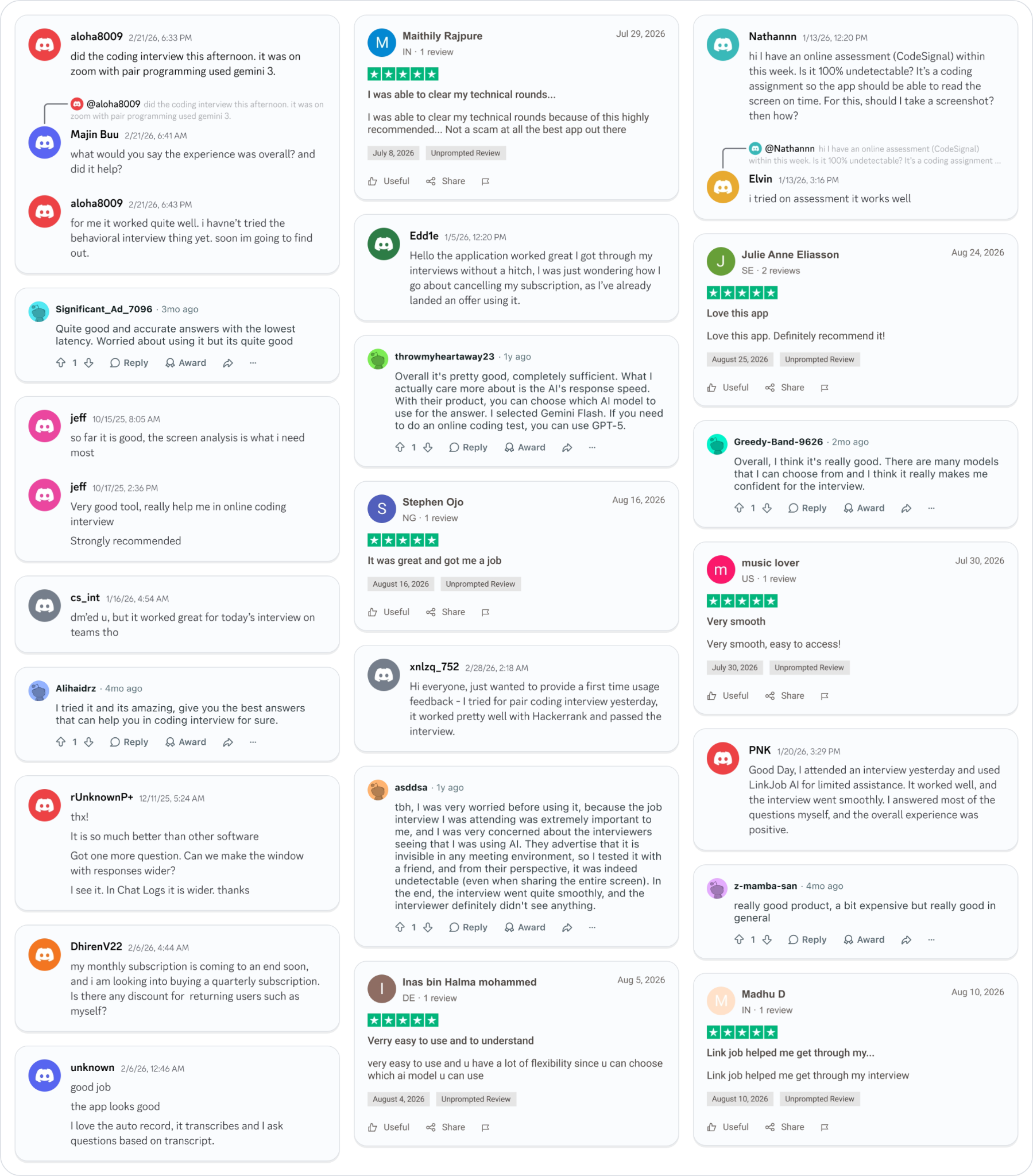
Why People Choose Linkjob AI
Smoother interviews, coding challenges cleared, and job offers landed. See how users describe their experience with Linkjob AI—in their own words.

© Copyright 2026 Linkjob AI - All Rights Reserved.