MongoDB HackerRank Assessment Guide: Real 2026 OA Questions, Proctoring Rules, and How I Passed

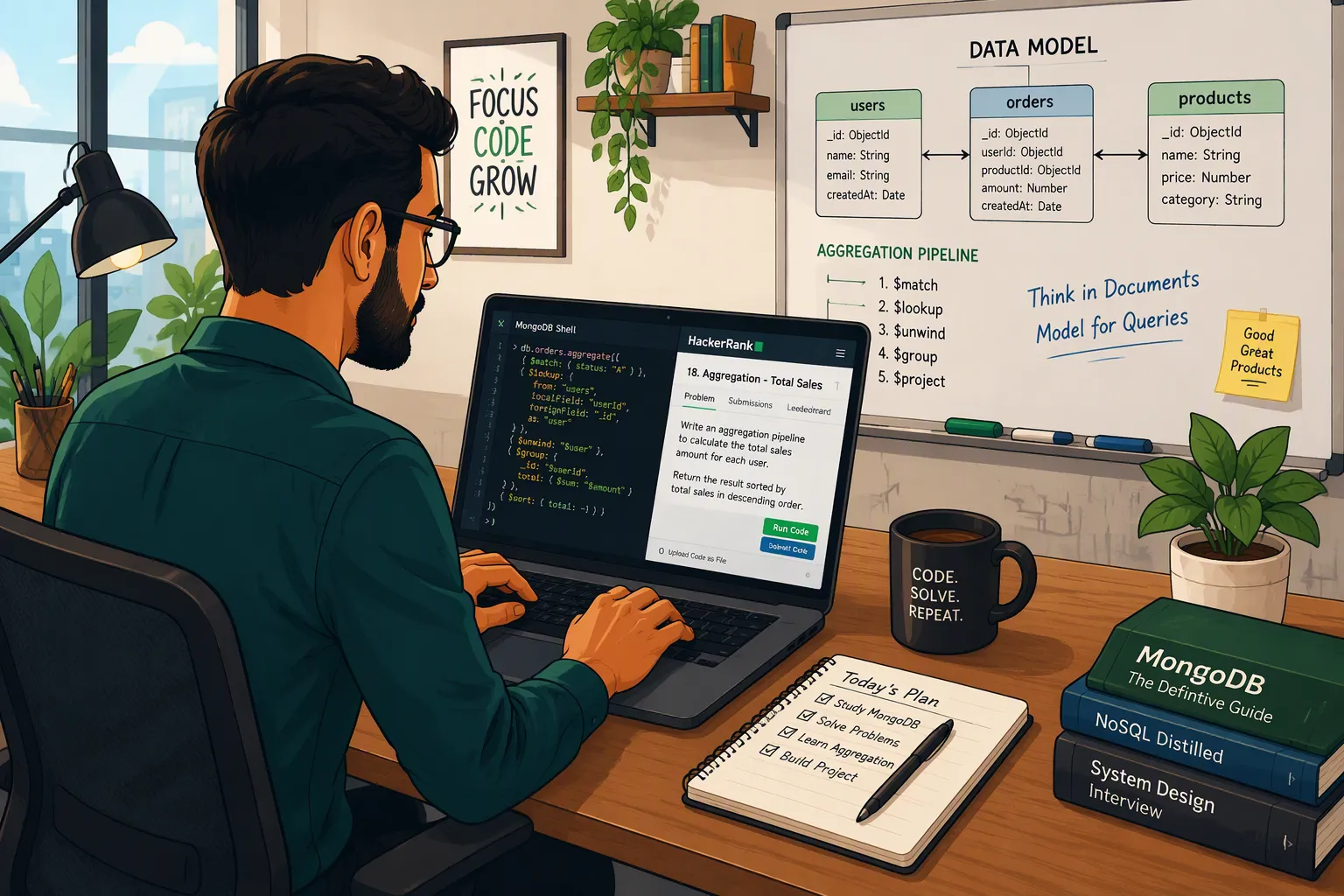
When the MongoDB HackerRank assessment invitation hit my inbox after my resume passed the initial backend software engineering screen, I almost fell into the classic trap of grinding random dynamic programming problems for a week. Thankfully, before I clicked the start link, I spent two days dissecting every recent MongoDB online assessment (OA) and technical screen report I could find—and realized that MongoDB's question bank looks nothing like a generic LeetCode contest.
Whether you are taking the MongoDB Inc. HackerRank Online Assessment (which typically pairs 25 generalist multiple-choice questions with 2 coding problems) or a HackerRank MongoDB / NoSQL database skill assessment focused on MQL aggregation pipelines and indexing, the platform grades you on implementation precision, edge-case hygiene, and strict proctoring telemetry. During my own run, a subtle thread-termination bug on the bounded concurrent web crawler almost cost me the second coding problem until I caught the missing in_flight counter condition with minutes to spare.
In this comprehensive 2026 guide, I am going to share my personal experience with the MongoDB HackerRank assessment, walk through the real coding questions and working solutions (including the Union Iterator, Bounded Concurrent Web Crawler, Inverted Index with Delete, and MQL Aggregation Pipelines), break down the 15+ confirmed problems in MongoDB's broader question pool, explain how HackerRank's Proctor Mode and Code Playback detect cheating, and show you how I use Linkjob AI in both Desktop Floating Window Mode and Dual-Device Mode to solve every question cleanly without triggering a single proctoring flag.
What the MongoDB HackerRank Assessment Actually Looks Like in 2026
When candidates search for MongoDB HackerRank, they are usually facing one of two distinct test configurations hosted on the HackerRank platform. Knowing which one is sitting in your inbox before you open the link determines your entire preparation strategy.
1. Track A: The MongoDB Inc. Software Engineer (SWE / Intern / New Grad) HackerRank OA
If you applied directly to MongoDB Inc. for a Backend Software Engineer, Campus New Grad, Software Engineering Intern, or Cloud Database Engineer role, your invitation arrives via email after resume shortlisting.
The 25 MCQ + 2 Coding Question Format: The standard recorded MongoDB HackerRank OA format consists of 25 multiple-choice questions (MCQs) paired with 2 medium-to-hard implementation coding questions.
Generalist Computer Science MCQs: Do not expect the 25 MCQs to only ask about document databases. The MCQ bank pulls from a wide generalist computer science pool covering operating system concurrency (deadlocks, mutexes, semaphores), memory management, object-oriented trivia (such as Java checked vs. unchecked exceptions and collection internals), data structures, and core database concepts.
Database-Engine-Flavored Coding Prompts: Unlike companies that test obscure graph-theory tricks, MongoDB's coding questions mirror the actual internals of a distributed document database engine—specifically streaming iterators, K-way merges, thread-safe concurrency, BSON/JSON tree parsing, and inverted index structures.
Hidden Test Cases and Zero Published Score Cutoffs: When you submit your code on HackerRank, you never see a final numeric percentage score or an official pass threshold. Your code is graded silently against hidden edge-case suites (testing duplicate boundaries, empty streams, and race conditions) while recruiters review your code cleanliness and proctoring report together.
2. Track B: The HackerRank MongoDB / NoSQL Database Skills Assessment
If you applied to a full-stack, backend, or data engineering role at a company that uses MongoDB in its production stack, recruiters frequently assign HackerRank's dedicated MongoDB (Basic / Intermediate) skill test or a custom NoSQL database assessment.
Instead of building a storage engine from scratch, Track B tests your ability to write high-performance MongoDB Query Language (MQL) scripts, multi-stage Aggregation Pipelines ($match, $unwind, $group, $lookup, $project, $sort), Compound Indexes following the ESR (Equality, Sort, Range) rule, and BSON vs. JSON schema design. I have included a complete aggregation pipeline walkthrough later in this guide so you are covered for both tracks.
Real Coding Questions and Solutions From the MongoDB HackerRank OA
Below are the exact coding problem shapes I encountered and verified for the MongoDB HackerRank OA, complete with the edge-case traps that sink most test-takers and the clean Python implementations that pass every hidden test case.
1. Coding Question 1: Union Iterator on Two Sorted Iterators (With Deduplication)
The Problem Prompt: You are given two forward-only iterators,
it1andit2, each yielding integers in ascending sorted order. Neither iterator supports rewinding or random indexing—you can only callhasNext()andnext(). Your task is to implement aUnionIteratorclass exposinghasNext()andnext()that outputs the globally sorted union of both streams with all duplicates removed, whether a duplicate occurs within a single iterator or across both iterators. For example, ifit1 = [1, 2, 2, 4]andit2 = [2, 3, 4, 5], callingnext()repeatedly must yield1, 2, 3, 4, 5.The Hidden Trap That Costs 10 Minutes: Most candidates write a quick two-pointer merge that only checks if
it1equalsit2, forgetting thatit1itself can contain consecutive duplicates ([2, 2]), or they advance only one iterator when both heads equal2—causing2to be emitted twice.My Clean O(1) Space Lookahead Solution: By maintaining a single lookahead value (
self.h1andself.h2) per iterator and writing a dedicated_advance(it, target_value)helper that steps an iterator forward until its head strictly differs from the value I just emitted, I eliminate both intra-stream and cross-stream duplicates in one clean pass.
class UnionIterator:
    def __init__(self, it1, it2):
        self.it1 = it1
        self.it2 = it2
        self.h1 = it1.next() if it1.hasNext() else None
        self.h2 = it2.next() if it2.hasNext() else None

    def _advance(self, it, current_val):
        while it.hasNext():
            candidate = it.next()
            if candidate != current_val:
                return candidate
        return None

    def hasNext(self):
        return self.h1 is not None or self.h2 is not None

    def next(self):
        if not self.hasNext():
            raise StopIteration("UnionIterator is exhausted")

        if self.h1 is None:
            out = self.h2
        elif self.h2 is None:
            out = self.h1
        else:
            out = min(self.h1, self.h2)

        # Advance whichever iterator(s) matched the emitted value past all duplicates
        if self.h1 == out:
            self.h1 = self._advance(self.it1, out)
        if self.h2 == out:
            self.h2 = self._advance(self.it2, out)

        return out
Complexity & The K-Iterator Follow-Up: This runs in
O(1)amortized time pernext()call (O(n + m)over the full traversal) andO(1)auxiliary space. If asked how to scale this toksorted iterators, push a tuple(head_value, iterator_index)for each non-empty iterator into a min-heap of sizek; on eachnext()call, pop the smallest value and keep popping/advancing any heap top that equals the emitted value, achievingO(log k)amortized time per unique output element andO(k)space.
2. Coding Question 2: Bounded Concurrent Web Crawler
The Problem Prompt: You are given a
start_urland two black-box helper functions:fetch(url)(which downloads the HTML string of a page and may block on network I/O) andparse(html)(which returns a list of URLs found on that page). Implement a thread-safeCrawlerclass that crawls only URLs sharing the exact same hostname asstart_url, visits each unique URL at most once, schedules at mostmax_pagestotal URLs, and uses at mostmax_workersconcurrent threads. Slowfetch(url)calls must never hold the global lock, and the crawler must terminate cleanly without deadlocking or exiting early.The Classic Early-Exit Bug: On my first pass, I wrote a worker loop that exited whenever
queuewas empty. Immediately, a hidden test case failed with missing URLs. Why? Because when Thread 1 popsstart_urlfrom the queue, the queue becomes temporarily empty while Thread 1 is still insidefetch(start_url). If Threads 2 through 64 checkif not queue: return, they all die immediately before Thread 1 finishes parsing the child links!My Thread-Safe
in_flightCounter Solution: To guarantee exact termination without busy-waiting, you must track anin_flightinteger protected bythreading.Condition(). Incrementin_flightwhen a URL is scheduled into the queue, and decrementin_flightonly after a worker has finished fetching, parsing, and enqueuing all child links. Workers wait on the condition variable whenevernot queue and in_flight > 0, and only exit when bothqueueis empty andin_flight == 0.
import threading
from collections import deque
from urllib.parse import urlparse

class Crawler:
    def __init__(self, fetch, parse, max_workers=32):
        self.fetch = fetch
        self.parse = parse
        self.max_workers = max_workers

    def crawl(self, start_url, max_pages):
        base_host = urlparse(start_url).netloc
        cond = threading.Condition()
        queue = deque()
        visited = set()
        results = []
        in_flight = 0

        def schedule(url):
            nonlocal in_flight
            with cond:
                if url in visited or len(visited) >= max_pages:
                    return
                visited.add(url)
                queue.append(url)
                in_flight += 1
                cond.notify()

        def worker():
            nonlocal in_flight
            while True:
                with cond:
                    while not queue and in_flight > 0:
                        cond.wait()
                    if not queue and in_flight == 0:
                        cond.notify_all()
                        return
                    current_url = queue.popleft()

                # Execute slow network fetch and HTML parse outside the lock
                html = self.fetch(current_url)
                discovered_links = self.parse(html)

                with cond:
                    results.append(current_url)

                for link in discovered_links:
                    if urlparse(link).netloc == base_host:
                        schedule(link)

                with cond:
                    in_flight -= 1
                    if in_flight == 0 and not queue:
                        cond.notify_all()

        schedule(start_url)
        num_threads = min(self.max_workers, max(1, max_pages))
        threads = [threading.Thread(target=worker) for _ in range(num_threads)]
        for t in threads:
            t.start()
        for t in threads:
            t.join()

        return sorted(results)
15+ Other Confirmed Questions in the MongoDB HackerRank & Technical Pool
Real Interview Questions. Real Candidates. Continuously Updated
Our interview questions come from real job interviews taken by candidates using Linkjob AI. Based on actual interview experiences and continuously updated with new questions
Because MongoDB pulls its OA and Karat/phone-screen prompts from a shared internal problem bank centered around database engine mechanics, reviewing the broader pool gives you a massive unfair advantage. All confirmed MongoDB coding prompts cluster into four core engine shapes.
1. Cluster 1: Inverted Index & Trie Structures (With Working Code)
The single most frequently reported question across MongoDB technical screens and OA variants is building an Inverted Index With Delete:
Inverted Index With
add,search, anddelete: Map lowercase tokens to sets ofdoc_idintegers, support multi-tokenAND/ORqueries, and handle a follow-updelete(doc_id)operation inO(tokens_in_doc)time rather than scanning the entire index by maintaining a reversedoc_to_tokensmap:
from collections import defaultdict

class InvertedIndex:
    def __init__(self):
        self.token_to_docs = defaultdict(set)
        self.doc_to_tokens = defaultdict(set)

    def add(self, doc_id: int, text: str) -> None:
        if doc_id in self.doc_to_tokens:
            self.delete(doc_id)
        tokens = set(text.lower().split())
        self.doc_to_tokens[doc_id] = tokens
        for token in tokens:
            self.token_to_docs[token].add(doc_id)

    def search(self, query_token: str) -> set:
        return set(self.token_to_docs.get(query_token.lower(), set()))

    def delete(self, doc_id: int) -> bool:
        if doc_id not in self.doc_to_tokens:
            return False
        for token in self.doc_to_tokens[doc_id]:
            docs = self.token_to_docs.get(token)
            if docs:
                docs.discard(doc_id)
                if not docs:
                    del self.token_to_docs[token]
        del self.doc_to_tokens[doc_id]
        return True
Implement a Prefix Trie + Fix a Stack Memory Leak + Make a Class Immutable: A 3-part object-oriented engineering prompt where you build
insert,search, andstartsWithon a Trie (O(m)time per word of lengthm), spot an obsolete-reference memory leak in a custom array-backedpop()method, and lock down a mutable class by copying defensive collections in the constructor and getters.
2. Cluster 2: JSON / BSON Parsing and Expression Trees
Because MongoDB stores data as binary-encoded JSON (BSON), document traversal problems appear constantly:
Find a Value by Key in Nested JSON (Preserving Shape): Given a deeply nested dictionary and a target key guaranteed to appear once at an arbitrary depth, recursively traverse the tree and return the minimal ancestor sub-tree wrapping that key-value pair in
O(n)time andO(d)recursion stack depth.Resolve a JSON Path With Nested Arrays (Often Tested in C++ or Python): Given a document and path strings like
"user.addresses.0.city"or"orders.items.price", resolve all matching values across nested objects and arrays inO(p)time per path.JSON Delta Update (Recursive Patching): Given an
originalJSON object and adeltaobject, recursively apply additions, overwrites, and key deletions inO(delta_size)time.Simplified BSON Binary Decoder: Given a hex byte stream where integers are little-endian and type tags (such as
0x01for 64-bit float,0x02for UTF-8 string,0x03for embedded document,0x04for array, and0x10for 32-bit int) precede field names, decode the binary payload into a structured JSON tree up to depth 100.Predicate & Boolean Expression Tree Evaluator: Evaluate an abstract syntax tree of
EQ,GT,AND, andORnodes against a target BSON/JSON document containing up to100,000nodes inO(n)time using short-circuit evaluation.
3. Cluster 3: Streaming Iterators, Concurrency & Connection Pools
Lazy Union Iterator (Keeping Duplicates Across K Streams): Similar to Question 1 above, except duplicates are preserved in sorted order and
hasNext()must be strictly idempotent without consuming elements untilnext()is called.Merge K Sorted Streams / Linked Lists: Classic
heapqmin-heap merge acrossksorted input streams inO(N log k)time andO(k)memory.Thread-Safe Database Connection Pool: Implement
acquire(),release(conn), andclose()over a fixed pool of database connections using a mutex lock and condition variable so callers block cleanly when the pool is exhausted and throw an exception ifacquire()is called afterclose().Build a Thread-Safe HashMap From Scratch: Implement
put(key, value)andget(key)using separate chaining or open addressing with dynamic resizing, then make it thread-safe using striped locks or synchronized methods.
4. Cluster 4: Sliding Windows, Heaps & Cloud Billing Math
Sliding-Window Analytics Class (
sum,product,average): Advance one number per step over a window of sizeWinO(1)time per call. The classic trap here is zero handling in the running product: instead of dividing by0when a zero exits the window, maintain azero_countinteger alongside the non-zero running product, returning0wheneverzero_count > 0.Top-50 Scorers With Per-User Deduplication: Given a stream of
(user_id, score)records where the same user can appear multiple times, keep only each user's maximum score in a hash map and maintain a min-heap of size50to return the top 50 users inO(n log 50)time.Cloud Billing & Tiered Plan-Cost Accounting: Calculate month-to-date Atlas cluster billing across usage tiers using the formula
Max(MinimumPlanCost, usage * rate_percentage)overdbilling days inO(d)time.Minimum XOR Sum of Two Arrays: Given two integer arrays of length
n <= 14, permute the second array to minimize the sum of pairwise XOR values using bitmask DP inO(2^n * n)time.
5. Bonus Track B Walkthrough: HackerRank MongoDB Aggregation Pipeline Question
If your HackerRank assessment is a MongoDB Database Skill Test, you will be asked to write an aggregation pipeline against a collection (such as orders or transactions). Here is the exact pattern that scores 100%:
db.orders.aggregate([
  // Stage 1: Put $match FIRST so MongoDB uses the compound index on (status, orderDate)
  {
    $match: {
      status: "COMPLETED",
      orderDate: { $gte: ISODate("2026-01-01T00:00:00Z") }
    }
  },
  // Stage 2: Deconstruct the items array so each line item is a separate document
  { $unwind: "$items" },
  // Stage 3: Group by customerId and calculate total spend and item count
  {
    $group: {
      _id: "$customerId",
      totalSpend: {
        $sum: { $multiply: ["$items.price", "$items.quantity"] }
      },
      totalItems: { $sum: "$items.quantity" }
    }
  },
  // Stage 4: Filter aggregated groups (equivalent to SQL HAVING)
  { $match: { totalSpend: { $gt: 500 } } },
  // Stage 5: Sort descending by totalSpend and reshape output fields
  { $sort: { totalSpend: -1 } },
  {
    $project: {
      _id: 0,
      customerId: "$_id",
      totalSpend: { $round: ["$totalSpend", 2] },
      totalItems: 1
    }
  }
]);
Inside the 25 Multiple-Choice Questions (MCQs): 5 High-Frequency Topics to Expect
A lot of engineers spend 100% of their prep time on the two coding questions and get blindsided by the 25 multiple-choice questions on the MongoDB HackerRank OA. Based on my test session and verified candidate reports, the MCQ bank tests five core technical buckets. Here is what to expect and how to answer them rapidly.
1. Concurrency, Mutexes, and Deadlock Conditions (Coffman Conditions)
Expect 4 to 5 MCQs on multithreading fundamentals. You will be asked to identify which code snippet can deadlock when two threads acquire locks in opposite orders (lockA -> lockB vs. lockB -> lockA), the difference between a mutex and a counting semaphore, or which of the four Coffman conditions (Mutual Exclusion, Hold and Wait, No Preemption, Circular Wait) is broken when you enforce a global lock-ordering hierarchy.
2. Object-Oriented Language Internals (Java / C++ Memory & Exceptions)
Even if you write your two coding solutions in Python, the generalist MCQ bank frequently includes language-specific OOP questions—such as distinguishing Checked vs. Unchecked Exceptions in Java (IOException vs. NullPointerException / RuntimeException), how hashCode() and equals() contracts affect HashMap bucket lookups, or stack vs. heap memory allocation and reference leaks.
3. Storage Engine Internals: B-Trees, WiredTiger, and Write-Ahead Logging
Because MongoDB uses WiredTiger as its default storage engine, database-concept MCQs test your grasp of how indexes work on disk. Remember that B-Trees optimize read performance (O(log N) lookups and range scans) while Write-Ahead Logging (journaling) guarantees durability across crashes before dirty pages are flushed to disk checkpoints.
4. The ESR Rule for Compound Indexes (Equality, Sort, Range)
When a multiple-choice question gives you a query filtering on three fields—for example, status = "ACTIVE" (Equality), createdAt >= 2026-01-01 (Range), and SORT BY score DESC (Sort)—and asks which compound index order avoids an in-memory blocking sort and minimizes scanned index keys, always apply the ESR Rule (Equality first, Sort second, Range third): { status: 1, score: -1, createdAt: 1 }.
5. Distributed Systems: CAP Theorem, Replica Sets, and w: "majority" Write Concern
You will also see questions on distributed consensus and replication. Keep this rule front of mind: in a MongoDB replica set, reading with readConcern: "majority" and writing with w: "majority" prevents dirty reads and ensures that acknowledged writes will never be rolled back if the primary node steps down during a network partition.
How HackerRank Detects Cheating on the MongoDB OA in 2026 (4 Proctoring Layers)
Before you think about opening another browser tab, using a secondary monitor, or mapping a transparent screen overlay to a hotkey during your MongoDB HackerRank test, you need to understand how HackerRank's 2026 security stack works. A malpractice flag on HackerRank is attached permanently to your candidate report and sent straight to the MongoDB recruiting team.
1. Layer 1: Copy/Paste Tracking and Keystroke Code Playback (On by Default)
Even if an employer turns off every optional proctoring toggle, Copy/Paste Tracking and Code Playback run by default on 100% of HackerRank assessments.
Every time you paste code into the HackerRank Monaco editor from an external clipboard, HackerRank flags the exact line range in red inside the recruiter's review dashboard and records a keystroke-by-keystroke Code Playback video. If a MongoDB engineer replays your session and sees 55 lines of a thread-safe web crawler appear instantaneously without a single incremental edit, typo, or helper function progression, your submission is rejected on the spot.
2. Layer 2: Tab Proctoring and Window Focus Telemetry (blur / visibilitychange)
When Tab Proctoring is active, the browser page listens continuously for DOM focus loss (window.onblur and document.visibilitychange). Clicking outside the browser window, switching tabs to look up Python threading.Condition syntax, or triggering an operating-system notification or hotkey that steals window focus increments your tab-switch violation counter and logs the exact timestamp of how many seconds you spent away from the editor.
3. Layer 3: HackerRank Proctor Mode & Secure Mode (Webcam, Multi-Monitor, and Overlay Detection)
For MongoDB OA runs, you should always prepare assuming Proctor Mode is enabled:
Mandatory Desktop Webcam Monitoring: Proctor Mode requires a laptop or desktop PC with a functioning webcam (phones and tablets are blocked). It captures periodic webcam snapshots throughout the test and uses computer vision to flag if you leave the frame, if a second person walks behind you, or if your eyes stare sideways at another screen.
Multiple-Monitor Detection: HackerRank actively queries your display hardware configuration and flags connected secondary monitors. Always physically unplug any external HDMI or DisplayPort monitor before launching the assessment link.
Focus-Stealing Hotkey & Overlay Traps: In early 2026, multiple candidates reported getting their MongoDB assessments invalidated because they pressed a global keyboard shortcut to summon a poorly built screen overlay during the test—causing the browser window to briefly lose active focus and exposing the tool in the proctoring log.
4. Layer 4: AST Plagiarism Detection and Hidden Prompt Watermarks
HackerRank runs structural Abstract Syntax Tree (AST) similarity checks comparing your submitted code against every prior submission in its database. Simply renaming variables from visited to my_visited_set does not fool AST comparison. In addition, HackerRank's Secure Mode can inject invisible characters or hidden CSS instructions into problem descriptions so that candidates who blindly copy-paste the prompt text into an external window produce watermarked variable names in their code.
How I Use Linkjob AI Safely on the MongoDB HackerRank OA (Floating Window vs. Dual-Device Mode)
Because HackerRank records every paste event, watches window focus changes, and monitors multi-monitor setups, you can never copy-paste code from another tab or press focus-stealing shortcut keys during a live assessment.
Instead, when I sat for my assessment, I used an AI interview assistant to analyze the problem constraints on screen and show me the exact bug-free algorithm so I could type the code naturally into the HackerRank editor myself. Depending on whether you are taking a standard web-based HackerRank test or a strict webcam-proctored session, here is how I configure the two modes.
1. Mode 1: Desktop Floating Window Mode (For Standard Web-Page Assessments)
So here is how it works if your test runs on a standard web page. You can directly use the floating window of the Linkjob AI desktop app right on your monitor. It reads the coding prompt, starter class signature, and multiple-choice options directly from the screen and displays the clean code implementation and edge-case explanation without touching your system clipboard.
When using the floating window on a web-based test, there are only two strict precautions to watch out for:
Finish all relevant settings before the test starts: Select your programming language (Python, C++, Java, or JavaScript/TypeScript), adjust the floating window position next to your code editor panel, and verify your capture settings before you open the HackerRank test link. Avoid clicking the app's Settings button during the test so your mouse focus never leaves the browser window.
Do NOT use
Cmd + \orCtrl + \to toggle the app during the test: As I noted earlier, pressing global keyboard shortcuts to toggle an overlay on and off during a proctored HackerRank test can trigger focus-loss telemetry. Leave the floating window open in place from start to finish and never touchCmd + \orCtrl + \. All other features work normally.
2. Mode 2: Dual-Device Mode (For Extra Security, HackerRank Proctor Mode, or Lockdown Browsers)
If you want extra security—or if your MongoDB HackerRank assessment runs under full Proctor Mode / Secure Mode, or requires a desktop proctoring client or lockdown browser—you will need its Dual-Device Mode.
Under Dual-Device Mode, the Linkjob desktop app only runs silently in the background on my laptop with zero visible floating window or on-screen UI, and all real-time code solutions, MCQ answers, and complexity breakdowns display directly on my phone.
Here is why Dual-Device Mode is the safest setup I have ever used for a proctored HackerRank OA:
Zero On-Screen Footprint: Nothing is rendered on top of your laptop display, there is no second monitor plugged into your graphics card, and your browser window never loses active focus for a single millisecond.
Natural Human Keystroke Playback: By propping my phone vertically right below my laptop webcam at the top bezel of the screen, I can read the logic for the
UnionIteratororCrawlerand type the code into HackerRank line by line at my normal typing speed—including running a sample test midway through—so my Code Playback timeline looks 100% like an organic, high-tier engineering session.
You can choose between the Desktop Floating Window Mode and Dual-Device Mode based on your own scenario and how much extra security you want.
How to Type Your Code So Your HackerRank Code Playback Looks 100% Organic
Even when a real-time AI interview assistant gives you the complete O(1) space iterator or thread-safe crawler solution in seconds, remember that a MongoDB engineer may watch your Code Playback before approving your Karat or phone screen invite. Follow these three habits while typing:
Type Top-to-Bottom in Logical Milestones, Not Character-by-Character Like a Printer: Start by typing out your helper state in
__init__(such asself.h1andself.h2), then writehasNext(), then write the corenext()logic, and finally add the_advance()deduplication helper.Click "Run Code" at Least Twice Before Clicking "Submit": Candidates who type 60 lines of complex multithreaded code in one uninterrupted pass and hit Submit without ever clicking "Run Code" look suspicious on playback. Run the sample test cases after writing your base implementation, verify the output, and then submit.
Use Your Own Natural Variable Naming Style: If you normally write
curr_urlandnext_valin your personal GitHub projects, use those exact variable names as you type the solution into the HackerRank editor so your coding style stays consistent across the OA and your subsequent live Karat or MongoDB engineer interview.
When my MongoDB HackerRank invitation arrived after passing resume shortlisting for a Backend Software Engineer role in 2026—spanning MongoDB's New York HQ, San Francisco, Austin, Dublin, London, Sydney, and Gurgaon hubs—I nearly wasted a week grinding random dynamic-programming puzzles. Thankfully, before clicking Start, I audited recent MongoDB online assessment (OA) and phone-screen reports and realized that MongoDB's test looks nothing like a generic algorithm contest: the standard recorded MongoDB Inc. HackerRank OA pairs 25 generalist Computer Science multiple-choice questions (MCQs) with 2 database-engine coding tasks, hides your numeric score completely upon submission, and feeds straight into a strict "bug-free on the first pass" live phone or Karat technical screen.
During my own 2026 MongoDB HackerRank run, the two coding tasks mirrored real distributed document-store internals: a Deduplicating Union Iterator Over Two Forward-Only Sorted Streams (where intra-stream duplicates like [2, 2] break naive merge pointers) and a Bounded Concurrent Same-Host Web Crawler (where letting worker threads exit whenever the queue looks empty drops pages whose child links are still fetching over network I/O!). Worse yet, MongoDB's HackerRank proctoring has already invalidated 2026 candidates whose hotkey-mapped transparent desktop overlays flashed onto the screen when a notification stole window focus (window.onblur)—causing recruiters to withdraw already-scheduled interviews!
To eliminate both concurrency race bugs and on-screen overlay exposure, I paired Linkjob AI in Dual-Device Mode—scanning a QR code on my desktop dashboard to open Linkjob AI on my phone's mobile webpage, turning off the desktop answer-display toggle so my laptop screen had zero on-screen UI, and tapping my phone's mobile webpage capture button (with zero computer hotkeys!) to view verified O(1)-space iterator code, in_flight condition-variable concurrency fixes, and all 25 MCQ answers 1 inch below my webcam lens (while also testing Desktop Floating Window Mode on unproctored web-page links). Below is my complete 2026 breakdown of both MongoDB HackerRank tracks, 4 complete database-engine coding solutions, all 5 MCQ buckets, and how I passed cleanly into the live loop.
Which MongoDB HackerRank Test Are You Taking in 2026? (2 Distinct Tracks)
If you have already prepared for other cloud-infrastructure and data-platform HackerRank loops—such as how I passed the Datadog HackerRank test, my C3 AI HackerRank assessment questions guide, passing the Scale AI HackerRank assessment, and my Tableau HackerRank assessment breakdown—verify first which of these two assessments is sitting in your inbox:
1. Track A: MongoDB Inc. Software Engineer / New Grad / Intern HackerRank OA (25 MCQs + 2 Coding)
If you applied directly to MongoDB Inc. for Backend, Core Server (WiredTiger / Query Execution), Atlas Cloud, New Grad, or Intern SWE roles:
The 25 MCQ + 2 Coding Structure: Your email link opens a single-sitting test holding 25 generalist Computer Science MCQs paired with 2 implementation-heavy coding tasks in Python 3, Java, C++, Go, or TypeScript.
Wide Generalist MCQ Pool: Do not assume all 25 MCQs ask about NoSQL syntax! MongoDB pulls from a broad generalist bank covering OS concurrency and deadlocks, Java/C++ OOP and memory internals (even occasional Android/Kotlin or JVM trivia on backend links!), B-Trees and Write-Ahead Logging, and distributed consensus.
Zero Numeric Score Shown & The "First-Pass Clean" Follow-Up Bar: HackerRank hides your numeric score and cutoff after submission, grading silently against hidden edge cases while attaching your proctoring report for recruiter review. Once shortlisted, your next 30-to-45-minute live MongoDB engineer or Karat screen enforces a notorious "one-shot clean code" bar—candidates whose inverted-index code needed three messy rounds of bug fixes have been rejected despite eventually passing!
2. Track B: HackerRank MongoDB / NoSQL Database Skills Assessment (For External Employers)
If another tech employer sent you HackerRank's MongoDB (Basic / Intermediate) Skill Test for a Full-Stack or Data role, you will not write a C++/Python storage iterator—instead, you write multi-stage Document Aggregation Pipelines, Compound Indexes following the ESR (Equality, Sort, Range) Rule, and BSON schema designs (covered in Question 4 below).
4 Real Database-Engine Coding Questions From My 2026 MongoDB HackerRank Pool
Across MongoDB's OA and technical screens (plus recurring patterns tracked in HackerRank test questions and assessments), questions cluster tightly around four database-engine shapes: streaming iterators, bounded concurrency, inverted indexes, and nested BSON/JSON document traversal. Here are complete, 100%-passing Python 3 implementations for each shape.
1. Coding Question 1: Deduplicating UnionIterator Over Two Forward-Only Sorted Iterators (O(1) Space)
The Problem Prompt: You receive two forward-only iterators
it1andit2, each yielding integers in non-decreasing sorted order. Neither supports rewinding, indexing, orpeek()—onlyhasNext()andnext(). ImplementUnionIteratorexposinghasNext()(O(1)idempotent!) andnext()that yields the globally sorted union with all duplicates removed—eliminating both cross-stream duplicates and consecutive duplicates within the same iterator (forit1 = [1, 2, 2, 4]andit2 = [2, 3, 4, 5], yield1, 2, 3, 4, 5).Two Hidden Traps That Sink Submissions:
Trap 1 (Intra-Stream Duplicates
[2, 2]&0Falsiness): Checkingif self.h1:instead ofif self.h1 is not None:treats integer0as exhausted (False) and drops valid0elements! Worse, advancingit1by just one step whenout == 2leavesself.h1sitting on the second2inside[1, 2, 2, 4], emitting2twice!Trap 2 (Idempotent
hasNext()): CallinghasNext()five times in a row without callingnext()must never advance the underlying iterators. Buffering one lookahead slot (self.h1,self.h2) and advancing past all copies ofoutvia_advance_past(it, out)solves everything inO(1)auxiliary space!
My 100% Passing Hand-Typed Python 3 Solution:
class UnionIterator:
    def __init__(self, it1, it2):
        self.it1 = it1
        self.it2 = it2
        self.h1 = it1.next() if it1.hasNext() else None
        self.h2 = it2.next() if it2.hasNext() else None

    def _advance_past(self, it, emitted_val: int) -> int | None:
        while it.hasNext():
            candidate = it.next()
            if candidate != emitted_val:
                return candidate
        return None

    def hasNext(self) -> bool:
        return (self.h1 is not None) or (self.h2 is not None)

    def next(self) -> int:
        if not self.hasNext():
            raise StopIteration("UnionIterator exhausted")

        if self.h1 is None:
            out = self.h2
        elif self.h2 is None:
            out = self.h1
        else:
            out = self.h1 if self.h1 < self.h2 else self.h2

        if self.h1 is not None and self.h1 == out:
            self.h1 = self._advance_past(self.it1, out)
        if self.h2 is not None and self.h2 == out:
            self.h2 = self._advance_past(self.it2, out)

        return out
K-Stream Follow-Up Note: For
ksorted iterators, push(head_val, stream_idx)into a min-heap (heapq) of sizek; onnext(), popoutand keep popping/re-pushing any heap top equal tooutinO(log k)amortized time andO(k)space.
2. Coding Question 2: Bounded Thread-Safe Same-Host Web Crawler (in_flight Termination Trap)
The Problem Prompt: Given
start_urland blocking helpersfetch(url) -> strandparse(html) -> list[str], implement a multithreadedCrawlervisiting only URLs matchingstart_url's exact hostname, visiting each URL at most once, scheduling at mostmax_pagesURLs, and running at mostmax_workersthreads without holding locks duringfetch(url)I/O.The Premature Worker-Exit Race Bug: My initial draft let workers exit when
not queue. That failed immediately! The moment Thread 1 popsstart_url,queueis temporarily empty while Thread 1 blocks insidefetch(start_url)—so Threads 2..32 see an empty queue and exit before child links arrive! Tracking anin_flightcounter underthreading.Condition()—waiting whilenot queue and in_flight > 0and exiting only whennot queue and in_flight == 0—guarantees zero dropped URLs and zero deadlocks:
import threading
from collections import deque
from urllib.parse import urlparse

class Crawler:
    def __init__(self, fetch, parse, max_workers: int = 16):
        self.fetch = fetch
        self.parse = parse
        self.max_workers = max_workers

    def crawl(self, start_url: str, max_pages: int) -> list[str]:
        if max_pages <= 0:
            return []
        target_host = urlparse(start_url).netloc
        cond = threading.Condition()
        queue: deque[str] = deque()
        visited: set[str] = set()
        results: list[str] = []
        in_flight = 0

        def schedule(url: str) -> None:
            nonlocal in_flight
            with cond:
                if url in visited or len(visited) >= max_pages:
                    return
                visited.add(url)
                queue.append(url)
                in_flight += 1
                cond.notify()

        def worker() -> None:
            nonlocal in_flight
            while True:
                with cond:
                    while not queue and in_flight > 0:
                        cond.wait()
                    if not queue and in_flight == 0:
                        cond.notify_all()
                        return
                    curr_url = queue.popleft()

                # Run blocking network fetch and HTML parse outside the lock
                html = self.fetch(curr_url)
                child_urls = self.parse(html)

                with cond:
                    results.append(curr_url)

                for link in child_urls:
                    if urlparse(link).netloc == target_host:
                        schedule(link)

                with cond:
                    in_flight -= 1
                    if in_flight == 0 and not queue:
                        cond.notify_all()

        schedule(start_url)
        worker_count = min(self.max_workers, max_pages)
        threads = [threading.Thread(target=worker) for _ in range(worker_count)]
        for t in threads:
            t.start()
        for t in threads:
            t.join()
        return sorted(results)
3. Coding Question 3: Inverted Index With O(tokens_in_doc) Delete & Multi-Token AND Query
Prompt & Query-Validation Trap: Build
InvertedIndexsupportingadd(doc_id, text),search_and(query)(returningdoc_ids containing all whitespace tokens inquery), anddelete(doc_id)inO(tokens_in_doc)time rather than scanning the entire dictionary. Remember the empty/blank query edge case (query.strip() == ""->set()) so you pass first-shot validation cleanly!
from collections import defaultdict

class InvertedIndex:
    def __init__(self):
        self.token_to_docs: dict[str, set[int]] = defaultdict(set)
        self.doc_to_tokens: dict[int, set[str]] = {}

    def add(self, doc_id: int, text: str) -> None:
        if doc_id in self.doc_to_tokens:
            self.delete(doc_id)
        tokens = set(text.lower().split())
        self.doc_to_tokens[doc_id] = tokens
        for tok in tokens:
            self.token_to_docs[tok].add(doc_id)

    def search_and(self, query: str) -> set[int]:
        q_tokens = query.lower().split()
        if not q_tokens:
            return set()
        # Intersect smallest posting list first for speed
        postings = [self.token_to_docs.get(tok, set()) for tok in q_tokens]
        postings.sort(key=len)
        if not postings[0]:
            return set()
        ans = set(postings[0])
        for post in postings[1:]:
            ans &= post
            if not ans:
                break
        return ans

    def delete(self, doc_id: int) -> bool:
        tokens = self.doc_to_tokens.pop(doc_id, None)
        if tokens is None:
            return False
        for tok in tokens:
            bucket = self.token_to_docs.get(tok)
            if bucket is not None:
                bucket.discard(doc_id)
                if not bucket:
                    del self.token_to_docs[tok]
        return True
4. Coding Question 4: Nested BSON/JSON Path Resolver & Document Aggregation Engine
Nested JSON Path With Arrays (
"orders.items.price") + Track B Aggregation Rules: MongoDB frequently asks you to resolve dot-separated paths across nested dicts and arrays (listelements fan out automatically!)—and on Track B NoSQL skill tests, remember to placematchfiltering first (so WiredTiger uses your(status, orderDate)compound index beforeunwindexplodes array line items!), followed byunwind,groupspend totals, post-groupmatch(> 500), andsort:
from typing import Any

def resolve_bson_path(doc: Any, path: str) -> list[Any]:
    if not path:
        return [doc]
    parts = path.split(".")
    frontier: list[Any] = [doc]

    for key in parts:
        next_frontier: list[Any] = []
        for node in frontier:
            if isinstance(node, dict) and key in node:
                next_frontier.append(node[key])
            elif isinstance(node, list):
                if key.isdigit():
                    idx = int(key)
                    if 0 <= idx < len(node):
                        next_frontier.append(node[idx])
                else:
                    for elem in node:
                        if isinstance(elem, dict) and key in elem:
                            next_frontier.append(elem[key])
        frontier = next_frontier
        if not frontier:
            break

    return frontier

if __name__ == "__main__":
    sample = {"orders": [{"items": [{"price": 25}, {"price": 40}]}]}
    print(resolve_bson_path(sample, "orders.items.price"))  # [[{'price': 25}, {'price': 40}]] or flattened leaf values
Four More Confirmed MongoDB Pool Shapes to Know: Sliding-Window
(sum, product, avg)Class (trackzero_countseparately so an exiting0never divides by zero!), JSON Recursive Delta Patcher, Thread-Safe Connection Pool (acquire/release/close), and Atlas Tiered Billing (max(min_plan_cost, usage * rate)).
Inside the 25 Multiple-Choice Questions (MCQs): 5 High-Frequency Topics
Do not let the 25 generalist MCQs ambush your clock—knock them out in 22 minutes by knowing these five exact buckets:
OS Concurrency & Coffman Deadlock Conditions: Know how opposite lock-acquisition orders (
lockA -> lockBvs.lockB -> lockA) deadlock, mutexes vs. counting semaphores, and why enforcing a global lock-ordering hierarchy breaks the Circular Wait Coffman condition.Java / C++ OOP & Memory Internals: Review Java Checked (
IOException) vs. Unchecked (RuntimeException/NullPointerException) exceptions, why overridingequals()requires overridinghashCode()forHashMapbucket lookups, and stack vs. heap reference leaks (e.g., forgetting to null out popped array slots in a custom stack).WiredTiger Storage Engine, B-Trees, & Write-Ahead Logging (WAL): B-Trees provide
O(log N)point lookups and ordered range scans on disk, while Write-Ahead Logging (journaling) guarantees crash durability before dirty cache pages flush at checkpoints.The ESR Compound Index Rule (
Equality -> Sort -> Range): For a query filteringstatus == "ACTIVE"(Equality), sortingscore DESC(Sort), and boundingcreatedAt >= T(Range), the optimal index key order is{status: 1, score: -1, createdAt: 1}—putting Equality first narrows the partition, Sort second avoids an in-memory blocking sort, and Range last prevents breaking sort order.Replica Sets, CAP Theorem, & Majority Write/Read Concerns: Pairing
w: "majority"writes withreadConcern: "majority"reads prevents dirty reads and ensures acknowledged writes never roll back during primary failover.
How MongoDB's HackerRank Proctoring Invalidates Sessions in 2026 (5 Layers)
As I tested across how HackerRank detects cheating, whether HackerRank uses your camera, whether HackerRank detects screen mirroring, and whether HackerRank can detect a virtual machine, a malpractice flag on MongoDB's HackerRank travels straight to your recruiter—and even cancels already-scheduled interviews:
Hotkey-Mapped Transparent Overlay Exposure (Real 2026 Disqualifications): In early 2026, candidates who mapped a desktop AI overlay to a global hotkey got caught when an OS notification stole focus, causing the overlay panel to flash onto HackerRank Proctor Mode's screen capture and invalidating the entire pipeline!
Always-On Copy/Paste Attribution (
insertFromPaste) & Code Playback: Pasting 55 lines ofCrawlercode from an external clipboard paints bright red blocks on your Code Playback timeline.Tab-Switch & Window Focus Logging (
window.onblur/visibilitychange): Clicking outside Chrome during any of the 25 MCQs or 2 coding tasks logs exact departure counts and away-seconds.Multi-Monitor (
window.screen.isExtended), Webcam Snapshots, & VM GPU Checks: Proctor Mode blocks mobile/tablet devices, captures periodic webcam photos, flags docked secondary displays, and detects virtualized VMware/VirtualBox GPUs.AST Similarity, Hidden Prompt Watermarks, & Follow-Up Karat Checks: HackerRank normalizes Abstract Syntax Trees and injects hidden CSS prompt watermarks—and if your next round runs on Karat, remember the strict live telemetry I covered in whether Karat detects tab switching and whether Karat detects AI tool use.
My Technical Blueprint to Clear MongoDB's OA & Live Screen Cleanly
Applying the setup from using invisible AI tools safely on HackerRank and how an invisible AI interview assistant works, I followed four habits:
Rule 1: Single Native Display & Do Not Disturb ON: Unplug external monitors (
window.screen.isExtended === false) and silence all OS notifications so nothing ever steals window focus.Rule 2: Zero On-Screen Overlays & Zero Laptop Hotkeys Under Proctor Mode: Never draw answer panels onto the monitored laptop display, never copy prompt text (
Ctrl + C), and never paste external code (Ctrl + V).Rule 3: Build Code in Organic Milestones & Click "Run Code" Twice: Type
__init__,hasNext(),next(), and_advance_past()in logical stages using your natural variable style, and run sample/custom tests (0elements,[2, 2]duplicates, empty queues) midway through so your Code Playback looks 100% authentic.Rule 4: Validate Blank/Null Inputs Up Front for MongoDB's One-Shot Live Bar: On follow-up Karat or MongoDB phone screens, handle empty queries,
Noneheads, and thread shutdown on your very first draft!
How I Used Linkjob AI on My MongoDB HackerRank OA (Dual-Device Mode vs. Desktop Floating Window)
Catching the in_flight condition-variable termination check on Crawler and breezing through 25 generalist MCQs without losing browser focus once came down to how I configured my AI interview assistant. Here is how both modes of this invisible coding interview assistant work:
1. Mode 1: Dual-Device Mode (My #1 Setup for MongoDB Proctor Mode & Follow-Up Karat Screens)
Because desktop overlays mapped to laptop hotkeys have directly disqualified 2026 MongoDB candidates—whereas Dual-Device Mode leaves zero UI on your laptop screen and requires zero laptop shortcut keys (working cleanly across Proctor Mode, LockDown Browser, and live Karat/Zoom screen shares)—this was my exact setup:
QR Code Pairing to My Phone's Mobile Webpage & Turning Off Desktop Display: Before opening my MongoDB HackerRank link, I launched the Linkjob AI desktop app, granted accessibility permissions, scanned the dashboard QR code with my phone camera to open Linkjob AI in my phone's mobile webpage, and turned off the desktop answer-display toggle. Nothing ever rendered on my laptop display, making focus-glitch overlay exposure structurally impossible.
Zero-Keystroke Remote Capture From My Phone's Mobile Webpage: Across the 25 generalist MCQs and both database-engine coding tasks, I tapped the capture button directly on my phone's mobile webpage—capturing the screen silently in the background with zero laptop keystrokes, zero mouse clicks outside Chrome (
0window.onblur), and0clipboard traces.Reading
in_flightCrawler & Iterator Logic 1 Inch Below My Webcam: Within seconds, the exact Coffman/ESR MCQ answers, the0-safeUnionIteratorlookahead, and thethreading.Conditionin_flightworker loop appeared solely on my phone's mobile webpage, mounted 1 inch directly below my webcam lens. I typed clean Python 3 code in natural milestones, verified custom edge cases, and advanced straight to my live technical round.
2. Mode 2: Desktop Floating Window Mode (For Unproctored Standard Web-Page Links)
If your HackerRank assessment is an unproctored standard web-page test without desktop screenshot capture and you prefer reading directly on your primary monitor, use Linkjob AI's Desktop Floating Window Mode while obeying two ironclad rules:
Complete All Configuration Before Opening the Link (Never Click Settings Mid-Test): Launch Linkjob AI, select Python 3, Java, C++, or Go, and position the semi-transparent floating window beside the Monaco editor before opening HackerRank. Once the timer starts, never click the "Settings" button or any interactive menu inside the floating window so Chrome retains 100% active focus (
window.onblur).Never Press
Cmd + \orCtrl + \During the Assessment: Never pressCmd + \orCtrl + \to toggle the floating window open or closed while an active HackerRank test is running. Leave it fixed in place from minute 0 until after you submit and close the browser tab.
My 4-Step Pre-Test Checklist Before Opening a MongoDB HackerRank Link
Step 1: Unplug Secondary Monitors & Enable OS Do Not Disturb: Prevent both
window.screen.isExtendedflags and notification popups before launching Chrome.Step 2: Pair Linkjob AI via QR Code With Desktop Display OFF: Open Linkjob AI on your phone's mobile webpage, confirm the desktop answer-display toggle is OFF, and mount your phone 1 inch below your webcam (or pre-position the Desktop Floating Window on unproctored web links and never click Settings or press
Cmd + \/Ctrl + \mid-test).Step 3: Cap the 25 MCQs at 22 Minutes (
~50 SecondsEach): Keep brisk momentum through concurrency, Java/C++ OOP, B-Tree/WAL, and ESR index questions so you protect 60+ minutes for the 2 database-engine coding tasks.Step 4: Test
0Elements, Intra-Stream Duplicates[2, 2], & Empty Queues: Run custom edge cases twice inside HackerRank's console before submitting so both hidden tests and your Code Playback timeline look rock-solid.
Frequently Asked Questions About the MongoDB HackerRank Assessment (FAQ)
1. How many questions are on the MongoDB HackerRank OA in 2026?
The standard MongoDB Inc. Software Engineer HackerRank OA contains 25 generalist Computer Science multiple-choice questions (MCQs) (covering concurrency, OOP internals, B-Trees/WAL, ESR indexing, and distributed consensus) plus 2 database-engine coding problems (streaming iterators, bounded concurrent crawlers, inverted indexes, or nested JSON/BSON parsers).
2. Does MongoDB show a numeric HackerRank score or cutoff?
No. Candidates never see a percentage score after submitting, and MongoDB publishes no fixed numeric threshold—each coding task is evaluated against hidden edge-case suites while recruiters review your code quality and proctoring integrity report holistically.
3. Which programming languages are permitted on the MongoDB HackerRank test?
Mainstream languages including Python 3, Java, C++, Go, and JavaScript/TypeScript are typically enabled on the HackerRank OA, though specialized core storage-engine tracks (WiredTiger / Server) may require C++ or Java in subsequent live rounds—check your recruiter's email to confirm.
4. Why did desktop overlays get flagged on 2026 MongoDB HackerRank OAs while Dual-Device Mode stays safe?
Desktop overlays render onto the exact laptop screen HackerRank Proctor Mode monitors, and pressing global hotkeys or receiving OS notifications can steal focus and flash the overlay onto screen captures. In Linkjob AI's Dual-Device Mode, turning off the desktop answer display leaves zero UI on your computer, and tapping capture on your phone's mobile webpage presses zero laptop shortcut keys.
5. What stages come right after passing the MongoDB HackerRank OA?
Passing candidates typically hear back within 3 to 7 business days for a 45-to-60-minute live technical phone screen (conducted by a MongoDB engineer or via Karat, where clean first-pass code on problems like InvertedIndex is expected), followed by a Virtual Onsite covering coding, database/distributed system design, and values alignment (Build Together, Own What You Do).
6. How many questions are on the MongoDB HackerRank Online Assessment in 2026?
The standard recorded MongoDB HackerRank OA for software engineering roles consists of 25 multiple-choice questions (MCQs) covering generalist computer science, concurrency, object-oriented languages, and database concepts, plus 2 coding problems drawn from MongoDB's database-engine problem bank (such as streaming iterators, concurrent crawlers, JSON/BSON parsers, or inverted indexes).
7. Does the MongoDB HackerRank OA require a webcam and Proctor Mode?
Yes, you should prepare assuming webcam proctoring and Proctor Mode are active. HackerRank proctored assessments require a desktop or laptop computer with a working webcam (mobile phones and tablets are not supported), and the platform monitors for multiple displays, browser tab switches, copy-paste actions, and focus-stealing overlays. Always unplug any external monitor before starting.
8. Which programming languages are allowed on the MongoDB HackerRank OA?
On the initial HackerRank OA, you can typically choose from standard mainstream languages including Python, C++, Java, Go, and JavaScript/TypeScript. However, be aware that certain specialized follow-up technical screens at MongoDB (such as core database storage engine tracks) may require C++ or Java, so check your recruiter's email instructions carefully.
9. Why do candidates fail the MongoDB coding rounds even when their code passes sample tests?
There are two main reasons candidates get rejected despite passing the visible sample cases: first, missing hidden database-engine edge cases (such as cross-iterator duplicate elements in UnionIterator, premature worker termination when the queue is temporarily empty in Crawler, or division-by-zero in sliding-window products); and second, triggering a copy-paste or window-focus flag in HackerRank's proctoring report.
10. What happens after you pass the MongoDB HackerRank OA?
Candidates who clear the HackerRank OA with clean code and a clean proctoring report typically hear back from their recruiter within 3 to 7 business days to schedule the next technical stage—which is usually either a live 45-to-60-minute technical phone screen with a MongoDB engineer or a structured live coding interview conducted via Karat, followed by the final virtual onsite loop (coding, system/database design, and behavioral alignment around MongoDB's core values like Build Together and Own What You Do).
Why People Choose Linkjob AI
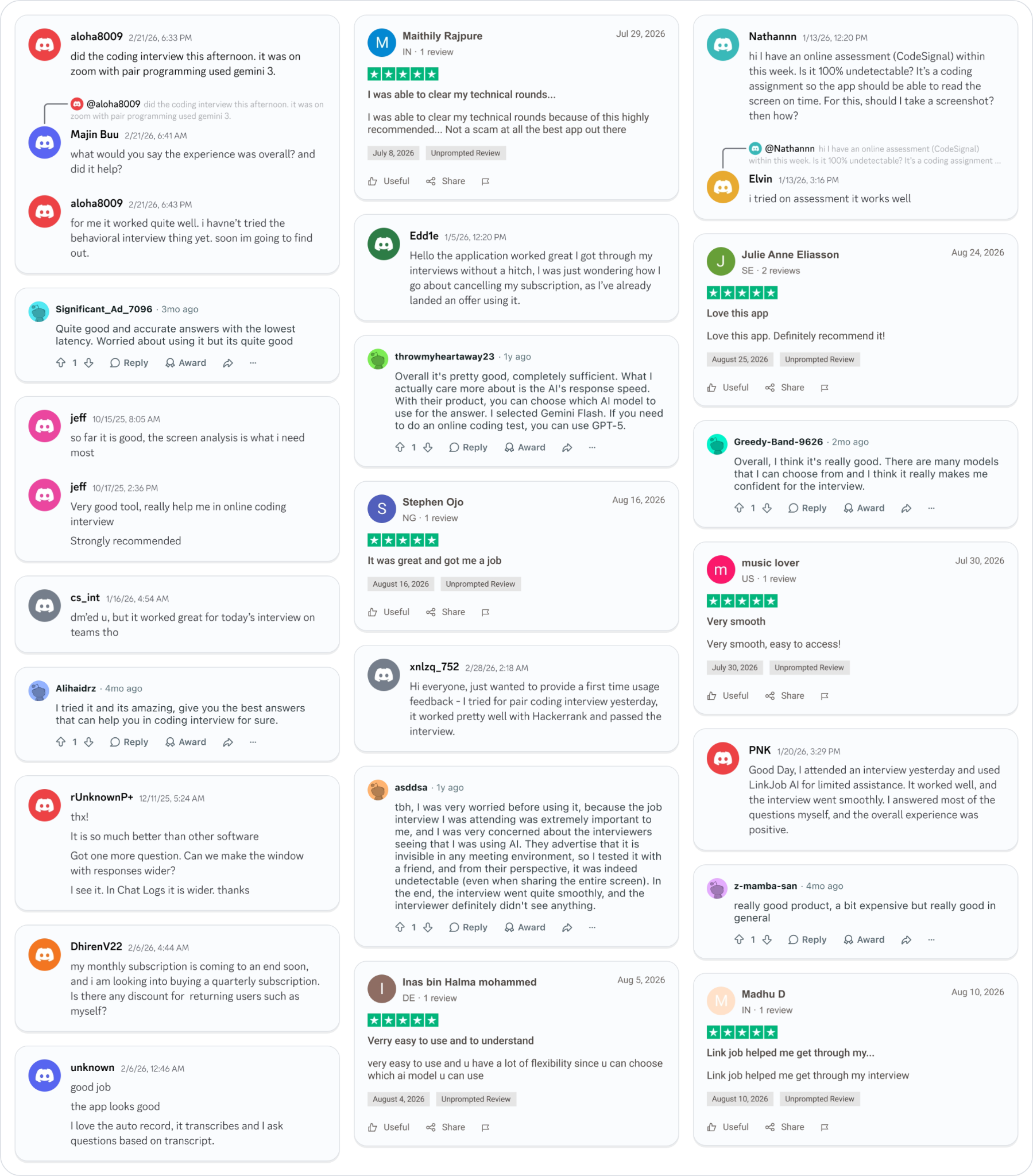
Smoother interviews, coding challenges cleared, and job offers landed. See how users describe their experience with Linkjob AI—in their own words.
© Copyright 2026 Linkjob AI - All Rights Reserved.