Inside My 2026 Jump Trading Codility Assessment: The 3 Timed Tasks, Stack-Machine Traps, and How I Passed
Jump Trading is known as the quietest, most engineering-driven high-frequency trading firm across Chicago, New York, London, Singapore, Amsterdam, and Sydney—and when my Jump Trading Codility invite arrived in 2026, I saw why few applicants post recaps afterward. Skipping gamified mental-math screens, Jump sends engineers straight into an un-pausable Codility assessment testing parsing simulations, interval sweeps, sliding windows, and bit-level insights—while hiding your final score upon submission.
During my own 2026 Jump Trading Codility sitting, I faced three timed tasks on one continuous countdown clock: an Interval-Union Measure Sweep (where touching endpoints decide 100% vs. 60% Correctness), a 20-Bit Unsigned Word-Machine / RPN Stack Interpreter (where operand pop order on "-" and (1 << 20) - 1 overflow catch rushed coders), and a Monotonic-Deque Sliding-Window Subarray Task (N <= 100,000, where re-scanning max - min inside a shrinking loop hits TIMEOUT ERROR immediately). Because Codility's "Run" button checks only 2 or 3 tiny examples—saving hidden Correctness and N = 100,000 Performance grading until after you lock your code—while logging prompt copies, external pastes (insertFromPaste), "Out of Focus" (window.onblur) events, and Timeline Slider snapshots, one boundary guess can end your run early.
Instead of risking timeline flags or sliding-window bugs, I paired Linkjob AI in Dual-Device Mode—scanning a QR code to open Linkjob AI on my phone's mobile webpage, turning off the desktop answer display for zero on-screen UI, and tapping capture on my phone's mobile webpage to view O(N) solutions 1 inch below my webcam (plus testing Desktop Floating Window Mode on unproctored links). Below are the exact 2026 tasks I faced, Jump's 4 role tracks, and how I reached the C++ phone screen.
How the Jump Trading Codility OA Works in 2026 (4 Role Tracks & Hidden Scoring)
Before opening my Codility link, I compared Jump's recruiting funnel against the other Chicago and global prop-trading screens I had completed—including how I solved the 2026 DRW Codility assessment, my Akuna Capital HackerRank test process and questions, my Citadel CoderPad interview and assessment guide, how I approached the Susquehanna International Group CodeSignal test, and my Marshall Wace Codility test breakdown. Unlike firms that use one generic campus test, Jump Trading routes candidates into four specialized assessment formats:
1. Track 1: Core Software Engineer & Campus SWE (C++20 / Python Codility OA — 3 to 4 Tasks, 80 to 120+ Minutes)
This is Jump's dominant engineering screen—and the exact format I sat for in 2026:
Un-Pausable Whole-Session Clock: You receive 3 coding tasks (occasionally 4 on longer senior C++ links spanning 80 to 150 minutes) under a single session timer that never pauses once clicked. You can jump freely among all tasks before locking each submission.
Four Hidden Report Scores: Unlike practice Codility links, Jump configures Codility to hide your numerical score at the end of the session. Behind the scenes, Jump's hiring team receives four scores on your Candidate Report: Overall Score, Individual Task Score, Correctness Score (malformed inputs, empty sets, 20-bit boundaries, touching intervals), and Performance Score (
O(N)orO(N log N)scaling up toN = 100,000).C++20/C++23 vs. Python Selection: Campus and general SWE Codility links allow both Python 3 and C++20 (I used Python 3 on the OA to move fast on string tokenization and arbitrary-precision integers, then switched to C++20 for the live
std::vectortechnical phone screen), whereas dedicated Low-Latency Core C++ links restrict the editor to C++.
2. Track 2: Crypto & Algorithmic Quant Trader Codility OA (90 Minutes, 3 Brain-Teaser / DP Tasks)
For Quantitative Trader and Jump Crypto trading applicants, Jump skips pure systems parsing and sends a 90-minute, 3-problem Codility test with a heavy mathematical/combinatorial twist: typically 1 string case-analysis counting task, 1 bounded 0/1 knapsack optimization, and 1 two-player optimal-strategy turn-game dynamic programming task.
3. Track 3: Platform Engineer, Linux Systems & SRE Codility Screen (40 to 60 Minutes)
Infrastructure, Linux kernel/networking, and SRE candidates receive a crisp two-part Codility test: roughly 10 single-choice Bash, Linux /proc, process/thread, and TCP/UDP multicast questions followed by 1 dynamic-programming or log-parsing coding task.
4. Track 4: Quantitative Researcher (QR) Multi-Hour Data & Modeling Screen
QR PhD/Masters candidates face a multi-hour single-dataset research task in Pandas/NumPy, leading into Jump's 60-minute live scikit-learn/Lasso modeling round and 75-minute ML debugging interview.
All 4 Real Coding Tasks From My 2026 Jump Trading Codility Sitting & Question Pool
Here are the three exact tasks from my 2026 Jump Trading SWE Codility sitting plus Jump's famous 4th recurring bitwise insight task (alongside patterns tracked in Codility test questions and assessments), showing every trap that breaks hidden Correctness and Performance tests.
1. Task 1: 20-Bit Unsigned Word-Machine / RPN Stack Interpreter (DUP, POP, +, -)
The Problem Prompt: Jump's longest-running signature Codility task asks you to simulate a 20-bit unsigned integer stack machine executing a space-separated string
S(1 <= len(S) <= 100,000) of operations:Decimal integer token
X(0 <= X <= 1,048,575, i.e.,2^20 - 1): pushXonto the stack."POP": remove the topmost integer from the stack (error if the stack is empty)."DUP": push a duplicate of the topmost integer onto the stack (error if the stack is empty)."+": pop the top two elements (top1first, thentop2), and pushtop1 + top2(error if< 2elements exist OR iftop1 + top2 > 1,048,575!)."-": pop the top two elements (top1first, thentop2), and pushtop1 - top2(the topmost element minus the second-topmost element! Error if< 2elements exist OR iftop1 - top2 < 0!).After processing all tokens, return the topmost element of the stack—or return
-1immediately if any error occurred or if the final stack is empty!
Three Hidden Correctness Traps That Wipe Out Rushed Submissions:
Trap 1 (Reversed Subtraction Order
top2 - top1vs.top1 - top2): Standard school RPN calculators evaluate"5 3 -"as5 - 3 = 2, whereas Codility's Word-Machine specification explicitly defines"-"as topmost minus second-topmost (top1 - top2, so pushing3then5and running"-"computes5 - 3 = 2)! Always check the example trace in your prompt ("13 DUP 4 POP 5 DUP + DUP + -"->7) before writing one line of code.Trap 2 (20-Bit Ceiling
1,048,575vs.1,000,000):2^20 - 1equals(1 << 20) - 1 = 1,048,575, not10^6and not1 << 20(1,048,576)!Trap 3 (Empty Final Stack): An input like
"42 POP"executes every instruction without error yet leaves the stack empty at termination—returning-1instead of crashing withIndexErrorsaves 20% of hidden Correctness points.
My 100% Correctness & 100% Performance Hand-Typed Python Solution:
def solution(S: str) -> int:
    MAX_VAL = (1 << 20) - 1  # 1,048,575
    stack: list[int] = []

    for token in S.split():
        if token == "POP":
            if not stack:
                return -1
            stack.pop()
        elif token == "DUP":
            if not stack:
                return -1
            stack.append(stack[-1])
        elif token == "+":
            if len(stack) < 2:
                return -1
            top1 = stack.pop()
            top2 = stack.pop()
            res = top1 + top2
            if res > MAX_VAL:
                return -1
            stack.append(res)
        elif token == "-":
            if len(stack) < 2:
                return -1
            top1 = stack.pop()
            top2 = stack.pop()
            res = top1 - top2
            if res < 0:
                return -1
            stack.append(res)
        else:
            # Unsigned integer literal
            if not token.isdigit():
                return -1
            val = int(token)
            if val < 0 or val > MAX_VAL:
                return -1
            stack.append(val)

    return stack[-1] if stack else -1

if __name__ == "__main__":
    print(solution("4 5 6 - 7 +"))                # 8
    print(solution("13 DUP 4 POP 5 DUP + DUP + -"))  # 7
    print(solution("5 6 + -"))                    # -1 (underflow < 2 items)
    print(solution("1048575 DUP +"))              # -1 (20-bit overflow)
2. Task 2: Total Length of a Union of Intervals (O(N log N) Sweep & Point-Touching Rule)
The Problem Prompt: Given two integer arrays
AandBof lengthN(0 <= N <= 100,000,-10^9 <= A[i] <= B[i] <= 10^9) representingNclosed intervals[A[i], B[i]]on the real line, return the total length (measure) of their union (capped at1,000,000,000or returned as a 64-bit integer per prompt signature).Why the Touching-Endpoint & C++ Overflow Rules Decide Full Credit:
Touching Endpoints Add Zero Extra Length: Two intervals
[1, 4](length3) and[4, 6](length2) touch atx = 4; their continuous union[1, 6]has length5(6 - 1), not6! Sorting intervals by(start, end)and merging whenevernext_start <= cur_endviacur_end = max(cur_end, next_end)resolves touching, nested, duplicate, and zero-length ([4, 4]) intervals automatically!C++ 32-Bit Signed Overflow on
[-10^9, 10^9]: A single interval from-10^9to+10^9has span2 * 10^9, and two disjoint intervals exceedINT_MAX(2,147,483,647)! In C++20, always compute(long long)cur_end - (long long)cur_startusingint64_t.
My 100% Correctness & 100% Performance Hand-Typed Python Solution:
def solution(A: list[int], B: list[int]) -> int:
    n = len(A)
    if n == 0:
        return 0

    intervals = sorted(zip(A, B))
    cur_start, cur_end = intervals[0]
    if cur_start > cur_end:
        cur_start, cur_end = cur_end, cur_start

    total_span = 0
    for nxt_s, nxt_e in intervals[1:]:
        if nxt_s > nxt_e:
            nxt_s, nxt_e = nxt_e, nxt_s
        if nxt_s <= cur_end:
            if nxt_e > cur_end:
                cur_end = nxt_e
        else:
            total_span += cur_end - cur_start
            cur_start, cur_end = nxt_s, nxt_e

    total_span += cur_end - cur_start
    return total_span

if __name__ == "__main__":
    print(solution([1, 4, 8], [4, 6, 10]))      # 7 -> [1, 6] (5) + [8, 10] (2)
    print(solution([-10**9, 5], [0, 10**9]))    # 1999999995
3. Task 3: Longest Bounded-Spread Contiguous Subarray (O(N) Dual Monotonic Deque Sliding Window)
The Problem Prompt: Given an integer array
Aof lengthN(1 <= N <= 100,000,-10^9 <= A[i] <= 10^9) representing microsecond quote ticks and a non-negative integerK, find the maximum length (or total count, capped at10^9on Codility's classic bounded-slice variant) of a contiguous subarrayA[left .. right]satisfyingmax(A[left .. right]) - min(A[left .. right]) <= K.Why Naive Window Shrinking Hits
TIMEOUT ERROR: Callingmax(A[left:right+1])when advancingleftdegrades toO(N^2). Maintaining a monotonic decreasing dequemax_dqand a monotonic increasing dequemin_dqof indices keepsA[max_dq[0]]andA[min_dq[0]]ready inO(1)time—and wheneverA[max_dq[0]] - A[min_dq[0]] > K, advancingleftand popping expired front indices repairs the window in amortizedO(1)time (O(N)overall)!My 100% Correctness & 100% Performance Hand-Typed Python Solution:
from collections import deque

def solution(K: int, A: list[int]) -> int:
    max_dq: deque[int] = deque()
    min_dq: deque[int] = deque()
    left = 0
    best_len = 0

    for right, val in enumerate(A):
        while max_dq and A[max_dq[-1]] <= val:
            max_dq.pop()
        max_dq.append(right)

        while min_dq and A[min_dq[-1]] >= val:
            min_dq.pop()
        min_dq.append(right)

        while A[max_dq[0]] - A[min_dq[0]] > K:
            left += 1
            if max_dq[0] < left:
                max_dq.popleft()
            if min_dq[0] < left:
                min_dq.popleft()

        curr_len = right - left + 1
        if curr_len > best_len:
            best_len = curr_len

    return best_len

if __name__ == "__main__":
    print(solution(2, [3, 5, 7, 6, 3]))  # 3 -> [5, 7, 6]
4. Bonus Recurring Jump Task: Largest Subset With Bitwise AND > 0 (O(30 * N) Bit-Column Insight)
Prompt & Bit-Column Shortcut: Given an array
AofNpositive integers (1 <= N <= 100,000,1 <= A[i] <= 10^9), return the size of the largest subset whose bitwiseANDis strictly greater than0. Subset DP times out immediately; the hardware-level insight Jump loves is that a subset's bitwiseANDis non-zero if and only if every chosen number has1in at least one shared bit positionb(0 <= b <= 29)! Counting set bits per column0..29and takingmax()runs inO(30 * N)with zero extra memory:
def largest_nonzero_and_subset(A: list[int]) -> int:
    best = 0
    for bit in range(30):
        mask = 1 << bit
        cnt = sum(1 for x in A if x & mask)
        if cnt > best:
            best = cnt
    return best
How Jump Trading's Codility OA Flags Suspicious Attempts in 2026 (6 Quiet Signals)
As I broke down in how Codility detects cheating, can Codility detect copy and paste, can Codility detect tab switching when proctoring is enabled, whether Codility records your screen, and whether Codility uses your camera, Jump Trading's Codility surface tracks six behavioral and plagiarism telemetry streams that route candidate reports straight to human scrutiny:
Copying the Task Prompt (
copyEvent on the Problem Pane): Highlighting and pressingCtrl + C/Cmd + Cinside the left-hand Codility problem description is explicitly logged as a high-signal indicator of external lookup or LLM prompt pasting!External Paste Attribution (
insertFromPaste) on the Timeline Slider: Every paste from outside Codility's Monaco editor places a flagged Pasted Text event directly onto your interactive Timeline Slider."Out of Focus" Tab/Window Switches & Abnormally Fast Solve Times: Leaving the Codility tab (
window.onblur/visibilitychange) records timestamped absence durations, and submitting a 45-line monotonic-deque solution in 90 seconds with zero edits triggers Codility's abnormally short task duration alert.Cross-Submission AST Plagiarism & Leaked-Solution Matching: Codility compares your normalized Abstract Syntax Tree against historical Jump Trading submissions (catching recycled LeetCode Discuss/GitHub solutions instantly) and default LLM templates.
Per-Invite Proctoring Switches & Codility App "Device Integrity": While Video/Screen Proctoring is configurable per invite, Codility's 2026 Device Integrity desktop app scans for known local desktop overlay processes—always check your welcome screen's permissions list before starting.
Live Technical Phone Screen Verification (
implement std::vector): Even after clearing Codility, Jump follows up with a rapid 20-question CS/C++ phone quiz (allowing only 1–2 misses) and live screen-shared coding (like implementingstd::vector<T>with2xreallocation, placementnew, andstd::forward), similar to the live verification I faced after my 2026 Toptal Codility test.
My Technical Blueprint to Clear Jump Trading Codility With Zero Integrity Flags
Applying the architecture from how an invisible AI interview assistant works, I followed four strict rules on exam day:
Rule 1: Single Bare-Metal Display (
window.screen.isExtended === false): Disconnect external monitors and docks so your setup reports one native display and your gaze never drifts sideways.Rule 2: Zero Prompt
Ctrl + C, Zero ExternalCtrl + V, & Zero Tab Exits: Never copy a single word of the task statement, never paste from your system clipboard, and never click outside the active Codility tab.Rule 3: Take Answers Off the Laptop Screen Completely: Rather than relying on basic browser extensions, view your reference
O(N)logic on a physically separate smartphone mounted 1 inch directly below your webcam lens so no desktop screenshot, screen share, or Device Integrity check sees any on-screen overlay.Rule 4: Pace Edits Naturally, Test 5 Adversarial Inputs, & Strip
print(): Build your code in logical stages over 12 to 20 minutes per task, run 5 custom inputs in Codility's bottom console (""/"42 POP",1048575 DUP +, touching intervals[1, 4]+[4, 6], negative coordinates-10^9), and delete everyprint()statement so stdout never causes aTIMEOUT ERROR.
How I Used Linkjob AI on My Jump Trading Codility OA (Dual-Device Mode vs. Desktop Floating Window)
Forty minutes into my sitting, verifying the exact two-deque boundary repair on Task 3 and the "top1 - top2" underflow order on Task 1 without touching my browser focus saved my entire attempt. That is why I used my AI interview assistant. Depending on your invitation's proctoring switches, here is how both modes of this invisible coding interview assistant work:
1. Mode 1: Dual-Device Mode (My #1 Setup for Jump Trading Codility & Live Screen-Shared Rounds)
Because Dual-Device Mode keeps 100% of the AI output off your computer monitor (working cleanly across proctored Codility links, Codility Device Integrity, LockDown Browser, and Jump's subsequent live screen-shared C++ interview), this was my exact setup:
QR Code Pairing to My Phone's Mobile Webpage & Turning Off Desktop Display: Before opening my Jump Trading Codility link, I launched the Linkjob AI desktop app, granted accessibility permissions, scanned the dashboard QR code with my phone camera to open Linkjob AI in my phone's mobile webpage, and turned off the desktop answer-display toggle. My laptop screen stayed 100% pure Monaco IDE with zero floating windows and zero overlays.
Silent Remote Capture From My Phone's Mobile Webpage: As each of my 3 Jump tasks loaded, I tapped the capture button directly on my phone's mobile webpage. The desktop service captured the full specification silently with zero mouse clicks, zero keystrokes, zero prompt
Ctrl + C, and0"Out of Focus" (window.onblur) markers on my laptop.Reading Verified
O(N)Logic 1 Inch Below My Webcam: Within seconds, the 20-bit(1 << 20) - 1stack machine checks and the dual-deque repair loop appeared exclusively on my phone's mobile webpage, mounted 1 inch below my webcam lens. I typed the code manually at a natural engineering pace, verified 5 edge cases in the custom console, and locked all 3 tasks with time to spare.
2. Mode 2: Desktop Floating Window Mode (For Unproctored Standard Web-Page Codility Links)
If your Jump Trading welcome screen shows a standard unproctored web-page Codility session (with Video/Screen Proctoring and the Codility App disabled) and you prefer viewing hints right on your primary monitor, use Linkjob AI's Desktop Floating Window Mode while following two strict rules:
Complete All Configuration Before Opening the Link (Never Click Settings Mid-Test): Launch Linkjob AI, select C++20 or Python 3, upload your resume, and position the semi-transparent floating window beside the Monaco editor before opening your Codility link. Once the un-pausable timer starts, never click the "Settings" button or any interactive menu inside the floating window so Chrome never loses active window focus (
window.onblur).Never Press
Cmd + \orCtrl + \During the Assessment: Never pressCmd + \orCtrl + \to toggle the floating window open or closed while an active Codility session is running. Leave the floating window untouched in its fixed spot from minute 0 until after you submit your final task and close the browser tab.
My 4-Step Pre-Test Checklist Before Clicking Start on Jump Trading Codility
Step 1: Carve Out an Uninterrupted 2.5-Hour Block & Single Monitor: Jump's whole-session timer never pauses—close Slack/Discord, silence notifications, and unplug external displays (
window.screen.isExtended === false).Step 2: Lock In Linkjob AI Before Entering the Assessment: Pair Dual-Device Mode via QR code to your phone's mobile webpage with desktop answer display turned OFF (recommended), or pre-position the Desktop Floating Window on unproctored web links and never click Settings or press
Cmd + \/Ctrl + \mid-test.Step 3: Audit Overflow Ceilings & Operand Order Before Coding: Check
(1 << 20) - 1 = 1,048,575, verifytop1 - top2vs.top2 - top1on stack machines, and use 64-bitint64_t(long long) in C++ for[-10^9, 10^9]coordinate spans.Step 4: Run 5 Adversarial Custom Cases & Strip All
print()Calls: Remember that Jump hides your final score—catch empty-stack, point-touching, andN = 1edge cases in Codility's bottom console before clicking Submit!
Frequently Asked Questions About the Jump Trading Codility OA (FAQ)
1. How many questions and minutes are on the 2026 Jump Trading Codility OA?
Most Software Engineer and Campus SWE candidates receive 3 coding tasks (occasionally 4 on longer senior C++ links) under a single un-pausable timer ranging from 80 to 120+ minutes. Platform/SRE candidates typically get ~10 Linux/Bash MCQs plus 1 DP task in 40–60 minutes, while Crypto Quant Traders get 3 math/DP coding tasks in 90 minutes.
2. Does Jump Trading show your Codility percentage score after you submit?
No. Jump Trading configures Codility to hide all four report scores (Overall, Individual Task, Correctness, and Performance) from the candidate after submission. Because you only get Example-test feedback while coding, testing adversarial edge cases manually before locking each task is critical.
3. Should I take the Jump Trading Codility assessment in C++ or Python?
If your link allows both Python 3 and C++20 (common on early-career and general SWE invites), Python 3 is completely fine for the Codility OA and avoids 32-bit overflow bugs on [-10^9, 10^9] interval sums. However, be ready to pivot immediately to modern C++20/C++23 (std::vector internals, move semantics, cache-line alignment, and RAII) for the technical phone screen that follows!
4. Why is Linkjob AI's Dual-Device Mode safer than browser overlays on Jump Trading Codility?
Scanning the desktop QR code opens Linkjob AI on your phone's mobile webpage and turning off the desktop answer-display toggle removes 100% of AI UI from your computer screen—capturing long simulation prompts silently from your phone with 0 prompt-copy events, 0 external pastes, and 0 "Out of Focus" flags, while also working seamlessly during Jump's live screen-shared phone round.
5. What happens after passing the Jump Trading Codility OA?
Recruiters usually reach out within 1 to 2 weeks for a 20-question CS/C++ phone quiz (covering virtual memory, CPU caches, vtable/templates, and kernel bypass, allowing at most 1–2 misses), followed by a live C++ coding screen (often implementing std::vector<T>) and a Superday.
See Also
Ways to Successfully Evade HackerEarth Proctoring Detection in 2026
Find the Top CodeRank Substitute for Your Needs in 2026
Using ChatGPT Effectively in Coding Interviews Throughout 2026
Strategies to Outsmart Detection in Pair Programming Interviews This Year
Bypassing CodinGame CoderPad Screen Test Detection in 2026 with AI Tools
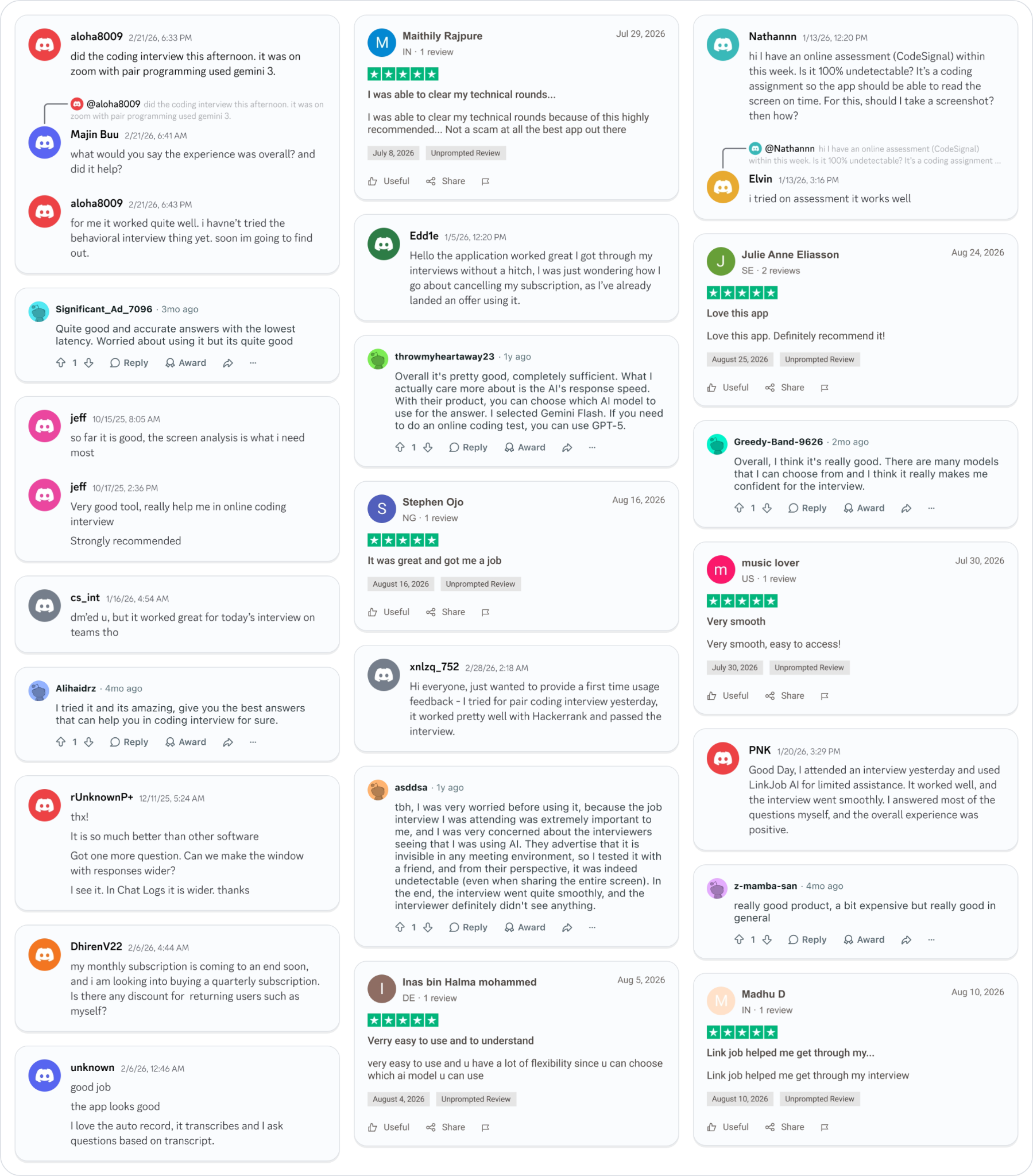
Why People Choose Linkjob AI
Smoother interviews, coding challenges cleared, and job offers landed. See how users describe their experience with Linkjob AI—in their own words.
© Copyright 2026 Linkjob AI - All Rights Reserved.